

By Product Type (Submersible Solar Water Pumps, Surface Solar Water Pumps (Surface-Mounted/Floating)), By Power Rating (Up to 2 HP, 2 HP – 5 HP, Above 5 HP), By Motor Type (AC Pump......mps, DC Pumps), By Application (Irrigation, Livestock Watering, Drinking Water & Community Supply, Industrial Process Water), By End-User (Agriculture (Commercial & Smallholder Farms), Residential/Household, Commercial & Industrial Enterprises, Government & Municipal Bodies) Read more
- Environment
- Sep 2026
- 160
- PDF, Excel, PPT
South Africa Solar Water Pumps Market Key Takeaways
- The South Africa solar water pumps market was valued at USD 51.0 million in 2025 and is projected to grow from USD 56.0 million in 2026 to USD 98.1 million by 2032.
- The industry is projected to witness steady growth at a CAGR of 9.8% during 2026–2032.
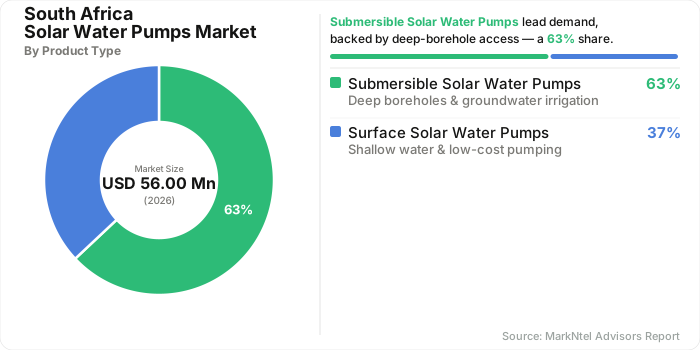
- Submersible solar water pumps remain the dominant product segment, accounting for an estimated 63% revenue share in 2026.
- Agriculture (commercial & smallholder farms) leads end-user demand, representing an estimated 57% market share in 2026.
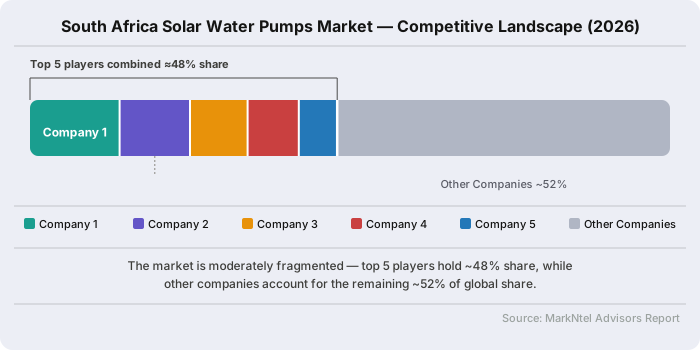
- The market is moderately fragmented, with the top five companies collectively accounting for approximately 48% of 2026 market revenue.
South Africa Solar Water Pumps Market Size and Outlook
The solar water pumps market in the South Africa is valued at USD 51 million in 2025, estimated at USD 56 million in 2026, and forecast to reach USD 98.1 million by 2032, registering a 9.8% CAGR across the outlook period.
Structural growth is supported by the Department of Water and Sanitation's administration of groundwater abstraction under the National Water Act, which places borehole-linked irrigation and rural water supply within a formal water-use authorization framework and supports demand for compliant solar water pump systems.
The renewable-energy ecosystem further strengthens the economics of solar water pumping. SAPVIA's FY2025/26 reporting confirms that South Africa's cumulative installed solar PV capacity reaches 10.12 GW, representing 19% year-on-year growth, expanding the domestic solar supply base and supporting broader cost efficiencies across photovoltaic modules and balance-of-system components. At the same time, Eskom's FY2025 performance disclosure records only 13 days of load-shedding during 1 April 2024–31 March 2025, compared with 329 and 208 days in the preceding financial years, maintaining the commercial rationale for decentralized pumping despite improved grid reliability.
This combination of formal groundwater regulation, expanding solar infrastructure and continued requirements for reliable decentralized water access supports sustained market expansion through 2032. The opportunity is particularly strong across agricultural irrigation and borehole applications, where solar water pumps, remote water pumping and energy-efficient water infrastructure can reduce dependence on conventional electricity or diesel-powered pumping while supporting reliable water availability.
South Africa Solar Water Pumps Market Key Indicators
- According to the South African Photovoltaic Industry Association (SAPVIA) FY2025/26 reporting, South Africa's cumulative installed solar PV capacity exceeds 10.12 GW, with 1.6 GW of new capacity added during 2025. This expanding solar ecosystem improves the availability of PV components and strengthens the economic foundation for decentralized solar-powered pumping applications.
- South Africa has approximately 1.33 million hectares of actively irrigated agricultural land, equivalent to around 1.1% of the country's total land surface. This extensive irrigated area represents a substantial addressable base for solar irrigation pumps, particularly across farms using groundwater and decentralized pumping infrastructure.
- As per Agri SA's cited estimate indicates that energy costs can account for up to 20% of production overhead for irrigated agriculture, strengthening the economic case for replacing diesel-dependent or grid-intensive pumping with solar-powered systems. This cost sensitivity supports the adoption of solar water pump systems among commercial and smallholder agricultural users.
South Africa Water Infrastructure Project Pipeline: Large-Scale Public Investment Supporting Solar Pumping Demand
South Africa’s water infrastructure pipeline is expanding through large-scale public investment aimed at improving water security, expanding supply networks and addressing underserved communities. The government has committed more than USD 8.6 billion to water and sanitation infrastructure over the next three years. In parallel, the National Water Access Acceleration Programme has launched 67 decentralised water-supply schemes across Gauteng, KwaZulu-Natal and the Eastern Cape, comprising boreholes and package plants and expected to benefit approximately 125,986 people. Phase One has received more than USD 11.1 million.
The pipeline is also supported by major bulk-water projects. The Lesotho Highlands Water Project Phase II has a revised capital investment of USD 3.0 billion, with construction underway and first water delivery projected for 2029/30. The 2026 National Budget also allocates substantial medium-term expenditure to projects including the Mokolo-Crocodile Water Augmentation Project and uMkhomazi Water Project, reinforcing demand for pumping, water conveyance and decentralized water infrastructure.
Consequently, the combination of USD 1.65 billion in public infrastructure commitments, 67 decentralized borehole schemes and multi-billion-rand bulk-water projects expands the addressable opportunity for solar water pumps beyond agriculture into rural water supply and decentralized municipal infrastructure. Borehole-based schemes are particularly relevant for solar pumping because they require reliable water abstraction and pumping in locations where grid connectivity and operating economics can constrain conventional electric pumping
South Africa Solar Water Pumps Market Scope
| Category | Segments |
|---|---|
| By Product Type | Submersible Solar Water Pumps, Surface Solar Water Pumps (Surface-Mounted/Floating |
| By Power Rating | Up to 2 HP, 2 HP – 5 HP, Above 5 HP |
| By Motor Type | AC Pumps, DC Pumps |
| By Application | Irrigation, Livestock Watering, Drinking Water & Community Supply, Industrial Process Water |
| By End-User | Agriculture (Commercial & Smallholder Farms), Residential/Household, Commercial & Industrial Enterprises, Government & Municipal Bodies |
South Africa Solar Water Pumps Market Growth Driver
Agricultural Irrigation Investment Accelerates Demand for Solar Water Pumping
South Africa's agricultural modernization is strengthening investment in decentralized irrigation infrastructure. According to the South African Government, the Agriculture and Agro-processing Master Plan (AAMP) has unlocked approximately USD 66.5 million from public and private financial institutions for irrigation upgrades and packhouse expansion. Modern irrigation practices are also reducing water utilization by 18%–25% on commercial farms, increasing the value of efficient pumping and water-management technologies.
Investment momentum is also extending into provincial farmer-support programs. The North West Department of Agriculture and Rural Development allocates approximately USD 66.5 million in its 2026/27 budget, including around USD 8.5 million through the Comprehensive Agricultural Support Programme (CASP) for farmer production inputs and infrastructure support, while approximately USD 0.5 million supports training for more than 2,200 farmers. This funding environment expands opportunities for solar irrigation pumps across commercial farms, smallholder agriculture, and livestock operations, particularly where decentralized pumping reduces dependence on conventional electricity infrastructure.
Recent Trend
Solar Pumping Shifts Toward Hybrid and Higher-Capacity Configurations
The South African market is increasingly shifting from standalone low-capacity DC borehole pumps toward hybrid solar water pumping systems capable of supporting larger agricultural and bulk-water requirements. Cedar Solar's current MultiFlow range incorporates solar, grid and generator operating modes with MPPT-based solar optimization, allowing pumping systems to maintain water delivery across variable power conditions. This architecture broadens the application base beyond basic off-grid borehole pumping toward irrigation, livestock and commercial water-supply requirements.
The trend is also expanding the addressable value of solar conversion projects. Cedar Solar's Veichi drive solutions support conversion of existing AC pumps to solar operation across capacities from 0.75 kW to 400 kW, covering deep boreholes, irrigation, livestock and bulk-water pumping. A relevant product example is Cedar Solar's MultiFlow AC/DC Hybrid Pump range, which combines solar, grid and generator inputs with automatic source switching and MPPT-based optimization. This product development supports the shift toward higher-capacity hybrid solar water pumps and solar conversion of existing pumping assets rather than only new small-scale installations.
South Africa Solar Water Pumps Market Opportunities and Challenges
Groundwater Compliance Complexity Creates Opportunity for Turnkey Solar Pump Providers
South Africa's evolving groundwater framework creates a compliance challenge for new borehole-linked solar water pumping projects. The Department of Water and Sanitation's December 2025 groundwater regulations require new borehole projects to obtain geosite identifiers and require pumping-equipment installers to submit yield-test results or the recommended sustainable abstraction rate together with pump installation settings before water abstraction begins. Existing pump installations must also provide pump-setting information within 12 months. These requirements increase technical documentation and project-preparation requirements for agricultural, commercial and rural water users.
The same compliance requirements create an opportunity for suppliers offering integrated solar pump systems rather than equipment-only sales. DWS states that sustainable abstraction rates vary by borehole and should be determined before pumping equipment is ordered, reinforcing the need to match pump selection with site-specific hydrogeological conditions. KSB's CORACHROM 100-Solar, for example, is specified for 4-inch and larger boreholes, with a maximum flow of 12 m³/h and maximum head of 451 m, and is positioned for irrigation, groundwater management and solar-powered pumping applications. Vendors that combine pump sizing, borehole assessment coordination, documentation and installation support can therefore capture additional project value while reducing compliance and system-selection complexity.
Segmentation Insights
Submersible Solar Pumps Capture Leading Revenue Share Through Borehole Irrigation Demand
Submersible solar water pumps hold a 63% revenue share in 2026, supported by the country's substantial irrigated-agriculture base and groundwater-dependent water supply. Statistics South Africa records 729,911 hectares of irrigated field-crop area, creating a large installed base requiring dependable water abstraction and pumping infrastructure. The deeper-source requirements of these applications structurally favor submersible configurations, strengthening their position in the solar water pumps industry.
Demand is further supported by the scale of agricultural water consumption and the need to operate pumping infrastructure across dispersed sites. South Africa's active agricultural irrigation uses approximately 10,221 million m³ of water annually, while the 2025 groundwater regulations require pumping installations to be supported by yield-test results or sustainable abstraction rates. These conditions favor engineered borehole solutions and sustain demand for solar irrigation pumps across commercial farming, livestock, and decentralized agricultural water supply. Based on product type, the industry is segmented into:
- Submersible Solar Water Pumps
- Surface Solar Water Pumps (Surface-Mounted/Floating)
Agricultural Water-Management Demand Positions Farms as the Largest Solar Pump End User
Agriculture leads South Africa solar water pump consumption with a 57% revenue share in 2026, supported by its large economic footprint and continued production activity. South Africa's agriculture and agro-processing value chain contributes approximately 14% of national GDP, equivalent to around USD 57 billion based on 2024 GDP. The sector's economic scale creates a broad installed base of commercial and smallholder users requiring reliable water, energy and farm infrastructure, supporting agriculture as the leading end-user for solar water pumps.
Demand is further supported by agricultural output growth and the sector's exposure to energy-cost pressures. Government reporting indicates that agricultural exports reach approximately USD 14.6 billion in 2025, representing the sector's strongest export performance since the COVID-19 period. The combination of export-oriented production, large farm operations and continued modernization encourages investment in decentralized energy infrastructure, creating opportunities for solar irrigation pumps across commercial farms, horticulture, livestock and other water-dependent agricultural activities. Based on End-User, the industry is segmented into:
- Agriculture (Commercial & Smallholder Farms)
- Residential/Household
- Commercial & Industrial Enterprises
- Government & Municipal Bodies
South Africa Solar Water Pumps Market Competitive Analysis
The South Africa solar water pumps industry is moderately consolidated, with the top five companies estimated to account for approximately 48% of 2026 market revenue. The leading five companies are BERNT LORENTZ GmbH (LORENTZ), Grundfos South Africa (Pty) Ltd, Franklin Electric South Africa (Pty) Ltd, CRI Pumps SA (Pty) Ltd, and KSB Pumps and Valves (Pty) Limited.
Top Companies in the South Africa Solar Water Pumps Industry:
- BERNT LORENTZ GmbH (LORENTZ)
- Grundfos South Africa (Pty) Ltd
- Franklin Electric South Africa (Pty) Ltd
- CRI Pumps SA (Pty) Ltd
- KSB Pumps and Valves (Pty) Limited
- Wilo Pumps SA
- Shakti Pumps (India) Limited
- Pedrollo S.p.A.
- DAB Pumps SA (Pty) Ltd
- Cedar Solar SA (Pty) Ltd
South Africa Solar Water Pumps Industry News and Recent Developments
September 2025: KSB Pumps and Valves (Pty) Ltd Launches CORAChrom Ultra-Durable Stainless-Steel Submersible Pump Range in South Africa
KSB Pumps and Valves (Pty) Ltd introduced its CORAChrom submersible pump series to the South African market, engineered specifically for deep boreholes and demanding freshwater and saline groundwater conditions. The range is built in corrosion-resistant stainless steel and offers solar-ready configuration options, targeting agriculture, domestic water supply, mining, and industrial end-users operating in harsh groundwater environments. The launch reinforces KSB's position within South Africa's submersible and borehole pump segment.
Impact Analysis: The CORAChrom launch directly strengthens the competitive positioning of vendors offering groundwater-condition-specific engineering over generic imported pump lines, and is likely to accelerate submersible solar pump replacement-cycle demand among commercial farms and mining-adjacent operators managing high-salinity or corrosive borehole water — reinforcing submersible technology's dominant position within the market's Product Type segmentation.
December 2025: NERSA Formally Gazettes Permanent Grid Capacity Allocation Rules (GCAR)
The National Energy Regulator of South Africa (NERSA) formally gazetted the permanent Grid Capacity Allocation Rules in late December 2025, replacing Eskom's interim allocation framework with a transparent, legally sound "first-ready, first-served" grid access mechanism for new generation and embedded generation projects, developed with input from SAPVIA and the South African Wind Energy Association through the SAREGS stakeholder process.
Impact Analysis: While primarily targeted at utility-scale and commercial embedded generation, the GCAR's replacement of an ad hoc interim framework with a codified allocation process reduces regulatory uncertainty for larger grid-tied or hybrid solar water pump installations at commercial farm and agro-processing scale, supporting continued private capital deployment into solar-linked agricultural infrastructure through the forecast period.
- Market Segmentation
- Introduction
- Product Definition
- Research Process
- Assumptions
- Executive Summary
- South Africa Solar Water Pumps Market Production Trend, 2022-2032F
- South Africa Solar Water Pumps Market Production Trend By Product Type
- Submersible Solar Water Pumps
- Surface Solar Water Pumps (Surface-Mounted/Floating)
- Company-Wise Production Plants and Statistics
- Installed Production Capacity
- Actual Production
- Planned Production Target
- South Africa Solar Water Pumps Market Production Trend By Product Type
- South Africa Solar Water Pumps Market Pricing Analysis, By Type of Product, 2022-2032F
- South Africa Solar Water Pumps Market Pricing Trend (USD Million) 2022-2032
- South Africa Solar Water Pumps Market Pricing Trend (USD Million) By Product Type
- Submersible Solar Water Pumps
- Surface Solar Water Pumps (Surface-Mounted/Floating)
- South Africa Solar Water Pumps Market Policies, Regulations, and Product Standards
- South Africa Solar Water Pumps Market Trends & Developments
- South Africa Solar Water Pumps Market Dynamics
- Growth Factors
- Challenges
- South Africa Solar Water Pumps Market Hotspot & Opportunities
- South Africa Solar Water Pumps Market Outlook, 2022-2032F
- Market Size & Outlook
- By Revenues (USD Million)
- By Unit Sold (Thousand Units)
- Market Segmentation & Outlook
- By Product Type- Market Size & Forecast 2022-2032, USD Million & Thousand Units
- Submersible Solar Water Pumps
- Surface Solar Water Pumps (Surface-Mounted/Floating)
- By Power Rating- Market Size & Forecast 2022-2032, USD Million & Thousand Units
- Up to 2 HP
- 2 HP – 5 HP
- Above 5 HP
- By Motor Type- Market Size & Forecast 2022-2032, USD Million & Thousand Units
- AC Pumps
- DC Pumps
- By Application- Market Size & Forecast 2022-2032, USD Million & Thousand Units
- Irrigation
- Livestock Watering
- Drinking Water & Community Supply
- Industrial Process Water
- By End-User- Market Size & Forecast 2022-2032, USD Million & Thousand Units
- Agriculture (Commercial & Smallholder Farms)
- Residential/Household
- Commercial & Industrial Enterprises
- Government & Municipal Bodies
- By Company
- Competition Characteristics
- Market Share & Analysis
- By Product Type- Market Size & Forecast 2022-2032, USD Million & Thousand Units
- Market Size & Outlook
- South Africa Submersible Solar Water Pumps Market Outlook, 2022-2032
- Market Size & Outlook
- By Revenues (USD Million)
- By Unit Sold (Thousand Units)
- Market Segmentation & Outlook
- By Power Rating- Market Size & Forecast 2022-2032, USD Million & Thousand Units
- By Motor Type- Market Size & Forecast 2022-2032, USD Million & Thousand Units
- By Application- Market Size & Forecast 2022-2032, USD Million & Thousand Units
- By End-User- Market Size & Forecast 2022-2032, USD Million & Thousand Units
- Market Size & Outlook
- South Africa Surface Solar Water Pumps Market Outlook, 2022-2032
- Market Size & Outlook
- By Revenues (USD Million)
- By Units Sold (Thousand Units)
- Market Segmentation & Outlook
- By Power Rating- Market Size & Forecast 2022-2032, USD Million & Thousand Units
- By Motor Type- Market Size & Forecast 2022-2032, USD Million & Thousand Units
- By Application- Market Size & Forecast 2022-2032, USD Million & Thousand Units
- By End-User- Market Size & Forecast 2022-2032, USD Million & Thousand Units
- Market Size & Outlook
- South Africa Solar Water Pumps Market Key Strategic Imperatives for Success & Growth
- Competitive Outlook
- Company Profiles
- BERNT LORENTZ GmbH (LORENTZ)
- Business Description
- Product Portfolio
- Collaborations & Alliances
- Recent Developments
- Financial Details
- Others
- Grundfos South Africa (Pty) Ltd
- Business Description
- Product Portfolio
- Collaborations & Alliances
- Recent Developments
- Financial Details
- Others
- Franklin Electric South Africa (Pty) Ltd
- Business Description
- Product Portfolio
- Collaborations & Alliances
- Recent Developments
- Financial Details
- Others
- CRI Pumps SA (Pty) Ltd
- Business Description
- Product Portfolio
- Collaborations & Alliances
- Recent Developments
- Financial Details
- Others
- KSB Pumps and Valves (Pty) Limited
- Business Description
- Product Portfolio
- Collaborations & Alliances
- Recent Developments
- Financial Details
- Others
- Wilo Pumps SA
- Business Description
- Product Portfolio
- Collaborations & Alliances
- Recent Developments
- Financial Details
- Others
- Shakti Pumps (India) Limited
- Business Description
- Product Portfolio
- Collaborations & Alliances
- Recent Developments
- Financial Details
- Others
- Pedrollo S.p.A.
- Business Description
- Product Portfolio
- Collaborations & Alliances
- Recent Developments
- Financial Details
- Others
- DAB Pumps SA (Pty) Ltd
- Business Description
- Product Portfolio
- Collaborations & Alliances
- Recent Developments
- Financial Details
- Others
- Cedar Solar SA (Pty) Ltd
- Business Description
- Product Portfolio
- Collaborations & Alliances
- Recent Developments
- Financial Details
- Others
- BERNT LORENTZ GmbH (LORENTZ)
- Company Profiles
- Disclaimer

MarkNtel Advisors follows a robust and iterative research methodology designed to ensure maximum accuracy and minimize deviation in market estimates and forecasts. Our approach combines both bottom-up and top-down techniques to effectively segment and quantify various aspects of the market. A consistent feature across all our research reports is data triangulation, which examines the market from three distinct perspectives to validate findings. Key components of our research process include:
1. Scope & Research Design At the outset, MarkNtel Advisors define the research objectives and formulate pertinent questions. This phase involves determining the type of research—qualitative or quantitative—and designing a methodology that outlines data collection methods, target demographics, and analytical tools. They also establish timelines and budgets to ensure the research aligns with client goals.
2. Sample Selection and Data Collection In this stage, the firm identifies the target audience and determines the appropriate sample size to ensure representativeness. They employ various sampling methods, such as random or stratified sampling, based on the research objectives. Data collection is carried out using tools like surveys, interviews, and observations, ensuring the gathered data is reliable and relevant.
3. Data Analysis and Validation Once data is collected, MarkNtel Advisors undertake a rigorous analysis process. This includes cleaning the data to remove inconsistencies, employing statistical software for quantitative analysis, and thematic analysis for qualitative data. Validation steps are taken to ensure the accuracy and reliability of the findings, minimizing biases and errors.

4. Data Forecast and FinalizationThe final phase involves forecasting future market trends based on the analyzed data. MarkNtel Advisors utilize predictive modeling and time series analysis to anticipate market behaviors. The insights are then compiled into comprehensive reports, featuring visual aids like charts and graphs, and include strategic recommendations to inform client decision-making
FILL THE FORM TO GET THE FREE SAMPLE PAGES
We offer flexible licensing options to cater to varying organizational needs. Choose the pricing pack that best suits your requirements:
Buy Now Inquire Before Buying
 Talk to our Consultant
 Request Customization