

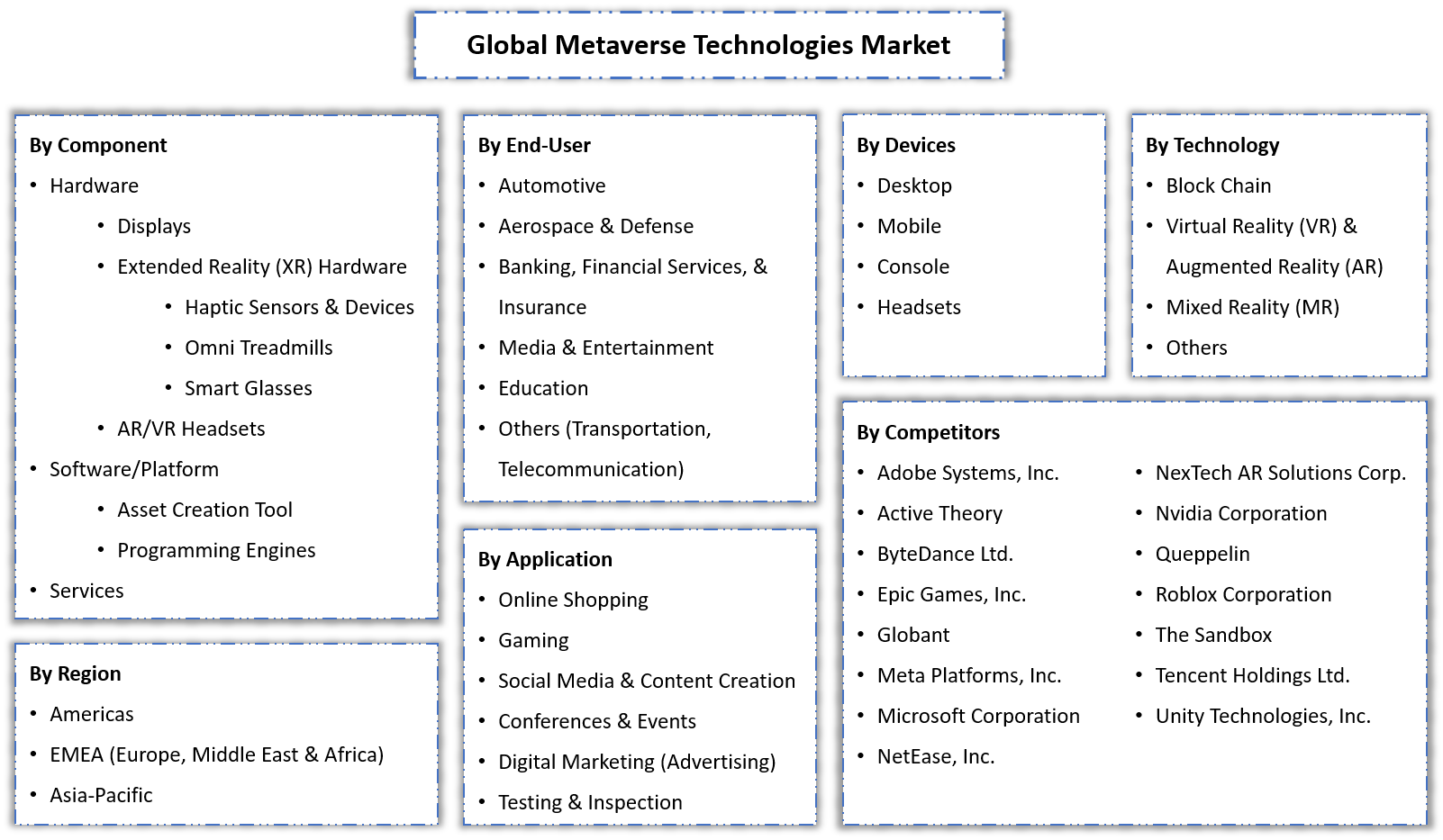
By Component (Hardware (Displays, Extended Reality (XR) Hardware (Haptic Sensors & Devices, Omni Treadmills, Smart Glasses), AR/VR Headsets), Software (Asset Creation Tool, Program......ming Engines), Services), By Device (Desktop, Mobile, Console, Headsets), By Application (Online Shopping, Gaming, Social Media & Content Creation, Conferences & Events, Digital Marketing (Advertising), Testing & Inspection), By Technology (Blockchain, Virtual Reality (VR) & Augmented Reality (AR), Mixed Reality), By End-User (Automotive, Aerospace & Defense, Banking, Financial Services, & Insurance (BFSI), Media & Entertainment, Education, Others (Telecommunication, Transportation, etc.)), By Region (Americas, Europe, Middle East & Africa (EMEA), Asia-Pacific), By Country (The US, Canada, Mexico, Brazil, Germany, The UK, France, Italy, Spain, China, Japan, India, South Korea), By Companies (Active Theory, ByteDance Ltd., Epic Games, Inc., Globant, Meta Platforms, Inc., Microsoft Corporation, NetEase, Inc., NexTech AR Solutions Corp., Nvidia Corporation, Queppelin, Roblox Corporation, The Sandbox, Tencent Holdings Ltd, Unity Technologies, Inc.) Read more
- ICT & Electronics
- May 2022
- 185
- PDF, Excel, PPT
Market Definition
The metaverse is considered an open digital ecosystem that runs parallel to the physical world. Not close to its full potential but rapidly evolving, it is viewed presently as the future of gaming, entertainment, & e-commerce, among others. However, its best implementation is likely to be for educational purposes. Equipped with high-end technologies like Augmented Reality (AR), Virtual Reality (VR), Mixed Reality (MR), etc., metaverse platforms intend to bridge all gaps between the physical & virtual worlds and deliver immersive user experiences. Many businesses & individuals involved in the world of the metaverse are already building their digital avatars & content in order to expand their reach and stay ahead of their competitors, which projects a big pool of opportunities for the metaverse market in the future.
Market Insights
The Global Metaverse Technologies Market is anticipated to register around 38.2% CAGR during the forecast period, i.e., 2022-27. The market expansion is likely to be propelled by the mounting focus of the leading tech companies on synchronizing digital & physical worlds, coupled with the increasing consumer requirements for applications based on VR, AR, & MR. Moreover, the rising popularity & application of technologies like Extended Reality (XR), edge & cloud computing, & computer vision shall also boost the global market in the forthcoming timeline.
| Report Coverage | Details |
|---|---|
| Study Period | Historical Data: 2017-20 |
| Base Year: 2021 | |
| Forecast Period: 2022-27 | |
| CAGR (2022-2027) | 38.2% |
| Regions Covered | Americas: The US, Canada, Mexico, Brazil |
| EMEA (Europe, Middle East & Africa): Germany, The UK, France, Italy, Spain, Rest of EMEA | |
| Asia-Pacific: China, Japan, India, South Korea, Rest of Asia-Pacific | |
| Key Companies Profiled | Active Theory, ByteDance Ltd., Epic Games, Inc., Globant, Meta Platforms, Inc., Microsoft Corporation, NetEase, Inc., NexTech AR Solutions Corp., Nvidia Corporation, Queppelin, Roblox Corporation, The Sandbox, Tencent Holdings Ltd, Unity Technologies, Inc. |
| Unit Denominations | USD Million/Billion |
Metaverse holds a great potential to deliver a next-level internet experience by creating a virtual world where users can socialize, operate businesses, engage in virtual real estate, play immersive games, enjoy immersive entertainment experiences, and much more. Using Blockchain technology in metaverse platforms further offers services like digital governance, secured transactions, & easy accessibility, among others. As a result, massive investments in Blockchain-integrated virtual world services are promoting the expansion of the metaverse technologies market globally.
Moreover, the concept of digital twin universities, which involves a virtual campus where students can interact, learn, & plan, is also leading to substantial funding on metaverse platforms. Across the retail sector, the metaverse is being implemented in the form of virtual fitting rooms to attract new customers, especially youngsters, who want more from their digital interactions with brands.
Besides, the massive crypto gaming industry is another prominent driver for the Global Metaverse Technologies Market. The growing user inclination toward play-&-earn games that allow players to win tokens within games and either redeem them for real-life values or reuse them as in-game purchases is projecting remunerative prospects for the global market in the gaming sector through 2027.
- Introduction
- Research Process
- Assumption
- Market Segmentation
- Market Definition
- Executive Summary
- Impact of Covid-19 on Global Metaverse Technologies Market
- Global Metaverse Technologies Market Trends & Insights
- Global Metaverse Technologies Market Dynamics
- Growth Drivers
- Challenges
- Global Metaverse Technologies Market Hotspot & Opportunities
- Global Metaverse Technologies Market Outlook, 2017–2027F
- Market Size and Analysis
- By Revenues (USD Billion)
- Market Share and Analysis
- By Component
- Hardware
- Displays
- Extended Reality (XR) Hardware
- Haptic Sensors & Devices
- Omni Treadmills
- Smart Glasses
- AR/VR Headsets
- Software/Platform
- Asset Creation Tool
- Programming Engines
- Services
- Hardware
- By Devices
- Desktop
- Mobile
- Console
- Headsets
- By Application
- Online Shopping
- Gaming
- Social Media & Content Creation
- Conferences & Events
- Digital Marketing (Advertising)
- Testing & Inspection
- By Technology
- Block Chain
- Virtual Reality (VR) & Augmented Reality (AR)
- Mixed Reality (MR)
- Others
- By End-User
- Automotive
- Aerospace & Defense
- Banking, Financial Services, & Insurance (BFSI)
- Media & Entertainment
- Education
- Others (Telecommunication, Transportation, etc.)
- By Region
- Americas
- EMEA (Europe, Middle East & Africa)
- Asia-Pacific
- By Company
- Competition Characteristics
- Revenue Shares
- Competitor Placement in MarkNtel Quadrant
- By Component
- Market Size and Analysis
- Americas Metaverse Technologies Market Outlook, 2017–2027F
- Market Size and Analysis
- By Revenues
- Market Share and Analysis
- By Component
- By Device
- By Application
- By Technology
- By End-User
- By Country
- The US
- Canada
- Mexico
- Brazil
- Market Size and Analysis
- EMEA Metaverse Technologies Market Outlook, 2017–2027F
- Market Size and Analysis
- By Revenues
- Market Share and Analysis
- By Component
- By Device
- By Application
- By Technology
- By End-User
- By Country
- Germany
- The UK
- France
- Italy
- Spain
- Rest of EMEA
- Market Size and Analysis
- Asia-Pacific Metaverse Technologies Market Outlook, 2017–2027F
- Market Size and Analysis
- By Revenues
- Market Share and Analysis
- By Component
- By Device
- By Application
- By Technology
- By End-User
- By Country
- China
- Japan
- India
- South Korea
- Rest of Asia-Pacific
- Market Size and Analysis
- Global Metaverse Technologies Market Key Strategic Imperatives for Success and Growth
- Competitive Outlook
- Competition Matrix
- Application Portfolio
- Brand Specialization
- Target Markets
- Target Applications
- Research & Development
- Strategic Alliances
- Strategic Initiatives
- Company Profiles (Business Description, Application Segments, Business Segments, Financials, Strategic Alliances/ Partnerships, Future Plans)
- Active Theory
- ByteDance Ltd.
- Epic Games, Inc.
- Globant
- Meta Platforms, Inc.
- Microsoft Corporation
- NetEase, Inc.
- NexTech AR Solutions Corp.
- Nvidia Corporation
- Queppelin
- Roblox Corporation
- The Sandbox
- Tencent Holdings Ltd
- Unity Technologies, Inc.
- Others
- Competition Matrix
- Disclaimer
MarkNtel Advisors follows a robust and iterative research methodology designed to ensure maximum accuracy and minimize deviation in market estimates and forecasts. Our approach combines both bottom-up and top-down techniques to effectively segment and quantify various aspects of the market. A consistent feature across all our research reports is data triangulation, which examines the market from three distinct perspectives to validate findings. Key components of our research process include:
1. Scope & Research Design At the outset, MarkNtel Advisors define the research objectives and formulate pertinent questions. This phase involves determining the type of research—qualitative or quantitative—and designing a methodology that outlines data collection methods, target demographics, and analytical tools. They also establish timelines and budgets to ensure the research aligns with client goals.
2. Sample Selection and Data Collection In this stage, the firm identifies the target audience and determines the appropriate sample size to ensure representativeness. They employ various sampling methods, such as random or stratified sampling, based on the research objectives. Data collection is carried out using tools like surveys, interviews, and observations, ensuring the gathered data is reliable and relevant.
3. Data Analysis and Validation Once data is collected, MarkNtel Advisors undertake a rigorous analysis process. This includes cleaning the data to remove inconsistencies, employing statistical software for quantitative analysis, and thematic analysis for qualitative data. Validation steps are taken to ensure the accuracy and reliability of the findings, minimizing biases and errors.

4. Data Forecast and FinalizationThe final phase involves forecasting future market trends based on the analyzed data. MarkNtel Advisors utilize predictive modeling and time series analysis to anticipate market behaviors. The insights are then compiled into comprehensive reports, featuring visual aids like charts and graphs, and include strategic recommendations to inform client decision-making
FILL THE FORM TO GET THE FREE SAMPLE PAGES
We offer flexible licensing options to cater to varying organizational needs. Choose the pricing pack that best suits your requirements:
Buy Now Inquire Before Buying
 Talk to our Consultant
 Request Customization