

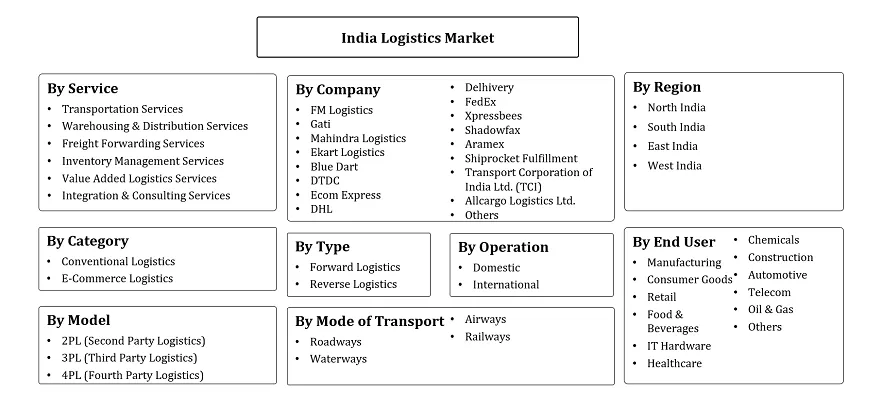
By Service (Express, CEP & Last-Mile Delivery, Warehousing & Storage, Cold Chain & Temperature-Controlled Logistics, Freight Forwarding & Customs Clearance, Value-Added Services),......By Type (Forward Logistics, Reverse Logistics), By Mode of Transport (Roadways, Waterways, Airways, Railways), By Model (2PL, 3PL, 4PL), By Scope of Operation (Domestic Logistics, International Freight), By End Use (FMCG & Retail, Food & Agriculture, Automotive & Industrial Manufacturing, Pharmaceuticals & Healthcare, Electronics, IT Hardware & Consumer Durables, Chemicals, Oil & Gas, Construction & Infrastructure, Others), and others Read more
- Automotive
- Jul 2026
- 145
- PDF, Excel, PPT
India Logistics Market Key Takeaways
- The India logistics market size was valued at USD 259 billion in 2025 and is projected to grow from USD 281.74 billion in 2026 to USD 466.81 billion by 2032.
- The market is projected to register a CAGR of 8.78% during 2026–2032.
- By Service, express, CEP & last-mile delivery dominated the market with 32% share in 2026.
- By mode of transport, roadways captured a significant share of 67% of the market in 2026.
- The industry is fragmented, with the top five players collectively accounting for approximately 28% of the market share in 2026.
India Logistics Market Size and Outlook
The logistics industry in India was valued at USD 259 billion in 2025 and is currently standing at USD 281.74 billion in 2026. The industry is projected to grow to USD 466.81 billion by 2032 showcasing a CAGR of around 8.78% during the forecast period, i.e., 2026–32.
The market is benefiting from sustained economic expansion, rising manufacturing output, stronger domestic consumption, and increasing trade activity, all of which continue to boost freight movement across road, rail, air, and maritime transport networks. India recorded 6.5% real GDP growth in FY2024 to 2025 and continues to be the world's fastest growing major economy. The sector also enjoys infrastructure status, enabling logistics developers to access long term financing on terms comparable with roads, railways, and other core infrastructure sectors, thereby supporting capacity expansion and private investment.
The government's policy framework is accelerating structural improvements across the logistics ecosystem. Under the national logistics policy 2022, India aims to reduce logistics costs to global benchmark levels, achieve a top 25 position in the world bank logistics performance index by 2030, and establish a data driven decision support ecosystem. Complementing these efforts, pm gati shakti has integrated 57 central ministries and departments, all 36 states and union territories, and around 1,700 geospatial data layers, enabling coordinated infrastructure planning across industrial corridors, transport networks, ports, airports, and multimodal logistics facilities.
Large scale infrastructure investment and measurable operational improvements continue to strengthen the long term outlook for the market. The global maritime India summit secured investment commitments exceeding USD 116 billion, supporting maritime amrit kaal vision 2047 through port modernization, connectivity enhancement, and multimodal infrastructure development. Moreover, India's logistics ecosystem is becoming increasingly efficient through digital integration and coordinated infrastructure planning, creating a stronger foundation for freight movement, lower transit bottlenecks, and improved supply chain competitiveness.
As public investment, policy execution, and multimodal connectivity continue to advance, the India logistics market is expected to witness sustained long term growth across manufacturing, trade, and e commerce supply chains.
India Logistics Market Key Indicators
- India's major ports handled a record 915.17 million tonnes of cargo in FY2025 to 2026, surpassing the annual target of 904 million tonnes and registering 7.06% year on year growth, reflecting rising maritime trade and improving port capacity. (2026)
- The western dedicated freight corridor was fully completed in March 2026, while 96.4% of the combined 2,843 kilometre dedicated freight corridor network had already been commissioned by December 2025, strengthening rail freight efficiency and multimodal connectivity. (2025-2026)
- India's warehousing sector recorded 72.5 million square feet of leasing across eight major markets in FY2024 to 2025, increasing 29% year on year and marking the highest annual transaction volume on record, highlighting robust demand for modern logistics infrastructure. (2025)
- The combined dark store network of blinkit, instamart, and zepto reached 5,026 locations by May 2026, expanding by approximately 48% year on year, while India's quick commerce segment grew by nearly 40%, increasing demand for rapid logistics services.
India Logistics Market Scope
| Category | Segments |
|---|---|
| By Service | Express, CEP & Last-Mile Delivery, Warehousing & Storage, Cold Chain & Temperature-Controlled Logistics, Freight Forwarding & Customs Clearance, Value-Added Services |
| By Type | Forward Logistics, Reverse Logistics |
| By Mode of Transport | Roadways, Waterways, Airways, Railways |
| By Model | 2PL, 3PL, 4PL |
| By Scope of Operation | Domestic Logistics, International Freight |
| By End Use | FMCG & Retail, Food & Agriculture, Automotive & Industrial Manufacturing, Pharmaceuticals & Healthcare, Electronics, IT Hardware & Consumer Durables, Chemicals, Oil & Gas, Construction & Infrastructure, Others |
India Logistics Market Growth Drivers
Logistics Cost Optimization Through Multimodal Connectivity
India's efforts to reduce logistics costs are becoming a major demand catalyst for the logistics industry in India as businesses increasingly prioritize faster, lower-cost, and more reliable supply chains. Freight transport accounts for the largest share of India's logistics expenditure, with road transportation contributing 41.7% of the national logistics bill, followed by warehousing at 24.8%. This has intensified government investment in multimodal infrastructure that shifts cargo from higher cost road transport to more economical rail and coastal shipping, improving supply chain competitiveness across manufacturing, retail, and export industries.
The cost advantage of this transition is substantial. The DPIIT and NCAER Report (2025) estimates rail freight costs at USD 0.023 per tonne kilometre, nearly half of road freight at USD 0.044 per tonne kilometre, while multimodal transport becomes commercially viable for freight movements beyond roughly 600 kilometres. Supporting this shift, the western dedicated freight corridor was fully completed in March 2026, with rail's share of Jawaharlal Nehru Port container traffic expected to rise up to 30%.
Simultaneously, Sagarmala 2.0 was launched in 2026 with budgetary support of around USD 4.7 billion to catalyse nearly USD 140 billion in investments over the next decade, while GST reforms have already reduced freight transit time by more than 33%. Together, these initiatives are lowering logistics costs, improving network efficiency, and encouraging greater freight movement, thereby driving sustained demand across the India logistics industry.
- Market Segmentation
- Introduction
- Product Definition
- Research Process
- Assumptions
- Executive Summary
- India Logistics Market Policies, Regulations, and Product Standards
- India Logistics Market Trends & Developments
- India Logistics Market Dynamics
- 6.1. Growth Factors
- 6.2. Challenges
- India Logistics Market Hotspot & Opportunities
- India Logistics Market Outlook, 2022-2032
- Market Size & Outlook
- By Revenues (USD Million)
- Market Segmentation & Outlook
- By Service- Market Size & Forecast 2022-2032, USD Million
- Express, CEP & Last-Mile Delivery
- Warehousing & Storage
- Cold Chain & Temperature-Controlled Logistics
- Freight Forwarding & Customs Clearance
- Value-Added Services
- By Type- Market Size & Forecast 2022-2032, USD Million
- Forward Logistics
- Reverse Logistics
- By Mode of Transport- Market Size & Forecast 2022-2032, USD Million
- Roadways
- Waterways
- Airways
- Railways
- By Model- Market Size & Forecast 2022-2032, USD Million
- 2PL
- 3PL
- 4PL
- By Scope of Operation- Market Size & Forecast 2022-2032, USD Million
- Domestic Logistics
- International Freight
- By End Use- Market Size & Forecast 2022-2032, USD Million
- FMCG & Retail
- Food & Agriculture
- Automotive & Industrial Manufacturing
- Pharmaceuticals & Healthcare
- Electronics, IT Hardware & Consumer Durables
- Chemicals, Oil & Gas
- Construction & Infrastructure
- Others
- By Region- Market Size & Forecast 2022-2032, USD Million
- North India
- South India
- East India
- West India
- By Company
- Competition Characteristics
- Market Share & Analysis
- By Service- Market Size & Forecast 2022-2032, USD Million
- India Forward Logistics Market Outlook, 2022-2032
- Market Size & Outlook
- By Revenues (USD Million)
- Market Segmentation & Outlook
- By Service- Market Size & Forecast 2022-2032, USD Million
- By Mode of Transport- Market Size & Forecast 2022-2032, USD Million
- By Model- Market Size & Forecast 2022-2032, USD Million
- By Scope of Operation- Market Size & Forecast 2022-2032, USD Million
- By End Use- Market Size & Forecast 2022-2032, USD Million
- By Region- Market Size & Forecast 2022-2032, USD Million
- Market Size & Outlook
- India Reverse Logistics Market Outlook, 2022-2032
- Market Size & Outlook
- By Revenues (USD Million)
- Market Segmentation & Outlook
- By Service- Market Size & Forecast 2022-2032, USD Million
- By Mode of Transport- Market Size & Forecast 2022-2032, USD Million
- By Model- Market Size & Forecast 2022-2032, USD Million
- By Scope of Operation- Market Size & Forecast 2022-2032, USD Million
- By End Use- Market Size & Forecast 2022-2032, USD Million
- By Region- Market Size & Forecast 2022-2032, USD Million
- Market Size & Outlook
- India Logistics Market Key Strategic Imperatives for Success & Growth
- Competitive Outlook
- Company Profiles
- Delhivery Ltd.
- Business Description
- Product Portfolio
- Collaborations & Alliances
- Recent Developments
- Financial Details
- Others
- Transport Corporation of India Ltd.
- Business Description
- Product Portfolio
- Collaborations & Alliances
- Recent Developments
- Financial Details
- Others
- Allcargo Logistics Ltd. (Gati)
- Business Description
- Product Portfolio
- Collaborations & Alliances
- Recent Developments
- Financial Details
- Others
- Safexpress Pvt. Ltd.
- Business Description
- Product Portfolio
- Collaborations & Alliances
- Recent Developments
- Financial Details
- Others
- Blue Dart Express Ltd.
- Business Description
- Product Portfolio
- Collaborations & Alliances
- Recent Developments
- Financial Details
- Others
- Mahindra Logistics Ltd.
- Business Description
- Product Portfolio
- Collaborations & Alliances
- Recent Developments
- Financial Details
- Others
- Ekart Logistics (Flipkart Group)
- Business Description
- Product Portfolio
- Collaborations & Alliances
- Recent Developments
- Financial Details
- Others
- Xpressbees (Busybees Logistics Solutions Pvt. Ltd.)
- Business Description
- Product Portfolio
- Collaborations & Alliances
- Recent Developments
- Financial Details
- Others
- Ecom Express Ltd.
- Business Description
- Product Portfolio
- Collaborations & Alliances
- Recent Developments
- Financial Details
- Others
- DTDC Express Ltd.
- Business Description
- Product Portfolio
- Collaborations & Alliances
- Recent Developments
- Financial Details
- Others
- Delhivery Ltd.
- Company Profiles
- Disclaimer
MarkNtel Advisors follows a robust and iterative research methodology designed to ensure maximum accuracy and minimize deviation in market estimates and forecasts. Our approach combines both bottom-up and top-down techniques to effectively segment and quantify various aspects of the market. A consistent feature across all our research reports is data triangulation, which examines the market from three distinct perspectives to validate findings. Key components of our research process include:
1. Scope & Research Design At the outset, MarkNtel Advisors define the research objectives and formulate pertinent questions. This phase involves determining the type of research—qualitative or quantitative—and designing a methodology that outlines data collection methods, target demographics, and analytical tools. They also establish timelines and budgets to ensure the research aligns with client goals.
2. Sample Selection and Data Collection In this stage, the firm identifies the target audience and determines the appropriate sample size to ensure representativeness. They employ various sampling methods, such as random or stratified sampling, based on the research objectives. Data collection is carried out using tools like surveys, interviews, and observations, ensuring the gathered data is reliable and relevant.
3. Data Analysis and Validation Once data is collected, MarkNtel Advisors undertake a rigorous analysis process. This includes cleaning the data to remove inconsistencies, employing statistical software for quantitative analysis, and thematic analysis for qualitative data. Validation steps are taken to ensure the accuracy and reliability of the findings, minimizing biases and errors.

4. Data Forecast and FinalizationThe final phase involves forecasting future market trends based on the analyzed data. MarkNtel Advisors utilize predictive modeling and time series analysis to anticipate market behaviors. The insights are then compiled into comprehensive reports, featuring visual aids like charts and graphs, and include strategic recommendations to inform client decision-making
FILL THE FORM TO GET THE FREE SAMPLE PAGES
We offer flexible licensing options to cater to varying organizational needs. Choose the pricing pack that best suits your requirements:
Buy Now Inquire Before Buying
 Talk to our Consultant
 Request Customization