

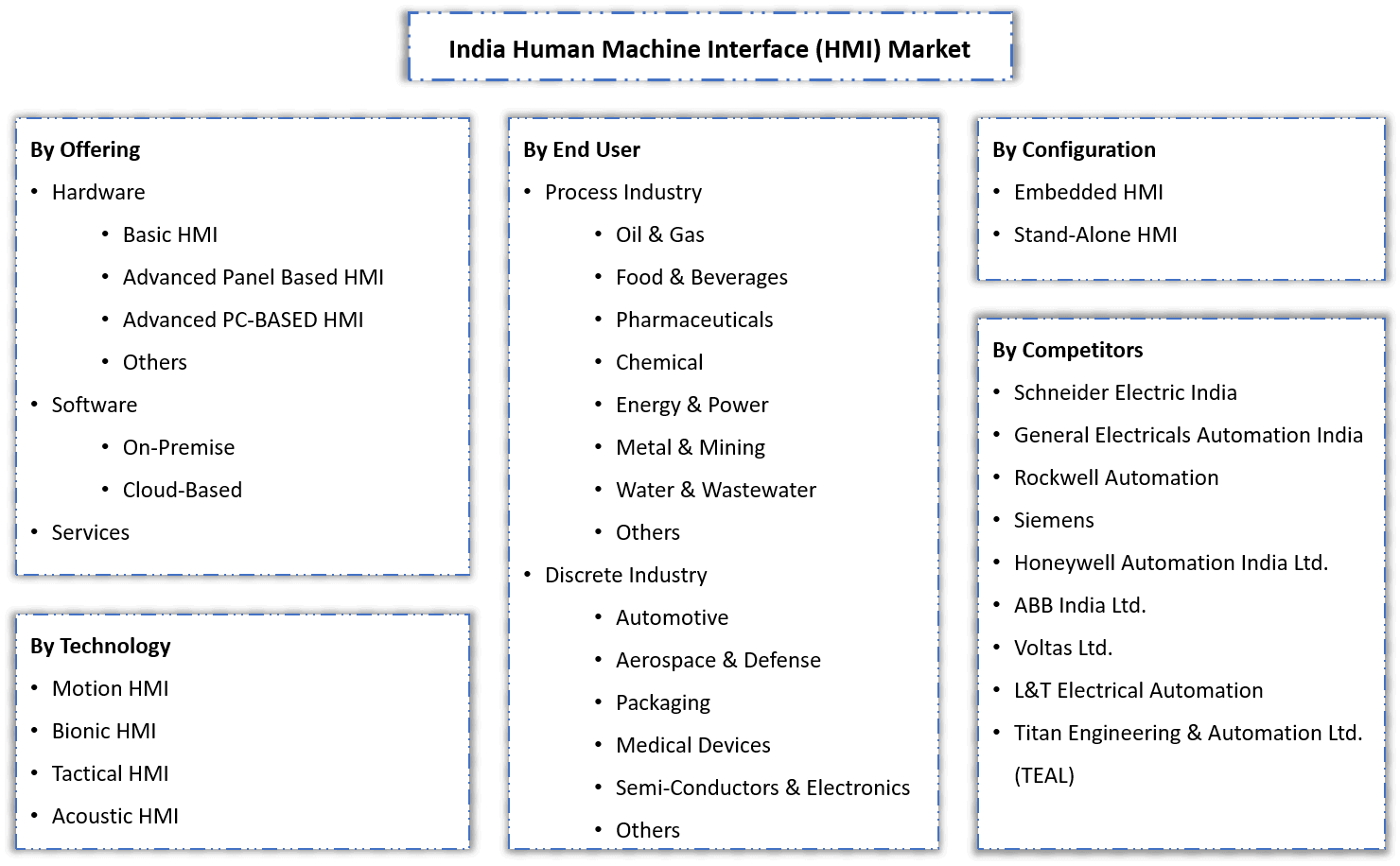
India Human Machine Interface Market - By Offering (Hardware (Basic HMI, Advanced Panel Based HMI, Advanced PC-BASED HMI), Software (On-Premise, Cloud-Based), Services), By Configu......ration (Embedded HMI, Stand-Alone HMI), By Technology (Motion HMI, Bionic HMI, Tactical HMI, Acoustic HMI), By End-User (Process Industry (Oil & Gas, Food & Beverages, Pharmaceuticals, Chemical, Energy & Power, Metal & Mining, Water & Wastewater), Discrete Industry (Automotive, Aerospace & Defense, Packaging, Medical Devices, Semi-Conductors & Electronics) and others Read more
- ICT & Electronics
- Sep 2025
- 110
- PDF, Excel, PPT
Market Insights & Analysis: India Human Machine Interface (HMI) Market (2025-30):
The India Human Machine Interface (HMI) Market size is valued at around USD 183 million in 2025 and is expected to reach USD 291 million by 2030. Along with this, the market is estimated to grow at a CAGR of around 9.72% during the forecast period, i.e., 2025-30. The market growth is driven by the rapid integration of Industrial Internet of Things (IIOT) solutions across the manufacturing, automotive, and energy sectors. As companies aim for real-time monitoring and predictive maintenance, HMIs are evolving from basic data display tools into smart, interactive platforms that support advanced analytics and remote access.
Moreover, the market experiences rapid growth because users demand interfaces that offer both convenience and customization options. The Indian workforce learning smart manufacturing techniques needs user-friendly dashboards that present complicated operations in an understandable way to accelerate training while reducing mistakes during production. The Indian automotive industry leads the way by using touch-screen HMIs with AI diagnostics, which boost production line efficiency. For instance, in India automotive industry leads the way by using touch-screen HMIs with AI diagnostics, which boost production line efficiency.
The spread of smart infrastructure, along with building automation systems, has created new opportunities for HMI technology to move past traditional industrial environments. The Indian smart city initiatives have adopted HMIs to control energy networks, water systems, and transportation infrastructure, which drives market growth in urban utility sectors.
India Human Machine Interface (HMI) Market Scope:
| Category | Segments |
|---|---|
| By Offering | Hardware, Basic HMI, Advanced Panel Based HMI, Advanced PC-BASED HMI, Software, On-Premise, Cloud-Based, Services |
| By Configuration | Embedded HMI, Stand-Alone HMI |
| By Technology | Motion HMI, Bionic HMI, Tactical HMI, Acoustic HMI |
| By End-User | Process Industry (Oil & Gas, Food & Beverages, Pharmaceuticals, Chemical, Energy & Power, Metal & Mining, Water & Wastewater, Discrete Industry (Automotive, Aerospace & Defense, Packaging, Medical Devices, Semi-Conductors & Electronics) and others |
India Human Machine Interface (HMI) Market Driver:
Integration of Industrial Internet of Things (IIoT) – The market growth is driven by the rapid adoption of Industrial Internet of Things (IIoT) in industries like manufacturing, automotive, and energy. Traditional HMI systems undergo transformation into intelligent data-driven platforms through IIoT technology, which enables real-time monitoring, predictive maintenance, and seamless connectivity to improve operational performance and reduce system downtime. IIoT integration brings a complete transformation to industrial automation by delivering remote access to essential information, which enables operators to make rapid decisions.
For instance, Tata Motors operates IIoT-enabled HMIs within their automotive plants, which track equipment status and control production systems to decrease machine breakdowns and enhance assembly line efficiency. The growing interest in automation and data-based operations leads to higher requirements for customizable, user-friendly HMI solutions in India, which positions IIoT as the leading market growth driver.
- Introduction
- Product Definition
- Research Process
- Assumptions
- Market Segmentation
- Executive Summary
- Impact of COVID-19 on India Human Machine Interface (HMI) Market Analysis
- India Human Machine Interface (HMI) Market Outlook, 2020-2030F
- Market Size & Analysis
- By Revenues
- Market Share & Analysis
- By Offering
- Hardware
- Basic HMI
- Advanced Panel-Based HMI
- Advanced PC-Based HMI
- Others
- Software
- On-Premise
- Cloud-Based
- Services
- Hardware
- By Configuration
- Embedded HMI
- Stand-Alone HMI
- By Technology
- Motion HMI
- Bionic HMI
- Tactical HMI
- Acoustic HMI
- By End-User
- Process Industry
- Oil & Gas
- Food & Beverages
- Pharmaceuticals
- Chemical
- Energy & Power
- Metal & Mining
- Water & Wastewater
- Others
- Discrete Industry
- Automotive
- Aerospace & Defense
- Packaging
- Medical Devices
- Semi-Conductors & Electronics
- Others
- Others
- Process Industry
- By Competitor
- Competition Characteristics
- Market Share
- Competitor Alignment in Competition Metrix
- By Offering
- Market Size & Analysis
- India Human Machine Interface (HMI) Market Analysis Dynamics
- Growth Drivers
- Challenges
- Impact Analysis
- India Human Machine Interface (HMI) Market Analysis Trends & Insights
- India Human Machine Interface (HMI) Market Analysis Hotspots & Opportunities
- India Human Machine Interface (HMI) Market Analysis Regulations
- Competitive Benchmarking
- Competition Matrix
- Product Portfolio
- Target Markets
- Target End Users
- Research & Development
- Strategic Alliances
- Strategic Initiatives
- Company Profiles (Business Description, Product Offering, Target Markets, Assets, Strategic Alliances or Partnerships, etc.)
- Schneider Electric India
- General Electricals Automation India
- Rockwell Automation
- Siemens
- Honeywell Automation India Ltd.
- ABB India Ltd.
- Voltas Ltd.
- L&T Electrical Automation
- Titan Engineering & Automation Ltd. (TEAL)
- Others
- Competition Matrix
- Disclaimer
MarkNtel Advisors follows a robust and iterative research methodology designed to ensure maximum accuracy and minimize deviation in market estimates and forecasts. Our approach combines both bottom-up and top-down techniques to effectively segment and quantify various aspects of the market. A consistent feature across all our research reports is data triangulation, which examines the market from three distinct perspectives to validate findings. Key components of our research process include:
1. Scope & Research Design At the outset, MarkNtel Advisors define the research objectives and formulate pertinent questions. This phase involves determining the type of research—qualitative or quantitative—and designing a methodology that outlines data collection methods, target demographics, and analytical tools. They also establish timelines and budgets to ensure the research aligns with client goals.
2. Sample Selection and Data Collection In this stage, the firm identifies the target audience and determines the appropriate sample size to ensure representativeness. They employ various sampling methods, such as random or stratified sampling, based on the research objectives. Data collection is carried out using tools like surveys, interviews, and observations, ensuring the gathered data is reliable and relevant.
3. Data Analysis and Validation Once data is collected, MarkNtel Advisors undertake a rigorous analysis process. This includes cleaning the data to remove inconsistencies, employing statistical software for quantitative analysis, and thematic analysis for qualitative data. Validation steps are taken to ensure the accuracy and reliability of the findings, minimizing biases and errors.

4. Data Forecast and FinalizationThe final phase involves forecasting future market trends based on the analyzed data. MarkNtel Advisors utilize predictive modeling and time series analysis to anticipate market behaviors. The insights are then compiled into comprehensive reports, featuring visual aids like charts and graphs, and include strategic recommendations to inform client decision-making
FILL THE FORM TO GET THE FREE SAMPLE PAGES
We offer flexible licensing options to cater to varying organizational needs. Choose the pricing pack that best suits your requirements:
Buy Now Inquire Before Buying
 Talk to our Consultant
 Request Customization