

By Product Type (Glyphosate, 2,4-D, Atrazine, Pendimethalin, Butachlor, Pretilachlor, Oxyfluorfen, Paraquat, Metsulfuron-methyl, Others), By Crop Type (Cereals & Grains, Oilseeds &...... Pulses, Fruits & Vegetables, Plantation Crops, Commercial Crops, Others), By Formulation (Liquid, Granular, Powder), and others Read more
- Environment
- Jul 2026
- 145
- PDF, Excel, PPT
India Herbicides Market Key Takeaways
- The India Herbicides Market was valued at USD 0.47 billion in 2025 and is projected to grow from USD 0.51 billion in 2026 to USD 0.84 billion by 2032, registering a CAGR of 8.67% during the forecast period (2026–2032).
- Cereals & Grains dominate the market by crop type, accounting for approximately 49% of the total market share.
- Synthetic herbicides lead the market by source with an estimated 96% share.
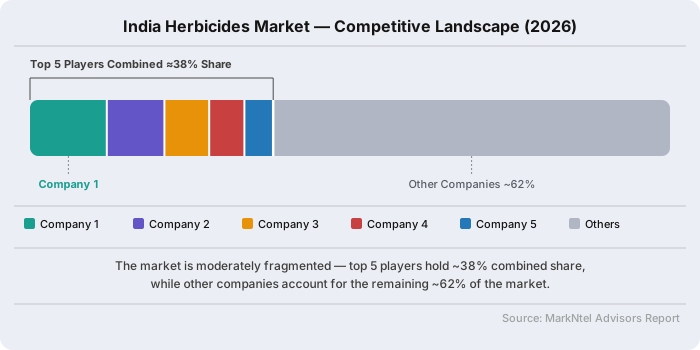
- The market is moderately consolidated, with the top five companies collectively accounting for around 38% of total revenue.
India Herbicides Market Size and Outlook
The herbicides market in India was valued at USD 0.47 billion in 2025 and is projected to grow from USD 0.51 billion in 2026 to USD 0.84 billion by 2032, registering a CAGR of 8.67% during the forecast period. Market growth is primarily driven by rising rural labor costs, which have made manual weeding increasingly expensive, along with the growing adoption of chemical weed control across major crops such as paddy, wheat, maize, cotton, and soybean. A 2024 study estimated that pesticides are currently applied on only around 25% of India's cultivated land, covering approximately 16.7 million hectares, highlighting significant untapped potential for greater herbicide adoption as farming practices become more intensive.
Government initiatives are further supporting market expansion by encouraging modern cultivation methods. Haryana offers an incentive of USD 46.74 per acre under its Direct Seeded Rice (DSR) Programme through Direct Benefit Transfer, promoting a cultivation method that relies more heavily on pre- and post-emergence herbicides while reducing labor and water consumption. Reflecting this shift, the DSR cultivation area in Ambala district increased from 4,691 acres in 2023–24 to 8,653 acres in 2025–26. Regulatory support has also strengthened the market. In May 2025, the Central Insecticides Board and Registration Committee (CIB&RC) approved 27 new crop protection products under Section 9(3) of the Insecticides Act, including PI Industries' Pyroxasulfone 85% WG, a pre-emergence herbicide developed for controlling Phalaris minor in wheat.
Leading agrochemical companies are expanding their product portfolios to address evolving weed management requirements across key crops. In August 2025, UPL launched Brucia (tolpyralate), a post-emergence herbicide for maize, while Godrej Agrovet, in collaboration with Japan's ISK, introduced Ashitaka for broadleaf and grassy weed control in maize. Corteva Agriscience launched Pixxaro for broadleaf weed management in wheat, and Insecticides India commercialized Altair (metazosulfuron), developed with Nissan Chemical, for pre-emergence weed control in paddy. These crop-specific product launches are expanding herbicide adoption across India's major cereal and commercial crop segments.
Looking ahead, increasing adoption of water-efficient farming practices, supportive regulatory approvals, and a steady pipeline of advanced selective herbicides are expected to sustain long-term market growth throughout the forecast period.
India Herbicides Market Key Indicators
- According to the Ministry of Agriculture & Farmers' Welfare, India produced a record 150.184 million tonnes of rice and 117.95 million tonnes of wheat in 2024–25. The continued expansion of large-scale cereal cultivation is increasing weed management requirements, driving higher adoption of pre- and post-emergence herbicides across India's rice–wheat production systems.
- According to the ICAR-Directorate of Weed Research and FSII, weeds cause 25–26% yield losses in kharif crops and 18–25% in rabi crops, resulting in an estimated annual economic loss of approximately USD 10.7 billion in 2024. This substantial productivity loss is accelerating the adoption of herbicides across Indian agriculture.
- According to the USDA FAS 2025 India Report, herbicide-tolerant (HTBT) cotton covers 15–25% of India's 11–13 million hectares of cotton cultivation. Farmers save approximately USD 82–94 per acre by reducing manual weeding costs, driving sustained glyphosate demand across the country's major cotton-producing regions.
- According to the India Brand Equity Foundation (IBEF), herbicides accounted for 22% of India's USD 7.82 billion domestic agrochemical market in FY24. As the second-largest crop protection segment by value, herbicides continue to attract investments in new active ingredients and advanced weed management technologies, supporting long-term market growth.
India Herbicides Market Scope
| Category | Segments |
|---|---|
| By Product Type | Glyphosate, 2,4-D, Atrazine, Pendimethalin, Butachlor, Pretilachlor, Oxyfluorfen, Paraquat, Metsulfuron-methyl, Others |
| By Crop Type | Cereals & Grains, Oilseeds & Pulses, Fruits & Vegetables, Plantation Crops, Commercial Crops, Others |
| By Formulation | Liquid, Granular, Powder |
| By Source | Synthetic, Bio-based |
India Herbicides Market Growth Drivers
Escalating Farm-Labor Scarcity and Rural Wage Inflation Accelerating the Shift from Manual Weeding to Chemical Weed Control
Rising rural labor costs are accelerating the transition from manual weeding to herbicide-based weed management across Indian agriculture. Weeding remains one of the most labor-intensive farming operations, and its cost has increased significantly as agricultural workers continue to shift toward non-farm employment. The Ministry of Labor and Employment revised the variable dearness allowance for agricultural workers with effect from 1 April 2025, following the Consumer Price Index for Industrial Workers reaching 413.42 points as on 31 December 2024, an 11.33-point increase that raised statutory farm wage floors nationwide. As labor availability declines and manual weeding becomes increasingly expensive during critical crop stages, farmers are adopting selective and broad-spectrum herbicides as a more cost-effective alternative.
The economic impact of weed infestation further strengthens herbicide demand. According to a Directorate of Weed Research and Federation of Seed Industry of India study released in 2024, weeds cause USD 9.58 billion in annual crop productivity losses, resulting in 25–26% yield reductions in kharif crops and 18–25% in rabi crops across rice, wheat, maize, cotton, sugarcane, soybean, and mustard. The study also estimated per-acre weed-control expenditure between USD 38.41 and USD 82.01 making herbicide-based weed management a more economical solution than repeated manual weeding. As labor shortages persist, demand for efficient, crop-specific herbicides is expected to strengthen throughout the forecast period.
Recent Trends
Shift Toward Multi-Active Pre-Mix Herbicides for Managing Herbicide-Resistant Weeds
Indian farmers are increasingly shifting from single-active herbicides to multi-active pre-mix formulations that combine two or more complementary modes of action in a single product. This transition is primarily driven by the growing incidence of herbicide-resistant weeds. According to a December 2025 ICAR publication, the repeated use of a limited range of herbicides in India's rice–wheat cropping systems has led to widespread weed resistance, reducing the effectiveness of conventional weed-control practices and increasing production costs. As a result, farmers are adopting advanced pre-mix herbicides that provide broader weed control while delaying the development of resistance.
The growing preference for multi-active formulations is also reflected in new product launches. In June 2026, Saffire Crop Science, a Crystal Crop Protection group company, introduced PINAKA for soybean cultivation in Madhya Pradesh. The product combines Quizalofop-ethyl 3.6%, Fomesafen 12%, and Imazethapyr 7% SC, enabling effective control of both narrow-leaf and broadleaf weeds through a single application. As herbicide resistance continues to expand, demand for multi-mode-of-action pre-mix herbicides is expected to increase, encouraging manufacturers to prioritize resistance-management solutions and advanced crop-specific formulations over standalone active ingredients.
India Herbicides Market Opportunities and Challenges
Heavy Dependence on Chinese Herbicide Technical Driving Domestic Backward Integration and Make-in-India Manufacturing Opportunities
India's herbicide industry continues to rely heavily on imported technical-grade agrochemical ingredients, making domestic manufacturers vulnerable to supply disruptions and raw material price fluctuations. During the Agro-Chem Summit 2025, industry representatives highlighted that India depends on China for nearly 50% of its technical-grade agrochemical inputs, while lengthy and complex product registration procedures continue to delay the commercialization of new crop protection products. Since a significant share of herbicide active ingredients and intermediates is sourced from China, production disruptions caused by environmental regulations and power restrictions directly affect the availability and cost of raw materials for Indian formulators, putting pressure on margins in the highly price-sensitive agricultural market.
The industry's reliance on imported herbicide technical is creating significant opportunities for domestic manufacturing and localization. In June 2026, Nissan Chemical announced plans to establish a new manufacturing facility in India through its subsidiary Nissan Bharat Ras Ayan to produce its next-generation herbicide Ryzonic (iptriazopyrid). The facility, expected to commence operations in FY2028, is intended to secure product supply ahead of the herbicide's 2027 global launch across India and Japan. This investment highlights India's growing role as a manufacturing hub for advanced paddy herbicides while strengthening local production capabilities.
As localization accelerates, investments in technical-grade herbicides and key intermediates are expected to reduce import dependence, improve supply chain resilience, and enhance cost competitiveness.
Segmentation Insights
Cereals & Grains Lead the India Herbicides Industry, Supported by Crop-Specific Product Innovation
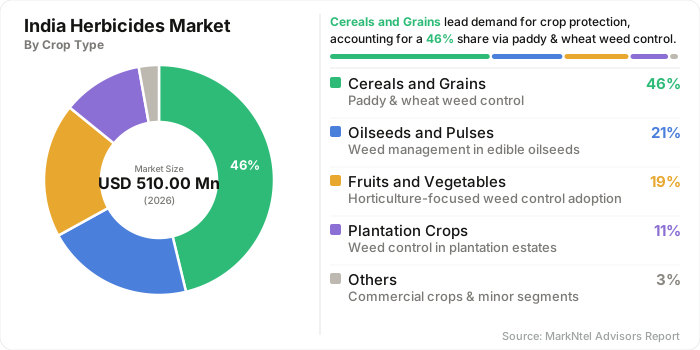
The Cereals & Grains segment is projected to hold the largest share of the India herbicides market, accounting for approximately 49% of total market revenue, driven by the extensive cultivation of rice, wheat, and maize across major agricultural regions. These crops require effective and timely weed management solutions to minimize yield losses, improve input efficiency, and enhance overall farm productivity. The segment benefits from a well-established portfolio of registered herbicides, higher farmer awareness, and recurring demand across multiple crop cycles.
Market growth is further supported by continuous innovation in cereal-focused herbicide solutions. In October 2024, Insecticides (India) Ltd. introduced Torry Super, a post-emergence herbicide for maize based on its proprietary SPF Technology, designed to deliver faster weed control, improved crop safety, and longer residual performance. Additionally, FMC India launched Vayobel® (Beflubutamid 2.5% GR) for transplanted rice, introducing a novel mode of action in India to support broad-spectrum pre-emergence weed control and resistance management. Such targeted product developments highlight ongoing industry investment in cereal crop protection, strengthening the segment’s dominance in the country. By Crop type the market is further segmented into the following sub-categories:
- Cereals & Grains
- Oilseeds & Pulses
- Fruits & Vegetables
- Plantation Crops
- Commercial Crops
- Others
Synthetic Herbicides Dominate the India Herbicides Market Due to Proven Efficacy and Continuous Product Innovation
The synthetic herbicides segment is estimated to account for approximately 96% of the India herbicides market, driven by their widespread adoption across major crops such as rice, maize, soybean, and sugarcane. Synthetic herbicides remain the preferred weed management solution due to their high effectiveness, rapid action, longer residual activity, and availability of crop-specific formulations. Their established performance, extensive distribution networks, and compatibility with large-scale farming practices provide a significant advantage over emerging bio-based alternatives.
The segment’s dominance is further supported by continuous innovation from leading agrochemical companies. UPL introduced Ricebeaux (2026) for key rice-producing states, offering an advanced synthetic formulation to address severe weed pressure while maintaining crop safety. Crystal Crop Protection launched Takuro (2026), a patented combination herbicide for maize featuring a three-layer weed management approach, and Samorian (2026) for soybean with a three-way mode of action targeting both grassy and broadleaf weeds. Additionally, Dhanuka Agritech introduced Tizom (2024), developed with Nissan Chemical, Japan, for broad-spectrum weed control in sugarcane.
These developments highlight ongoing industry focus on advanced synthetic solutions, reinforcing their leadership in India’s herbicides market. By source the market is further segmented into the following sub-categories:
- Synthetic
- Bio-based
India Herbicides Market Competitive Landscape
The India herbicides market is moderately consolidated, with top five players, Bayer AG, Syngenta Group, UPL Limited, BASF SE, and FMC Corporation, collectively account for approximately 38% market share, supported by their extensive herbicide portfolios, strong farmer reach, and continuous product innovation.
Major Companies in the India Herbicides Market
- BASF SE
- Bayer AG
- Corteva Agriscience
- FMC Corporation
- Nufarm Ltd.
- Syngenta Group
- UPL Limited
- PI Industries
- Sumitomo Chemical Co., Ltd.
- Gharda Chemicals Ltd.
India Herbicides Market News and Recent Developments
2025: Syngenta Launches ALTESSIA Herbicide for Rice in India
Syngenta introduced its ALTESSIA herbicide for rice cultivation in India as part of its broader Asia-Middle East-Africa crop protection growth strategy, alongside new VANIVA nematicide/fungicide registrations.
Market Impact Analysis: Rice/paddy represents a core weed-pressure segment in India. Syngenta's targeted launch reinforces MNC commitment to India despite regulatory tightening (CIBRC re-registration norms) and pricing pressure from generic glyphosate competition. It signals continued innovation-led investment by multinationals even as domestic players gain share, sustaining a two-tier competitive market: MNC-led premium/patented actives versus domestic low-cost generics — a dynamic expected to persist through 2030 as the herbicide segment outpaces insecticides in growth.
2026: FMC India Launches Vayobel Herbicide Among Five New Crop Protection Products in Central India
FMC India expanded its portfolio with five new crop protection products unveiled at a customer engagement event in Central India, among them, a beflubutamid 2.5% granular formulation for weed management, alongside Resonex Insecticide (chlorantraniliprole 5% w/w DT) for stem borer in rice. The granular herbicide format targets ease of application in the flooded and moist-soil conditions typical of paddy systems, extending FMC's India crop protection range into selective residual weed control and complementing its existing insecticide-led paddy portfolio.
Impact Analysis: A branded granular herbicide broadens differentiated, higher-margin product supply in a market long dominated by generic liquid formulations, supporting premiumisation of weed-control demand. By anchoring new chemistry to paddy — the country's single largest herbicide-consuming crop — the introduction deepens a multinational's distribution reach among rice growers and intensifies competitive pressure on domestic players marketing older, off-patent selective herbicides.
2026: BASF and Corteva Launch Clearfield® Mustard Production System in India
BASF India and Corteva Agriscience India introduced the Clearfield® Mustard Production System, integrating BASF's Kifix® herbicide with herbicide-tolerant mustard hybrids developed by Corteva. The non-GM production system is designed to provide effective post-emergence weed control, including difficult weeds such as Orobanche, while improving mustard productivity and reducing crop losses. The launch aims to support Indian farmers with an integrated weed management solution that enhances cultivation efficiency and contributes to higher oilseed production.
Market Impact Analysis: The launch strengthens the adoption of advanced herbicide-based weed management in India's oilseed sector, expanding herbicide applications beyond cereals. It is expected to increase demand for selective post-emergence herbicides, encourage integrated crop protection technologies, and support market growth through improved farm productivity and sustainable weed management practices.
- Market Segmentation
- Introduction
- Product Definition
- Research Process
- Assumptions
- Executive Summary
- India Herbicides Market Policies, Regulations, and Product Standards
- India Herbicides Market Trends & Developments
- India Herbicides Market Dynamics
- Growth Factors
- Challenges
- India Herbicides Market Hotspot & Opportunities
- India Herbicides Market Outlook, 2022-2032
- Market Size & Outlook
- By Revenues (USD Million)
- Market Share & Outlook
- By Product Type- Market Size & Forecast 2022-2032, USD Million
- Glyphosate
- 2,4-D
- Atrazine
- Pendimethalin
- Butachlor
- Pretilachlor
- Oxyfluorfen
- Paraquat
- Metsulfuron-methyl
- Others
- By Crop Type- Market Size & Forecast 2022-2032, USD Million
- Cereals & Grains
- Oilseeds & Pulses
- Fruits & Vegetables
- Plantation Crops
- Commercial Crops
- Others
- By Formulation- Market Size & Forecast 2022-2032, USD Million
- Liquid
- Granular
- Powder
- By Source- Market Size & Forecast 2022-2032, USD Million
- Synthetic
- Bio-based
- By Region - Market Size & Forecast 2022-2032, USD Million
- North
- South
- East
- West
- Central
- By Company
- Competition Characteristics
- Market Share & Analysis
- By Product Type- Market Size & Forecast 2022-2032, USD Million
- Market Size & Outlook
- India Synthetic Herbicides Market Outlook, 2022-2032
- Market Size & Outlook
- By Revenues (USD Million)
- Market Share & Outlook
- By Ingredient Type-Market Size & Forecast 2022-2032, USD Million
- By Crop Type- Market Size & Forecast 2022-2032, USD Million
- By Formulation- Market Size & Forecast 2022-2032, USD Million
- By Region - Market Size & Forecast 2022-2032, USD Million
- Market Size & Outlook
- India Bio-based Herbicides Market Outlook, 2022-2032
- Market Size & Outlook
- By Revenues (USD Million)
- Market Share & Outlook
- By Ingredient Type-Market Size & Forecast 2022-2032, USD Million
- By Crop Type- Market Size & Forecast 2022-2032, USD Million
- By Formulation- Market Size & Forecast 2022-2032, USD Million
- By Region - Market Size & Forecast 2022-2032, USD Million
- Market Size & Outlook
- India Herbicides Market Key Strategic Imperatives for Success & Growth
- Competitive Outlook
- Company Profiles
- BASF SE
- Business Description
- Product Portfolio
- Collaborations & Alliances
- Recent Developments
- Financial Details
- Others
- Bayer AG
- Business Description
- Product Portfolio
- Collaborations & Alliances
- Recent Developments
- Financial Details
- Others
- Corteva Agriscience
- Business Description
- Product Portfolio
- Collaborations & Alliances
- Recent Developments
- Financial Details
- Others
- FMC Corporation
- Business Description
- Product Portfolio
- Collaborations & Alliances
- Recent Developments
- Financial Details
- Others
- Nufarm Ltd.
- Business Description
- Product Portfolio
- Collaborations & Alliances
- Recent Developments
- Financial Details
- Others
- Syngenta Group
- Business Description
- Product Portfolio
- Collaborations & Alliances
- Recent Developments
- Financial Details
- Others
- UPL Limited
- Business Description
- Product Portfolio
- Collaborations & Alliances
- Recent Developments
- Financial Details
- Others
- PI Industries
- Business Description
- Product Portfolio
- Collaborations & Alliances
- Recent Developments
- Financial Details
- Others
- Sumitomo Chemical Co., Ltd.
- Business Description
- Product Portfolio
- Collaborations & Alliances
- Recent Developments
- Financial Details
- Others
- Gharda Chemicals Ltd.
- Business Description
- Product Portfolio
- Collaborations & Alliances
- Recent Developments
- Financial Details
- Others
- BASF SE
- Company Profiles
- Disclaimer

MarkNtel Advisors follows a robust and iterative research methodology designed to ensure maximum accuracy and minimize deviation in market estimates and forecasts. Our approach combines both bottom-up and top-down techniques to effectively segment and quantify various aspects of the market. A consistent feature across all our research reports is data triangulation, which examines the market from three distinct perspectives to validate findings. Key components of our research process include:
1. Scope & Research Design At the outset, MarkNtel Advisors define the research objectives and formulate pertinent questions. This phase involves determining the type of research—qualitative or quantitative—and designing a methodology that outlines data collection methods, target demographics, and analytical tools. They also establish timelines and budgets to ensure the research aligns with client goals.
2. Sample Selection and Data Collection In this stage, the firm identifies the target audience and determines the appropriate sample size to ensure representativeness. They employ various sampling methods, such as random or stratified sampling, based on the research objectives. Data collection is carried out using tools like surveys, interviews, and observations, ensuring the gathered data is reliable and relevant.
3. Data Analysis and Validation Once data is collected, MarkNtel Advisors undertake a rigorous analysis process. This includes cleaning the data to remove inconsistencies, employing statistical software for quantitative analysis, and thematic analysis for qualitative data. Validation steps are taken to ensure the accuracy and reliability of the findings, minimizing biases and errors.

4. Data Forecast and FinalizationThe final phase involves forecasting future market trends based on the analyzed data. MarkNtel Advisors utilize predictive modeling and time series analysis to anticipate market behaviors. The insights are then compiled into comprehensive reports, featuring visual aids like charts and graphs, and include strategic recommendations to inform client decision-making
FILL THE FORM TO GET THE FREE SAMPLE PAGES
We offer flexible licensing options to cater to varying organizational needs. Choose the pricing pack that best suits your requirements:
Buy Now Inquire Before Buying
 Talk to our Consultant
 Request Customization