

By Base Oil (Mineral Oil, Synthetic Oil, Semi-Synthetic Oil, Bio-based Compressor Oil), By Compressor Type (Positive Displacement Compressors, Dynamic Compressors), By End User (Ge......neral Manufacturing, Automotive, Oil & Gas, Power Generation, Mining & Metals, Food & Beverage, Pharmaceuticals, Chemicals & Petrochemicals, Construction, HVAC & Refrigeration, Textile, Others), and others Read more
- Chemicals
- Jul 2026
- 140
- PDF, Excel, PPT
India Compressor Oil Market Key Takeaways
- The India compressor oil market was valued at USD 480.95 million in 2025 and is projected to grow from USD 512.11 million in 2026 to USD 747.48 million by 2032.
- The industry is projected to witness steady growth at a 6.51% CAGR during 2026–2032.
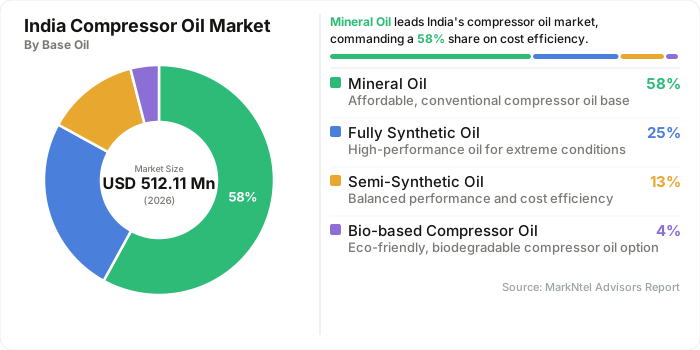
- Mineral oil dominated the base oil segment, accounting for approximately 58% of the market share.
- General manufacturing emerged as the leading end-user segment, capturing approximately 37% of the market in 2026.
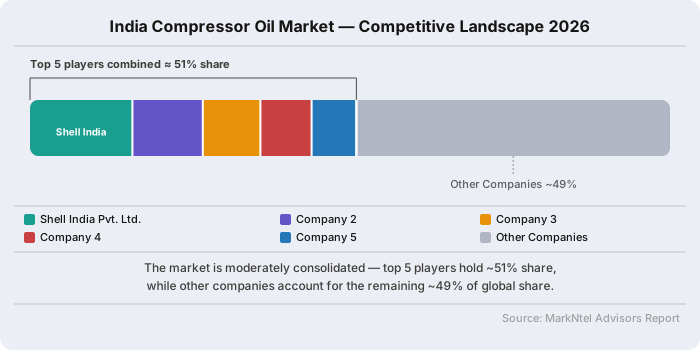
- The market remains moderately consolidated, with the top five companies collectively holding approximately 51% of the total market share.
India Compressor Oil Market Size and Outlook
The India compressor oil market size was valued at USD 480.95 million in 2025 and is projected to grow from USD 512.11 million in 2026 to USD 747.48 million by 2032, registering a CAGR of 6.51% during 2026–2032. Growth is supported by increasing pharmaceutical manufacturing under India's Production Linked Incentive Scheme and wider implementation of the Perform, Achieve and Trade (PAT) programme, accelerating adoption of compressor maintenance fluids and equipment reliability solutions across industrial facilities.
India's industrial production continues to provide a strong foundation for lubricant demand. According to the National Statistical Office, the manufacturing component of the Index of Industrial Production increased 6.2% in April 2026, marking the first reading under the rebased 2022–23 series. Rising production across steel, cement, automotive, and engineering industries is increasing compressor utilization, shortening lubricant replacement intervals, and driving demand for industrial machinery maintenance solutions throughout manufacturing operations.
The National Manufacturing Mission, announced in the Union Budget 2025–26, is expected to accelerate investments in manufacturing capacity across steel, cement, automotive, and engineering industries. As additional production facilities become operational, demand for compressed air systems and continuous-duty compressor lubricants is expected to rise steadily. This policy-led industrial expansion is anticipated to strengthen long-term growth prospects for the India compressor oil industry by supporting sustained capital investment across manufacturing clusters.
Automotive manufacturing remains another important demand contributor. According to the Society of Indian Automobile Manufacturers (SIAM), cumulative vehicle production reached 27.4 million units during April 2025–January 2026. Vehicle manufacturing facilities depend extensively on pneumatic tools, paint-shop compressors, and robotic assembly systems that require reliable lubrication. Continued expansion of passenger and commercial vehicle production is expected to sustain recurring demand for premium compressor oils from automotive OEMs and component manufacturers across India.
Market Key Indicators
- Per the Central Electricity Authority, India's total installed power generation capacity reached 542.35 GW as of May 2026, spanning thermal, hydro, nuclear and renewable sources. Thermal and gas-based plants depend on turbocompressors for combustion air supply and instrumentation, requiring lubricants rated for continuous high-temperature duty. As capacity additions continue toward the government's long-term resource adequacy targets, power generators represent a structurally growing, technically demanding compressor lubricant end market.
- The Petroleum Planning and Analysis Cell, Ministry of Petroleum and Natural Gas, records India's installed refining capacity at 258.1 million metric tonnes per annum as of April 2025. Refineries and gas-processing units depend on reciprocating and centrifugal compressors for hydrocarbon handling under high pressure. This sustained overcapacity operation intensifies wear on compression equipment, driving frequent replacement cycles for specialized compressor lubricants across India's refining infrastructure.
- Per the Ministry of Mines, India produced 289 million metric tonnes of iron ore in 2024, with non-ferrous metal output, including refined copper, rising sharply in 2025. Mining and metal-processing operations run pneumatic drills, ventilation compressors, and ore-handling systems continuously in abrasive, dust-heavy conditions. These harsh operating environments accelerate lubricant breakdown, sustaining structurally higher compressor oil consumption per unit of installed compression capacity than in cleaner industrial settings.
- Union Budget 2025–26 documents show a budgeted allocation of approximately USD 33.22 billion for roads and highways, continuing India's sustained capital expenditure push under flagship road-building programmes. Highway construction equipment, including pneumatic breakers, concrete batching plants, and tunnel-boring systems, runs on compressor-driven pneumatic power. Rising road-construction activity nationwide is expanding the installed base of mobile and stationary compressors requiring regular lubrication at active project sites.
India Compressor Oil Market Scope
| Category | Segments |
|---|---|
| By Base Oil | Mineral Oil, Synthetic Oil, Semi-Synthetic Oil, Bio-based Compressor Oil |
| By Compressor Type | Positive Displacement Compressors, Dynamic Compressors |
| By End User | General Manufacturing, Automotive, Oil & Gas, Power Generation, Mining & Metals, Food & Beverage, Pharmaceuticals, Chemicals & Petrochemicals, Construction, HVAC & Refrigeration, Textile, Others |
India Compressor Oil Market Growth Drivers
Expansion of Bulk Drug and Pharmaceutical Manufacturing Under India’s PLI Scheme
India's Production Linked Incentive (PLI) Scheme for bulk drugs is expanding domestic manufacturing of Active Pharmaceutical Ingredients, Key Starting Materials, and Drug Intermediates, increasing demand for compressed air systems across pharmaceutical facilities. As of December 2024, 34 projects had been commissioned with realized investments exceeding USD 500.5 million, supporting higher consumption of high-performance lubricants in continuous compressor operations. This trend is strengthening the India compressor oil industry.
Major investments further reinforce this demand. The Penicillin G facility in Andhra Pradesh received committed investment of approximately USD 224.7 million, while the Clavulanic Acid project in Himachal Pradesh attracted nearly USD 52.9 million. Fermentation-based antibiotic production requires uninterrupted, contamination-controlled compressed air, encouraging greater adoption of synthetic and semi-synthetic compressor oils compared with conventional manufacturing applications.
For lubricant manufacturers, the ongoing expansion creates opportunities to transition from conventional mineral oils to validated synthetic formulations designed for pharmaceutical environments. Bulk drug parks in Gujarat, Telangana, and Andhra Pradesh are expected to support sustained industrial expansion, driving long-term demand for premium lubrication products. Consequently, this development is expected to significantly support the growth of the India compressor oil market over the forecast period.
Recent Trends
Expansion of India’s PAT Scheme Driving Energy-Efficient Lubricant Adoption
India's expanding Perform, Achieve and Trade (PAT) Scheme is reshaping lubricant selection across industrial facilities by increasing emphasis on energy-efficient operations. According to the Bureau of Energy Efficiency's India Energy Scenario 2023–24, more than 1,333 Designated Consumers have been covered across eight PAT cycles. As compressed air systems remain among the largest electricity consumers in manufacturing plants, industries are increasingly adopting energy-efficient lubricants, supporting the India compressor oil market.
The Bureau of Energy Efficiency has also announced plans to extend the PAT framework to ten additional energy-intensive sectors, including automobile, chemicals, dairy, glass, and mining. As more facilities are required to reduce specific energy consumption, plant engineers are increasingly selecting extended drain interval oils that minimize frictional losses and improve compressor efficiency instead of relying solely on conventional mineral lubricants.
This transition represents a long-term industry trend because the PAT mechanism operates through rolling three-year compliance cycles with continuous sector expansion. Consequently, compressor lubricant selection is increasingly evaluated on its contribution to energy efficiency, operational reliability, and lifecycle performance alongside equipment protection. This evolving procurement approach is expected to accelerate demand for premium synthetic and semi-synthetic lubricants, strengthening the India compressor oil industry.
India Compressor Oil Market Opportunities and Challenges
Extended Producer Responsibility (EPR) Driving Circular Lubricant Development
The implementation of Extended Producer Responsibility (EPR) for used oil under the Hazardous and Other Wastes (Management and Transboundary Movement) Second Amendment Rules, effective from 1 April 2024, has increased regulatory obligations for producers of base oil, lubricating oil, and importers. Mandatory CPCB registration, procurement of EPR certificates from registered recyclers, and compliance with recycling targets have increased operational complexity, challenging the India compressor oil market while accelerating adoption of industrial lubrication technologies.
The evolving regulatory framework is simultaneously creating opportunities to establish a circular lubricant ecosystem across India. Compliance-driven demand for authorized collection, recycling, and re-refining encourages lubricant manufacturers to strengthen supply chains, improve resource efficiency, and diversify sustainable raw material sourcing. These developments are expected to support greater production of premium industrial oils, reduce dependence on virgin base oils, and strengthen long-term sustainability across the lubricant value chain.
The opportunity is further reinforced by the January 2026 Memorandum of Understanding between Hindustan Petroleum Corporation Limited (HPCL) and Castrol India to explore a Re-Refined Base Oil (RRBO) ecosystem. The initiative will evaluate large-scale collection of used lubricating oil and its re-refining for lubricant production, supporting a circular supply chain and creating sustainable growth opportunities for the India compressor oil industry through increased availability of recycled base oils.
Segmentation Insights
Mineral Oil Dominates Due to Domestic Refining Availability and Cost Stability
Mineral oil accounted for approximately 58% of the India compressor oil industry by base oil in 2025, primarily supported by extensive domestic refining capacity and its cost advantage over synthetic alternatives. Widespread availability, established supply networks, and lower procurement costs continue to make mineral oil the preferred choice for industrial users seeking dependable industrial compressor lubricants across diverse manufacturing applications.
According to the Petroleum Planning and Analysis Cell (PPAC), India's crude oil import dependency reached approximately 88.3% during 2024. Although both mineral and synthetic base oils ultimately depend on imported crude feedstock, domestically refined Group I and Group II mineral base oils benefit from established refining infrastructure, reducing additional freight costs and foreign exchange exposure associated with imported synthetic base stocks.
In contrast, Group III and Group IV synthetic base oils continue to rely largely on imports, increasing procurement costs and supply-chain uncertainty. Consequently, mineral oils remain the preferred option for industries prioritizing cost-effective operations, consistent availability, and proven performance. Their competitive pricing and compatibility with conventional compressor systems continue to strengthen demand for air compressor lubricants. Based on base oil, the scope has been bifurcated into:
- Mineral Oil
- Semi-Synthetic Oil
- Synthetic Oil
- Bio-based Compressor Oil
General Manufacturing Leads Due to India's Large Registered Factory Base
The general manufacturing segment accounted for approximately 37% of the India compressor oil market. Its leadership is primarily attributed to India's extensive industrial base, where compressed air systems are widely used for pneumatic tools, material handling, assembly operations, and automated production processes. This broad operational footprint sustains consistent demand for compressor lubrication solutions across diverse manufacturing facilities.
According to the National Statistical Office, India's Annual Survey of Industries 2023–24 recorded 260,061 registered factories, while Gross Value Added increased 11.89% at current prices over the previous year. The country's manufacturing landscape spans basic metals, motor vehicles, chemicals, food products, machinery, and fabricated metal products, all of which rely extensively on compressed air systems for day-to-day industrial operations.
The continuous operation of compressors in production environments requires scheduled lubrication to maintain efficiency, reduce equipment wear, and minimize operational downtime. As a result, manufacturing remains the largest institutional consumer of compressor oils. This sustained utilization continues to strengthen demand for rotary screw compressor oil across India's established manufacturing ecosystem. The key end-user segments analyzed in the study include:
- General Manufacturing
- Automotive
- Oil & Gas
- Power Generation
- Mining & Metals
- Food & Beverage
- Pharmaceuticals
- Chemicals & Petrochemicals
- Construction
- HVAC & Refrigeration
- Textile
- Others
- Others
India Compressor Oil Market Competitive Analysis
The India compressor oil industry is moderately consolidated, with the top five players collectively accounting for approximately 51% of the total market. Shell India Pvt. Ltd., Castrol India Ltd., Indian Oil Corporation Ltd. (SERVO), Bharat Petroleum Corporation Ltd. (MAK Lubricants), and ExxonMobil Lubricants Pvt. Ltd. maintain strong positions through extensive distribution networks, broad industrial lubricant portfolios, established OEM partnerships, and nationwide manufacturing capabilities. Meanwhile, companies such as Hindustan Petroleum Corporation, TotalEnergies, FUCHS, Gulf Oil Lubricants, and PETRONAS intensify competition by expanding premium synthetic lubricant offerings, strengthening regional distribution, and targeting high-growth industrial sectors.
Leading Companies in India Compressor Oil Market
- Shell India Pvt. Ltd.
- Castrol India Ltd.
- Indian Oil Corporation Ltd. (SERVO)
- Bharat Petroleum Corporation Ltd. (MAK Lubricants)
- Hindustan Petroleum Corporation Ltd. (HP Lubricants)
- ExxonMobil Lubricants Pvt. Ltd.
- TotalEnergies Marketing India Pvt. Ltd.
- FUCHS Lubricants (India) Pvt. Ltd.
- Gulf Oil Lubricants India Ltd.
- PETRONAS Lubricants India Pvt. Ltd.
- Others
India Compressor Oil Industry News and Recent Developments
August 2025: Shell India Launches Upgraded Shell Helix Ultra Meeting 2025 API SQ Standard
Shell India launched the upgraded Shell Helix Ultra lubricant range, engineered to meet the advanced 2025 API SQ Standard. The latest formulation incorporates Shell's PurePlus Technology, delivering up to 1.8% more engine power, 3.4% improved responsiveness, and 100% engine power retention, alongside refreshed product packaging. The launch reinforces Shell's commitment to lubricant innovation and premium performance in the Indian market.
Impact Analysis: Although introduced for passenger vehicles, the launch reflects broader technological advancements across Shell's lubricant portfolio, including developments in premium base oil and additive technologies applicable to industrial lubricants. The introduction of API SQ-compliant formulations highlights increasing industry emphasis on higher thermal stability, oxidation resistance, and energy-efficient lubrication. These innovations are expected to strengthen competition among lubricant manufacturers and encourage continued investment in advanced lubricant formulations, benefiting the wider industrial lubrication ecosystem, including compressor oil applications.
August 2025: TotalEnergies Launches API SQ and ILSAC GF-7 Certified Lubricants
TotalEnergies Marketing India introduced its upgraded Quartz engine oil range meeting the latest API SQ and ILSAC GF-7 performance standards. The new formulations deliver enhanced fuel efficiency, engine protection, and compatibility with modern gasoline engines, reflecting the company's continued investment in advanced lubricant technologies and next-generation formulations for the Indian market.
Impact Analysis: Although targeted at passenger vehicles, the launch demonstrates the accelerating adoption of advanced additive chemistry and premium base oil technologies across India's lubricant industry. The technological advancements are expected to influence industrial lubricant development, including compressor oils, by encouraging manufacturers to invest in higher-performance formulations with improved oxidation stability, wear protection, and energy efficiency. This trend strengthens competition in premium lubricant segments and supports innovation across industrial lubrication applications.
June 2025: PETRONAS Lubricants India Secures Mahindra Aftermarket Service-Fill Contract
PETRONAS Lubricants India secured the aftermarket service-fill contract from Mahindra's Automotive Division in June 2025. Under the agreement, PETRONAS became the sole distributor of vehicle fluids supplied under the Maximile brand to Mahindra's authorized dealers, workshops, and stockists across its South Zone network, covering approximately 50 stock-keeping units spanning engine, transmission, axle, and steering fluids.
Impact Analysis: The contract strengthens PETRONAS' position within India's lubricant market by expanding OEM relationships and reinforcing its nationwide aftermarket presence. Broader OEM collaborations improve brand credibility, distribution capabilities, and technical service expertise that can also benefit industrial lubricant portfolios, including compressor oils. The development reflects increasing competition among lubricant manufacturers to secure long-term institutional customers through value-added technical support and strategic partnerships.
- Market Segmentation
- Introduction
- Product Definition
- Research Process
- Assumptions
- Executive Summary
- India Compressor Oil Market Supply Chain Analysis
- India Compressor Oil Market Raw Material & Feedstock Analysis
- India Compressor Oil Market Import & Export Analysis
- India Compressor Oil Market Policies, Regulations, and Product Standards
- India Compressor Oil Production Trend 2022-2032
- India Compressor Oil Trend by Type of Base Oil
- Mineral Oil
- Semi-Synthetic Oil
- Fully Synthetic Oil
- Bio-based Compressor Oil
- Company Wise Production Plants and Statistics
- Installed Production Capacity
- Actual Production
- Planned Production Target
- India Compressor Oil Trend by Type of Base Oil
- India Compressor Oil Pricing Analysis 2022-2032
- India Compressor Oil Pricing Trend 2022-2032
- India Compressor Oil Pricing Trend by Base Oil 2022-2032
- Mineral Oil
- Semi-Synthetic Oil
- Fully Synthetic Oil
- Bio-based Compressor Oil
- India Compressor Oil Market Dynamics
- Growth Factors
- Challenges
- India Compressor Oil Market Hotspot & Opportunities
- India Compressor Oil Market Outlook, 2022-2032
- Market Size & Outlook
- By Revenues (USD Million)
- Market Segmentation & Outlook
- By Base Oil- Market Size & Forecast 2022-2032, USD Million
- Mineral Oil
- Synthetic Oil
- Semi-Synthetic Oil
- Bio-based Compressor Oil
- By Compressor Type- Market Size & Forecast 2022-2032, USD Million
- Positive Displacement Compressors
- Reciprocating
- Rotary Screw
- Rotary Vane
- Scroll
- Others
- Dynamic Compressors
- Centrifugal
- Axial
- Positive Displacement Compressors
- By End User - Market Size & Forecast 2022-2032, USD Million
- General Manufacturing
- Automotive
- Oil & Gas
- Power Generation
- Mining & Metals
- Food & Beverage
- Pharmaceuticals
- Chemicals & Petrochemicals
- Construction
- HVAC & Refrigeration
- Textile
- Others
- By Region- Market Size & Forecast 2022-2032, USD Million
- North
- South
- East
- West
- By Company
- Competition Characteristics
- Market Share & Analysis
- By Base Oil- Market Size & Forecast 2022-2032, USD Million
- Market Size & Outlook
- India Mineral Compressor Oil Market Outlook, 2022-2032
- Market Size & Outlook
- By Revenues (USD Million)
- Market Segmentation & Outlook
- By Compressor Type- Market Size & Forecast 2022-2032, USD Million
- By End User - Market Size & Forecast 2022-2032, USD Million
- By Region- Market Size & Forecast 2022-2032, USD Million
- Market Size & Outlook
- India Semi-Synthetic Compressor Oil Market Outlook, 2022-2032
- Market Size & Outlook
- By Revenues (USD Million)
- Market Segmentation & Outlook
- By Compressor Type- Market Size & Forecast 2022-2032, USD Million
- By End User - Market Size & Forecast 2022-2032, USD Million
- By Region- Market Size & Forecast 2022-2032, USD Million
- Market Size & Outlook
- India Synthetic Compressor Oil Market Outlook, 2022-2032
- Market Size & Outlook
- By Revenues (USD Million)
- Market Segmentation & Outlook
- By Compressor Type- Market Size & Forecast 2022-2032, USD Million
- By End User - Market Size & Forecast 2022-2032, USD Million
- By Region- Market Size & Forecast 2022-2032, USD Million
- Market Size & Outlook
- India Bio-based Compressor Oil Market Outlook, 2022-2032
- Market Size & Outlook
- By Revenues (USD Million)
- Market Segmentation & Outlook
- By Compressor Type- Market Size & Forecast 2022-2032, USD Million
- By End User - Market Size & Forecast 2022-2032, USD Million
- By Region- Market Size & Forecast 2022-2032, USD Million
- Market Size & Outlook
- India Compressor Oil Market Key Strategic Imperatives for Success & Growth
- Competitive Outlook
- Company Profiles
- Shell India Pvt. Ltd.
- Business Description
- Product Portfolio
- Collaborations & Alliances
- Recent Developments
- Financial Details
- Others
- Castrol India Ltd.
- Business Description
- Product Portfolio
- Collaborations & Alliances
- Recent Developments
- Financial Details
- Others
- Indian Oil Corporation Ltd. (SERVO)
- Business Description
- Product Portfolio
- Collaborations & Alliances
- Recent Developments
- Financial Details
- Others
- Bharat Petroleum Corporation Ltd. (MAK Lubricants)
- Business Description
- Product Portfolio
- Collaborations & Alliances
- Recent Developments
- Financial Details
- Others
- Hindustan Petroleum Corporation Ltd. (HP Lubricants)
- Business Description
- Product Portfolio
- Collaborations & Alliances
- Recent Developments
- Financial Details
- Others
- ExxonMobil Lubricants Pvt. Ltd.
- Business Description
- Product Portfolio
- Collaborations & Alliances
- Recent Developments
- Financial Details
- Others
- TotalEnergies Marketing India Pvt. Ltd.
- Business Description
- Product Portfolio
- Collaborations & Alliances
- Recent Developments
- Financial Details
- Others
- FUCHS Lubricants (India) Pvt. Ltd.
- Business Description
- Product Portfolio
- Collaborations & Alliances
- Recent Developments
- Financial Details
- Others
- Gulf Oil Lubricants India Ltd.
- Business Description
- Product Portfolio
- Collaborations & Alliances
- Recent Developments
- Financial Details
- Others
- PETRONAS Lubricants India Pvt. Ltd.
- Business Description
- Product Portfolio
- Collaborations & Alliances
- Recent Developments
- Financial Details
- Others
- Others
- Shell India Pvt. Ltd.
- Company Profiles
- Disclaimer

MarkNtel Advisors follows a robust and iterative research methodology designed to ensure maximum accuracy and minimize deviation in market estimates and forecasts. Our approach combines both bottom-up and top-down techniques to effectively segment and quantify various aspects of the market. A consistent feature across all our research reports is data triangulation, which examines the market from three distinct perspectives to validate findings. Key components of our research process include:
1. Scope & Research Design At the outset, MarkNtel Advisors define the research objectives and formulate pertinent questions. This phase involves determining the type of research—qualitative or quantitative—and designing a methodology that outlines data collection methods, target demographics, and analytical tools. They also establish timelines and budgets to ensure the research aligns with client goals.
2. Sample Selection and Data Collection In this stage, the firm identifies the target audience and determines the appropriate sample size to ensure representativeness. They employ various sampling methods, such as random or stratified sampling, based on the research objectives. Data collection is carried out using tools like surveys, interviews, and observations, ensuring the gathered data is reliable and relevant.
3. Data Analysis and Validation Once data is collected, MarkNtel Advisors undertake a rigorous analysis process. This includes cleaning the data to remove inconsistencies, employing statistical software for quantitative analysis, and thematic analysis for qualitative data. Validation steps are taken to ensure the accuracy and reliability of the findings, minimizing biases and errors.

4. Data Forecast and FinalizationThe final phase involves forecasting future market trends based on the analyzed data. MarkNtel Advisors utilize predictive modeling and time series analysis to anticipate market behaviors. The insights are then compiled into comprehensive reports, featuring visual aids like charts and graphs, and include strategic recommendations to inform client decision-making
FILL THE FORM TO GET THE FREE SAMPLE PAGES
We offer flexible licensing options to cater to varying organizational needs. Choose the pricing pack that best suits your requirements:
Buy Now Inquire Before Buying
 Talk to our Consultant
 Request Customization