

By Type (Standard Fan, Decorative Fan, Energy Saving Fan, Smart Ceiling Fans, Others), By Technology (Conventional, Smart), By Blade Number (3-Blade Ceiling Fans, 4-Blade Ceiling F......ans, 5-Blade and Above), By Application (Residential, Commercial), By Distribution Channel (Offline (Electrical Retail Stores, Exclusive Brand Outlets, Multi-Brand Appliance Stores, Distributors & Wholesalers, Others), Online (E-commerce Marketplaces, Brand-Owned Websites)), and others Read more
- FMCG
- Aug 2026
- 150
- PDF, Excel, PPT
India Ceiling Fan Market Key Takeaways
- The India ceiling fan market stood at around USD 1.28 billion in 2025 and is anticipated to expand from USD 1.52 billion in 2026 to USD 2.58 billion by 2032.
- The industry is projected to witness steady growth at a CAGR of 9.22% over the forecast period.
- North India led the regional segment with a 36% share in 2026.
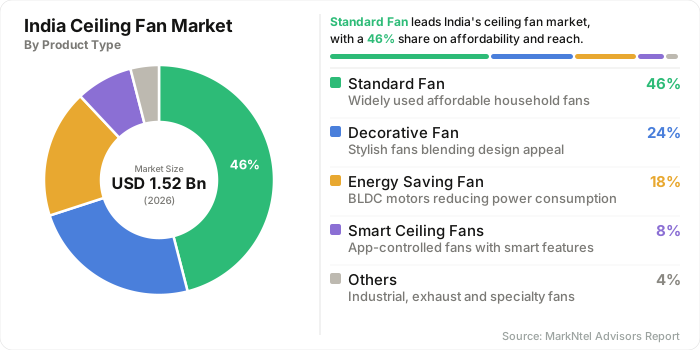
- Standard fans held nearly 46% share of the product type segment in 2026.
- Residential applications accounted for approximately 82% share of the market in 2026.
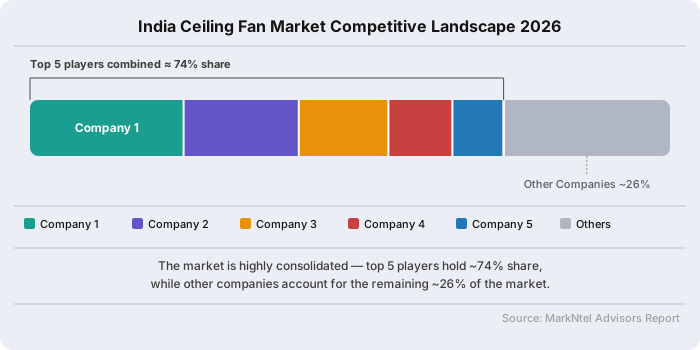
- The industry is moderately consolidated, with the top five leading players accounting for approximately 74% of the total market share.
India Ceiling Fan Market Size and Outlook
India's tropical and sub-tropical climate has long made ceiling fans an essential household appliance rather than a discretionary purchase, and this dependence is strengthening as rising temperatures become a long-term climatic trend rather than isolated seasonal events. According to the India Meteorological Department (IMD), the decade 2016–2025 was India's warmest on record, with a decadal mean temperature anomaly of +0.32°C, while January–February 2025 was the warmest winter recorded since 1901. Increasing heat stress, coupled with expanding electrification, urbanization, and residential construction, continues to support strong demand for ceiling fans across both urban and rural markets.
At the same time, consumer preferences are shifting from conventional induction fans toward premium decorative, BLDC, and smart ceiling fans that offer higher energy efficiency, connected features, and modern aesthetics. Government initiatives promoting energy-efficient appliances, expanding housing developments, and the growing replacement cycle of aging ceiling fans are further accelerating market growth. Supported by these structural, technological, and climatic trends, the ceiling fan market in India was valued at USD 1.28 billion in 2025, reached USD 1.52 billion in 2026, and is projected to reach USD 2.58 billion by 2032, registering a CAGR of 9.22% during the forecast period.
India Ceiling Fan Market Key Indicators
- Ceiling fans have achieved near-universal penetration in India, with 97% of surveyed rural households and 100% of surveyed urban households reporting ownership, according to a Bureau of Energy Efficiency (BEE) household survey. This indicates that the market is increasingly driven by replacement and upgrade demand, with consumers shifting toward energy-efficient, decorative, and smart ceiling fans rather than relying solely on first-time purchases.
- Mandatory star-rating labeling for ceiling fans came into effect across India on January 1, 2023, under the Bureau of Energy Efficiency (BEE) Standards & Labeling Programme. The regulation requires manufacturers to display a 1-to-5-star energy efficiency rating on ceiling fans, encouraging the transition toward BLDC and higher-efficiency models and accelerating growth in the energy-saving ceiling fan segment.
- India's per-capita electricity consumption increased by 45.8%, rising from 957 kWh in 2013–14 to 1,395 kWh in 2023–24, according to the Ministry of Power. Higher electricity availability and improving household purchasing power are supporting multi-fan installations and increasing demand for premium decorative and smart ceiling fans across residential buildings.
- More than 2.95 crore (29.5 million) rural houses had been completed under the Pradhan Mantri Awas Yojana–Gramin (PMAY-G) as of February 2026, according to the Ministry of Rural Development. The continued expansion of rural housing creates substantial opportunities for first-time ceiling fan installations, strengthening demand across India's rural market.
- The residential sector accounted for approximately 25% of India's total electricity consumption in FY2024–25 and continues to register steady growth, according to BEE-supported assessments. As households account for a significant share of electricity usage, ceiling fans remain one of the most widely used electrical appliances, supporting sustained replacement demand and increasing adoption of energy-efficient models.
India Ceiling Fan Market Scope
| Category | Segments |
|---|---|
| By Type | Standard Fan, Decorative Fan, Energy Saving Fan, Smart Ceiling Fans, Others |
| By Technology | Conventional, Smart |
| By Blade Number | 3-Blade Ceiling Fans, 4-Blade Ceiling Fans, 5-Blade and Above |
| By Application | Residential, Commercial |
| By Distribution Channel | Offline (Electrical Retail Stores, Exclusive Brand Outlets, Multi-Brand Appliance Stores, Distributors & Wholesalers, Others), Online (E-commerce Marketplaces, Brand-Owned Websites |
India Ceiling Fan Market Growth Drivers
Rising Household Formation Outpacing Population Growth
India's demographic structure is gradually shifting from large joint families toward smaller, independent households, driven by urbanization, migration, rising disposable incomes, and evolving lifestyle preferences. According to the Census of India (Registrar General & Census Commissioner), the total number of households increased by 27.4% between 2001 and 2011, rising from 193.6 million to 246.7 million, significantly outpacing the 17.7% growth in population during the same period. This trend indicates that household formation is expanding faster than population growth, creating a larger addressable market for essential household appliances.
The continued expansion of housing infrastructure is reinforcing this structural shift. As of July 2026, more than 99 lakh houses had been completed under the Pradhan Mantri Awas Yojana–Urban (PMAY-U), according to the Ministry of Housing and Urban Affairs. Every newly occupied home requires basic electrical appliances, with ceiling fans remaining among the first installations due to their affordability and suitability for India's climatic conditions. At the same time, rising consumer preference for energy-efficient and connected appliances is encouraging greater adoption of smart ceiling fans, particularly in urban households seeking enhanced convenience and modern home solutions. Consequently, the increasing number of independent households continues to generate sustained demand across the India ceiling fan industry.
Recent Trends
Growing Shift Toward BLDC and Energy-Efficient Ceiling Fans
India's ceiling fan industry is undergoing a significant transition toward energy-efficient technologies as regulatory standards continue to evolve. The Bureau of Energy Efficiency's (BEE) revised star-rating criteria for ceiling fans came into effect on January 1, 2026, and will remain applicable until December, 2028, increasing the minimum service-value (air delivery per watt) required for each star rating. These revised standards are encouraging manufacturers to adopt energy-efficient fan motors, enabling comparable airflow while significantly reducing electricity consumption compared with conventional induction motor technologies.
The regulatory changes are reinforcing a market transition that had already begun through increasing consumer acceptance of high-efficiency products. A BEE-commissioned household survey found that 38% of ceiling fans owned by surveyed households were already BLDC models, compared with 62% conventional induction fans, indicating that energy-efficient technologies are steadily gaining traction across Indian households. As demand for efficient appliances continues to strengthen alongside stricter regulatory requirements, manufacturers are expanding their portfolios of BEE star-rated ceiling fans, increasing production of higher-efficiency models and making them a mainstream offering across both value-oriented and premium product segments.
India Ceiling Fan Market Opportunities and Challenges
Rare-Earth Magnet Import Dependency Leading to Domestic Magnet Manufacturing Capacity
As India's ceiling fan industry accelerates its transition toward BLDC ceiling fans to comply with tightening Bureau of Energy Efficiency (BEE) standards, manufacturers are becoming increasingly dependent on rare-earth permanent magnets, a critical component used in BLDC motors. Although India possesses substantial rare-earth mineral reserves, the Ministry of Earth Sciences has stated that the country continues to rely heavily on imports of finished rare-earth magnets due to low domestic ore grades, mining and coastal-zone restrictions, and the limited development of an integrated magnet manufacturing ecosystem.
With the adoption of BLDC ceiling fans, electric vehicles, and renewable energy technologies continuing to accelerate, demand for rare-earth permanent magnets is projected to double by 2030 compared with 2025 levels, further emphasizing the need to strengthen domestic manufacturing capabilities.
Recognizing the strategic importance of establishing a resilient domestic supply chain, the Government of India approved a nearly USD 880 million scheme for the promotion of manufacturing of sintered rare earth permanent magnets on 26 November 2025, targeting an integrated production capacity of 6,000 metric tonnes per annum across the entire value chain, from rare-earth oxides to finished magnets. As domestic production capacity expands, manufacturers are expected to gain improved access to critical components, reducing dependence on imported magnets and enhancing supply chain stability.
This strengthening of the domestic manufacturing ecosystem is anticipated to support the wider adoption of smart ceiling fans, improve production competitiveness, and create long-term growth opportunities for the sector.
Segmentation Insights
Standard Fans Hold 46% Share Driven by Affordability-Led Mass Market Demand
Affordability continues to play a defining role in household purchasing decisions, as India's per capita spending power, although steadily improving, remains modest relative to the cost of premium appliances. According to the National Statistical Office's Household Consumption Expenditure Survey (HCES) 2023–24, the average monthly per capita consumption expenditure stood at approximately USD 43.3 in rural India and USD 73.5 in urban India, with the rural-urban expenditure gap remaining close to 70%. This spending pattern highlights that consumers continue to prioritize cost-effective electrical appliances capable of delivering essential functionality at an affordable price.
Against this backdrop, standard fans continue to dominate the product landscape by offering dependable cooling performance at the lowest entry price point, making them the preferred choice across rural and price-sensitive semi-urban households. Since most Indian homes require multiple ceiling fans for different rooms, affordability becomes an even more significant consideration at the household level, encouraging consumers to prioritize functional models over decorative or technology-enabled alternatives. Consequently, standard fans continue to represent the largest product category despite the faster percentage growth of premium segments. Based on product type, the market has been segmented into:
- Standard Fan
- Decorative Fan
- Energy Saving Fan
- Smart Ceiling Fans
- Others
Residential Segment Dominates with an 82% Application Share
India's occupied building stock is predominantly residential, reflecting the country's large housing base relative to its commercial infrastructure. According to the Ministry of Housing and Urban Affairs' Housing Statistics Compendium, based on Census 2011 data, 244.64 million of India's 306.16 million occupied census houses were used for residential purposes, compared with 61.52 million used for non-residential purposes such as offices, shops, schools, and factories. This represents nearly four residential buildings for every one non-residential building, creating a significantly larger installation base for household electrical appliances.
This structural composition continues to anchor demand for ceiling fans across the residential sector. Individual homes typically require multiple ceiling fans across bedrooms, living rooms, dining areas, and kitchens, whereas larger commercial establishments are increasingly incorporating centralized HVAC systems and split air conditioners for space cooling. As a result, the significantly larger residential building stock continues to account for the highest volume of ceiling fan installations across the country, supporting the segment's dominant position. Based on application, the market is categorized into:
- Residential
- Commercial
India Ceiling Fan Market Geographical Outlook
North India dominates the India ceiling fan industry, accounting for approximately 36% of total demand, primarily due to its large residential base, intense summer temperatures, and high cooling requirements. The region includes highly populated states such as Uttar Pradesh, Rajasthan, Punjab, Haryana, and Delhi, creating a substantial household base for ceiling fan installations. These climatic conditions further strengthen demand, with the India Meteorological Department reporting maximum temperatures of 40°C–44°C across parts of northwest India in April 2026, with Sri Ganganagar reaching 44.5°C.
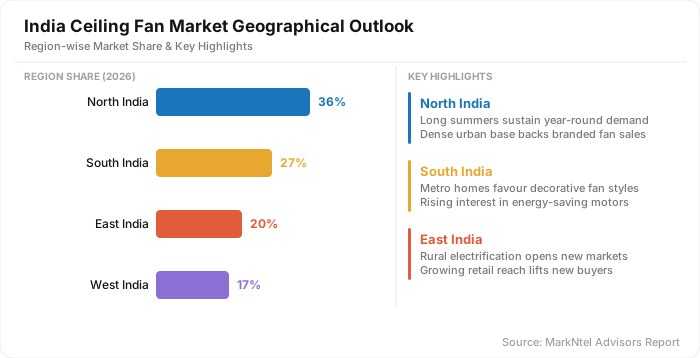
The resulting need for prolonged indoor cooling is complemented by growing household purchasing capacity. According to the National Statistical Office's Household Consumption Expenditure Survey 2023–24, monthly per-capita expenditure reached USD 79.0 in Delhi, USD 73.5 in Haryana, and USD 73.1 in Punjab, indicating greater capacity to spend on household electrical appliances. Together, the region's extensive residential base, prolonged summer conditions, and improving household expenditure capacity reinforce its leading position in demand.
India Ceiling Fan Market Competitive Analysis
A moderately consolidated competitive landscape characterizes the market, with companies competing through product innovation, energy-efficient technologies, and extensive distribution networks. Crompton Greaves Consumer Electricals Limited, Orient Electric, Havells India Ltd., Usha International Limited, and Atomberg Technologies Private Limited collectively account for approximately 74% of the market.
Key Players of Ceiling Fan in India
- Crompton Greaves Consumer Electricals Limited
- Orient Electric
- Havells India Ltd.
- Usha International Limited
- Atomberg Technologies Private Limited
- Bajaj Electricals Limited
- Polycab India Limited
- V-Guard Industries Limited
- Panasonic India
- RR Kabel Limited
- Others
India Ceiling Fan Industry News and Recent Developments
June 2026: Orient Electric Launches Aerosilent BLDC Ceiling Fan
Orient Electric, part of the CKA Birla Group, launched Aerosilent, a BLDC-powered ceiling fan operating below 50 dB, delivering up to 260 CMM of airflow while consuming nearly 50% less energy than conventional induction motor models. The product also received the Red Dot Design Award 2026, strengthening the company's premium and energy-efficient ceiling fan portfolio.
Impact Analysis: The launch highlights the growing focus on premiumization and product differentiation within India's ceiling fan industry through energy-efficient technologies, low-noise operation, and advanced product design. It is expected to accelerate consumer adoption of premium BLDC ceiling fans, intensify competition among leading manufacturers, and strengthen innovation across the decorative and energy-efficient ceiling fan segments.
December 2025: Atomberg Technologies Secures USD 24 Million in Series C Extension
Atomberg Technologies raised USD 24 million in a Series C extension led by Temasek's Jongsong Investments, with participation from Jungle Ventures, Inflexor Fund, and the company's co-founders. Following the investment, Atomberg's cumulative funding surpassed USD 150 million, supporting the company's expansion in BLDC-powered ceiling fan manufacturing and distribution.
Impact Analysis: The investment reflects growing investor confidence in India's energy-efficient appliance industry and is expected to strengthen Atomberg's manufacturing capabilities, product innovation, and distribution network. It is likely to intensify competition within the BLDC ceiling fan segment while accelerating the adoption of energy-efficient and technologically advanced ceiling fans across the Indian market
- Market Segmentation
- Introduction
- Product Definition
- Research Process
- Assumptions
- Executive Summary
- India Ceiling Fan Market Pricing Analysis
- India Ceiling Fan Market Trends & Developments
- India Ceiling Fan Market Dynamics
- Growth Drivers
- Challenges
- India Ceiling Fan Market Regulations, Policies & Standards
- India Ceiling Fan Market Hotspot & Opportunities
- India Ceiling Fan Market Outlook, 2022-2032F
- Market Size & Analysis
- By Revenue (USD Million)
- By Unit Sold (Thousand Units)
- Market Share & Analysis
- By Type- (Thousand Units)
- Standard Fan
- Decorative Fan
- Energy Saving Fan
- Smart Ceiling Fans
- Others
- By Technology- (Thousand Units)
- Conventional
- Smart
- By Blade Number- (Thousand Units)
- 3-Blade Ceiling Fans
- 4-Blade Ceiling Fans
- 5-Blade and Above
- By Application- (Thousand Units)
- Residential
- Commercial
- By Distribution Channel- (Thousand Units)
- Offline
- Electrical Retail Stores
- Exclusive Brand Outlets
- Multi-Brand Appliance Stores
- Distributors & Wholesalers
- Others
- Online
- E-commerce Marketplaces
- Brand-Owned Websites
- Offline
- By Region
- North
- South
- East
- west
- By Company
- Revenue Shares
- Competition Characteristics
- By Type- (Thousand Units)
- Market Size & Analysis
- India Standard Ceiling Fan Market Outlook, 2022-2032F
- Market Size & Analysis
- By Revenue (USD Million)
- By Unit Sold (Thousand Units)
- Market Share & Analysis
- By Type- (Thousand Units)
- By Technology- (Thousand Units)
- By Blade Number- (Thousand Units)
- By Application- (Thousand Units)
- By Distribution Channel- (Thousand Units)
- Market Size & Analysis
- India Decorative Ceiling Fan Market Outlook, 2022-2032F
- Market Size & Analysis
- By Revenue (USD Million)
- By Unit Sold (Thousand Units)
- Market Share & Analysis
- By Type- (Thousand Units)
- By Technology- (Thousand Units)
- By Blade Number- (Thousand Units)
- By Application- (Thousand Units)
- By Distribution Channel- (Thousand Units)
- Market Size & Analysis
- India Energy Saving Ceiling Fan Market Outlook, 2022-2032F
- Market Size & Analysis
- By Revenue (USD Million)
- By Unit Sold (Thousand Units)
- Market Share & Analysis
- By Type- (Thousand Units)
- By Technology- (Thousand Units)
- By Blade Number- (Thousand Units)
- By Application- (Thousand Units)
- By Distribution Channel- (Thousand Units)
- Market Size & Analysis
- India Smart Ceiling Fan Market Outlook, 2022-2032F
- Market Size & Analysis
- By Revenue (USD Million)
- By Unit Sold (Thousand Units)
- Market Share & Analysis
- By Type- (Thousand Units)
- By Technology- (Thousand Units)
- By Blade Number- (Thousand Units)
- By Application- (Thousand Units)
- By Distribution Channel- (Thousand Units)
- Market Size & Analysis
- India Ceiling Fan Market Key Strategic Imperatives for Growth & Success
- Competitive Outlook
- Company Profiles
- Crompton Greaves Consumer Electricals Limited
- Business Description
- Product Portfolio
- Strategic Alliances or Partnerships
- Recent Developments
- Financial Details
- Others
- Orient Electric
- Business Description
- Product Portfolio
- Strategic Alliances or Partnerships
- Recent Developments
- Financial Details
- Others
- Havells India Ltd.
- Business Description
- Product Portfolio
- Strategic Alliances or Partnerships
- Recent Developments
- Financial Details
- Others
- Usha International Limited
- Business Description
- Product Portfolio
- Strategic Alliances or Partnerships
- Recent Developments
- Financial Details
- Others
- Atomberg Technologies Private Limited
- Business Description
- Product Portfolio
- Strategic Alliances or Partnerships
- Recent Developments
- Financial Details
- Others
- Bajaj Electricals Limited
- Business Description
- Product Portfolio
- Strategic Alliances or Partnerships
- Recent Developments
- Financial Details
- Others
- Polycab India Limited
- Business Description
- Product Portfolio
- Strategic Alliances or Partnerships
- Recent Developments
- Financial Details
- Others
- V-Guard Industries Limited
- Business Description
- Product Portfolio
- Strategic Alliances or Partnerships
- Recent Developments
- Financial Details
- Others
- Panasonic India
- Business Description
- Product Portfolio
- Strategic Alliances or Partnerships
- Recent Developments
- Financial Details
- Others
- RR Kabel Limited
- Business Description
- Product Portfolio
- Strategic Alliances or Partnerships
- Recent Developments
- Financial Details
- Others
- Others
- Crompton Greaves Consumer Electricals Limited
- Company Profiles
- Disclaimer

MarkNtel Advisors follows a robust and iterative research methodology designed to ensure maximum accuracy and minimize deviation in market estimates and forecasts. Our approach combines both bottom-up and top-down techniques to effectively segment and quantify various aspects of the market. A consistent feature across all our research reports is data triangulation, which examines the market from three distinct perspectives to validate findings. Key components of our research process include:
1. Scope & Research Design At the outset, MarkNtel Advisors define the research objectives and formulate pertinent questions. This phase involves determining the type of research—qualitative or quantitative—and designing a methodology that outlines data collection methods, target demographics, and analytical tools. They also establish timelines and budgets to ensure the research aligns with client goals.
2. Sample Selection and Data Collection In this stage, the firm identifies the target audience and determines the appropriate sample size to ensure representativeness. They employ various sampling methods, such as random or stratified sampling, based on the research objectives. Data collection is carried out using tools like surveys, interviews, and observations, ensuring the gathered data is reliable and relevant.
3. Data Analysis and Validation Once data is collected, MarkNtel Advisors undertake a rigorous analysis process. This includes cleaning the data to remove inconsistencies, employing statistical software for quantitative analysis, and thematic analysis for qualitative data. Validation steps are taken to ensure the accuracy and reliability of the findings, minimizing biases and errors.

4. Data Forecast and FinalizationThe final phase involves forecasting future market trends based on the analyzed data. MarkNtel Advisors utilize predictive modeling and time series analysis to anticipate market behaviors. The insights are then compiled into comprehensive reports, featuring visual aids like charts and graphs, and include strategic recommendations to inform client decision-making
FILL THE FORM TO GET THE FREE SAMPLE PAGES
We offer flexible licensing options to cater to varying organizational needs. Choose the pricing pack that best suits your requirements:
Buy Now Inquire Before Buying
 Talk to our Consultant
 Request Customization