

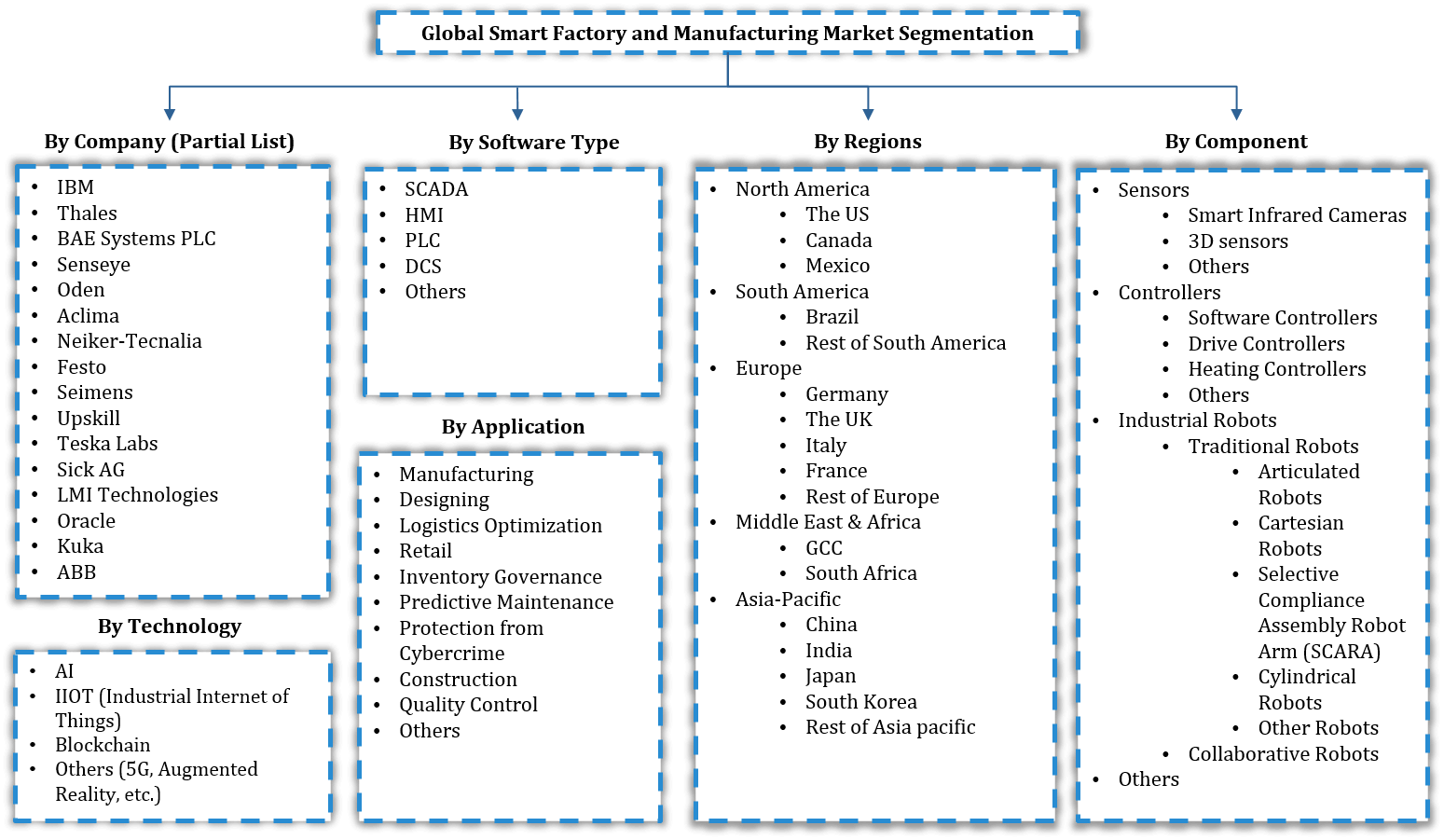
By Technology (AI (Artificial Intelligence), IIOT (Industrial Internet of Things), Cloud-based, Blockchain, others), By Application (Manufacturing, Logistics & Transportation, Reta......il, Storage, Maintenance, Protection from Cybercrime, Construction, Quality Control, Others), By Software Type (SCADA, HMI, PLC, DCS, Others), By Component (Sensors Smart Infrared Cameras, 3D sensors, Others, Controllers, Software Controllers, Drive Controllers, Heating Controllers, Others, Industrial Robots, (Traditional Robots (Articulated Robots, Cartesian Robot, Selective Compliance Assembly Robot Arm (SCARA), Cylindrical Robots, Other Robots), (Collaborative Robots), Others), By Region (North America, South America, Europe, Asia-Pacific, Middle East, and Africa), By Competitors (IBM, Thales, BAE Systems PLC, Senseye, Oden, Aclima, Neiker-Tecnalia, Festo, Seimens, Upskill, Teska Labs, Sick AG, LMI Technologies, Oracle) Read more
- ICT & Electronics
- Jan 2022
- 276
- PDF, Excel, PPT
Market Definition
Smart factory & manufacturing is when an industry sets up an environment surrounding machines & equipment to enhance processes with automation & self-optimization. Smart factory & manufacturing solutions provide several benefits that extend to functions like supply chains logistics, planning, product development, etc. As a result, several manufacturing companies worldwide are swiftly adopting these solutions.
Market Insights
The Global Smart Factory and Manufacturing Market is projected to grow at a CAGR of around 9.7% during the forecast period, i.e., 2021-26. The market is driven primarily by the mounting demand for high-quality products with better end-to-end visibility of manufacturing processes entwined with the increasing adoption of smart factories & manufacturing solutions across industries associated with robotic systems.
In addition, with the increasing focus of manufacturers on reducing human labor, especially across challenging & risky environments, the demand for smart factories & manufacturing is increasing swiftly. Processes & operations like quality checks are observing an increasing transformation with greater availability of these smart factory systems equipped with more user-friendly controls, i.e., projected to boost the market in the coming years.
Besides, the advent of technologies like the Industrial Internet of Things (IIoT) & Artificial Intelligence (AI) in smart factory devices connected via the internet provides detailed & real-time insights. These insights are making modern-day control systems highly efficient in managing manufacturing units & factories.
Key Trends in the Market
- Mounting Demand for Online 3D Printing & the Advent of Industrial Internet of Things (IIoT)
With rapid developments in the industrial sector and increasing inclination toward Industry 4.0 to bring operational & cost efficiency by linking customers with warehouses, providers, supplies, & systems to distribute products, the market is anticipated to observe a significant expansion in the coming years. These connections are projected to surge and facilitate digital technologies like 3D printing, Manufacturing Execution Systems (MES), & robotic automation and, in turn, drive the market during 2021-26.
| Report Coverage | Details |
|---|---|
| Study Period | Historical Data: 2016-19 |
| Base Year: 2020 | |
| Forecast Period: 2021-26 | |
| CAGR (2021-2026) | 9.7% |
| Regions Covered | North America: USA, Canada, Mexico |
| Europe: Germany, UK, France, Italy | |
| Asia-Pacific: China, India, Japan, South Korea | |
| South America: Brazil, and Argentina | |
| Middle East & Africa: GCC, South Africa | |
| Key Companies Profiled | IBM, Thales, BAE Systems PLC, Senseye, Oden, Aclima, Neiker-Tecnalia, Festo, Seimens, Upskill, Teska Labs, Sick AG, LMI Technologies, Oracle |
| Unit Denominations | USD Million/Billion |
Impact of Covid-19 on the Global Smart Factory and Manufacturing Market
The Covid-19 pandemic in 2020 had a decelerating effect on most industries across the globe, and the Smart Factory & Manufacturing Market was no exception. The imposition of stringent movement restrictions & lockdowns by the government of different countries worldwide to curb the spread of the dreadful disease resulted in several unprecedented challenges for the market.
These included the reduced shipment of smart factories & manufacturing components & low revenue generation due to disruptions in the supply chain, lack of production materials, shut down of manufacturing units, etc.
However, with the gradual betterment in the Covid-19 situation with reducing cases, the governments of different countries allowed the recommencement of business operations. This revival is anticipated to enable the market to regain its usual pace & recover from financial losses in the coming years since the supply chain is back on track & manufacturing units have resumed their production capabilities.
- Introduction
- Product Definition
- Research Process
- Market Segmentation
- Assumptions
- Preface
- Executive Summary
- Impact of COVID-19 on Global Smart Factory and Manufacturing Market
- Impact of IOT & AI on Global Smart Factory and Manufacturing Market
- Global Smart Factory and Manufacturing Market Trends & Insights
- Global Smart Factory and Manufacturing Market Dynamics
- Drivers
- Challenges
- Impact Analysis
- Global Smart Factory and Manufacturing Market Hotspots & Opportunities
- Global Smart Factory and Manufacturing Market Start-up Ecosystem, 2016-2021
- Entrepreneurial Activity
- Year On Year Funding Received
- Funding Received by Top Companies
- Key Investors Active in the Market
- Series Wise Funding Received
- Seed Funding
- Angel Investing
- Venture Capital
- Others
- Global Smart Factory and Manufacturing Market Value Chain Analysis
- Global Smart Factory and Manufacturing Market Regulations & Policy
- Global Smart Factory and Manufacturing Market Analysis, 2016-2026F
- Market Size & Analysis
- By Revenues
- Market Share & Analysis
- By Technology
- AI (Artificial Intelligence)
- IIOT (Industrial Internet of Things)
- Blockchain
- Others (5G, Augmented Reality, etc.)
- By Software Type
- SCADA
- HMI
- PLC
- DCS
- Others
- By Component
- Sensors
- Smart Infrared Cameras
- 3D sensors
- Others
- Controllers
- Software Controllers
- Drive Controllers
- Heating Controllers
- Others
- Industrial Robots
- Traditional Robots
- Articulated Robots
- Cartesian Robots
- Selective Compliance Assembly Robot Arm (SCARA)
- Cylindrical Robots
- Other Robots
- Collaborative Robots
- Traditional Robots
- Others
- Sensors
- By Applications
- Manufacturing
- Designing
- Logistics Optimization
- Retail
- Inventory Governance
- Predictive Maintenance
- Protection from Cybercrime
- Construction
- Quality Control
- Others
- By Technology
- Market Size & Analysis
- By Region
- North America
- South America
- Europe
- Asia-Pacific
- Middle East, and Africa
- North America Smart Factory and Manufacturing Market Analysis, 2016-2026F
- Market Size & Analysis
- By Revenues
- Market Share & Analysis
- By Technology
- By Application
- By Country
- The US
- Canada
- Mexico
- The US Smart Factory and Manufacturing Market Analysis, 2016-2026F
- Market Size & Analysis
- By Revenues
- Market Share & Analysis
- By Technology
- By Application
- Market Size & Analysis
- Canada Smart Factory and Manufacturing Market Analysis, 2016-2026F
- Market Size & Analysis
- By Revenues
- Market Share & Analysis
- By Technology
- By Application
- Market Size & Analysis
- Mexico Smart Factory and Manufacturing Market Analysis, 2016-2026F
- Market Size & Analysis
- By Revenues
- Market Share & Analysis
- By Technology
- By Application
- Market Size & Analysis
- Market Size & Analysis
- South America Smart Factory and Manufacturing Market Analysis, 2016-2026F
- Market Size & Analysis
- By Revenues
- Market Share & Analysis
- By Technology
- By Application
- By Country
- Brazil
- Others
- Brazil Smart Factory and Manufacturing Market Analysis, 2016-2026F
- Market Size & Analysis
- By Revenues
- Market Share & Analysis
- By Technology
- By Application
- Market Size & Analysis
- Rest of South America Smart Factory and Manufacturing Market Analysis, 2016-2026F
- Market Size & Analysis
- By Revenues
- Market Share & Analysis
- By Technology
- By Application
- Market Size & Analysis
- Market Size & Analysis
- Europe Smart Factory and Manufacturing Market Analysis, 2016-2026F
- Market Size & Analysis
- By Revenues
- Market Share & Analysis
- By Technology
- By Application
- By Country
- Germany
- The UK
- France
- Italy
- Others
- Germany Smart Factory and Manufacturing Market Analysis, 2016-2026F
- Market Size & Analysis
- By Revenues
- Market Share & Analysis
- By Technology
- By Application
- Market Size & Analysis
- The UK Smart Factory and Manufacturing Analysis, 2016-2026F
- Market Size & Analysis
- By Revenues
- Market Share & Analysis
- By Technology
- By Application
- Market Size & Analysis
- Italy Smart Factory and Manufacturing Market Analysis, 2016-2026F
- Market Size & Analysis
- By Revenues
- Market Share & Analysis
- By Technology
- By Application
- Market Size & Analysis
- France Smart Factory and Manufacturing Market Analysis, 2016-2026F
- Market Size & Analysis
- By Revenues
- Market Share & Analysis
- By Technology
- By Application
- Market Size & Analysis
- Rest of Europe Smart Factory and Manufacturing Market Analysis, 2016-2026F
- Market Size & Analysis
- By Revenues
- Market Share & Analysis
- By Technology
- By Application
- Market Size & Analysis
- Market Size & Analysis
- Asia-Pacific Smart Factory and Manufacturing Market Analysis, 2016-2026F
- Market Size & Analysis
- By Revenues
- Market Share & Analysis
- By Technology
- By Application
- By Country
- China
- India
- Japan
- South Korea
- Others
- China Smart Factory and Manufacturing Market Analysis, 2016-2026F
- Market Size & Analysis
- By Revenues
- Market Share & Analysis
- By Technology
- By Application
- Market Size & Analysis
- India Smart Factory and Manufacturing Market Analysis, 2016-2026F
- Market Size & Analysis
- By Revenues
- Market Share & Analysis
- By Technology
- By Application
- Market Size & Analysis
- Japan Smart Factory and Manufacturing Market Analysis, 2016-2026F
- Market Size & Analysis
- By Revenues
- Market Share & Analysis
- By Technology
- By Application
- Market Size & Analysis
- South Korea Smart Factory and Manufacturing Market Analysis, 2016-2026F
- Market Size & Analysis
- By Revenues
- Market Share & Analysis
- By Technology
- By Application
- Market Size & Analysis
- Market Size & Analysis
- Middle East & Africa Smart Factory and Manufacturing Market Analysis, 2016-2026F
- Market Size & Analysis
- By Revenues
- Market Share & Analysis
- By Technology
- By Application
- By Country
- GCC
- South Africa
- Others
- GCC Smart Factory and Manufacturing Market Analysis, 2016-2026F
- Market Size & Analysis
- By Revenues
- Market Share & Analysis
- By Technology
- By Application
- Market Size & Analysis
- South Africa Smart Factory and Manufacturing Market Analysis, 2016-2026F
- Market Size & Analysis
- By Revenues
- Market Share & Analysis
- By Technology
- By Application
- Market Size & Analysis
- Market Size & Analysis
- Key Strategic Imperatives for Success and Growth
- Competition Analysis
- Competition Matrix
- Product/Solution Portfolio
- Target Markets
- Target End Users
- Research & Development
- Strategic Alliances
- Strategic Initiatives
- Company Profiles
- IBM
- Thales
- BAE Systems PLC
- Senseye
- Oden
- Aclima
- Neiker-Tecnalia
- Festo
- Seimens
- Upskill
- Teska Labs
- Sick AG
- LMI Technologies
- Oracle
- Competition Matrix
- Disclaimer
MarkNtel Advisors follows a robust and iterative research methodology designed to ensure maximum accuracy and minimize deviation in market estimates and forecasts. Our approach combines both bottom-up and top-down techniques to effectively segment and quantify various aspects of the market. A consistent feature across all our research reports is data triangulation, which examines the market from three distinct perspectives to validate findings. Key components of our research process include:
1. Scope & Research Design At the outset, MarkNtel Advisors define the research objectives and formulate pertinent questions. This phase involves determining the type of research—qualitative or quantitative—and designing a methodology that outlines data collection methods, target demographics, and analytical tools. They also establish timelines and budgets to ensure the research aligns with client goals.
2. Sample Selection and Data Collection In this stage, the firm identifies the target audience and determines the appropriate sample size to ensure representativeness. They employ various sampling methods, such as random or stratified sampling, based on the research objectives. Data collection is carried out using tools like surveys, interviews, and observations, ensuring the gathered data is reliable and relevant.
3. Data Analysis and Validation Once data is collected, MarkNtel Advisors undertake a rigorous analysis process. This includes cleaning the data to remove inconsistencies, employing statistical software for quantitative analysis, and thematic analysis for qualitative data. Validation steps are taken to ensure the accuracy and reliability of the findings, minimizing biases and errors.

4. Data Forecast and FinalizationThe final phase involves forecasting future market trends based on the analyzed data. MarkNtel Advisors utilize predictive modeling and time series analysis to anticipate market behaviors. The insights are then compiled into comprehensive reports, featuring visual aids like charts and graphs, and include strategic recommendations to inform client decision-making
FILL THE FORM TO GET THE FREE SAMPLE PAGES
We offer flexible licensing options to cater to varying organizational needs. Choose the pricing pack that best suits your requirements:
Buy Now Inquire Before Buying
 Talk to our Consultant
 Request Customization