

By Offering (Water Treatment Chemicals (Coagulants & Flocculants, Corrosion & Scale Inhibitors, Biocides & Disinfectants, pH Control Chemicals, Other Specialty Chemicals), Water Tr......eatment Equipment (Filtration Systems & Separation, Membrane Systems, Disinfection Equipment, Evaporation & ZLD, Sludge Treatment Equipment, Other Treatment Systems), Water Treatment Services (Engineering, Procurement & Construction (EPC), Operations & Maintenance (O&M), Managed Services, Water Testing, Monitoring & Consulting)), By End-Use (Power Generation, Oil & Gas, Chemicals & Petrochemicals, Semiconductor & Electronics, Pharmaceuticals, Food & Beverage, Mining & Metals, Pulp & Paper, Textile) Read more
- Environment
- Jul 2026
- 140
- PDF, Excel, PPT
China Industrial Water Treatment Market Key Takeaways
- The China industrial water treatment market was valued at USD 18.82 billion in 2025 and is projected to grow from USD 20.36 billion in 2026 to USD 32.67 billion by 2032, registering a CAGR of 8.2% during 2026–2032.
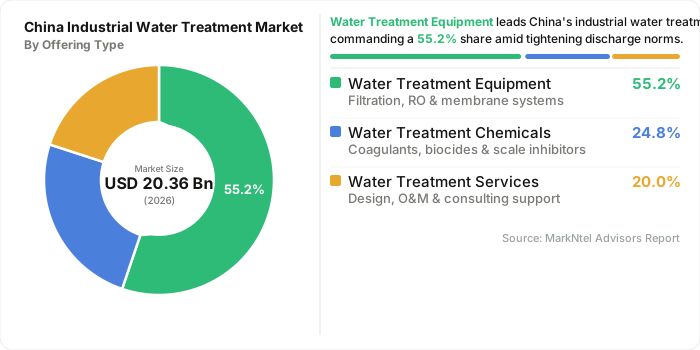
- By offering, water treatment equipment dominates the market, accounting for approximately 55.2% of the total market share in 2026.
- By end-use, power generation remains the largest segment, capturing nearly 24.8% of the market share in 2025.
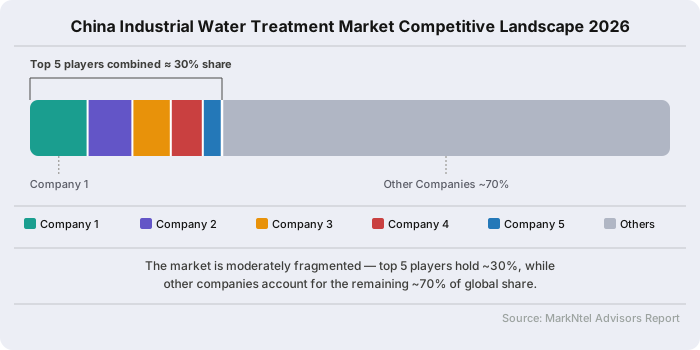
- The market is moderately fragmented, with the top five companies collectively accounting for 30% of the market share in 2026.
China Industrial Water Treatment Market Size & Outlook
The industrial water treatment market in China is valued at USD 18.82 billion in 2025 and is projected to reach USD 32.67 billion by 2032, expanding at a CAGR of 8.2% during 2026–2032.
The market continues to benefit from the growing complexity of industrial production, where manufacturers increasingly require high-performance treatment technologies to ensure process reliability, improve water efficiency, and support sustainable operations. Rising deployment of industrial water management solutions, advanced water treatment systems, and intelligent process control technologies is expected to sustain long-term market expansion.
China's abundant yet unevenly distributed water resources continue to increase the importance of efficient industrial water management. According to the Ministry of Water Resources (MWR), the country's total renewable water resources stood at approximately 3.0 trillion cubic metres in 2024, highlighting the need for efficient utilization across major industrial clusters. The growing emphasis on industrial water reuse technologies, high-recovery treatment systems, and optimized process water infrastructure is supporting continued investment in advanced industrial water treatment solutions.
Industrial wastewater characteristics are also becoming increasingly complex as high-value manufacturing sectors continue expanding. According to the Ministry of Ecology and Environment (MEE), China's industrial sector discharged approximately 308,000 tonnes of Chemical Oxygen Demand (COD) in 2024, demonstrating the continued requirement for advanced contaminant removal technologies. This is driving broader adoption of membrane filtration, biological treatment, and specialty chemical programs across industries requiring higher treatment efficiency and improved operational performance.
The market outlook remains favorable as industrial facilities continue modernizing treatment infrastructure to enhance productivity and resource efficiency. According to the World Bank, industry contributed approximately 36% of China's GDP in 2024, underscoring the country's extensive industrial base and long-term demand for water treatment technologies. Growing investment in industrial wastewater treatment technologies, process water optimization, and digital water management platforms is expected to create sustained opportunities for equipment manufacturers, specialty chemical suppliers, and integrated solution providers over the forecast period.
China Industrial Water Treatment Market Key Indicators
- According to the National Bureau of Statistics (NBS) of China, investment in environmental pollution control reached approximately USD 134.0 billion in 2024. The sustained increase in environmental capital expenditure is accelerating procurement of industrial wastewater treatment equipment, membrane filtration systems, and specialty water treatment chemicals across China's manufacturing sector.
- As per the National Bureau of Statistics (NBS) of China, the country's manufacturing sector generated approximately USD 4.7 trillion in value added in 2024, maintaining its position as the world's largest manufacturing base. The extensive industrial footprint continues to create substantial demand for process water treatment, cooling water treatment, boiler water treatment, and industrial wastewater management.
- From the UN Comtrade data, China imported more than USD 1.3 billion worth of filtration and purification machinery for liquids (HS 842121) in 2024. The high level of imports reflects continued investment in advanced industrial water treatment equipment, including membrane filtration, reverse osmosis, and high-purity water systems for industrial applications.
- By the Asian Development Bank (ADB), total infrastructure investment requirements for developing Asia remain at approximately USD 1.7 trillion annually, with water and wastewater infrastructure representing one of the key investment sectors. China's continued modernization of industrial infrastructure and water management facilities is supporting sustained demand for industrial water treatment technologies, process optimization solutions, and wastewater recycling systems.
China Industrial Water Treatment Market Scope
| Category | Segments |
|---|---|
| By Offering | Water Treatment Chemicals (Coagulants & Flocculants, Corrosion & Scale Inhibitors, Biocides & Disinfectants, pH Control Chemicals, Other Specialty Chemicals), Water Treatment Equipment (Filtration Systems & Separation, Membrane Systems, Disinfection Equipment, Evaporation & ZLD, Sludge Treatment Equipment, Other Treatment Systems), Water Treatment Services (Engineering, Procurement & Construction (EPC), Operations & Maintenance (O&M), Managed Services, Water Testing, Monitoring & Consulting |
| By End-Use | Power Generation, Oil & Gas, Chemicals & Petrochemicals, Semiconductor & Electronics, Pharmaceuticals, Food & Beverage, Mining & Metals, Pulp & Paper, Textile |
China Industrial Water Treatment Market Growth Drivers
Rising Industrial Water Demand from Manufacturing and Energy Production
China's expanding industrial production continues to increase demand for advanced water treatment solutions across water-intensive sectors. According to the International Energy Agency (IEA), China generated approximately 9,456 TWh of electricity in 2024, with thermal power remaining the dominant source requiring extensive industrial cooling water systems and boiler feed water treatment. The growing operational requirements of thermal and integrated energy facilities are accelerating investments in industrial water optimization technologies, including high-performance filtration, chemical treatment, and process water management systems.
The country's manufacturing expansion is also increasing industrial water treatment requirements across high-value industries. According to the National Bureau of Statistics (NBS) of China, the value added of high-tech manufacturing increased by 8.9% year-on-year in 2024, led by electronics, pharmaceuticals, and advanced materials production. These industries require stringent water quality standards for continuous operations, driving demand for high-purity water systems, industrial process water treatment, and advanced membrane-based purification technologies to improve operational efficiency and regulatory compliance.
Recent Trends
Growing Adoption of Advanced Water Treatment Solutions in AI Data Centers
China's rapid expansion of AI-driven computing infrastructure is increasing demand for advanced industrial water treatment technologies across large-scale data centers. According to the International Energy Agency (IEA), China accounted for the world's largest share of new data center capacity additions in 2024, driven by accelerating investments in artificial intelligence, cloud computing, and digital infrastructure. The increasing deployment of high-performance computing facilities is boosting demand for data center water management, closed-loop cooling systems, and advanced water purification technologies to maintain operational reliability while reducing water consumption.
The trend is further reinforced by China's growing emphasis on resource-efficient cooling infrastructure. According to the China Academy of Information and Communications Technology (CAICT), the country's total data center rack capacity exceeded 8.8 million standard racks in 2024, reflecting sustained expansion of digital infrastructure supporting AI applications. As hyperscale facilities require continuous cooling and high-quality process water, operators are increasingly deploying smart cooling-water treatment, high-efficiency filtration, and intelligent water-quality monitoring systems to improve water-use efficiency and support sustainable data center operations.
China Industrial Water Treatment Market Opportunities and Challenges
Capital-Intensive Compliance Creates a Strategic Opening for Advanced Water Treatment Technologies
The deployment of advanced industrial water treatment systems continues to require significant upfront capital, particularly for membrane-based reuse facilities, Zero Liquid Discharge (ZLD) systems, and advanced oxidation processes. According to the Ministry of Ecology and Environment (MEE), 2,262 key pollution-source entities were brought under mandatory automatic monitoring and disclosure requirements during 2024, increasing compliance obligations for industrial facilities. While large manufacturers continue upgrading treatment infrastructure, capital-intensive projects remain challenging for many small and medium-sized industrial enterprises, particularly in sectors such as textiles, metal processing, and regional chemical manufacturing, where financing constraints can delay investments in advanced treatment technologies.
At the same time, stricter industrial water quality requirements are creating substantial opportunities for technology providers. In September 2024, DuPont Water Solutions introduced its next-generation FilmTec™ Fortilife™ XC-N nanofiltration membrane, designed to improve contaminant removal while lowering energy consumption and operating costs for industrial water treatment applications. The launch expands the availability of high-performance membrane solutions for industrial water reuse, process water purification, and wastewater recycling, supporting growing adoption of industrial membrane technology, water reuse solutions, and energy-efficient water treatment systems across China's manufacturing industries.
Segmentation Insights
Capital Investments in Advanced Water Treatment Equipment Strengthen Market Leadership
Water Treatment Equipment dominated the China industrial water treatment market, accounting for 55.2% of the market share in 2026. The segment maintains its leadership as industrial enterprises increasingly deploy advanced treatment systems to improve operational reliability and water efficiency. According to the National Development and Reform Commission (NDRC), 94% of national-level industrial parks had established centralized wastewater treatment facilities by the end of 2024, reflecting continuous investment in integrated treatment infrastructure. The growing deployment of industrial water treatment equipment, membrane separation systems, and advanced filtration technologies continues to strengthen capital equipment demand across China's industrial sector.
The segment further benefits from rising investment in high-value manufacturing industries that require sophisticated treatment infrastructure for process water purification and wastewater recovery. According to the China Association of Environmental Protection Industry (CAEPI), demand for high-end environmental protection equipment continued to expand during 2024, with water pollution control equipment remaining one of the fastest-growing product categories. Increasing procurement of industrial filtration equipment, process water purification systems, and integrated treatment solutions across semiconductor, pharmaceutical, and chemical manufacturing facilities continues to reinforce the segment's dominant revenue position. By the offering type, the industry is segmented into:
- Water Treatment Chemicals
- Water Treatment Equipment
- Water Treatment Services
Expanding Power Infrastructure Sustains Leadership of the Power Generation End-Use Segment
Power Generation dominated the China industrial water treatment industry, accounting for 24.8% of the market share in 2026. The segment maintains its leading position as thermal and nuclear power facilities require high-performance water treatment systems to ensure boiler reliability, cooling efficiency, and environmental compliance. According to the National Energy Administration (NEA), China's total installed power generation capacity exceeded 3,350 GW in 2024, reflecting continuous expansion of electricity infrastructure requiring sophisticated water treatment assets. Growing deployment of power plant water treatment, boiler feed water systems, and industrial cooling water treatment continues to reinforce the segment's revenue leadership.
The segment further benefits from increasing investments in upgrading water management infrastructure across existing generating facilities to improve operational efficiency and reduce equipment fouling and corrosion. Large-scale thermal power stations continue deploying advanced filtration, reverse osmosis, condensate polishing, and wastewater recycling systems to optimize plant performance and meet stringent discharge requirements. The sustained modernization of generation assets is driving procurement of industrial water purification systems, cooling water management solutions, and integrated treatment technologies, strengthening the power generation segment's dominant contribution to the industry. Based on end user type, the industry is further segmented into:
- Power Generation
- Oil & Gas
- Chemicals & Petrochemicals
- Semiconductor & Electronics
- Pharmaceuticals
- Food & Beverage
- Mining & Metals
- Pulp & Paper
- Textile
- Automotive
- Others
China Industrial Water Treatment Market Competitive Analysis
The China industrial water treatment market is moderately fragmented, with the top five companies accounting for 30% of the market share in 2026, while numerous domestic equipment manufacturers, specialty chemical suppliers, and regional engineering companies compete across industrial applications. Market competition is driven by technological innovation, integrated water treatment solutions, membrane filtration expertise, recurring chemical supply contracts, and long-term operation & maintenance (O&M) services.
Top Companies in the China Industrial Water Treatment industry:
- Veolia Environnement S.A.
- SUEZ S.A.
- Beijing OriginWater Technology Co., Ltd.
- Ecolab Inc.
- Kurita Water Industries Ltd.
- Xylem Inc.
- DuPont de Nemours, Inc.
- Pentair plc
- China Everbright Water Limited
- Solenis LLC
- Aquatech International LLC
- Toray Industries, Inc.
China Industrial Water Treatment Industry News and Recent Developments
April 2026: DuPont Expands FilmTec™ Fortilife™ Portfolio for Zero Liquid Discharge Applications
DuPont Water Solutions launched the FilmTec™ Fortilife™ XC220 and XC-Max UHP reverse osmosis membrane elements designed for Minimal Liquid Discharge (MLD) and Zero Liquid Discharge (ZLD) industrial applications. The new products enable higher water recovery, increased brine concentration, and lower downstream thermal treatment requirements for industrial users.
Impact Analysis: The launch expands commercially available membrane technologies for industrial water recycling and resource recovery. The products are expected to support greater deployment of membrane-based ZLD systems in water-intensive industries by improving process economics and reducing both capital and operating costs.
- Market Segmentation
- Introduction
- Product Definition
- Research Process
- Assumptions
- Executive Summary
- China Industrial Water Treatment Market Policies, Regulations, and Product Standards
- China Industrial Water Treatment Market Trends & Developments
- China Industrial Water Treatment Market Dynamics
- Growth Factors
- Challenges
- China Industrial Water Treatment Market Hotspot & Opportunities
- China Industrial Water Treatment Market Outlook, 2022-2032
- Market Size & Outlook
- By Revenues (USD Million)
- Market Share & Analysis
- By Offering- Market Size & Forecast 2022-2032, USD Million
- Water Treatment Chemicals
- Coagulants & Flocculants
- Corrosion & Scale Inhibitors
- Biocides & Disinfectants
- pH Control Chemicals
- Other Specialty Chemicals
- Water Treatment Equipment
- Filtration Systems & Separation
- Membrane Systems
- Disinfection Equipment
- Evaporation & ZLD
- Sludge Treatment Equipment
- Other Treatment Systems
- Water Treatment Services
- Engineering, Procurement & Construction (EPC)
- Operations & Maintenance (O&M)
- Managed Services
- Water Testing, Monitoring & Consulting
- Water Treatment Chemicals
- By End-Use- Market Size & Forecast 2022-2032, USD Million
- Power Generation
- Oil & Gas
- Chemicals & Petrochemicals
- Semiconductor & Electronics
- Pharmaceuticals
- Food & Beverage
- Mining & Metals
- Pulp & Paper
- Textile
- Automotive
- Others
- By Company
- Competition Characteristics
- Market Share & Analysis
- By Offering- Market Size & Forecast 2022-2032, USD Million
- Market Size & Outlook
- China Water Treatment Chemicals Market Outlook, 2022-2032
- Market Size & Outlook
- By Revenues (USD Million)
- Market Segmentation & Analysis
- By End-Use- Market Size & Forecast 2022-2032, USD Million
- Market Size & Outlook
- China Water Treatment Equipment Market Outlook, 2022-2032
- Market Size & Outlook
- By Revenues (USD Million)
- Market Segmentation & Analysis
- By End-Use- Market Size & Forecast 2022-2032, USD Million
- Market Size & Outlook
- China Water Treatment Services Market Outlook, 2022-2032
- Market Size & Outlook
- By Revenues (USD Million)
- Market Segmentation & Analysis
- By End-Use- Market Size & Forecast 2022-2032, USD Million
- Market Size & Outlook
- China Industrial Water Treatment Market Key Strategic Imperatives for Success & Growth
- Competitive Outlook
- Company Profiles
- Veolia Environnement S.A.
- Business Description
- Product Portfolio
- Collaborations & Alliances
- Recent Developments
- Financial Details
- Others
- SUEZ S.A.
- Business Description
- Product Portfolio
- Collaborations & Alliances
- Recent Developments
- Financial Details
- Others
- Beijing OriginWater Technology Co., Ltd.
- Business Description
- Product Portfolio
- Collaborations & Alliances
- Recent Developments
- Financial Details
- Others
- Ecolab Inc.
- Business Description
- Product Portfolio
- Collaborations & Alliances
- Recent Developments
- Financial Details
- Others
- Kurita Water Industries Ltd.
- Business Description
- Product Portfolio
- Collaborations & Alliances
- Recent Developments
- Financial Details
- Others
- Xylem Inc.
- Business Description
- Product Portfolio
- Collaborations & Alliances
- Recent Developments
- Financial Details
- Others
- DuPont de Nemours, Inc.
- Business Description
- Product Portfolio
- Collaborations & Alliances
- Recent Developments
- Financial Details
- Others
- Pentair plc
- Business Description
- Product Portfolio
- Collaborations & Alliances
- Recent Developments
- Financial Details
- Others
- China Everbright Water Limited
- Business Description
- Product Portfolio
- Collaborations & Alliances
- Recent Developments
- Financial Details
- Others
- Solenis LLC
- Business Description
- Product Portfolio
- Collaborations & Alliances
- Recent Developments
- Financial Details
- Others
- Aquatech International LLC
- Business Description
- Product Portfolio
- Collaborations & Alliances
- Recent Developments
- Financial Details
- Others
- Veolia Environnement S.A.
- Company Profiles
- Disclaimer

MarkNtel Advisors follows a robust and iterative research methodology designed to ensure maximum accuracy and minimize deviation in market estimates and forecasts. Our approach combines both bottom-up and top-down techniques to effectively segment and quantify various aspects of the market. A consistent feature across all our research reports is data triangulation, which examines the market from three distinct perspectives to validate findings. Key components of our research process include:
1. Scope & Research Design At the outset, MarkNtel Advisors define the research objectives and formulate pertinent questions. This phase involves determining the type of research—qualitative or quantitative—and designing a methodology that outlines data collection methods, target demographics, and analytical tools. They also establish timelines and budgets to ensure the research aligns with client goals.
2. Sample Selection and Data Collection In this stage, the firm identifies the target audience and determines the appropriate sample size to ensure representativeness. They employ various sampling methods, such as random or stratified sampling, based on the research objectives. Data collection is carried out using tools like surveys, interviews, and observations, ensuring the gathered data is reliable and relevant.
3. Data Analysis and Validation Once data is collected, MarkNtel Advisors undertake a rigorous analysis process. This includes cleaning the data to remove inconsistencies, employing statistical software for quantitative analysis, and thematic analysis for qualitative data. Validation steps are taken to ensure the accuracy and reliability of the findings, minimizing biases and errors.

4. Data Forecast and FinalizationThe final phase involves forecasting future market trends based on the analyzed data. MarkNtel Advisors utilize predictive modeling and time series analysis to anticipate market behaviors. The insights are then compiled into comprehensive reports, featuring visual aids like charts and graphs, and include strategic recommendations to inform client decision-making
FILL THE FORM TO GET THE FREE SAMPLE PAGES
We offer flexible licensing options to cater to varying organizational needs. Choose the pricing pack that best suits your requirements:
Buy Now Inquire Before Buying
 Talk to our Consultant
 Request Customization