

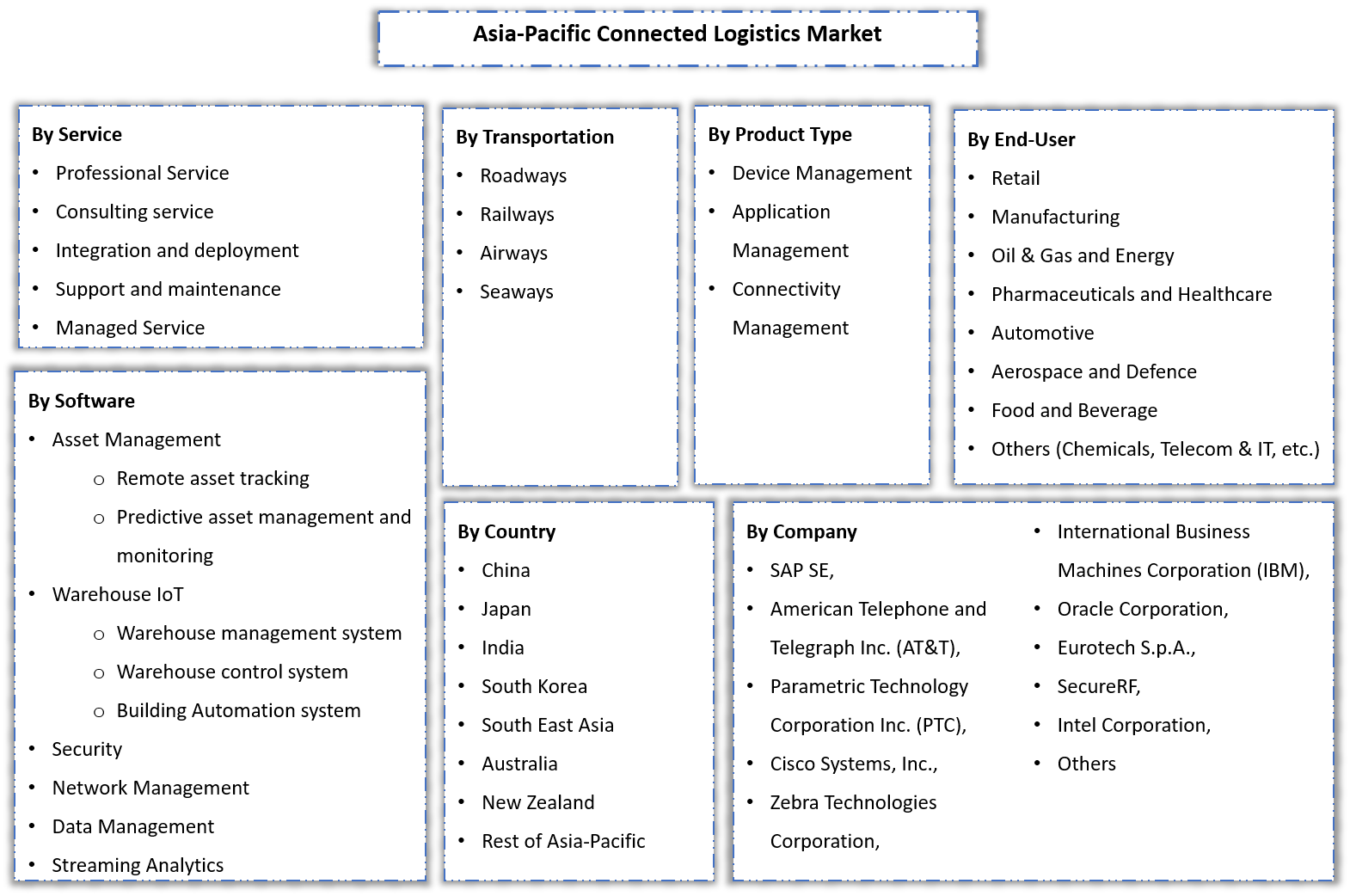
By Software (Asset Management, (Remote asset tracking, Predictive asset management and monitoring), Warehouse IoT, (Warehouse management system, Warehouse control system, Building......Automation system), Security, Network Management, Data Management, Streaming Analytics, By Product Type (Device Management, Application Management, Connectivity Management), By Service (Professional Service, Consulting service, Integration and deployment, Support and maintenance), Managed Service, By Transportation (Roadways, Railways, Airways, Seaways), By End-User (Retail, Manufacturing, Oil & Gas and Energy, Pharmaceuticals and Healthcare, Automotive, Aerospace and Defence, Food and Beverage, Others (Chemicals, Telecom & IT, etc.)), By Country (China, Japan, India, South Korea, South East Asia, Australia, New Zealand, Rest of Asia-Pacific), By Company (SAP SE, American Telephone and Telegraph Inc. (AT&T), Parametric Technology Corporation Inc. (PTC), Cisco Systems, Inc., Zebra Technologies Corporation, International Business Machines Corporation (IBM), Oracle Corporation, Eurotech S.p.A., SecureRF, Intel Corporation, Others) Read more
- ICT & Electronics
- Mar 2023
- 183
- PDF, Excel, PPT
Market Definition
Connected logistics comprises interconnected cloud platforms, communication systems, and Internet of Things (IoT) technologies that provide real-time information regarding the goods shipped through various transportation modes like roadways, railways, airways, & seaways. These solutions share relevant data & logistical information with supply chain operators to smoothen the transportation process and help companies improve their operational efficiency, productivity, & real-time access.
Market Insights & Analysis: Asia-Pacific Connected Logistics Market (2023-28)
The Asia-Pacific Connected Logistics Market is expected to grow at a CAGR of more than 18% CAGR during the forecast period, i.e., 2023-28. Currently, the market is in its nascent phase, and future growth would be driven primarily by the ever-growing need for optimizing the transportation & logistics industry to reduce operational costs & carbon emissions and the rapidly growing penetration of Industry 4.0 & industrial IoT devices. Besides, rapid technological advancements in transportation, the flourishing manufacturing & e-commerce sectors, and massive investments by governments in megacity projects are other prominent aspects projected to drive the connected logistics market in the forecast years.
| Report Coverage | Details |
|---|---|
| Study Period | Historical Data: 2018-21 |
| Base Year: 2022 | |
| Forecast Period: 2023-28 | |
| CAGR (2023-2028) | 18% |
| Country Covered | China, Japan, India, South Korea, South East Asia, Australia, New Zealand, Rest of Asia-Pacific |
| Key Companies Profiled | SAP SE, American Telephone and Telegraph Inc. (AT&T), Parametric Technology Corporation Inc. (PTC), Cisco Systems, Inc., Zebra Technologies Corporation, International Business Machines Corporation (IBM), Oracle Corporation, Eurotech S.p.A., SecureRF, Intel Corporation, Others. |
| Unit Denominations | USD Million/Billion |
Several countries across Asia-Pacific are actively working on bringing remarkable advancements in IoT-enabled solutions for supply chain management. Japan is making rigorous efforts toward transforming its logistics industry by integrating new technologies with existing processes in order to strengthen its position in the regional market.
Likewise, China is also witnessing a significantly expanding logistics sector owing to booming e-commerce. On the other hand, India has also recorded substantial e-commerce revenues in the past few years, thereby escalating the adoption of connected logistics solutions. Moreover, rapidly rising agricultural exports in Australia are further spurring growth in the logistics & warehousing industries across the country.
More & more connected logistics solutions equipped with top-notch interoperability, security, & accessibility features are becoming available across the region. Furthermore, continuous R&D in autonomous logistics trucks and declining costs of IoT-enabled sensors are also creating new avenues for the connected logistics industry to witness notable expansion in Asia-Pacific over the coming years.
Asia-Pacific Connected Logistics Market Research Report (2023-2028) - Table of Contents
- Market Segmentation
- Introduction
- Product Definition
- Research Process
- Assumptions
- Executive Summary
- Asia-Pacific Connected Logistics Market Start-Up Ecosystem
- Entrepreneurial Activity
- Year on Year Funding Received
- Funding Received by Top Companies
- Key Investors Active in the Market
- Series Wise Funding Received
- Seed Funding
- Angel Investing
- Venture Capitalists (VC) Funding
- Others
- Impact of COVID-19 on Asia-Pacific Connected Logistics Market
- Asia-Pacific Connected Logistics Market Regulations & Policy
- Asia-Pacific Connected Logistics Market Trends & Insights
- Asia-Pacific Connected Logistics Market Dynamics
- Growth Drivers
- Challenges
- Asia-Pacific Connected Logistics Market Hotspots & Opportunities
- Asia-Pacific Connected Logistics Market Value Chain Analysis
- Asia-Pacific Connected Logistics Market Porter's Five Forces Analysis
- Bargaining Power of Suppliers
- Bargaining Power of Buyers
- Threat of New Entrants
- Threat of Substitute Products
- Intensity of Competitive Rivalry
- Asia-Pacific Connected Logistics Market Outlook, 2018-2028
- Market Size & Analysis
- By Revenue (USD Million)
- Market Share & Analysis
- By Software
- Asset Management
- Remote asset tracking
- Predictive asset management and monitoring
- Warehouse IoT
- Warehouse management system
- Warehouse control system
- Building Automation system
- Security
- Network Management
- Data Management
- Streaming Analytics
- Asset Management
- By Product Type
- Device Management
- Application Management
- Connectivity Management
- By Service
- Professional Service
- Consulting service
- Integration and deployment
- Support and maintenance
- Managed Service
- Professional Service
- By Transportation
- Roadways
- Railways
- Airways
- Seaways
- By End-User
- Retail
- Manufacturing
- Oil & Gas and Energy
- Pharmaceuticals and Healthcare
- Automotive
- Aerospace and Defence
- Food and Beverage
- Others (Chemicals, Telecom & IT, etc.)
- By Country
- China
- Japan
- India
- South Korea
- South East Asia
- Australia
- New Zealand
- Rest of Asia-Pacific
- By Company
- Competition Characteristics
- Revenue Shares
- By Software
- Market Size & Analysis
- China Connected Logistics Market Outlook, 2018-2028
- Market Size & Analysis
- By Revenue
- Market Share & Analysis
- By Software
- By Product Type
- By Service
- By Transportation
- By End-User
- Market Size & Analysis
- Japan Connected Logistics Market Outlook, 2018-2028
- Market Size & Analysis
- By Revenue
- Market Share & Analysis
- By Software
- By Product Type
- By Service
- By Transportation
- By End-User
- Market Size & Analysis
- India Connected Logistics Market Outlook, 2018-2028
- Market Size & Analysis
- By Revenue
- Market Share & Analysis
- By Software
- By Product Type
- By Service
- By Transportation
- By End-User
- Market Size & Analysis
- South Korea Connected Logistics Market Outlook, 2018-2028
- Market Size & Analysis
- By Revenue
- Market Share & Analysis
- By Software
- By Product Type
- By Service
- By Transportation
- By End-User
- Market Size & Analysis
- South East Asia Connected Logistics Market Outlook, 2018-2028
- Market Size & Analysis
- By Revenue
- Market Share & Analysis
- By Software
- By Product Type
- By Service
- By Transportation
- By End-User
- Market Size & Analysis
- Australia Connected Logistics Market Outlook, 2018-2028
- Market Size & Analysis
- By Revenue
- Market Share & Analysis
- By Software
- By Product Type
- By Service
- By Transportation
- By End-User
- Market Size & Analysis
- New Zealand Connected Logistics Market Outlook, 2018-2028
- Market Size & Analysis
- By Revenue
- Market Share & Analysis
- By Software
- By Product Type
- By Service
- By Transportation
- By End-User
- Market Size & Analysis
- Asia-Pacific Connected Logistics Market Key Strategic Imperatives for Success & Growth
- Competition Outlook
- Competition Matrix
- Product Portfolio
- Target Markets
- Research & Development
- Strategic Alliances
- Strategic Initiatives
- Company Profiles (Business Description, Product Segments, Business Segments, Financials, Strategic Alliances/ Partnerships, Future Plans)
- SAP SE
- American Telephone and Telegraph Inc. (AT&T)
- Parametric Technology Corporation Inc. (PTC)
- Cisco Systems, Inc.
- Zebra Technologies Corporation
- International Business Machines Corporation (IBM)
- Oracle Corporation
- Eurotech S.p.A.
- SecureRF
- Intel Corporation
- Others
- Competition Matrix
- Disclaimer
MarkNtel Advisors follows a robust and iterative research methodology designed to ensure maximum accuracy and minimize deviation in market estimates and forecasts. Our approach combines both bottom-up and top-down techniques to effectively segment and quantify various aspects of the market. A consistent feature across all our research reports is data triangulation, which examines the market from three distinct perspectives to validate findings. Key components of our research process include:
1. Scope & Research Design At the outset, MarkNtel Advisors define the research objectives and formulate pertinent questions. This phase involves determining the type of research—qualitative or quantitative—and designing a methodology that outlines data collection methods, target demographics, and analytical tools. They also establish timelines and budgets to ensure the research aligns with client goals.
2. Sample Selection and Data Collection In this stage, the firm identifies the target audience and determines the appropriate sample size to ensure representativeness. They employ various sampling methods, such as random or stratified sampling, based on the research objectives. Data collection is carried out using tools like surveys, interviews, and observations, ensuring the gathered data is reliable and relevant.
3. Data Analysis and Validation Once data is collected, MarkNtel Advisors undertake a rigorous analysis process. This includes cleaning the data to remove inconsistencies, employing statistical software for quantitative analysis, and thematic analysis for qualitative data. Validation steps are taken to ensure the accuracy and reliability of the findings, minimizing biases and errors.

4. Data Forecast and FinalizationThe final phase involves forecasting future market trends based on the analyzed data. MarkNtel Advisors utilize predictive modeling and time series analysis to anticipate market behaviors. The insights are then compiled into comprehensive reports, featuring visual aids like charts and graphs, and include strategic recommendations to inform client decision-making
FILL THE FORM TO GET THE FREE SAMPLE PAGES
We offer flexible licensing options to cater to varying organizational needs. Choose the pricing pack that best suits your requirements:
Buy Now Inquire Before Buying
 Talk to our Consultant
 Request Customization