

By Service Type (Transportation Services, Warehousing & Storage Services, Supply Chain & Inventory Management Services, Maintenance & Sustainment Services, Integrated Logistics Support (ILS)), By End... ... port (ILS)), By End User (U.S. Army, U.S. Navy, U.S. Air Force, U.S. Marine Corps, Defense Agencies), By Transportation Mode (Land Logistics, Air Logistics, Sea Logistics), By Deployment Type (Domestic Logistics, Overseas / Expeditionary Logistics), and others Read more
- Aerospace & Defense
- Jul 2026
- 140
- PDF, Excel, PPT
U.S. Military Logistics Market Key Takeaways
- The U.S. Military Logistics market, valued at nearly USD 7.9 billion in 2025, is anticipated to expand steadily, reaching USD 13.09 billion by 2032 from USD 8.49 billion in 2026.
- The industry is projected to witness steady growth at a CAGR of 7.48% over 2026–2032.
- Transportation Services led the service type segment with a 36% share in 2026.
- The U.S. Army accounted for the largest end-user share at 42% in 2026.
- The industry is characterized by a moderately consolidated market structure, where the top five manufacturers hold roughly 46% of the market share.
U.S. Military Logistics Market Size and Outlook
At a CAGR of approximately 7.48% over 2026–2032, the United States military logistics market is expected to rise from USD 8.49 billion in 2026 to USD 13.09 billion by 2032, following a valuation of USD 7.9 billion in 2025.
Strengthening defense readiness and modernizing military operations have become strategic priorities for the United States, creating sustained demand for advanced logistics capabilities. Consequently, the U.S. Department of Defense (DoD) continues to invest in resilient supply chains, strategic mobility, and military supply chain management to improve operational effectiveness. Reflecting this commitment, the Defense Logistics Agency (DLA) reported USD 51.8 billion in revenue in FY2025, while its 2025–2030 Strategic Plan emphasizes digital transformation and resilient logistics networks to enhance mission support and operational efficiency.
As these modernization initiatives expand, logistics demand is increasingly driven by the U.S. Army, Navy, Air Force, Marine Corps, and defense agencies, all of which depend on transportation, warehousing, inventory management, maintenance, and sustainment services. At the same time, growing overseas deployments, multinational exercises, and pre-positioned stock programs are making military logistics operations more complex. Reinforcing this trend, the Congressional Budget Office noted that the DoD requested USD 362 billion for operation and maintenance in FY2026, supporting continued investment in logistics infrastructure and sustainment capabilities.
Beyond higher defense spending, government-led initiatives are further enhancing supply chain resilience and operational preparedness. The DLA's Global Resilience Initiative focuses on reducing supply lead times, strengthening industrial capacity, and improving coordination across the Joint Logistics Enterprise. These measures, together with workforce modernization and digital transformation programs, are improving lifecycle sustainment, strengthening asset availability, and enhancing mission readiness across defense operations.
In parallel with these policy initiatives, leading industry participants are advancing AI-enabled logistics platforms, predictive maintenance, warehouse automation, and digital inventory management solutions. Close collaboration between defense contractors and the DoD is improving supply chain visibility, accelerating logistics execution, and strengthening operational resilience. As technology adoption continues to reshape military logistics, continued investment in integrated logistics support (ILS) is expected to support the long-term growth of the U.S. military logistics market.
U.S. Military Logistics Market Key Indicators
- The Fiscal Year 2025 National Defense Authorization Act (NDAA) supports USD 895.2 billion in national defense funding, strengthening investments in force readiness, logistics modernization, and resilient supply chains, thereby increasing demand for transportation, warehousing, sustainment, and logistics support services.
- The Defense Logistics Agency (DLA) manages the Department of Defense's end-to-end global supply chain, supporting the military services, 11 combatant commands, federal agencies, and allied partners. The growing complexity of sustaining thousands of weapon systems continues to drive demand for advanced logistics, inventory management, and distribution capabilities.
- U.S. Transportation Command (USTRANSCOM) spends approximately USD 9.5 billion annually on commercial transportation services, reflecting sustained demand for strategic mobility, cargo movement, and defense transportation capabilities supporting military operations worldwide.
- The U.S. Army and Marine Corps spent more than USD 2.3 billion on ground-vehicle depot maintenance in FY2023, highlighting continued investment in equipment sustainment and reinforcing demand for maintenance, repair, overhaul, and logistics support services.
U.S. Military Logistics Market Scope
| Category | Segments |
|---|---|
| By Service Type | Transportation Services, Warehousing & Storage Services, Supply Chain & Inventory Management Services, Maintenance & Sustainment Services, Integrated Logistics Support (ILS |
| By End User | U.S. Army, U.S. Navy, U.S. Air Force, U.S. Marine Corps, Defense Agencies |
| By Transportation Mode | Land Logistics, Air Logistics, Sea Logistics |
| By Deployment Type | Domestic Logistics, Overseas / Expeditionary Logistics |
U.S. Military Logistics Market Growth Drivers
Rising U.S. Defense Readiness and Global Force Projection
As the United States expands its defense posture to address evolving geopolitical challenges, greater emphasis is being placed on rapid force deployment, forward military presence, and multinational military operations. These evolving operational requirements are increasing the need for efficient military logistics services to support personnel deployment, equipment transportation, ammunition distribution, maintenance, and sustainment activities. Reflecting this strategic priority, the U.S. Department of Defense's FY2026 Budget Request includes USD 848.3 billion in discretionary funding for the Department of Defense, with significant investments in force readiness, strategic mobility, logistics infrastructure, and sustainment programs. Collectively, these investments are strengthening operational resilience while accelerating defense supply chain resilience trends.
Complementing these strategic investments, ongoing modernization of defense logistics capabilities is enhancing the efficiency and responsiveness of military supply chains. The Defense Logistics Agency (DLA) supplies approximately 85% of the U.S. military's spare parts while supporting more than 24,000 weapon systems, highlighting its central role in sustaining defense operations. Meanwhile, continued procurement of advanced aircraft, missile systems, naval platforms, autonomous systems, and armored vehicles is generating sustained demand for transportation, warehousing, maintenance, and integrated logistics support services. As defense operations become increasingly complex and globally dispersed, these developments are driving greater investments in military logistics capabilities, creating sustained growth opportunities for the U.S. military logistics market.
Recent Trends
Growing Adoption of AI-Driven Digital Logistics Across U.S. Defense Supply Chains
Artificial intelligence is becoming a core enabler of logistics modernization across the U.S. defense sector as military organizations increasingly adopt digital technologies to improve supply chain efficiency and operational readiness. Growing investments in AI, machine learning, predictive analytics, and cloud-enabled logistics platforms are enhancing real-time asset visibility through military asset tracking technologies, optimizing inventory management, and enabling faster, data-driven decision-making. As a result, digital logistics capabilities are playing an increasingly important role in strengthening military sustainment operations.
This transformation is being reinforced through major defense modernization initiatives. The U.S. Department of Defense's Chief Digital and Artificial Intelligence Office (CDAO) is accelerating the adoption of data, analytics, and artificial intelligence through initiatives such as Open DAGIR, strengthening enterprise data integration and AI-enabled decision-making across logistics and sustainment functions. At the same time, the U.S. Army is advancing AI-enabled logistics through its Next Generation Command and Control (NGC2) initiative, where Rune Technologies' TyrOS platform enhances inventory visibility, forecasts supply requirements, and supports logistics operations in contested environments. Together, these developments are accelerating the deployment of digital logistics management platforms, enabling more predictive, data-driven, and resilient defense supply chain operations.
U.S. Military Logistics Market Opportunities and Challenges
Aging Military Logistics Infrastructure Creating Opportunities for Smart Warehousing Modernization
Aging military logistics infrastructure is emerging as a significant challenge for maintaining efficient and resilient defense supply chain operations across the United States. Many military depots, warehouses, and distribution facilities were established decades ago and are increasingly unable to support modern logistics requirements involving automation, real-time inventory visibility, and data-driven decision-making. These infrastructure limitations reduce operational efficiency, increase maintenance costs, and constrain the military's ability to respond rapidly to evolving mission demands. Recognizing this challenge, the U.S. Department of Defense's Fiscal Year 2026 Defense Budget Request includes continued investments in military construction and facility modernization to strengthen logistics readiness and enhance operational resilience.
This challenge is simultaneously creating significant opportunities for smart military warehousing technologies across defense logistics networks. Reflecting this shift, the Defense Logistics Agency (DLA) showcased advanced warehouse modernization technologies in January 2026, including AI-powered warehouse utilization tools, RFID-enabled inventory tracking, LiDAR-based 3D warehouse mapping, and automated cycle counting to improve inventory visibility, warehouse space utilization, and distribution efficiency. The growing adoption of these defense inventory optimization systems is accelerating the transition toward intelligent, technology-enabled logistics facilities, creating new opportunities for automation providers, digital logistics technology developers, and infrastructure modernization across the defense sector.
Segmentation Insights
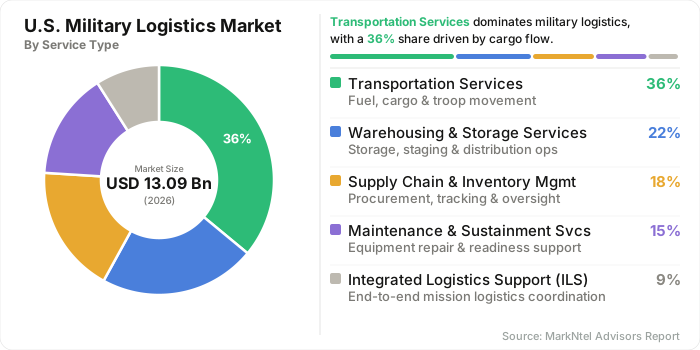
Transportation Services Capture Largest Market Share Owing to Critical Role in Strategic Mobility
A 36% share of market revenue in 2026 established transportation services as the dominant service line within the U.S. military logistics industry. The segment leads because the movement of personnel, equipment, ammunition, fuel, and critical materiel across strategic and operational distances represents the largest and most continuous logistics requirement for the U.S. Armed Forces. The Defense Transportation System relies on an integrated strategic mobility network comprising airlift, sealift, and prepositioned stocks to support global force projection, rapid deployment, and military transportation services, creating sustained demand across all military branches.
Among these strategic mobility capabilities, sealift plays the most significant role due to its unmatched cargo capacity for transporting heavy equipment and bulk military supplies. The Military Sealift Command operates approximately 125 civilian-crewed ships, while more than 90% of U.S. warfighters' equipment and supplies are transported by sea. However, the average age of the surge sealift fleet is nearly 40 years, driving ongoing fleet recapitalization and commercial sealift augmentation initiatives to strengthen strategic mobility capabilities. Consequently, continued investments in transportation modernization are expected to reinforce the dominance of transportation services throughout the forecast period. Based on service type, the market has been segmented into:
- Transportation Services
- Warehousing & Storage Services
- Supply Chain & Inventory Management Services
- Maintenance & Sustainment Services
- Integrated Logistics Support (ILS)
U.S. Army Dominates the Market Driven by Its Extensive Force Structure and Sustainment Requirements
With a 42% revenue share in 2026, the U.S. Army emerged as the largest end user in the U.S. military logistics industry. Its leadership is primarily attributed to its position as the largest military branch, operating the most extensive fleet of ground combat vehicles, rotary-wing aircraft, engineering equipment, and expeditionary assets. Supporting this scale, the FY2026 National Defense Authorization Act authorized approximately 454,000 active-duty soldiers, representing the highest active-duty force strength among all U.S. military services. The combination of a large personnel base and diverse equipment inventory creates continuous demand for transportation, maintenance, warehousing, inventory management, and military sustainment support to ensure operational readiness across domestic and overseas missions.
This extensive force structure translates into significant logistics requirements across global operations. Army Materiel Command, together with the Army Sustainment Command and Army Field Support Brigades, manages worldwide equipment distribution, depot-level maintenance, and readiness support across multiple operational theaters. As a result, the Army generates substantially higher demand for transportation, warehousing, inventory management, and maintenance services than any other military branch. As the Army continues its transition toward a multidomain-capable force, sustained investments in modernization, force readiness, and global operational capabilities are expected to further strengthen its long-term logistics requirements. Based on end user, the market is categorized into:
- U.S. Army
- U.S. Navy
- U.S. Air Force
- U.S. Marine Corps
- Defense Agencies
U.S. Military Logistics Market Competitive Analysis
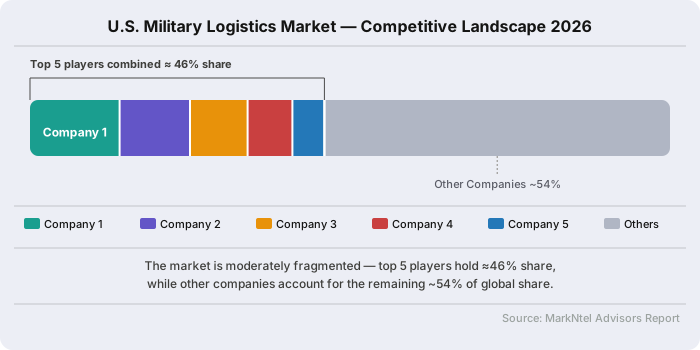
The U.S. military logistics market is moderately consolidated, with a mix of defense contractors, logistics service providers, and aerospace companies competing across transportation, sustainment, warehousing, and integrated logistics support services. The top five players, KBR, Inc., Amentum Holdings, Inc., V2X, Inc., Leidos Holdings, Inc., and CACI International Inc., collectively account for approximately 46% of the market, supported by long-term U.S. Department of Defense contracts, global logistics networks, advanced digital supply chain capabilities, and integrated sustainment solutions.
Key Players in the U.S. Military Logistics Market
- KBR, Inc.
- Amentum Holdings, Inc.
- V2X, Inc.
- Leidos Holdings, Inc.
- CACI International Inc.
- Science Applications International Corporation
- General Dynamics Corporation
- The Boeing Company
- Lockheed Martin Corporation
- Northrop Grumman Corporation
- Others
U.S. Military Logistics Industry News and Recent Developments
March 2026: Amentum Launches Center for Contested Logistics in Hawaii
Amentum expanded its Hawaii operations by establishing a Center for Contested Logistics to support the U.S. Indo-Pacific Command. The facility will develop advanced logistics concepts, digital sustainment capabilities, and resilient supply chain solutions for military operations.
Impact Analysis: The initiative enhances logistics readiness in contested environments and underscores the increasing focus on digital sustainment and resilient military supply chains across the Indo-Pacific region.
January 2025: Leidos Wins USD 2.6 Billion TSA Sustainment Contract
Leidos secured an eight-year Transportation Security Administration (TSA) sustainment contract valued at up to USD 2.6 billion. The agreement covers logistics, preventive maintenance, depot repair, and lifecycle support for approximately 12,000 transportation security systems across more than 430 U.S. airports.
Impact Analysis: The contract strengthens Leidos' leadership in logistics and sustainment services while highlighting growing investments in lifecycle support, asset readiness, and critical transportation infrastructure.
- Market Segmentation
- Introduction
- Product Definition
- Research Process
- Assumptions
- Executive Summary
- U.S. Military Logistics Market Policies, Regulations, and Product Standards
- U.S. Military Logistics Market Trends & Developments
- U.S. Military Logistics Market Dynamics
- Growth Factors
- Challenges
- U.S. Military Logistics Market Hotspot & Opportunities
- U.S. Military Logistics Market Outlook, 2022-2032
- Market Size & Outlook
- By Revenues (USD Million)
- Market Segmentation & Outlook
- By Service Type- Market Size & Forecast 2022-2032, USD Million
- Transportation Services
- Warehousing & Storage Services
- Supply Chain & Inventory Management Services
- Maintenance & Sustainment Services
- Integrated Logistics Support (ILS)
- By End User- Market Size & Forecast 2022-2032, USD Million
- U.S. Army
- U.S. Navy
- U.S. Air Force
- U.S. Marine Corps
- Defense Agencies
- By Transportation Mode- Market Size & Forecast 2022-2032, USD Million
- Land Logistics
- Air Logistics
- Sea Logistics
- By Deployment Type- Market Size & Forecast 2022-2032, USD Million
- Domestic Logistics
- Overseas / Expeditionary Logistics
- By Company
- Competition Characteristics
- Market Share & Analysis
- By Service Type- Market Size & Forecast 2022-2032, USD Million
- Market Size & Outlook
- U.S. Military Land Logistics Market Outlook, 2022-2032
- Market Size & Outlook
- By Revenues (USD Million)
- Market Segmentation & Outlook
- By End User- Market Size & Forecast 2022-2032, USD Million
- By Transportation Mode- Market Size & Forecast 2022-2032, USD Million
- By Deployment Type- Market Size & Forecast 2022-2032, USD Million
- Market Size & Outlook
- U.S. Military Air Logistics Market Outlook, 2022-2032
- Market Size & Outlook
- By Revenues (USD Million)
- Market Segmentation & Outlook
- By End User- Market Size & Forecast 2022-2032, USD Million
- By Transportation Mode- Market Size & Forecast 2022-2032, USD Million
- By Deployment Type- Market Size & Forecast 2022-2032, USD Million
- Market Size & Outlook
- U.S. Military Sea Logistics Market Outlook, 2022-2032
- Market Size & Outlook
- By Revenues (USD Million)
- Market Segmentation & Outlook
- By End User- Market Size & Forecast 2022-2032, USD Million
- By Transportation Mode- Market Size & Forecast 2022-2032, USD Million
- By Deployment Type- Market Size & Forecast 2022-2032, USD Million
- Market Size & Outlook
- U.S. Military Rail Logistics Market Outlook, 2022-2032
- Market Size & Outlook
- By Revenues (USD Million)
- Market Segmentation & Outlook
- By End User- Market Size & Forecast 2022-2032, USD Million
- By Transportation Mode- Market Size & Forecast 2022-2032, USD Million
- By Deployment Type- Market Size & Forecast 2022-2032, USD Million
- Market Size & Outlook
- U.S. Military Logistics Market Key Strategic Imperatives for Success & Growth
- Competitive Outlook
- Company Profiles
- KBR, Inc.
- Business Description
- Product Portfolio
- Collaborations & Alliances
- Recent Developments
- Financial Details
- Others
- Amentum Holdings, Inc.
- Business Description
- Product Portfolio
- Collaborations & Alliances
- Recent Developments
- Financial Details
- Others
- V2X, Inc.
- Business Description
- Product Portfolio
- Collaborations & Alliances
- Recent Developments
- Financial Details
- Others
- Leidos Holdings, Inc.
- Business Description
- Product Portfolio
- Collaborations & Alliances
- Recent Developments
- Financial Details
- Others
- CACI International Inc.
- Business Description
- Product Portfolio
- Collaborations & Alliances
- Recent Developments
- Financial Details
- Others
- Science Applications International Corporation
- Business Description
- Product Portfolio
- Collaborations & Alliances
- Recent Developments
- Financial Details
- Others
- General Dynamics Corporation
- Business Description
- Product Portfolio
- Collaborations & Alliances
- Recent Developments
- Financial Details
- Others
- The Boeing Company
- Business Description
- Product Portfolio
- Collaborations & Alliances
- Recent Developments
- Financial Details
- Others
- Lockheed Martin Corporation
- Business Description
- Product Portfolio
- Collaborations & Alliances
- Recent Developments
- Financial Details
- Others
- Northrop Grumman Corporation
- Business Description
- Product Portfolio
- Collaborations & Alliances
- Recent Developments
- Financial Details
- Others
- KBR, Inc.
- Company Profiles
- Disclaimer

MarkNtel Advisors follows a robust and iterative research methodology designed to ensure maximum accuracy and minimize deviation in market estimates and forecasts. Our approach combines both bottom-up and top-down techniques to effectively segment and quantify various aspects of the market. A consistent feature across all our research reports is data triangulation, which examines the market from three distinct perspectives to validate findings. Key components of our research process include:
1. Scope & Research Design At the outset, MarkNtel Advisors define the research objectives and formulate pertinent questions. This phase involves determining the type of research—qualitative or quantitative—and designing a methodology that outlines data collection methods, target demographics, and analytical tools. They also establish timelines and budgets to ensure the research aligns with client goals.
2. Sample Selection and Data Collection In this stage, the firm identifies the target audience and determines the appropriate sample size to ensure representativeness. They employ various sampling methods, such as random or stratified sampling, based on the research objectives. Data collection is carried out using tools like surveys, interviews, and observations, ensuring the gathered data is reliable and relevant.
3. Data Analysis and Validation Once data is collected, MarkNtel Advisors undertake a rigorous analysis process. This includes cleaning the data to remove inconsistencies, employing statistical software for quantitative analysis, and thematic analysis for qualitative data. Validation steps are taken to ensure the accuracy and reliability of the findings, minimizing biases and errors.

4. Data Forecast and FinalizationThe final phase involves forecasting future market trends based on the analyzed data. MarkNtel Advisors utilize predictive modeling and time series analysis to anticipate market behaviors. The insights are then compiled into comprehensive reports, featuring visual aids like charts and graphs, and include strategic recommendations to inform client decision-making
We’d love to understand what matters most to you.