

By Component (Services (Environmental Risk Assessment, Environmental Due Diligence, Environmental Auditing & Compliance, Site Investigation, Environmental Testing & Laboratory Services, Environmental... ... ices, Environmental Monitoring, Remediation & Mitigation Planning, Environmental Consulting & Engineering, ESG Advisory), Software & Platforms (Environmental Risk Analytics, Environmental Monitoring Platforms, Environmental Compliance Software, ESG Software with Environmental Risk Modules, Climate Risk Analytics, Environmental Reporting Platforms)), By Risk Type (Environmental Contamination Risk, Climate & Physical Risk, Natural Resources & Biodiversity Risk, Regulatory & Compliance Risk, Water Resource Risk), By Deployment Mode (On-Premises, Cloud-Based), By Enterprise Size (Large Enterprises, Small & Medium Enterprises (SMEs)), By Application (Environmental Risk Management Impact Assessment, Environmental Risk Management Monitoring & Reporting, Climate Risk Assessment, Waste Management Risk Management, Water Resource Risk Management, Site Contamination Assessment & Remediation), By End-Use Industry (Oil & Gas, Chemicals & Petrochemicals, Manufacturing, Mining & Metals, Construction & Infrastructure, Transportation & Logistics, Agriculture & Forestry, Government & Public Sector, Other Industries), and others Read more
- Environment
- Jul 2026
- 140
- PDF, Excel, PPT
United States Environmental Risk Management Market Key Takeaways
- The U.S. Environmental Risk Management Market was valued at USD 19.21 billion in 2025, to 20.39 billion in 2026, and is projected to reach USD 29.43 billion by 2032.
- The industry is projected to witness steady growth at a CAGR of 6.31% during the forecast period.
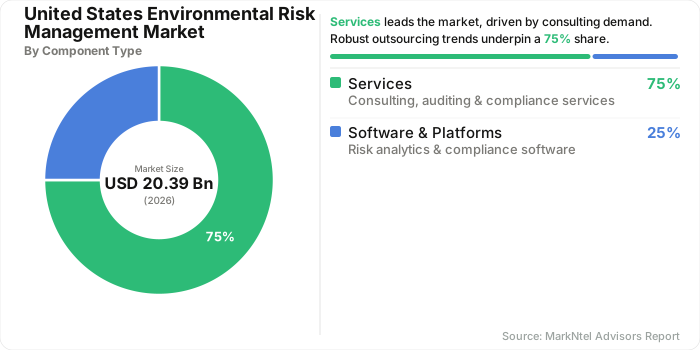
- By component, the services segment dominates the market, accounting for approximately 75% of total revenue.
- By deployment mode, cloud-based solutions lead the market with an estimated 66% share.
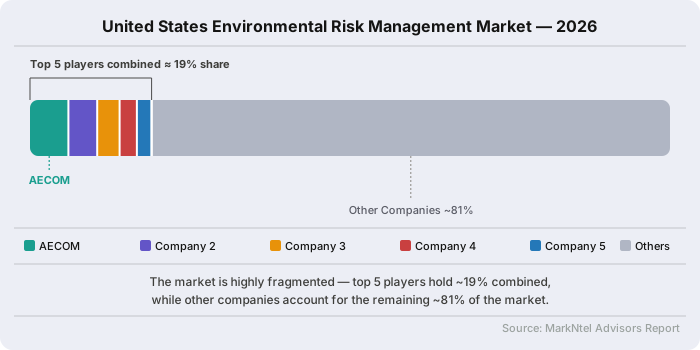
- The industry is highly fragmented, with the top five companies collectively accounting for approximately 19% of the total market share.
United States Environmental Risk Management Market Size & Outlook
The Environmental Risk Management Market size in the US was valued at USD 19.21 billion in 2025, to 20.39 billion in 2026, and is projected to reach USD 29.43 billion by 2032, registering a CAGR of 6.31% during the forecast period.
This trajectory is underpinned by intensifying federal enforcement of contaminated site cleanup, expanding industrial compliance obligations, and sustained infrastructure-linked remediation funding across public and private sectors, positioning environmental risk advisory and remediation services as a structurally embedded requirement for regulated industries nationwide.
Federal regulatory activity remains a core growth catalyst. The EPA Superfund enforcement program obtained approximately USD 52.5 billion in responsible party and third-party commitments for site cleanup since 1980, including USD 714.3 million secured in FY2025 alone, while the agency disbursed over USD 766 million for construction and post-construction projects in FY2025 under the Infrastructure Investment and Jobs Act, reinforcing consistent demand for risk assessment and remediation oversight.
Industry players are scaling capacity to meet this compliance demand. Tetra Tech secured a USD 100 million five-year contract with the Office of Land and Emergency Management for research on emerging advanced environmental technologies, alongside a USD 94 million single-award contract for emergency preparedness and response services with the EPA in FY2025, reflecting deepening integration of consulting expertise into federal environmental risk frameworks.
Sustained regulatory oversight, infrastructure-driven investment, and the increasing reliance on specialized environmental consulting services are expected to support the steady expansion of the United States Environmental Risk Management Market. Demand is anticipated to be increasingly driven by the need for faster site assessment and remediation timelines, while the growing adoption of technology-enabled risk assessment tools and data-driven environmental monitoring solutions will continue to enhance decision-making and improve contaminated land management throughout the forecast period.
United States Environmental Risk Management Market Key Indicators
- The United States experienced 23 separate billion-dollar weather and climate disasters in 2025, while the cumulative economic losses from such events have exceeded USD 3.1 trillion since 1980. This growing frequency and financial impact of extreme weather events are prompting industrial and commercial asset owners to adopt structured environmental risk management practices, including climate exposure assessments, environmental risk evaluations, and resilience planning, before making decisions on insurance coverage, facility expansion, or site relocation. This trend continues to strengthen demand for environmental risk management services across the country.
- In FY2025, the U.S. Environmental Protection Agency (EPA) completed 2,127 civil enforcement cases, the highest number in nine years, leading to the reduction, treatment, or elimination of nearly 116 million pounds of pollution across air, land, and water. This heightened regulatory enforcement is encouraging industrial facilities, manufacturers, and infrastructure operators to strengthen environmental compliance, conduct regular environmental risk assessments, and implement proactive liability management programs to minimize regulatory, operational, and financial risks.
- As per recent report by the U.S. Environmental Protection Agency (EPA), FY2025 criminal enforcement actions resulted in charges against 156 defendants, the highest level since 2016, and secured more than USD 600 million in fines, restitution, and court-ordered relief. The increasing financial and legal consequences of environmental non-compliance are driving companies to adopt comprehensive environmental risk audits, strengthen compliance frameworks, and implement proactive risk management strategies to reduce liability exposure.
- According to the U.S. Environmental Protection Agency (EPA), several communities were selected to receive more than USD 270 million in Brownfields Assessment, Revolving Loan Fund, and Cleanup Grants in FY2025. The continued expansion of federally funded brownfield redevelopment projects is driving demand for Phase I and Phase II Environmental Site Assessments (ESAs), as developers, investors, and property owners require comprehensive environmental due diligence before redevelopment and land transactions.
United States Environmental Risk Management Market Scope
| Category | Segments |
|---|---|
| By Component | Services (Environmental Risk Assessment, Environmental Due Diligence, Environmental Auditing & Compliance, Site Investigation, Environmental Testing & Laboratory Services, Environmental Monitoring, Remediation & Mitigation Planning, Environmental Consulting & Engineering, ESG Advisory), Software & Platforms (Environmental Risk Analytics, Environmental Monitoring Platforms, Environmental Compliance Software, ESG Software with Environmental Risk Modules, Climate Risk Analytics, Environmental Reporting Platforms |
| By Risk Type | Environmental Contamination Risk, Climate & Physical Risk, Natural Resources & Biodiversity Risk, Regulatory & Compliance Risk, Water Resource Risk |
| By Deployment Mode | On-Premises, Cloud-Based |
| By Enterprise Size | Large Enterprises, Small & Medium Enterprises (SMEs |
| By Application | Environmental Risk Management Impact Assessment, Environmental Risk Management Monitoring & Reporting, Climate Risk Assessment, Waste Management Risk Management, Water Resource Risk Management, Site Contamination Assessment & Remediation |
| By End-Use Industry | Oil & Gas, Chemicals & Petrochemicals, Manufacturing, Mining & Metals, Construction & Infrastructure, Transportation & Logistics, Agriculture & Forestry, Government & Public Sector, Other Industries |
United States Environmental Risk Management Market Growth Drivers
Expanding US Manufacturing and Industrial Facility Construction Elevates Environmental Risk Assessment Demand
The rebound in domestic manufacturing and industrial facility construction is generating sustained demand for pre-construction environmental due diligence, including contamination screening, permitting support, and liability risk assessment. According to the US Census Bureau, manufacturing construction spending reached a seasonally adjusted annual rate of USD 196.2 billion in January 2026, requiring developers and lenders to commission environmental site assessments before land acquisition and financing can proceed.
This construction activity extends well beyond manufacturing alone. Total private non- residential construction reached a seasonally adjusted annual rate of USD 728.2 billion in January 2026, while power-sector construction alone totalled USD 162.4 billion, reflecting industrial and energy infrastructure buildout spanning states such as Texas, Arizona, and Ohio, each requiring site-specific environmental compliance review before groundbreaking.
The expanding pipeline of industrial, commercial, and infrastructure developments is generating sustained demand for environmental risk management services across the United States. Financial institutions, insurers, and investors increasingly require Phase I and Phase II Environmental Site Assessments (ESAs) as part of their due diligence before approving project financing, acquisitions, or insurance coverage. As a result, environmental risk management services have become an integral component of project planning, regulatory compliance, and investment decision-making. This shift has strengthened the role of environmental consulting firms, positioning their services as an essential prerequisite for large-scale development projects rather than a discretionary expenditure.
Recent Trends
Rising Adoption of AI-Powered Wildfire Detection and Environmental Monitoring Networks
Environmental risk assessment across the United States Environmental Risk Management Market is increasingly transitioning from periodic manual site inspections to continuous, AI-powered monitoring systems capable of identifying environmental hazards in near real time. This shift is enabling earlier detection of wildfire risks, improving situational awareness, and supporting faster emergency response, thereby enhancing the effectiveness of environmental risk management strategies.
A notable example is Pano AI, which operates an extensive network of AI-enabled cameras installed on cell towers and mountaintops across 17 U.S. states, monitoring nearly 50 million acres of land. In 2025, the platform detected 915 wildfires before they were reported by the public, demonstrating the growing capability of AI-based monitoring systems to identify environmental threats faster than conventional reporting methods.
The transition is also extending to satellite-based environmental surveillance. In 2025, OroraTech expanded into the U.S. market, providing wildfire intelligence using data from 25 public satellites and announcing plans to launch eight additional satellites by early 2026 to strengthen nationwide coverage. As utilities, insurers, government agencies, and municipalities increasingly integrate AI-enabled camera networks and satellite monitoring into their standard risk management protocols, continuous environmental monitoring is expected to become a foundational component of environmental risk assessment, driving the long-term growth of the United States environmental risk management market.
United States Environmental Risk Management Market Opportunities & Challenges
CERCLA Hazardous Substance Liability Exposure Driving Demand for PFAS Risk Advisory and Insurance Services
The designation of perfluorooctanoic acid (PFOA) and perfluorooctanesulfonic acid (PFOS) as hazardous substances under the Comprehensive Environmental Response, Compensation, and Liability Act (CERCLA), effective July 8, 2024, has significantly expanded environmental liability across the United States. The designation extends CERCLA's strict, joint-and-several, and retroactive liability framework to passive receivers, including water utilities, municipal landfills, and property owners that neither manufactured nor intentionally used PFAS.
According to the U.S. Environmental Protection Agency (EPA), potential liability for non-federal Superfund sites alone could exceed USD 17.4 billion, equivalent to approximately USD 900 million annually over 30 years. Furthermore, in September 2025, the U.S. Department of Justice reaffirmed the EPA's commitment to defending the PFAS designation against ongoing legal challenges, reinforcing expectations that the expanded liability framework will remain in place over the long term.
The evolving regulatory landscape is creating sustained demand for specialized environmental risk management services, particularly in PFAS risk assessment, environmental due diligence, remediation planning, and insurance advisory. Despite the growing exposure, fewer than 20% of U.S. businesses with environmental liabilities currently maintain dedicated environmental insurance coverage, leaving a substantial protection gap. At the same time, the domestic market has expanded contractors' pollution liability insurance capacity to more than USD 250 million per placement, with insurers introducing increasingly comprehensive PFAS-specific coverage and integrated general liability products through 2026.
As organizations seek to quantify, manage, and transfer newly regulated PFAS liabilities, environmental risk management firms are becoming increasingly critical in conducting passive-receiver liability assessments, supporting regulatory compliance, and structuring tailored environmental insurance solutions, thereby strengthening demand across the United States environmental risk management industry.
Segmentation Insights
Services Dominate the Market Owing to Regulatory Compliance Requirements
Services account for approximately 75% of the United States environmental risk management industry by component in 2026, maintaining their leadership due to both regulatory requirements and the specialized expertise required to manage environmental liabilities. Critical activities such as environmental site assessments, contamination investigations, remediation planning, regulatory compliance audits, and permitting support must be conducted or certified by licensed environmental professionals.
As a result, regulatory agencies and permitting authorities continue to place primary responsibility on qualified service providers rather than software platforms, making environmental risk management a fundamentally service-driven market.
The segment's strength is further reflected in the financial performance of leading environmental consulting firms. ICF International reported that its Energy, Environment, Infrastructure, and Disaster Recovery business accounted for 52% of the company's second-quarter 2025 revenue, up from 46% in the corresponding period of 2024, highlighting the growing contribution of technical environmental consulting services to its overall business.
Recent contract awards further reinforce the dominance of the services segment. In May 2025, AECOM secured an USD 81.3 million, ten-year contract from the U.S. Army Corps of Engineers (USACE), Los Angeles District, to provide environmental remediation services at Vandenberg Space Force Base. Similarly, in April 2025, Jacobs was selected for a multi-award Indefinite Delivery/Indefinite Quantity (IDIQ) contract by the U.S.
Air Force Civil Engineer Center to deliver environmental restoration, compliance, and engineering services across federal facilities. While software and digital platforms continue to gain traction, illustrated by IBM's April 2026 launch of the Envizi Emissions API, which automates emissions calculations and streamlines compliance reporting, they primarily enhance data management and reporting capabilities rather than replace field-based environmental expertise.
Consequently, sustained federal remediation spending, increasingly stringent environmental regulations, and the continued need for certified professional oversight are expected to preserve the leadership of the services segment, with digital platforms serving as complementary tools within the broader United States environmental risk management industry. By components type the market is further segmented into the following sub-categories:
- Services
- Software & Platforms
Cloud-Based Solutions Lead the Deployment Segment as Enterprises Modernize Environmental Compliance Management
Cloud-based deployment accounts for approximately 66% of the United States environmental risk management industry by deployment mode in 2026, driven by the increasing need for centralized, real-time environmental compliance management across geographically dispersed operations. Organizations with multiple facilities are increasingly replacing legacy on-premises systems with cloud-based platforms that provide unified access to environmental data, automate regulatory reporting, and eliminate the need to maintain dedicated server infrastructure at individual sites. As environmental regulations continue to evolve, cloud platforms enable software providers to deploy compliance updates, regulatory workflows, and system enhancements simultaneously across all customer environments, improving operational efficiency and ensuring consistent regulatory adherence.
The scalability of cloud-based environmental management platforms is reflected in their growing enterprise adoption. In May 2026, Locus Technologies, headquartered in Mountain View, California, reported that its cloud platform manages more than 523 million environmental records across approximately 1.6 million sites in real time, demonstrating the ability of cloud architectures to support large-scale environmental data management that would be significantly more complex and resource-intensive under traditional on-premises deployments.
Recent product innovations and enterprise implementations continue to reinforce this transition. In July 2025, Locus Technologies introduced OneView, an AI-powered command center that consolidates real-time data from air quality, water, waste, environmental incidents, and other environmental management applications into a unified interface, enabling faster decision-making and enhanced operational visibility. Building on this momentum, in August 2025, a Fortune 10 U.S. oil and gas company selected Locus Water for a global deployment across its upstream, midstream, and downstream operations, with implementation commencing in North America.
Such large-scale deployments underscore the growing preference for cloud-native environmental risk management platforms, positioning cloud-based solutions as the primary system of record for environmental compliance, risk assessment, and sustainability reporting while progressively replacing fragmented, site-specific on-premises systems. Based on deployment, the market is bifurcated into:
- On-Premises
- Cloud-Based
United States Environmental Risk Management Market Competitive Landscape
The United States environmental risk management industry is highly fragmented, with a mix of global engineering and environmental consulting firms competing alongside specialized regional service providers. The market is led by AECOM, Tetra Tech, Jacobs Solutions Inc., WSP Global Inc., and Environmental Resources Management (ERM), which collectively account for approximately 19% of the total market share.
Major Companies in the United States Environmental Risk Management Industry
- AECOM
- Tetra Tech, Inc.
- Jacobs Solutions Inc.
- Clean Harbors, Inc.
- WSP Global Inc.
- Environmental Resources Management Limited (ERM)
- Arcadis N.V.
- Ramboll Group A/S
- Stantec Inc.
- TRC Companies, Inc.
United States Environmental Risk Management Market News and Recent Developments
2025: Environmental Science Associates Launches Beacon Software Platform to Automate Compliance Tracking
In September 2025, Environmental Science Associates (ESA), a 100% employee-owned US environmental consulting firm, launched Beacon, an open-source software platform designed to centralize environmental compliance management across a project's full lifecycle. The platform integrates a Commitment and Geospatial Library, a Compliance Tracker, and a Monitoring Dashboard, replacing spreadsheet-based tracking for projects that can generate thousands of individual mitigation and permit commitments. In February 2026, ESA extended Beacon with an AI-assisted commitment parsing capability that automatically extracts titles, identifiers, and timing requirements directly from environmental approval documents, now deployed on California's multi-year Delta Conveyance Project.
Impact Analysis: Beacon signals a shift among environmental consulting firms toward productized software offerings that generate recurring platform revenue alongside traditional billable-hour advisory work. By embedding AI-assisted document parsing into compliance workflows, ESA lowers the labor cost of managing large, multi-year infrastructure commitments, raising the competitive bar for mid-sized consultancies still reliant on manual spreadsheet tracking. This positions technology-enabled consultancies to capture a growing share of infrastructure and renewable energy compliance contracts where commitment volume has historically strained delivery capacity.
2025: Delos Insurance Partners with Spatial Informatics Group to Underwrite California Wildfire Risk
Delos Insurance, a California-focused excess and surplus lines managing general agent, disclosed in July 2025 that it underwrites property coverage using a proprietary wildfire risk model built in partnership with Spatial Informatics Group (SIG), a research organization that has supported wildfire modeling for CAL FIRE and the California Public Utilities Commission. Through the partnership, Delos gains exclusive insurance-sector access to SIG's wildfire behavior datasets. The company reports insuring more than 25,000 policyholders in California using the model, which it states has accurately predicted the scope of major wildfires over the past seven years.
Impact Analysis: The partnership demonstrates how specialty insurers use exclusive access to research-grade wildfire data to underwrite risk in markets standard carriers are exiting, expanding coverage availability in wildfire-exposed regions. This model-driven approach strengthens Delos's competitive positioning against larger insurers retreating from California, while establishing a data-exclusivity barrier that competing managing general agents without comparable research partnerships cannot easily replicate.
2025: Jacobs Launches Flood Platform, a Cloud-Based Flood Modelling Software Subscription Service
On October 9, 2025, Jacobs (NYSE: J) introduced Flood Platform, a cloud-hosted, subscription-based software-as-a-service tool built on Microsoft Azure that unifies flood modelling workflows through Jacobs' proprietary Flood Modeller engine. Originally developed for internal use and refined over more than 15 years of internal project delivery, the platform is now available to external clients worldwide. It has supported Melbourne Water's Flood Mapping Program, covering all municipalities across Greater Melbourne and the Westernport region, and the UK Environment Agency's Oxford-Cambridge Arc Flood Risk Investment Study, which the companies state helped unlock more than USD 134 billion (£100 billion) in economic value.
Impact Analysis: Externalizing a previously internal modelling tool as a subscription product gives Jacobs a recurring software-licensing revenue stream layered on top of its traditional engineering and advisory fees, diversifying its exposure beyond project-based billing. Cloud delivery on Microsoft Azure lets clients run large-scale flood simulations without maintaining in-house computing infrastructure, lowering the technical barrier for municipalities and agencies managing flood-resilience planning. This productization also strengthens Jacobs' competitive position against pure-play environmental software vendors, whose platforms lack the same depth of embedded engineering validation from decades of applied infrastructure projects.
- Market Segmentation
- Introduction
- Product Definition
- Research Process
- Assumptions
- Executive Summary
- United States Environmental Risk Management Market Policies, Regulations, and Product Standards
- United States Environmental Risk Management Market Trends & Developments
- United States Environmental Risk Management Market Dynamics
- Growth Factors
- Challenges
- United States Environmental Risk Management Market Hotspot & Opportunities
- United States Environmental Risk Management Market Outlook, 2022-2032F
- Market Size & Outlook
- By Revenues (USD Million)
- Market Segmentation & Outlook
- By Component- Market Size & Forecast 2022-2032, USD Million
- Services
- Environmental Risk Assessment
- Environmental Due Diligence
- Environmental Auditing & Compliance
- Site Investigation
- Environmental Testing & Laboratory Services
- Environmental Monitoring
- Remediation & Mitigation Planning
- Environmental Consulting & Engineering
- ESG Advisory
- Software & Platforms
- Environmental Risk Analytics
- Environmental Monitoring Platforms
- Environmental Compliance Software
- ESG Software with Environmental Risk Modules
- Climate Risk Analytics
- Environmental Reporting Platforms
- Services
- By Risk Type- Market Size & Forecast 2022-2032, USD Million
- Environmental Contamination Risk
- Climate & Physical Risk
- Natural Resources & Biodiversity Risk
- Regulatory & Compliance Risk
- Water Resource Risk
- By Deployment Mode- Market Size & Forecast 2022-2032, USD Million
- On-Premises
- Cloud-Based
- By Enterprise Size- Market Size & Forecast 2022-2032, USD Million
- Large Enterprises
- Small & Medium Enterprises (SMEs)
- By Application- Market Size & Forecast 2022-2032, USD Million
- Environmental Risk Management Impact Assessment
- Environmental Risk Management Monitoring & Reporting
- Climate Risk Assessment
- Waste Management Risk Management
- Water Resource Risk Management
- Site Contamination Assessment & Remediation
- By End-Use Industry- Market Size & Forecast 2022-2032, USD Million
- Oil & Gas
- Chemicals & Petrochemicals
- Manufacturing
- Mining & Metals
- Construction & Infrastructure
- Transportation & Logistics
- Agriculture & Forestry
- Government & Public Sector
- Other Industries
- By region- Market Size & Forecast 2022-2032, USD Million
- North
- South
- East
- West
- Central
- By Company
- Competition Characteristics
- Market Share & Analysis
- By Component- Market Size & Forecast 2022-2032, USD Million
- Market Size & Outlook
- United States Services Market Outlook, 2022-2032
- Market Size & Outlook
- By Revenues (USD Million)
- Market Segmentation & Outlook
- By Risk Type- Market Size & Forecast 2022-2032, USD Million
- By Deployment Mode- Market Size & Forecast 2022-2032, USD Million
- By Enterprise Size- Market Size & Forecast 2022-2032, USD Million
- By Application- Market Size & Forecast 2022-2032, USD Million
- By End-Use Industry- Market Size & Forecast 2022-2032, USD Million
- By region- Market Size & Forecast 2022-2032, USD Million
- Market Size & Outlook
- United States Software and Platforms Market Outlook, 2022-2032
- Market Size & Outlook
- By Revenues (USD Million)
- Market Segmentation & Outlook
- By Risk Type- Market Size & Forecast 2022-2032, USD Million
- By Deployment Mode- Market Size & Forecast 2022-2032, USD Million
- By Enterprise Size- Market Size & Forecast 2022-2032, USD Million
- By Application- Market Size & Forecast 2022-2032, USD Million
- By End-Use Industry- Market Size & Forecast 2022-2032, USD Million
- By region- Market Size & Forecast 2022-2032, USD Million
- Market Size & Outlook
- United States Environmental Risk Management Market Key Strategic Imperatives for Success & Growth
- Competitive Outlook
- Company Profiles
- AECOM
- Business Description
- Product Portfolio
- Collaborations & Alliances
- Recent Developments
- Financial Details
- Others
- Tetra Tech, Inc.
- Business Description
- Product Portfolio
- Collaborations & Alliances
- Recent Developments
- Financial Details
- Others
- Jacobs Solutions Inc.
- Business Description
- Product Portfolio
- Collaborations & Alliances
- Recent Developments
- Financial Details
- Others
- Clean Harbors, Inc.
- Business Description
- Product Portfolio
- Collaborations & Alliances
- Recent Developments
- Financial Details
- Others
- WSP Global Inc.
- Business Description
- Product Portfolio
- Collaborations & Alliances
- Recent Developments
- Financial Details
- Others
- Environmental Resources Management Limited (ERM)
- Business Description
- Product Portfolio
- Collaborations & Alliances
- Recent Developments
- Financial Details
- Others
- Arcadis N.V.
- Business Description
- Product Portfolio
- Collaborations & Alliances
- Recent Developments
- Financial Details
- Others
- Ramboll Group A/S
- Business Description
- Product Portfolio
- Collaborations & Alliances
- Recent Developments
- Financial Details
- Others
- Stantec Inc.
- Business Description
- Product Portfolio
- Collaborations & Alliances
- Recent Developments
- Financial Details
- Others
- TRC Companies, Inc.
- Business Description
- Product Portfolio
- Collaborations & Alliances
- Recent Developments
- Financial Details
- Others
- AECOM
- Company Profiles
- Disclaimer

MarkNtel Advisors follows a robust and iterative research methodology designed to ensure maximum accuracy and minimize deviation in market estimates and forecasts. Our approach combines both bottom-up and top-down techniques to effectively segment and quantify various aspects of the market. A consistent feature across all our research reports is data triangulation, which examines the market from three distinct perspectives to validate findings. Key components of our research process include:
1. Scope & Research Design At the outset, MarkNtel Advisors define the research objectives and formulate pertinent questions. This phase involves determining the type of research—qualitative or quantitative—and designing a methodology that outlines data collection methods, target demographics, and analytical tools. They also establish timelines and budgets to ensure the research aligns with client goals.
2. Sample Selection and Data Collection In this stage, the firm identifies the target audience and determines the appropriate sample size to ensure representativeness. They employ various sampling methods, such as random or stratified sampling, based on the research objectives. Data collection is carried out using tools like surveys, interviews, and observations, ensuring the gathered data is reliable and relevant.
3. Data Analysis and Validation Once data is collected, MarkNtel Advisors undertake a rigorous analysis process. This includes cleaning the data to remove inconsistencies, employing statistical software for quantitative analysis, and thematic analysis for qualitative data. Validation steps are taken to ensure the accuracy and reliability of the findings, minimizing biases and errors.

4. Data Forecast and FinalizationThe final phase involves forecasting future market trends based on the analyzed data. MarkNtel Advisors utilize predictive modeling and time series analysis to anticipate market behaviors. The insights are then compiled into comprehensive reports, featuring visual aids like charts and graphs, and include strategic recommendations to inform client decision-making
We’d love to understand what matters most to you.