

By Service Type (Managed Security Services, Professional Services (Consulting Services, Integration & Deployment, Support & Maintenance, Training & Education)), By Security Type (Network Security, App... ... etwork Security, Application Security, Cloud Security, Endpoint Security, Data Security, Identity & Access Management (IAM), Others), By Security Function (Threat Detection & Monitoring, Threat Investigation & Response, Security Analytics, Risk, Compliance & Governance, Incident Response Automation), By AI Capability (Predictive Analytics, Anomaly & Behavioral Detection, Intelligent Automation, Threat Intelligence Generation), By Application (Fraud Detection & Prevention, Vulnerability & Exposure Management, Security Operations), By Deployment Mode (On-Premises, Cloud-Based, Hybrid), By Organization Size (Large Enterprises, Small & Medium Enterprises (SMEs)), By Industry Vertical (BFSI, Healthcare & Life Sciences, IT & Telecom, Government & Defense, Retail & E-Commerce, Energy & Utilities, Transportation & Logistics, Others), and others Read more
- ICT & Electronics
- Jun 2026
- 155
- PDF, Excel, PPT
Singapore AI in Cybersecurity Services Market Key Takeaways
- The Singapore AI in cybersecurity services market size reached USD 63 million in 2025, growing from USD 79 million in 2026 to USD 165 million by 2032, at a CAGR of 13.06%.
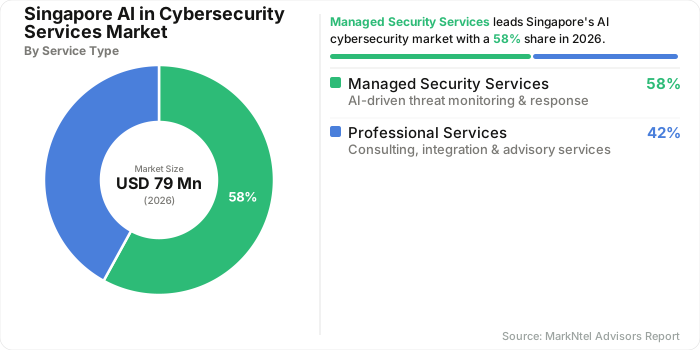
- Managed security services dominate the service landscape, capturing approximately a 58% share in 2026.
- With an estimated 26% share in 2026, BFSI remains the dominant industry vertical.
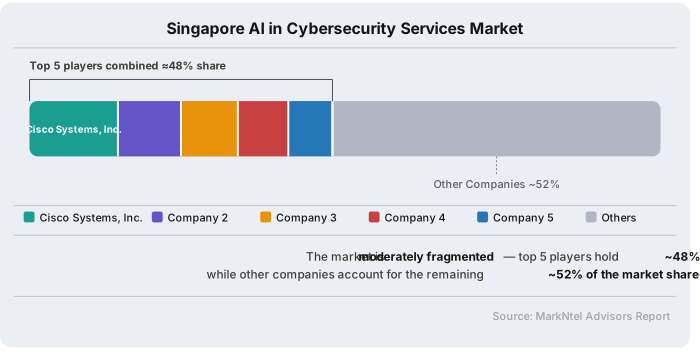
- The industry remains moderately fragmented, with the top five players collectively contributing nearly 48% share, reflecting a mix of global dominance and strong regional service specialization.
Singapore AI in Cybersecurity Services Market Size and Outlook
The Singapore AI in cybersecurity services market is projected to witness steady growth at a CAGR of 13.06% during the forecast period. This growth reflects increasing enterprise reliance on AI-enabled protection frameworks, as organizations adopt advanced AI security platforms to secure digital assets, manage complex cyber threats, and enhance operational resilience across financial services, government systems, and telecom infrastructure environments.
Singapore’s expanding digital economy continues to act as a fundamental growth driver. As per the IMDA, the digital economy reached USD 94.8 billion, accounting for 18.6% of GDP in 2024. This rapid digitalisation is significantly increasing exposure to cyber risks, accelerating adoption of cloud security solutions to protect distributed workloads, digital services, and interconnected data ecosystems across sectors undergoing large-scale digital transformation initiatives and cloud migration strategies.
Government-led investments are further reinforcing long-term market expansion and innovation. Budget 2025 allocated USD 2.2 billion to the National Productivity Fund for artificial intelligence and quantum computing, alongside USD 111.9 million under the Enterprise Compute Initiative . In addition, Singapore committed USD 779 million toward public AI research through 2030, expanding deployment of AI systems and increasing demand for security automation tools to ensure system monitoring, regulatory compliance, and secure AI lifecycle management .
Looking ahead, increasing AI adoption, regulatory strengthening, and digital infrastructure expansion will continue to elevate cybersecurity priorities across industries. Enterprises are expected to invest in integrated, AI-driven protection strategies to improve efficiency, resilience, and risk management capabilities. Reflecting these trends, the Singapore AI in cybersecurity services market is projected to grow from USD 79 million in 2026 to USD 165 million by 2032. In conclusion, sustained policy support, technological advancement, and enterprise digitalisation are expected to position Singapore AI in the cybersecurity services industry for stable, resilient, and long-term growth across evolving digital ecosystems and threat landscapes.
Singapore AI in Cybersecurity Services Market Key Indicators
- The rapid acceleration of enterprise AI adoption is reshaping cybersecurity demand dynamics. According to IMDA, AI adoption among SMEs rose from 4.2% to 14.5% in 2024, while non-SME adoption reached 62.5%. This expansion significantly increases exposure points across digital ecosystems, driving demand for AI threat detection solutions to secure models, pipelines, and inference environments across sectors.
- Singapore’s expanding technology workforce is strengthening the delivery backbone for advanced cybersecurity services. IMDA reported that the tech workforce grew to 214,000 in 2024, with AI and cybersecurity roles among the fastest-expanding segments. This workforce growth enhances service scalability and supports the deployment of cybersecurity automation solutions across enterprise and government clients requiring continuous monitoring and rapid response capabilities.
- A sharp rise in connected devices is increasing the need for structured security assurance frameworks. The Cyber Security Agency of Singapore confirmed that over 500 devices were certified under its Cybersecurity Labelling Scheme by September 2024, with international recognition. This expansion of IoT ecosystems is directly fueling demand for network security analytics to assess vulnerabilities and ensure compliance across interconnected environments.
- Despite a decline in total scam losses to approximately USD 678 million in 2025, Singapore recorded 41,974 cybercrime cases, indicating sustained threat activity . High incident volumes across sectors such as BFSI and e-commerce are reinforcing investments in cyber risk analytics, particularly for fraud detection, identity protection, and incident response systems designed to mitigate financial and reputational risks.
Singapore AI in Cybersecurity Services Market Scope
| Category | Segments |
|---|---|
| By Service Type | Managed Security Services, Professional Services (Consulting Services, Integration & Deployment, Support & Maintenance, Training & Education |
| By Security Type | Network Security, Application Security, Cloud Security, Endpoint Security, Data Security, Identity & Access Management (IAM), Others |
| By Security Function | Threat Detection & Monitoring, Threat Investigation & Response, Security Analytics, Risk, Compliance & Governance, Incident Response Automation |
| By AI Capability | Predictive Analytics, Anomaly & Behavioral Detection, Intelligent Automation, Threat Intelligence Generation |
| By Application | Fraud Detection & Prevention, Vulnerability & Exposure Management, Security Operations |
| By Deployment Mode | On-Premises, Cloud-Based, Hybrid |
| By Organization Size | Large Enterprises, Small & Medium Enterprises (SMEs |
| By Industry Vertical | BFSI, Healthcare & Life Sciences, IT & Telecom, Government & Defense, Retail & E-Commerce, Energy & Utilities, Transportation & Logistics, Others |
Singapore AI in Cybersecurity Services Market Growth Drivers
Growing Cyber Laws Accelerating Security Services Demand
Singapore’s evolving regulatory framework is a primary force accelerating demand for cybersecurity services across critical sectors. The Cybersecurity (Amendment) Act 2024 significantly expands oversight beyond Critical Information Infrastructure operators, requiring organizations in sectors to implement continuous monitoring, audits, and incident reporting . This regulatory tightening is directly increasing enterprise investments to address the cybersecurity talent shortage through automated and managed security frameworks.
Complementing legislative expansion, the Cyber Security Agency of Singapore has strengthened national cybersecurity standards by enhancing its Cyber Essentials and Cyber Trust certification schemes. The inclusion of artificial intelligence, cloud, and operational technology security requirements reflects rising enterprise reliance on cloud security demand, pushing organizations to adopt more advanced and scalable protection mechanisms.
The availability of up to 70% co-funding for SMEs further accelerates adoption, enabling smaller enterprises to implement robust security infrastructures that were previously cost-prohibitive. This policy-driven support is encouraging broader uptake of AI-driven security tools and managed services , while also improving baseline cyber hygiene across industries and strengthening national digital resilience.
This regulatory expansion, stricter certification frameworks, and financial incentives are transforming cybersecurity into a strategic investment priority, reinforcing sustained growth in the Singapore AI in cybersecurity services industry. Organizations are increasingly adopting scalable, compliance-driven, and AI-enabled security architectures to meet evolving regulatory mandates while strengthening resilience against sophisticated cyber threats.
Recent Trends
Adoption of Post-Quantum Cryptography Reshaping Security Frameworks
The adoption of quantum-safe cryptography is emerging as a defining trend in Singapore’s cybersecurity landscape, particularly within financial and critical infrastructure sectors. The Monetary Authority of Singapore has urged institutions to adopt cryptographic agility and post-quantum cryptography, reflecting growing awareness of future threats posed by quantum computing, alongside the increasing cybersecurity risks associated with generative AI.
To support this transition, MAS proposed an additional USD 74 million under its Financial Sector Technology and Innovation grant, enabling financial institutions to invest in quantum-resistant security frameworks . This funding initiative is accelerating innovation in AI threat detection systems designed to safeguard sensitive financial data against evolving computational threats.
Practical implementation is already underway through collaborative industry initiatives. Between September 2024 and March 2025, leading banks and technology partners conducted a Quantum Key Distribution sandbox, generating up to 6.75 million encryption keys daily. This large-scale deployment demonstrates the operational viability of quantum-secure systems while advancing zero trust adoption across high-security financial communication environments.
These advancements highlight a decisive transition toward future-proof cybersecurity architectures across Singapore’s financial ecosystem. As institutions accelerate investments in quantum-resilient encryption and secure communication frameworks, demand for advanced cybersecurity services is expected to rise steadily, positioning the Singapore AI in Cybersecurity Services industry for sustained innovation and long-term data protection leadership.
Singapore AI in Cybersecurity Services Market Opportunities and Challenges
Regulatory Pressure Accelerating Privacy-Centric Cybersecurity Solutions
Singapore’s tightening data privacy framework is creating operational challenges for enterprises deploying AI-driven systems across data-intensive environments. The Personal Data Protection Commission introduced guidelines in 2024 governing the use of personal data in AI systems, significantly increasing PDPA compliance requirements. These restrictions limit how organizations collect, process, and transfer data, particularly affecting cross-border analytics and large-scale AI model training initiatives.
Regulatory enforcement is also intensifying, with penalties imposed in 2025 following data breaches affecting approximately 689,000 individuals. Such developments highlight the growing financial and reputational risks associated with non-compliance, placing additional pressure on organizations already facing a widening cybersecurity workforce gap and limited in-house expertise to manage complex regulatory obligations.
However, these constraints are simultaneously creating strong demand for privacy-enhancing technologies and advanced data governance solutions. The expansion of the PET Sandbox by the Infocomm Media Development Authority in 2024, including generative AI use cases, is enabling enterprises to securely test and deploy AI models using privacy-preserving techniques such as synthetic data and secure computation.
This regulatory tightening is transforming compliance challenges into a structural growth driver, accelerating adoption of AI governance frameworks and privacy-focused cybersecurity solutions. This shift is expected to significantly expand demand across the Singapore AI in cybersecurity services market, reinforcing long-term innovation in secure and compliant AI deployment.
Segmentation Insights
Managed Security Services Dominating Service Type Landscape
Managed Security Services dominate the service type segment, accounting for approximately 58% of total revenue in the Singapore AI in cybersecurity services market. This dominance is driven by increasing enterprise reliance on outsourced security operations, particularly as organizations seek scalable solutions to address evolving cyber threats without expanding internal teams or infrastructure investments.
The segment’s growth is closely linked to rising adoption of SOC services in Singapore, where enterprises leverage third-party providers for continuous monitoring, threat detection, and incident response. These services are particularly critical for organizations lacking in-house expertise, enabling them to maintain real-time visibility and rapid response capabilities across increasingly complex digital environments.
Professional services, including consulting, integration and deployment, support and maintenance, and training and education, continue to play a complementary role. Organizations are increasingly engaging providers offering MDR (managed detection response) and AI security analytics to strengthen threat intelligence, improve system integration, and enhance overall cybersecurity posture across hybrid and cloud-based infrastructures.
The growing complexity of cyber threats and operational constraints is reinforcing the shift toward service-based cybersecurity models. This trend is expected to sustain the leadership of managed services within the Singapore AI in cybersecurity services industry, while driving continued demand for integrated, intelligence-driven security solutions across enterprise segments. The service type segment is categorized into the following components:
- Managed Security Services
- Professional Services
- Consulting Services
- Integration & Deployment
- Support & Maintenance
- Training & Education
BFSI Sector Leading Cybersecurity Demand in Singapore
The BFSI sector leads the end-user segment, accounting for approximately 50% of total demand in the Singapore AI in cybersecurity services market. This dominance is driven by high exposure to financial fraud, regulatory compliance requirements, and the need to secure sensitive customer data, positioning financial institutions as primary adopters of advanced cybersecurity frameworks and solutions.
The sector’s reliance on cybersecurity solutions for BFSI sector continues to intensify as digital banking, fintech platforms, and real-time payment systems expand. Organizations are increasingly adopting fintech cybersecurity tools to strengthen fraud detection, identity protection, and transaction monitoring, ensuring resilience against sophisticated cyberattacks targeting financial ecosystems.
Other sectors, including healthcare, IT and telecom, government and defense, and retail, are also witnessing rising cybersecurity investments. These industries are prioritizing data protection cybersecurity to safeguard critical infrastructure, patient records, digital services, and consumer data, particularly as cloud adoption and digital transformation initiatives accelerate across Singapore’s economy.
Collectively, sector-specific risk exposure and regulatory pressures are shaping demand patterns across industries. While BFSI remains dominant, expanding cybersecurity requirements across diverse verticals are expected to drive broader adoption, reinforcing long-term growth in the Singapore AI in cybersecurity services industry. The key industry vertical mapped in the study involves:
- BFSI
- Healthcare & Life Sciences
- IT & Telecom
- Government & Defense
- Retail & E-Commerce
- Energy & Utilities
- Transportation & Logistics
- Others
Singapore AI in Cybersecurity Services Market Competitive Analysis
The Singapore AI in cybersecurity services industry is led by key players including Palo Alto Networks, Inc., Cisco Systems, Inc., Fortinet, Inc., International Business Machines Corporation, and CrowdStrike Holdings, Inc., which collectively account for an estimated 48% market share. The industry remains moderately fragmented, with strong participation from regional specialists like Ensign InfoSecurity Pte. Ltd. and Horangi Pte. Ltd. Global firms dominate high-value enterprise contracts, while local players focus on managed and compliance-driven services.
Key Players in Singapore AI in Cybersecurity Services Market
- Ensign InfoSecurity Pte. Ltd.
- Horangi Pte. Ltd.
- Palo Alto Networks, Inc.
- International Business Machines Corporation (IBM)
- Cisco Systems, Inc.
- Fortinet, Inc.
- CrowdStrike Holdings, Inc.
- Darktrace Holdings Ltd
- Group-IB Global Private Limited
- Singapore Technologies Engineering Ltd (ST Engineering)
- Others
Singapore AI in Cybersecurity Services Industry News and Recent Developments
May 2026: KPMG Launches Trusted AI Centre of Excellence in Singapore
KPMG launched its Trusted AI Centre of Excellence (AI CoE) in Singapore in May 2026 with support from the Singapore Economic Development Board (EDB). The initiative focuses on AI governance, assurance, risk management, and enterprise AI deployment, while introducing a Trusted AI Assurance framework aligned with international standards. The centre aims to help organizations scale AI adoption securely while strengthening workforce readiness and responsible AI implementation.
Impact Analysis: The development strengthens Singapore’s position as a regional hub for trusted AI deployment and cybersecurity governance. As enterprises face increasing regulatory scrutiny around AI systems, demand for AI assurance, governance consulting, compliance validation, and cybersecurity risk assessment services is expected to rise. The initiative also expands local cybersecurity capabilities through Singapore-based AI specialists and supports wider adoption of secure AI frameworks across financial services, healthcare, manufacturing, and government sectors.
October 2025: ST Engineering Establishes AI Cybersecurity Centre of Excellence
Singapore Technologies Engineering Ltd established a Cybersecurity Centre of Excellence focused on developing agentic AI-driven cybersecurity solutions. Supported by Digital Industry Singapore and the Cyber Security Agency of Singapore, the centre will expand from 26 specialists to 81 professionals, focusing on AI security, 5G protection, OT cybersecurity, threat response, and security testing capabilities.
Impact Analysis: The centre enhances Singapore’s capability to develop autonomous cybersecurity technologies and next-generation Security Operations Centres (SOCs). Its focus on AI-driven threat detection, digital forensics, and incident response is expected to accelerate innovation in managed security services. The initiative also addresses cybersecurity talent development through partnerships with educational institutions, strengthening the long-term supply of AI-enabled cybersecurity expertise while improving protection for critical infrastructure and enterprise networks.
September 2025: StarHub and Vectra AI Introduce AI-Powered Threat Detection Platform
StarHub Ltd partnered with Vectra AI to launch an AI-powered threat detection platform for enterprises in Singapore. The collaboration integrates Vectra AI’s Network Detection and Response (NDR) technology with StarHub’s hybrid IT infrastructure, enabling enterprises to detect, investigate, and respond to increasingly sophisticated cyber threats across modern digital environments.
Impact Analysis: The launch reflects rising enterprise demand for AI-augmented cybersecurity services as attack surfaces expand across cloud, hybrid, and distributed environments. The platform strengthens real-time threat visibility and automated response capabilities, supporting sectors such as BFSI, telecom, and large enterprises. It also reinforces the growing shift toward AI-driven managed detection and response services, positioning Singapore as a leading adopter of intelligent cybersecurity operations across Southeast Asia.
- Market Segmentation
- Introduction
- Product Definition
- Research Process
- Assumptions
- Executive Summary
- Singapore AI in Cybersecurity Services Market Policies, Regulations, and Product Standards
- Singapore AI in Cybersecurity Services Market Trends & Developments
- Singapore AI in Cybersecurity Services Market Dynamics
- Growth Factors
- Challenges
- Singapore AI in Cybersecurity Services Market Hotspot & Opportunities
- Singapore AI in Cybersecurity Services Market Outlook, 2022-2032F
- Market Size & Outlook
- By Revenues (USD Million)
- Market Share & Outlook
- By Service Type - Market Size & Forecast 2022-2032, USD Million
- Managed Security Services
- Professional Services
- Consulting Services
- Integration & Deployment
- Support & Maintenance
- Training & Education
- By Security Type - Market Size & Forecast 2022-2032, USD Million
- Network Security
- Application Security
- Cloud Security
- Endpoint Security
- Data Security
- Identity & Access Management (IAM)
- Others
- By Security Function - Market Size & Forecast 2022-2032, USD Million
- Threat Detection & Monitoring
- Threat Investigation & Response
- Security Analytics
- Risk, Compliance & Governance
- Incident Response Automation
- By AI Capability - Market Size & Forecast 2022-2032, USD Million
- Predictive Analytics
- Anomaly & Behavioral Detection
- Intelligent Automation
- Threat Intelligence Generation
- By Application - Market Size & Forecast 2022-2032, USD Million
- Fraud Detection & Prevention
- Vulnerability & Exposure Management
- Security Operations
- By Deployment Mode - Market Size & Forecast 2022-2032, USD Million
- On-Premises
- Cloud-Based
- Hybrid
- By Organization Size - Market Size & Forecast 2022-2032, USD Million
- Large Enterprises
- Small & Medium Enterprises (SMEs)
- By Industry Vertical- Market Size & Forecast 2022-2032, USD Million
- BFSI
- Healthcare & Life Sciences
- IT & Telecom
- Government & Defense
- Retail & E-Commerce
- Energy & Utilities
- Transportation & Logistics
- Others
- By Region- Market Size & Forecast 2022-2032, USD Million
- North
- South
- East
- West
- Central
- By Company
- Competition Characteristics
- Market Share & Analysis
- By Service Type - Market Size & Forecast 2022-2032, USD Million
- Market Size & Outlook
- Singapore Network Security Market Outlook, 2022-2032
- Market Size & Outlook
- By Revenues (USD Million)
- Market Share & Outlook
- By Security Type - Market Size & Forecast 2022-2032, USD Million
- By Security Function - Market Size & Forecast 2022-2032, USD Million
- By AI Capability - Market Size & Forecast 2022-2032, USD Million
- By Application - Market Size & Forecast 2022-2032, USD Million
- By Deployment Mode - Market Size & Forecast 2022-2032, USD Million
- By Organization Size - Market Size & Forecast 2022-2032, USD Million
- By Industry Vertical- Market Size & Forecast 2022-2032, USD Million
- By Region- Market Size & Forecast 2022-2032, USD Million
- Market Size & Outlook
- Singapore Application Security Market Outlook, 2022-2032
- Market Size & Outlook
- By Revenues (USD Million)
- Market Share & Outlook
- By Security Type - Market Size & Forecast 2022-2032, USD Million
- By Security Function - Market Size & Forecast 2022-2032, USD Million
- By AI Capability - Market Size & Forecast 2022-2032, USD Million
- By Application - Market Size & Forecast 2022-2032, USD Million
- By Deployment Mode - Market Size & Forecast 2022-2032, USD Million
- By Organization Size - Market Size & Forecast 2022-2032, USD Million
- By Industry Vertical- Market Size & Forecast 2022-2032, USD Million
- By Region- Market Size & Forecast 2022-2032, USD Million
- Market Size & Outlook
- Singapore Cloud Security Market Outlook, 2022-2032
- Market Size & Outlook
- By Revenues (USD Million)
- Market Share & Outlook
- By Security Type - Market Size & Forecast 2022-2032, USD Million
- By Security Function - Market Size & Forecast 2022-2032, USD Million
- By AI Capability - Market Size & Forecast 2022-2032, USD Million
- By Application - Market Size & Forecast 2022-2032, USD Million
- By Deployment Mode - Market Size & Forecast 2022-2032, USD Million
- By Organization Size - Market Size & Forecast 2022-2032, USD Million
- By Industry Vertical- Market Size & Forecast 2022-2032, USD Million
- By Region- Market Size & Forecast 2022-2032, USD Million
- Market Size & Outlook
- Singapore Endpoint Security Market Outlook, 2022-2032
- Market Size & Outlook
- By Revenues (USD Million)
- Market Share & Outlook
- By Security Type - Market Size & Forecast 2022-2032, USD Million
- By Security Function - Market Size & Forecast 2022-2032, USD Million
- By AI Capability - Market Size & Forecast 2022-2032, USD Million
- By Application - Market Size & Forecast 2022-2032, USD Million
- By Deployment Mode - Market Size & Forecast 2022-2032, USD Million
- By Organization Size - Market Size & Forecast 2022-2032, USD Million
- By Industry Vertical- Market Size & Forecast 2022-2032, USD Million
- By Region- Market Size & Forecast 2022-2032, USD Million
- Market Size & Outlook
- Singapore Data Security Market Outlook, 2022-2032
- Market Size & Outlook
- By Revenues (USD Million)
- Market Share & Outlook
- By Security Type - Market Size & Forecast 2022-2032, USD Million
- By Security Function - Market Size & Forecast 2022-2032, USD Million
- By AI Capability - Market Size & Forecast 2022-2032, USD Million
- By Application - Market Size & Forecast 2022-2032, USD Million
- By Deployment Mode - Market Size & Forecast 2022-2032, USD Million
- By Organization Size - Market Size & Forecast 2022-2032, USD Million
- By Industry Vertical- Market Size & Forecast 2022-2032, USD Million
- By Region- Market Size & Forecast 2022-2032, USD Million
- Market Size & Outlook
- Singapore Identity & Access Management (IAM) Market Outlook, 2022-2032
- Market Size & Outlook
- By Revenues (USD Million)
- Market Share & Outlook
- By Security Type - Market Size & Forecast 2022-2032, USD Million
- By Security Function - Market Size & Forecast 2022-2032, USD Million
- By AI Capability - Market Size & Forecast 2022-2032, USD Million
- By Application - Market Size & Forecast 2022-2032, USD Million
- By Deployment Mode - Market Size & Forecast 2022-2032, USD Million
- By Organization Size - Market Size & Forecast 2022-2032, USD Million
- By Industry Vertical- Market Size & Forecast 2022-2032, USD Million
- By Region- Market Size & Forecast 2022-2032, USD Million
- Market Size & Outlook
- Singapore AI in Cybersecurity Services Market Key Strategic Imperatives for Success & Growth
- Competitive Outlook
- Company Profiles
- Ensign InfoSecurity Pte. Ltd.
- Business Description
- Product Portfolio
- Collaborations & Alliances
- Recent Developments
- Financial Details
- Others
- Horangi Pte. Ltd.
- Business Description
- Product Portfolio
- Collaborations & Alliances
- Recent Developments
- Financial Details
- Others
- Palo Alto Networks, Inc.
- Business Description
- Product Portfolio
- Collaborations & Alliances
- Recent Developments
- Financial Details
- Others
- International Business Machines Corporation (IBM)
- Business Description
- Product Portfolio
- Collaborations & Alliances
- Recent Developments
- Financial Details
- Others
- Cisco Systems, Inc.
- Business Description
- Product Portfolio
- Collaborations & Alliances
- Recent Developments
- Financial Details
- Others
- Fortinet, Inc.
- Business Description
- Product Portfolio
- Collaborations & Alliances
- Recent Developments
- Financial Details
- Others
- CrowdStrike Holdings, Inc.
- Business Description
- Product Portfolio
- Collaborations & Alliances
- Recent Developments
- Financial Details
- Others
- Darktrace Holdings Ltd
- Business Description
- Product Portfolio
- Collaborations & Alliances
- Recent Developments
- Financial Details
- Others
- Group-IB Global Private Limited
- Business Description
- Product Portfolio
- Collaborations & Alliances
- Recent Developments
- Financial Details
- Others
- Singapore Technologies Engineering Ltd (ST Engineering)
- Business Description
- Product Portfolio
- Collaborations & Alliances
- Recent Developments
- Financial Details
- Others
- Others
- Ensign InfoSecurity Pte. Ltd.
- Company Profiles
- Disclaimer

MarkNtel Advisors follows a robust and iterative research methodology designed to ensure maximum accuracy and minimize deviation in market estimates and forecasts. Our approach combines both bottom-up and top-down techniques to effectively segment and quantify various aspects of the market. A consistent feature across all our research reports is data triangulation, which examines the market from three distinct perspectives to validate findings. Key components of our research process include:
1. Scope & Research Design At the outset, MarkNtel Advisors define the research objectives and formulate pertinent questions. This phase involves determining the type of research—qualitative or quantitative—and designing a methodology that outlines data collection methods, target demographics, and analytical tools. They also establish timelines and budgets to ensure the research aligns with client goals.
2. Sample Selection and Data Collection In this stage, the firm identifies the target audience and determines the appropriate sample size to ensure representativeness. They employ various sampling methods, such as random or stratified sampling, based on the research objectives. Data collection is carried out using tools like surveys, interviews, and observations, ensuring the gathered data is reliable and relevant.
3. Data Analysis and Validation Once data is collected, MarkNtel Advisors undertake a rigorous analysis process. This includes cleaning the data to remove inconsistencies, employing statistical software for quantitative analysis, and thematic analysis for qualitative data. Validation steps are taken to ensure the accuracy and reliability of the findings, minimizing biases and errors.

4. Data Forecast and FinalizationThe final phase involves forecasting future market trends based on the analyzed data. MarkNtel Advisors utilize predictive modeling and time series analysis to anticipate market behaviors. The insights are then compiled into comprehensive reports, featuring visual aids like charts and graphs, and include strategic recommendations to inform client decision-making
We’d love to understand what matters most to you.