

By Equipment Type (Crushers, Grinding Mills, Screens, Feeders, Conveyors, Flotation Equipment, Thickeners, Filters, Material Handling Systems, Mineral Processing Plants, Others), By Power Source (Dies... ... y Power Source (Diesel, Electric, Hybrid Systems), By Spare Parts Type (Wear Parts, Crusher Liners and Mantles, Mill Liners, Conveyor Belts and Components, Pumps and Valves, Bearings and Mechanical Components, Hydraulic Components, Electrical and Electronic Components, Motors and Drives, Filters and Seals), By Automation Level (Manual Equipment, Semi-Autonomous Equipment, Fully Autonomous Equipment), By Mining Type (Coal Mining, Copper Mining, Gold Mining, Iron Ore Mining, Fluorspar Mining, Others), By End User (Large Mining Companies, Mid-Sized Mining Companies, Small Mining Operators, Mineral Processing Plants, Contract Mining Service Providers), By Sales Channel (Direct Sales, Authorized Dealers and Distributors, OEM Aftermarket Services, Independent Spare Parts Suppliers, Online Procurement Platforms) Read more
- Buildings, Construction, Metals & Mining
- Aug 2026
- 180
- PDF, Excel, PPT
Mongolia Fixed Mining Equipment Market Key Takeaways
- The Mongolia fixed mining equipment market was valued at approximately USD 71 million in 2025 and is projected to reach USD 75 million in 2026 and USD 86 million by 2032.
- The industry is projected to witness steady growth at a CAGR of 2.3% during 2026–2032.
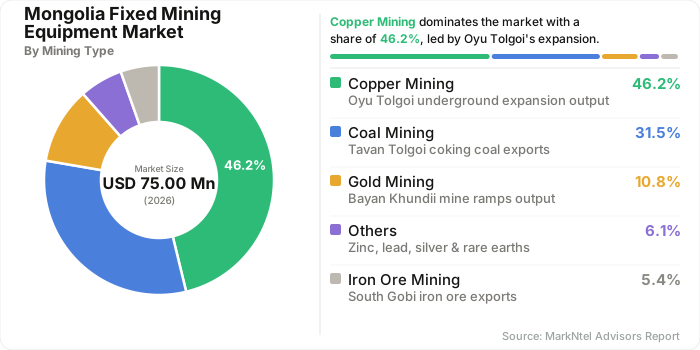
- Copper mining remains the dominant mining-type segment, accounting for 46.2% of market demand in 2026.
- Grinding mills lead by equipment type, projected to account for approximately 26.5% of market revenue by 2026.
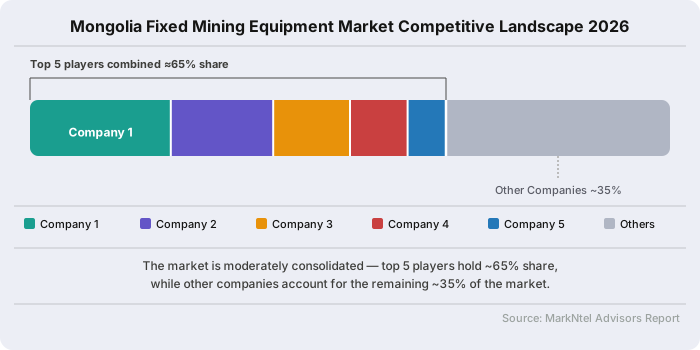
- The market exhibits a moderately consolidated competitive structure, with the top 5 companies collectively accounting for approximately 65% of market revenue in 2026.
Mongolia Fixed Mining Equipment Market Size and Outlook
The fixed mining equipment market in Mongolia is valued at approximately USD 71 million in 2025, estimated to reach USD 75 million in 2026, and projected to expand to approximately USD 86 million by 2032, registering a CAGR of 2.3% during 2026–2032.
Growth is structurally supported by the Industrial Recovery pillar of Mongolia’s New Recovery Policy, a ten-year program adopted by Parliament in 2021 that promotes domestic deep processing of coal and minerals rather than raw-material exports. This policy direction is strengthening demand for fixed crushing, grinding, screening, washing, conveying, and beneficiation equipment.
Market expansion is further supported by the economic importance of mining and the country’s ongoing processing-capacity investments. Mining and quarrying, including coal, contributed approximately 28% of Mongolia’s USD 23.6 billion GDP, equivalent to around USD 6.6 billion, highlighting the sector’s substantial contribution to national economic activity and its capacity to support capital-intensive infrastructure investments.
Long term equipment demand is reinforced by Erdenes Tavan Tolgoi JSC’s coal concentration complex, where the first 10-million-tonne-per-year module reached full-capacity operation in December 2024, while the remaining two 10-million-tonne modules are scheduled for commissioning in 2026. The resulting 30-million-tonne-per-year planned processing capacity is expected to expand Mongolia’s fixed coal-washing equipment base and sustain market growth through 2032.
Mongolia Fixed Mining Equipment Market Key Indicators
- According to the National Statistics Office of Mongolia (NSO), Mongolia records approximately 95.5 million tonnes of coal production in 2025, establishing a substantial throughput base for fixed crushing, screening, feeding, conveying, coal-washing, and bulk material-handling systems and reinforcing coal mining as a major equipment-demand application.
- As per the Oyu Tolgoi, the underground operation targets approximately 500,000 tonnes of annual copper production at full ramp-up, supporting sustained utilization, expansion, and modernization of fixed crushing, conveying, grinding, flotation, thickening, and filtration systems across the copper-processing value chain.
- By the National Statistics Office of Mongolia (NSO), gross fixed capital formation within the national extractives and mineral-processing sector increases by 11.4% year-over-year to reach USD 1.25 billion, indicating sustained capital allocation toward stationary processing infrastructure, plant modernization, and capacity-expansion projects that support demand for fixed mining equipment.
- The Mongolia's Ministry of Economy and Development, mining accounts for approximately 70% of national industrial output, demonstrating the structural importance of mineral extraction to the industrial economy and supporting continued investment in high-capacity fixed processing and material-handling infrastructure.
- According to Mongolian Mining Corporation (MMC), the Ukhaa Khudag coal-processing complex operates with an installed washing capacity of approximately 15 million tonnes per year, demonstrating the scale of fixed coal-processing infrastructure and supporting demand for screens, crushers, dense-medium separation, conveyors, pumps, and dewatering equipment.
Mongolia Fixed Mining Equipment Market Scope
| Category | Segments |
|---|---|
| By Equipment Type | Crushers, Grinding Mills, Screens, Feeders, Conveyors, Flotation Equipment, Thickeners, Filters, Material Handling Systems, Mineral Processing Plants, Others |
| By Power Source | Diesel, Electric, Hybrid Systems |
| By Spare Parts Type | Wear Parts, Crusher Liners and Mantles, Mill Liners, Conveyor Belts and Components, Pumps and Valves, Bearings and Mechanical Components, Hydraulic Components, Electrical and Electronic Components, Motors and Drives, Filters and Seals |
| By Automation Level | Manual Equipment, Semi-Autonomous Equipment, Fully Autonomous Equipment |
| By Mining Type | Coal Mining, Copper Mining, Gold Mining, Iron Ore Mining, Fluorspar Mining, Others |
| By End User | Large Mining Companies, Mid-Sized Mining Companies, Small Mining Operators, Mineral Processing Plants, Contract Mining Service Providers |
| By Sales Channel | Direct Sales, Authorized Dealers and Distributors, OEM Aftermarket Services, Independent Spare Parts Suppliers, Online Procurement Platforms |
Mongolia Fixed Mining Equipment Market Growth Driver
New Recovery Policy’s Industrial Recovery Mandate Fuels Fixed Processing-Plant Equipment Demand
Mongolia’s structural shift from raw-mineral exports toward domestic value-added processing is a primary driver of fixed mining equipment demand. The government’s New Recovery Policy explicitly prioritizes industrial recovery through the staged development of value-added mining-processing plants, expansion of processing capacity, and development of value-adding heavy industry. The policy also identifies comprehensive development of Tavan Tolgoi coal deposits and increased processing of Erdenet and Oyu Tolgoi copper resources as priority projects, directly supporting demand for crushers, grinding mills, screens, conveyors, flotation systems, thickeners, filters, and integrated processing plants.
This policy mandate is translating into substantial operator-level capital deployment. Erdenet Mining Corporation approves a 2026 investment program of approximately USD 217 million, while continuing Phase I of its ore-preparation line, thickened-tailings technology, tailings-storage development, and copper-processing initiatives. The company indicates that annual investment averaged approximately USD 308-336 million over the preceding four years. This sustained capital allocation strengthens demand for stationary comminution, material-handling, dewatering, and mineral-processing equipment and supports continued modernization of Mongolia’s fixed mining-equipment installed base.
Recent Trend
Transition to High-Efficiency SAG Mills and Gearless Mill
Mongolia’s transition toward deeper underground copper mining is increasing demand for high-throughput, energy-efficient comminution systems. Technical documentation from Oyu Tolgoi indicates that ore extracted from the Hugo North Lift 1 underground block cave exhibits higher rock-hardness characteristics, with a Bond Work Index exceeding 16.5 kWh/t. Higher ore hardness increases grinding-energy requirements, supporting adoption of semi-autogenous grinding (SAG) mills, variable-speed drives, and gearless mill drives (GMDs) that enable operating adjustments according to changing ore characteristics and throughput requirements.
Equipment manufacturers are also adapting grinding systems to Mongolia’s severe operating environment, where sub-zero winter temperatures can affect mechanical availability. Metso’s customized grinding-mill configurations incorporate dual-pinion drives and modular poly-metallic wear liners for demanding mining applications. These technologies strengthen equipment durability and support continuous processing under harsh climatic conditions. Consequently, Mongolia’s fixed mining equipment industry is witnessing increasing demand for SAG mills, GMDs, advanced wear liners, mill components, and specialized cold-weather engineering, alongside recurring aftermarket and maintenance requirements.
Mongolia Fixed Mining Equipment Market Opportunities and Challenges
Extreme Sub-Zero Conditions and Thermal Stress Accelerate Demand for Advanced Comminution Wear Components
Operating fixed mineral-processing infrastructure in Mongolia’s South Gobi region creates significant mechanical challenges because winter temperatures can fall below -35°C. According to operational assessment reports from the Mongolian National Mining Association (MNMA), such conditions increase brittleness in standard high-manganese steel crusher jaw plates, conveyor belts, and slurry-pump casings. This thermal stress leads to an average of 340 hours of unprogrammed plant downtime annually across Gobi mining operations, increasing maintenance expenditure and disrupting processing throughput.
This operating challenge creates an opportunity for suppliers of thermal-shock-resistant wear liners, cold-resistant alloys, reinforced conveyor belting, and modular replacement components. FLSmidth reports that cold-resistant composite crushing liners and reinforced steel-cord conveyor belting rated for temperatures as low as -50°C can reduce structural wear rates by approximately 28%. Adoption of these engineered solutions enables mining operators to improve winter equipment availability, reduce unplanned maintenance, and maintain stable processing throughput, supporting recurring demand for specialized aftermarket components.
Segmentation Insights
Mongolia’s Copper Frontier Drives Fixed-Equipment Investment
The copper mining sub-segment commands the largest market share, projected to capture 46.2% of industry share in 2026. Mongolia is exceptionally rich in copper, with some of the world’s largest active and relatively untapped deposits concentrated across the South Gobi and northern regions. The scale of Oyu Tolgoi further demonstrates this resource potential, with the operation targeting approximately 500,000 tonnes of annual copper production at full ramp-up, creating sustained requirements for large-scale mining and mineral-processing infrastructure.
The segment is further supported by Oyu Tolgoi and Erdenet, Mongolia’s two major copper complexes. Oyu Tolgoi’s underground ramp-up is increasing processing requirements, while Erdenet produced a record 574,000 tonnes of copper concentrate in 2025 and approved a USD 217 million investment program for 2026. Future demand is further supported by Oyu Tolgoi’s phased underground development through Panel 1, Panel 2 South, and Panel 2 North through 2036, alongside Erdenet’s ore-preparation modernization. These projects sustain recurring demand for crushers, SAG and ball mills, flotation circuits, thickeners, filtration systems, conveyors, and associated aftermarket components, reinforcing copper mining’s leading position. Based on mining type, the industry is segmented into:
- Coal Mining
- Copper Mining
- Gold Mining
- Iron Ore Mining
- Fluorspar Mining
- Others
High-Intensity Comminution Cycles Position Grinding Mills as Mongolia’s Core Equipment Revenue Engine
Grinding mills are projected to account for approximately 26.5% of Mongolia’s fixed mining equipment industry revenue by 2032, making them the leading equipment-type segment. The segment benefits from the high capital intensity of SAG and ball mills used across Mongolia’s major copper-processing operations. According to engineering metrics from Metso Corporation, high ore abrasiveness in South Gobi copper deposits requires complete replacement of mill shell liners and lifter bars every 6–9 months, creating recurring aftermarket demand alongside new equipment demand.
Future demand is supported by rising emphasis on energy-efficient comminution technologies and modernization of existing processing circuits. FLSmidth highlights increasing adoption of high-pressure grinding rolls (HPGR) in tertiary grinding applications, with the technology capable of reducing electrical power consumption by up to 20% compared with conventional tertiary crushing. As Mongolian operators modernize aging grinding circuits and seek lower processing costs, opportunities expand for SAG mills, ball mills, HPGR systems, advanced liners, grinding drives, and associated aftermarket services, particularly across major copper and mineral-processing plants. Based on equipment type, the industry is segmented into:
- Crushers
- Grinding Mills
- Screens
- Feeders
- Conveyors
- Flotation Equipment
- Thickeners
- Filters
- Material Handling Systems
- Mineral Processing Plants
- Others
Mongolia Fixed Mining Equipment Market Competitive Analysis
The Mongolia fixed mining equipment market exhibits a moderately consolidated competitive structure, with the top five manufacturers Metso, Sandvik, FLSmidth, Caterpillar, and Weir Group estimated to collectively command approximately 65% of market revenue in 2026.
Top Companies in the Mongolia Fixed Mining Equipment industry:
- BASF SE
- Metso
- Sandvik
- FLSmidth
- Caterpillar
- Weir Group
- Thyssenkrupp Mining Technologies
- Komatsu
- McLanahan Corporation
- TAKRAF Group
- MMD Group
- Others
Mongolia Fixed Mining Equipment Industry News and Recent Developments
July 2025: Sandvik Secures USD 30 Million Underground Equipment Order from Oyu Tolgoi
Sandvik received an underground mining equipment order valued at approximately around USD 30 million from Oyu Tolgoi LLC in July 2025. The order includes loaders and trucks, with deliveries scheduled to begin in October 2025 and continue through November 2026. The equipment will support the Oyu Tolgoi copper-gold mine’s underground development, reinforcing demand for high-capacity underground mining equipment and demonstrating continued expansion of Sandvik’s installed equipment base at the operation.
Impact Analysis: The order strengthens Sandvik’s position at Mongolia’s largest underground mining operation and demonstrates the continued procurement of equipment aligned with Oyu Tolgoi’s phased underground ramp-up. The multi-year delivery schedule also supports recurring demand for underground equipment, replacement parts, maintenance, and aftermarket services, while strengthening the competitive position of established OEMs with existing equipment fleets at major Mongolian mines.
December 2024: Erdenes Tavan Tolgoi Begins Full-Scale Operation of First 10 Million-Tonne Coal Concentration Module
Erdenes Tavan Tolgoi JSC completed commissioning of the first 10 million-tonne-per-year coal concentration module, with trial beneficiation beginning in October 2024 and full-capacity operation scheduled for December. The module is designed to process 10 million tonnes of raw coal annually and produce approximately 8 million tonnes of coking coal and 2 million tonnes of thermal coal. The company's three-module complex is planned to reach 30 million tonnes of annual processing capacity, with the remaining modules targeted for commissioning in 2026.
Impact Analysis: The development accelerates Mongolia’s shift from raw-coal exports toward higher-value beneficiated products and directly expands the addressable market for crushers, screens, dense-medium cyclones, flotation equipment, feeders, conveyors, and material-handling systems. The planned expansion from one 10-million-tonne module toward the full 30-million-tonne complex creates additional near-term procurement opportunities for fixed coal-processing equipment and associated aftermarket components
- Market Segmentation
- Introduction
- Product Definition
- Research Process
- Assumptions
- Executive Summary
- Mongolia Fixed Mining Equipment Market Pricing Analysis, By Equipment
- Mongolia Fixed Mining Equipment Market Policies, Regulations, and Product Standards
- Mongolia Fixed Mining Equipment Market Trends & Developments
- Mongolia Fixed Mining Equipment Market Dynamics
- Growth Factors
- Challenges
- Mongolia Fixed Mining Equipment Market Hotspot & Opportunities
- Mongolia Fixed Mining Equipment Market Outlook, 2022-2032F
- Market Size & Outlook
- By Revenues (USD Million)
- Market Share & Analysis
- By Equipment Type - (USD Million)
- Crushers
- Grinding Mills
- Screens
- Feeders
- Conveyors
- Flotation Equipment
- Thickeners
- Filters
- Material Handling Systems
- Mineral Processing Plants
- Others
- By Power Source - (USD Million)
- Diesel
- Electric
- Hybrid Systems
- By Spare Parts Type- (USD Million)
- Wear Parts
- Crusher Liners and Mantles
- Mill Liners
- Conveyor Belts and Components
- Pumps and Valves
- Bearings and Mechanical Components
- Hydraulic Components
- Electrical and Electronic Components
- Motors and Drives
- Filters and Seals
- By Automation Level- (USD Million)
- Manual Equipment
- Semi-Autonomous Equipment
- Fully Autonomous Equipment
- By Mining Type- (USD Million)
- Coal Mining
- Copper Mining
- Gold Mining
- Iron Ore Mining
- Fluorspar Mining
- Others
- By End User- (USD Million)
- Large Mining Companies
- Mid-Sized Mining Companies
- Small Mining Operators
- Mineral Processing Plants
- Contract Mining Service Providers
- By Sales Channel
- Direct Sales
- Authorized Dealers and Distributors
- OEM Aftermarket Services
- Independent Spare Parts Suppliers
- Online Procurement Platforms
- By Company
- Competition Characteristics
- Market Share & Analysis
- By Equipment Type - (USD Million)
- Market Size & Outlook
- Mongolia Fixed Mining Manual Equipment Market Outlook, 2022-2032F
- Market Size & Outlook
- By Revenues (USD Million)
- Market Share & Analysis
- By Equipment Type - (USD Million)
- By Power Source - (USD Million)
- By Spare Parts Type - (USD Million)
- By Mining Type- (USD Million)
- By End User- (USD Million)
- By Sales Channel- (USD Million)
- Market Size & Outlook
- Mongolia Fixed Mining Semi- Autonomous Equipment Market Outlook, 2022-2032F
- Market Size & Outlook
- By Revenues (USD Million)
- Market Share & Analysis
- By Equipment Type - (USD Million)
- By Power Source - (USD Million)
- By Spare Parts Type - (USD Million)
- By Mining Type- (USD Million)
- By End User- (USD Million)
- By Sales Channel- (USD Million)
- Market Size & Outlook
- Mongolia Fixed Mining Fully- Autonomous Equipment Market Outlook, 2022-2032F
- Market Size & Outlook
- By Revenues (USD Million)
- Market Share & Analysis
- By Equipment Type - (USD Million)
- By Power Source - (USD Million)
- By Spare Parts Type - (USD Million)
- By Mining Type- (USD Million)
- By End User- (USD Million)
- By Sales Channel- (USD Million)
- Market Size & Outlook
- Mongolia Fixed Mining Equipment Market Key Strategic Imperatives for Success & Growth
- Competitive Outlook
- Company Profiles
- Metso
- Business Description
- Product Portfolio
- Strategic Alliances or Partnerships
- Recent Developments
- Financial Details
- Others
- Sandvik
- Business Description
- Product Portfolio
- Strategic Alliances or Partnerships
- Recent Developments
- Financial Details
- Others
- FLSmidth
- Business Description
- Product Portfolio
- Strategic Alliances or Partnerships
- Recent Developments
- Financial Details
- Others
- Caterpillar
- Business Description
- Product Portfolio
- Strategic Alliances or Partnerships
- Recent Developments
- Financial Details
- Others
- Weir Group
- Business Description
- Product Portfolio
- Strategic Alliances or Partnerships
- Recent Developments
- Financial Details
- Others
- Thyssenkrupp Mining Technologies
- Business Description
- Product Portfolio
- Strategic Alliances or Partnerships
- Recent Developments
- Financial Details
- Others
- Komatsu
- Business Description
- Product Portfolio
- Strategic Alliances or Partnerships
- Recent Developments
- Financial Details
- Others
- McLanahan Corporation
- Business Description
- Product Portfolio
- Strategic Alliances or Partnerships
- Recent Developments
- Financial Details
- Others
- TAKRAF Group
- Business Description
- Product Portfolio
- Strategic Alliances or Partnerships
- Recent Developments
- Financial Details
- Others
- MMD Group
- Business Description
- Product Portfolio
- Strategic Alliances or Partnerships
- Recent Developments
- Financial Details
- Others
- Others
- Metso
- Company Profiles
- Disclaimer

MarkNtel Advisors follows a robust and iterative research methodology designed to ensure maximum accuracy and minimize deviation in market estimates and forecasts. Our approach combines both bottom-up and top-down techniques to effectively segment and quantify various aspects of the market. A consistent feature across all our research reports is data triangulation, which examines the market from three distinct perspectives to validate findings. Key components of our research process include:
1. Scope & Research Design At the outset, MarkNtel Advisors define the research objectives and formulate pertinent questions. This phase involves determining the type of research—qualitative or quantitative—and designing a methodology that outlines data collection methods, target demographics, and analytical tools. They also establish timelines and budgets to ensure the research aligns with client goals.
2. Sample Selection and Data Collection In this stage, the firm identifies the target audience and determines the appropriate sample size to ensure representativeness. They employ various sampling methods, such as random or stratified sampling, based on the research objectives. Data collection is carried out using tools like surveys, interviews, and observations, ensuring the gathered data is reliable and relevant.
3. Data Analysis and Validation Once data is collected, MarkNtel Advisors undertake a rigorous analysis process. This includes cleaning the data to remove inconsistencies, employing statistical software for quantitative analysis, and thematic analysis for qualitative data. Validation steps are taken to ensure the accuracy and reliability of the findings, minimizing biases and errors.

4. Data Forecast and FinalizationThe final phase involves forecasting future market trends based on the analyzed data. MarkNtel Advisors utilize predictive modeling and time series analysis to anticipate market behaviors. The insights are then compiled into comprehensive reports, featuring visual aids like charts and graphs, and include strategic recommendations to inform client decision-making
We’d love to understand what matters most to you.