

By Offerings (Solutions (Network Security Solutions, Endpoint & Device Security, Identity & Access Management (IAM), Threat Detection & Incident Response, Others), Services), By Deployment Mode (On-Pr... ... ployment Mode (On-Premises, Cloud), By Application (Energy and Power, Financial, Industrial, Transportation & Logistics, Others), By Organization Size (Large Enterprises, Small and Medium-Sized Enterprises), and others Read more
- ICT & Electronics
- May 2026
- 175
- PDF, Excel, PPT
Italy Operational Technology Security Market Report Key Takeaways
- The Italy Operational Technology Security Market was valued at around USD 0.61 billion in 2025 and is projected to grow from USD 0.671 billion in 2026 to USD 1.500 billion by 2032, exhibiting a CAGR of 14.35% during 2026–2032.
- Northern Italy is expected to account for approximately 48% of the total market shares in 2026.
- By offering type, the solutions segment represents a significant share of around 60%.
- By application type, the industrial segment accounts for a significant share of approximately 41%.
- The market is moderately consolidated, with approximately 16 companies; the top five players collectively account for nearly 60% of total market revenue.
Italy Operational Technology Security Market Size and Outlook
The Italy Operational Technology Security Market is expected to grow at a CAGR of 14.35% during 2026–2032, driven by rapid industrial digitalization and the increasing convergence of IT and OT systems across critical infrastructure sectors. Additionally, stringent EU-driven cybersecurity regulations and compliance requirements are compelling organizations to strengthen their security frameworks. The rising frequency of cyber threats targeting industrial environments, coupled with growing investments in advanced security solutions to protect operational assets, is further accelerating market growth.
Moreover, the country’s manufacturing-heavy economy has been modernizing under structured industrial transformation programs such as “Transizione 4.0,” which has accelerated the integration of connected industrial systems and automation across factories. This expansion of industrial IoT and smart production ecosystems has increased exposure to cyber-physical risks, making OT security a critical requirement for industrial operators. The convergence of IT and OT environments has further expanded the attack surface, reinforcing demand for advanced monitoring and protection systems in industrial operations.
A major structural driver of market growth is the regulatory enforcement of the EU NIS2 Directive, which Italy has formally transposed through Legislative Decree No. 138/2024. The Operational Technology Security Market in Italy was valued at around USD 0.61 billion in 2025, reflecting the growing importance of regulatory-driven cybersecurity adoption. The directive imposes mandatory cybersecurity governance, risk management, and incident reporting obligations across essential sectors including energy, transport, manufacturing, healthcare, and digital infrastructure. The Agenzia per la Cybersicurezza Nazionale (ACN) acts as the central authority responsible for enforcement and supervision of cybersecurity compliance in Italy. Additionally, the EU Cyber Resilience Act strengthens security requirements for connected industrial products, reinforcing secure-by-design principles across OT environments.
Industrial and technology players are actively reinforcing OT cybersecurity ecosystems through partnerships and integrated security offerings. For example, Leonardo S.p.A. has expanded cybersecurity solutions specifically targeting industrial and critical infrastructure environments, aligning with Italy’s national security priorities. Similarly, Siemens AG has strengthened industrial cybersecurity capabilities by embedding protection features into automation and digital manufacturing platforms used across European factories. These developments demonstrate how private-sector innovation is aligning with regulatory mandates to secure industrial control systems and critical infrastructure operations.
Looking ahead, Italy’s OT security market is projected to expand from USD 0.671 billion in 2026 to USD 1.500 billion by 2032, reflecting strong future growth momentum. This expansion is expected to be driven by the increasing integration of artificial intelligence, cloud-based industrial systems, and smart infrastructure modernization initiatives. Government-backed cybersecurity frameworks under the Agenzia per la Cybersicurezza Nazionale (ACN) continue to enhance national resilience capabilities and improve incident response readiness across sectors. As industrial environments become more interconnected, demand for real-time threat detection, secure-by-design systems, and supply-chain security enforcement is anticipated to rise across manufacturing, energy, and public infrastructure ecosystems.
Italy Operational Technology Security Industry Key Indicators
- Italy's Piano Nazionale di Ripresa e Resilienza (PNRR) allocated USD 44.1 billion from the Recovery and Resilience Facility to Mission 1 Digitalization, Innovation, Competitiveness, and Culture; utility operators, transport authorities, and industrial concession holders receiving PNRR funds are contractually required to modernize legacy infrastructure, directly accelerating the replacement of end-of-life operational technology (OT) systems with connected, cyber-secure architectures.
- According to the International Organisation of Motor Vehicle Manufacturers (OICA), Italy produced approximately 236,195 motor vehicles in 2023. Automotive assembly plants and Tier-1 supplier facilities across Piedmont and Emilia-Romagna deploy robot controllers, vision systems, and manufacturing execution systems (MES) communicating over OT protocols, linking vehicle production volumes directly to industrial automation infrastructure demand.
Italy Operational Technology Security Market Scope
| Category | Segments |
|---|---|
| By Offerings | Solutions (Network Security Solutions, Endpoint & Device Security, Identity & Access Management (IAM), Threat Detection & Incident Response, Others), Services |
| By Deployment Mode | On-Premises, Cloud |
| By Application | Energy and Power, Financial, Industrial, Transportation & Logistics, Others |
| By Organization Size | Large Enterprises, Small and Medium-Sized Enterprises |
Italy Operational Technology Security Industry Growth Drivers
Regulatory Pressure from EU NIS2 Directive Driving Mandatory OT Cybersecurity Investments
A key structural driver accelerating the Italy Operational Technology Security Market is the enforcement of the EU NIS2 Directive, which has transformed cybersecurity from a voluntary practice into a legally mandated requirement across critical infrastructure sectors.
The directive entered into force in 2023 and expands cybersecurity obligations across 18 high-impact sectors, including energy, manufacturing, transport, healthcare, and digital infrastructure, significantly widening the compliance base . Unlike earlier frameworks, NIS2 introduces stricter governance, risk management, and incident reporting obligations, making cybersecurity a board-level responsibility rather than an IT function. This regulatory shift directly increases demand for OT security solutions such as industrial monitoring, segmentation, and incident response systems.
The driver has intensified in recent years due to its transposition into national laws, including Italy’s Legislative Decree aligned with NIS2 requirements, which extends enforcement authority to national cybersecurity bodies. Member states are required to supervise compliance, enforce penalties, and ensure risk mitigation across essential entities, significantly increasing regulatory oversight intensity. Additionally, ENISA has emphasized that NIS2 expands coverage to a larger share of the economy, bringing more medium and larger industrial operators into mandatory compliance frameworks. This expansion is structurally increasing the installed base of organizations required to invest in OT cybersecurity capabilities.
The economic impact is not limited to initial adoption but creates sustained market volume expansion because compliance requires continuous security upgrades, audits, and monitoring systems. Organizations must implement ongoing risk management measures, supply chain security controls, and incident reporting mechanisms for operational systems, embedding recurring OT cybersecurity spending into budgets. ENISA also highlights that the directive introduces stronger supervision tools and enforcement mechanisms, increasing the cost of non-compliance and accelerating adoption cycles. As a result, demand is structurally amplified across industrial operators, transforming cybersecurity from discretionary spending into a mandatory operational expenditure category.
Recent Trends
AI-Powered Threat Detection in Italy’s OT Security Market
A major structural trend in Italy’s operational technology security market is the rapid adoption of AI-powered threat detection systems. This shift has emerged due to the increasing complexity of cyberattacks targeting industrial environments such as manufacturing plants, energy grids, and logistics networks. Traditional rule-based security tools are no longer sufficient, as OT systems generate massive volumes of real-time machine data that require continuous analysis. As a result, organizations are integrating artificial intelligence and machine learning into security platforms to identify anomalies, predict threats, and automate response actions with minimal human intervention.
This trend is fundamentally transforming security operations within industrial ecosystems. Instead of relying on manual monitoring or delayed incident response, enterprises are moving toward real-time, automated security decision-making. AI-enabled systems can correlate data from sensors, PLCs, SCADA systems, and enterprise IT networks to detect subtle intrusion patterns that would otherwise go unnoticed. This is driving the convergence of OT and IT security architectures and increasing adoption of advanced Security Operations Centers (SOCs) with AI-driven analytics capabilities. It is also pushing vendors to shift from static solutions to continuous, cloud-integrated threat intelligence platforms.
For instance, HWG Sababa is an Italy-based cybersecurity firm focused specifically on IT/OT and IoT environments. It provides HyperSOC™ services, which use advanced analytics and automated detection systems for industrial threats. The company applies AI-supported monitoring across critical infrastructures, improving response time and reducing manual intervention.
The trend is expected to persist as industrial digitalization accelerates under EU cybersecurity frameworks such as NIS2, which mandate stronger risk detection and incident response capabilities. Growing deployment of Industry 4.0 technologies in Italy further increases exposure to cyber risks, reinforcing demand for AI-based protection systems. This structural dependence on real-time intelligence ensures long-term expansion of AI-driven OT security adoption across critical infrastructure sectors.
Opportunities and Challenges
Vulnerability of Legacy OT Infrastructure and IT/OT Convergence creating Secure Modernization, and OT Visibility Solutions
Italy’s industrial base is heavily dependent on legacy Operational Technology (OT) systems such as SCADA, PLCs, and industrial control systems that were originally designed for isolated, offline environments. These systems were not built for modern connectivity, making them highly exposed as industries integrate IT and OT networks under Industry 4.0 transformation.
The main challenge arises from IT/OT convergence, where industrial systems are now connected to enterprise IT networks and cloud platforms. This increases the attack surface significantly, as cyber threats can now move from IT systems into physical industrial operations. Legacy OT systems also lack built-in security features like encryption, authentication, and real-time monitoring, making them difficult to secure without modernization.
This issue is widely recognized in industrial cybersecurity research and industry deployments. Siemens highlights that OT environments still rely heavily on legacy systems and require specialized security approaches due to their operational constraints and outdated architecture.
While legacy infrastructure creates risk, it simultaneously generates a strong commercial opportunity in Italy’s OT security market. The convergence of IT and OT is driving demand for Industrial IoT (IIoT), secure networking, asset visibility tools, and retrofit cybersecurity solutions that can bridge old and new systems without disrupting operations.
Companies are increasingly investing in AI-driven anomaly detection, network segmentation, and OT visibility platforms that visualize legacy industrial assets in real time. Governments are also taking action; for instance, Italy has developed a national cybersecurity strategy led by ACN (Agenzia per la Cybersicurezza Nazionale), backed by extensive funding to enhance the security of critical digital and industrial infrastructure. A primary goal of this strategy is to safeguard industrial systems, public infrastructure, and hybrid IT/OT environments through modernization, robust monitoring, and risk management frameworks. The government has allocated USD 2.2 billion for cybersecurity upgrades, focusing on secure digital infrastructure and the protection of vital systems, including industrial OT environments. This effort is fueling demand for retrofit security solutions that safeguard legacy industrial assets while facilitating IT/OT integration.
Segmentation Analysis
Solutions Segment the Dominant Revenue Contributor
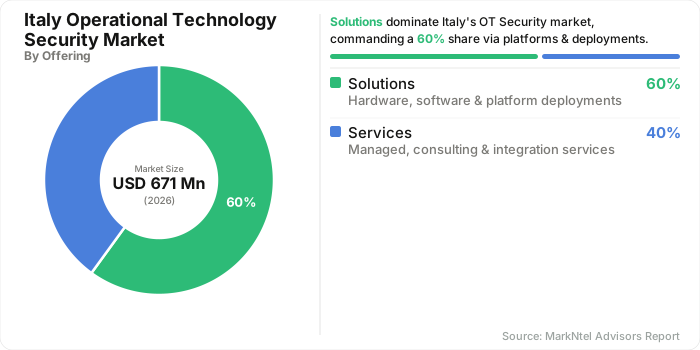
The Solutions segment dominates the Italy OT security industry with a market share of 60% due to increasing deployment of integrated cybersecurity platforms across industrial and critical infrastructure environments. Growth is strongly driven by EU NIS2 compliance requirements and Italy’s national cybersecurity strategy, which mandate advanced protection for operational technology systems. Industrial operators are investing heavily in network security, endpoint protection, IAM, and threat detection systems to secure SCADA and ICS environments. This regulatory pressure has significantly accelerated demand for scalable and automated OT security solutions.
A key factor reinforcing leadership is strong investment from global cybersecurity vendors such as Fortinet, which provide integrated OT security architectures. For example, Fortinet’s OT Security Platform is widely deployed in European industrial environments, including manufacturing and energy networks. End-user demand is concentrated in manufacturing clusters in Northern Italy, where automation density is high. Industries such as automotive, machinery, and energy require continuous monitoring and real-time threat detection systems. As a result, solutions dominate over services due to their direct role in securing operational continuity and industrial uptime. By offering category, the market is further subdivided into the following categories:
- Solutions
- Network Security Solutions
- Endpoint & Device Security
- Identity & Access Management (IAM)
- Threat Detection & Incident Response
- Others
- Services
Industrial Automation Driving Market Leadership
The Industrial segment leads Italy’s OT security market with a market share of 41% due to the country’s highly concentrated and automation-intensive manufacturing base. Northern Italy, particularly Lombardy, Emilia-Romagna, and Veneto, hosts dense industrial clusters in machinery, automotive, packaging, and precision engineering. These sectors rely heavily on interconnected SCADA, PLCs, and industrial IoT systems, which significantly increases exposure to cyber risks. Manufacturing remains one of the most targeted sectors for industrial cyberattacks in Europe, reinforcing the need for OT-specific protection in Italy’s industrial ecosystem.
A key driver is the prominent presence of industrial automation and control technology providers within Italian factories. Companies like Siemens are enhancing their Industrial Edge platform by integrating artificial intelligence capabilities with embedded cybersecurity functions tailored for OT environments. The upgraded system enables real-time industrial data processing while strengthening security across connected operational systems. It supports secure IT–OT convergence by combining automation, analytics, and cyber protection within a single industrial architecture.
These deployments reinforce cybersecurity adoption at the production layer rather than just IT perimeter security. This tight integration between automation vendors and manufacturers significantly strengthens industrial OT security penetration in Italy.
Additionally, Italy’s export-oriented manufacturing model increases cybersecurity priority within industrial operations. Industrial firms competing in global supply chains must maintain high reliability, making resilience against cyber disruption a production requirement.
This combination of high operational dependency, automation intensity, and exposure to cyber threats ensures the Industrial segment remains the dominant contributor to Italy’s OT security market. Based on application, the market is further subdivided into the following sub- categories:
- Energy and Power
- Financial
- Industrial
- Transportation & Logistics
- Others
Italy Operational Technology Market Geographical Outlook
Northern Italy leads operational technology security industry with 48% shares, due to its dominant industrial and economic structure. ISTAT regional accounts confirm that the North-West and North-East together account for over 50%+ of Italy’s GDP and industrial value added. Lombardy alone generates around USD 490.5 billion in added value, making it the single largest regional economy in Italy. This heavy concentration of manufacturing activity creates sustained demand for automation, control systems, and OT infrastructure.
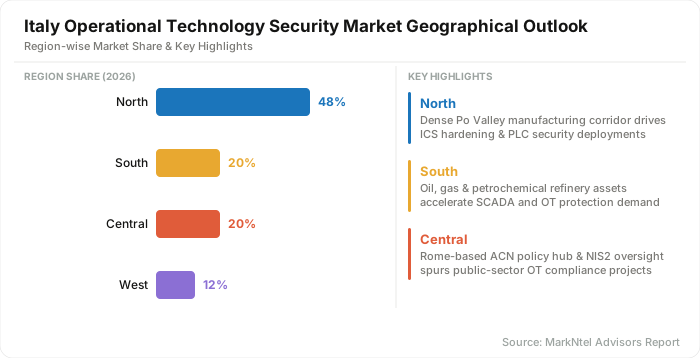
Industrial clustering further strengthens this dominance through highly specialized manufacturing ecosystems. Regions like Emilia-Romagna, Veneto, and Lombardy host dense industrial districts focused on machinery, automotive, and precision engineering. Emilia-Romagna alone contributes over USD 57.0 billion in manufacturing value added and dominates machinery exports. Such clustered production systems require continuous deployment of PLCs, SCADA, and industrial monitoring technologies.
Companies like CNH Industrial (now part of Iveco Group) are major industrial and automotive manufacturing players. It operates large-scale production facilities in Northern Italy with high automation intensity. Its manufacturing plants rely heavily on OT systems for robotics and assembly automation. This creates continuous demand for industrial control and monitoring technologies.
End-user demand is structurally higher in Northern Italy due to the presence of export-oriented, technology-intensive industries. The region hosts globally competitive firms in automotive, industrial machinery, food processing, and mechatronics. Italy’s manufacturing sector is a core contributor to national industrial GDP, reinforcing continuous OT investment needs. This strong industrial ecosystem ensures sustained demand for automation, industrial IoT, and operational technology systems.
Italy Operational Technology Security Industry Competitive Landscape
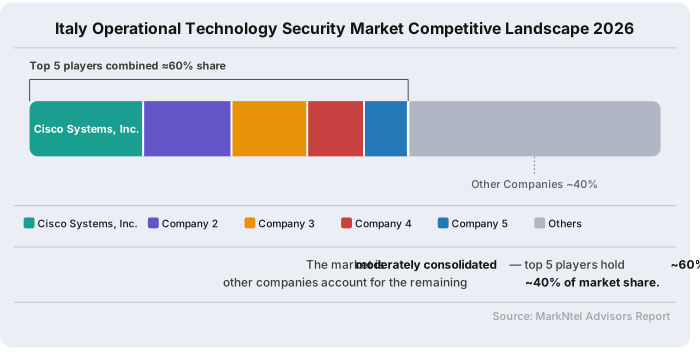
The Italy operational technology security market is moderately consolidated, with a mix of domestic cybersecurity specialists and global industrial automation and IT security leaders. The market is primarily led by a small group of strong players, including Leonardo S.p.A., Cisco Systems, Fortinet, Palo Alto Networks, and IBM Corporation, contributing a significant share of 60%.
Major players of Italy Operational Technology Security Market
- Leonardo S.p.A.
- Tinexta Cyber (Tinexta S.p.A.)
- Telsy S.p.A.
- Engineering Ingegneria Informatica S.p.A.
- Reply S.p.A.
- Cyber Evolution
- Drivesec
- MON5
- Schneider Electric SE
- Rockwell Automation, Inc.
- Honeywell International Inc.
- Cisco Systems, Inc.
- Microsoft Corporation
- International Business Machines Corporation
- Palo Alto Networks, Inc.
- Fortinet, Inc
Italy Operational Technology Security Industry News and Recent Developments
2026: Italian solar sector gears up for cybersecurity regulations on PV systems over 100 kW
Italy’s energy regulator ARERA has introduced new cybersecurity-linked requirements for photovoltaic (PV) and wind systems above 100 kW. The regulation mandates the installation of central plant controllers (CCI), enabling remote monitoring and operational control of energy assets. These systems are directly linked to OT environments as they manage industrial-scale energy generation infrastructure. Compliance deadlines are being phased up to 2028, depending on plant size and capacity. The rules aim to improve grid stability and reduce vulnerabilities in increasingly digitalized renewable energy systems. This reflects rising convergence between energy infrastructure and cybersecurity requirements in Italy.
Impact Analysis: This regulation significantly increases demand for OT cybersecurity solutions in Italy’s energy sector. Solar and wind operators will require secure SCADA, remote monitoring, and industrial control protection systems. It expands the addressable market for cybersecurity vendors focused on critical infrastructure protection. The compliance requirement accelerates IT–OT convergence across renewable energy operators. It also strengthens opportunities for vendors offering industrial firewalling, intrusion detection, and AI-based monitoring. Overall, it acts as a structural growth driver for Italy’s OT security market, especially in distributed energy systems.
2026: Edison Group accelerates industrial security with TXOne Networks
Edison Group, one of Italy’s leading energy companies, has implemented TXOne Networks’ OT cybersecurity solutions to strengthen protection across its industrial infrastructure.
The deployment focuses on securing OT environments such as power generation plants, legacy systems, and industrial control networks. The solution improves visibility across assets while enabling controlled updates and reducing operational cyber risk. Edison operates a complex energy mix, including renewable, hydro, and thermoelectric plants, increasing OT complexity. The collaboration reflects the growing convergence of IT and OT security in critical energy infrastructure. It also highlights the need for continuous monitoring in legacy-heavy industrial environments.
Impact Analysis: This development strengthens demand for OT cybersecurity solutions in Italy’s energy and utilities sector. It demonstrates real enterprise-level adoption of industrial cybersecurity platforms in critical infrastructure environments. Such deployments increase market validation for vendors offering OT visibility, endpoint protection, and network segmentation tools. It also highlights the commercial shift from reactive security to preventive OT risk management systems. The case supports growth in managed OT security services and platform-based industrial cybersecurity solutions. Overall, it signals increasing maturity and investment intensity in Italy’s OT cybersecurity market.
- Market Segmentation
- Introduction
- Product Definition
- Research Process
- Assumptions
- Executive Summary
- Italy Operational Technology Security Market Policies, Regulations, and Product Standards
- Italy Operational Technology Security Market Trends & Developments
- Italy Operational Technology Security Market Dynamics
- Growth Factors
- Challenges
- Italy Operational Technology Security Market Hotspot & Opportunities
- Italy Operational Technology Security Market Outlook, 2022-2032F
- Market Size & Outlook
- By Revenues (USD Million)
- Market Share & Outlook
- By Offerings- Market Size & Forecast 2022-2032, USD Million
- Solutions
- Network Security Solutions
- Endpoint & Device Security
- Identity & Access Management (IAM)
- Threat Detection & Incident Response
- Others
- Services
- Solutions
- By Deployment Mode- Market Size & Forecast 2022-2032, USD Million
- On-Premises
- Cloud
- By Application- Market Size & Forecast 2022-2032, USD Million
- Energy and Power
- Financial
- Industrial
- Transportation & Logistics
- Others
- By Organization Size- Market Size & Forecast 2022-2032, USD Million
- Large Enterprises
- Small and Medium-Sized Enterprises
- By Region- Market Size & Forecast 2022-2032, USD Million
- Central
- Northern
- Southern
- Western
- By Company
- Competition Characteristics
- Market Share & Analysis
- By Offerings- Market Size & Forecast 2022-2032, USD Million
- Market Size & Outlook
- Italy Operational Technology Security Solutions Market Outlook, 2022-2032
- Market Size & Outlook
- By Revenues (USD Million)
- Market Share & Outlook
- By Deployment Mode- Market Size & Forecast 2022-2032, USD Million
- By Application- Market Size & Forecast 2022-2032, USD Million
- By Organization Size- Market Size & Forecast 2022-2032, USD Million
- By Region- Market Size & Forecast 2022-2032, USD Million
- Market Size & Outlook
- Italy Operational Technology Security Services Market Outlook, 2022-2032
- Market Size & Outlook
- By Revenues (USD Million)
- Market Share & Outlook
- By Deployment Mode- Market Size & Forecast 2022-2032, USD Million
- By Application- Market Size & Forecast 2022-2032, USD Million
- By Organization Size- Market Size & Forecast 2022-2032, USD Million
- By Region- Market Size & Forecast 2022-2032, USD Million
- Market Size & Outlook
- Italy Operational Security Services Market Key Strategic Imperatives for Success & Growth
- Competitive Outlook
- Company Profiles
- Tinexta Cyber (Tinexta S.p.A.)
- Business Description
- Product Portfolio
- Collaborations & Alliances
- Recent Developments
- Financial Details
- Others
- Telsy S.p.A.
- Business Description
- Product Portfolio
- Collaborations & Alliances
- Recent Developments
- Financial Details
- Others
- Engineering Ingegneria Informatica S.p.A.
- Business Description
- Product Portfolio
- Collaborations & Alliances
- Recent Developments
- Financial Details
- Others
- Reply S.p.A.
- Business Description
- Product Portfolio
- Collaborations & Alliances
- Recent Developments
- Financial Details
- Others
- Cyber Evolution
- Business Description
- Product Portfolio
- Collaborations & Alliances
- Recent Developments
- Financial Details
- Others
- Drivesec
- Business Description
- Product Portfolio
- Collaborations & Alliances
- Recent Developments
- Financial Details
- Others
- MON5
- Business Description
- Product Portfolio
- Collaborations & Alliances
- Recent Developments
- Financial Details
- Others
- Schneider Electric SE
- Business Description
- Product Portfolio
- Collaborations & Alliances
- Recent Developments
- Financial Details
- Others
- Rockwell Automation, Inc.
- Business Description
- Product Portfolio
- Collaborations & Alliances
- Recent Developments
- Financial Details
- Others
- Honeywell International Inc.
- Business Description
- Product Portfolio
- Collaborations & Alliances
- Recent Developments
- Financial Details
- Others
- Leonardo S.p.A.
- Business Description
- Product Portfolio
- Collaborations & Alliances
- Recent Developments
- Financial Details
- Others
- Cisco Systems, Inc.
- Business Description
- Product Portfolio
- Collaborations & Alliances
- Recent Developments
- Financial Details
- Others
- Microsoft Corporation
- Business Description
- Product Portfolio
- Collaborations & Alliances
- Recent Developments
- Financial Details
- Others
- International Business Machines Corporation
- Business Description
- Product Portfolio
- Collaborations & Alliances
- Recent Developments
- Financial Details
- Others
- Palo Alto Networks, Inc.
- Business Description
- Product Portfolio
- Collaborations & Alliances
- Recent Developments
- Financial Details
- Others
- Fortinet, Inc
- Business Description
- Product Portfolio
- Collaborations & Alliances
- Recent Developments
- Financial Details
- Others
- Others
- Tinexta Cyber (Tinexta S.p.A.)
- Company Profiles
- Disclaimer

MarkNtel Advisors follows a robust and iterative research methodology designed to ensure maximum accuracy and minimize deviation in market estimates and forecasts. Our approach combines both bottom-up and top-down techniques to effectively segment and quantify various aspects of the market. A consistent feature across all our research reports is data triangulation, which examines the market from three distinct perspectives to validate findings. Key components of our research process include:
1. Scope & Research Design At the outset, MarkNtel Advisors define the research objectives and formulate pertinent questions. This phase involves determining the type of research—qualitative or quantitative—and designing a methodology that outlines data collection methods, target demographics, and analytical tools. They also establish timelines and budgets to ensure the research aligns with client goals.
2. Sample Selection and Data Collection In this stage, the firm identifies the target audience and determines the appropriate sample size to ensure representativeness. They employ various sampling methods, such as random or stratified sampling, based on the research objectives. Data collection is carried out using tools like surveys, interviews, and observations, ensuring the gathered data is reliable and relevant.
3. Data Analysis and Validation Once data is collected, MarkNtel Advisors undertake a rigorous analysis process. This includes cleaning the data to remove inconsistencies, employing statistical software for quantitative analysis, and thematic analysis for qualitative data. Validation steps are taken to ensure the accuracy and reliability of the findings, minimizing biases and errors.

4. Data Forecast and FinalizationThe final phase involves forecasting future market trends based on the analyzed data. MarkNtel Advisors utilize predictive modeling and time series analysis to anticipate market behaviors. The insights are then compiled into comprehensive reports, featuring visual aids like charts and graphs, and include strategic recommendations to inform client decision-making
We’d love to understand what matters most to you.