

By Product Form (Raw Organic Honey, Processed Organic Honey, Creamed Organic Honey, Comb Organic Honey), By Botanical Source (Multifloral (Wildflower/Forest), Monofloral), By Packaging Format (Glass J... ... ging Format (Glass Jars, Plastic Bottles, Sachets & Stick Packs, Bulk Containers), By Distribution Channel (Supermarkets & Hypermarkets, Specialty Organic Stores, Convenience Stores, Pharmacies & Health Stores, Online Retail, Foodservice Direct (HoReCa)), By Application (Food & Beverages, Pharmaceuticals, Nutraceuticals, Personal Care & Cosmetics), and others Read more
- Food & Beverages
- Jul 2026
- 130
- PDF, Excel, PPT
India Organic Honey Market Key Takeaways
- The India organic honey market was valued at USD 5.12 million in 2025 and is estimated to grow from USD 6.98 million in 2026 to USD 12.28 million by 2032.
- The industry is projected to witness steady growth at a 9.87% CAGR during 2026–2032.
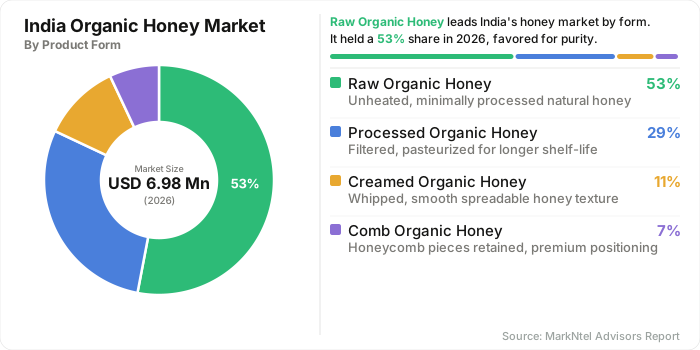
- Raw organic honey dominated the product form segment, accounting for an estimated 53% market share.
- Food & beverages emerged as the leading application segment, capturing approximately 72% of the market share in 2026.
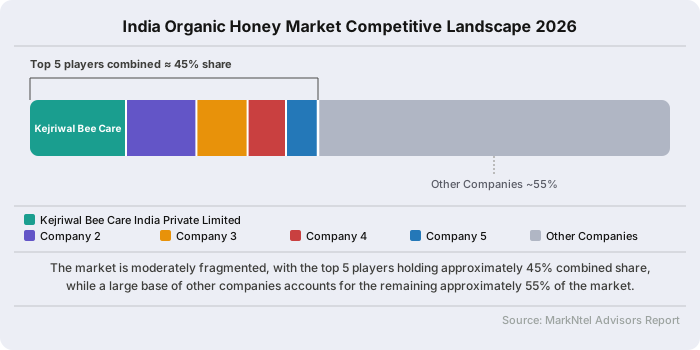
- The market is moderately fragmented, with the top five players collectively accounting for nearly 45% of the total market share.
India Organic Honey Market Size and Outlook
The India organic honey market size was valued at USD 5.12 million in 2025 and is projected to grow from USD 6.98 million in 2026 to USD 12.28 million by 2032, registering a CAGR of 9.87% during 2026–2032. Growth is expected to remain steady as expanding digital commerce infrastructure improves market accessibility while evolving climate-resilient production practices strengthen long-term supply stability. Rising consumer preference for natural sweeteners and premium food products is further supporting industry expansion.
Government initiatives continue to strengthen the industry's production ecosystem. The National Beekeeping and Honey Mission, supported by a USD 57.8 million outlay extended through 2025, had sanctioned 26 Honey Processing Units and 6 world-class Honey Testing Labs by March 2025, according to the Ministry of Agriculture and Farmers Welfare. This infrastructure enhances quality assurance, increases certified production capacity, and supports greater adoption of honey traceability, enabling producers to strengthen premium positioning and consumer confidence.
Regulatory modernization is also expected to improve long-term competitiveness. APEDA introduced the 8th Edition of the National Programme for Organic Production (NPOP) in 2026, updating certification and accreditation protocols for Indian organic operators. The revised framework strengthens certification credibility, improves transparency across the supply chain, and differentiates certified products from unregulated offerings. These developments are expected to reinforce consumer trust while enhancing the competitiveness of the India organic honey industry across both domestic and international channels.
International demand is creating additional opportunities for Indian exporters. A severe US honeybee colony collapse exceeding 55% in 2025 tightened global honey supply, increasing US import prices to USD 2,640 per metric tonne by November 2025, according to APEDA–CRISIL trade data. Simultaneously, the European Union, the world's largest honey importer, is projected to import 0.36–0.37 million metric tonnes valued at more than USD 1.1 billion during 2025, supporting demand for monofloral honey and other certified honey varieties .
India Organic Honey Market Key Indicators
- According to APEDA, India's total area under organic cultivation reached 7.3 million hectares in FY24, spanning diverse agro-climatic zones rich in wildflowers and medicinal flora. This expansive organic floral base directly supports apiaries positioned near certified organic farmland, giving beekeepers wider access to pesticide-free forage and strengthening the raw-material foundation on which certified organic honey production ultimately depends nationwide.
- The National Bee Board reports that India produced approximately 0.15 million metric tonnes of natural honey in calendar year 2024. Rising honey production capacity across major beekeeping states creates a larger base pool from which certification bodies can draw organic-compliant volumes, easing supply constraints that would otherwise cap growth for branded, NPOP-certified manufacturers competing for retail shelf space.
- As per the Ministry of Commerce and Industry, India's agricultural exports crossed nearly USD 51 billion in 2024, with APEDA-scheduled products alone contributing over USD 28 billion. This established agri-export infrastructure, including cold-chain and documentation systems built for scheduled commodities, lowers the compliance burden for organic honey exporters seeking certified access to premium buyers in the USA and European Union.
- The National Bee Board's records show 97 Farmer Producer Organisations of beekeepers formed by March 2025 under the National Beekeeping and Honey Mission . Collective FPO-led aggregation improves batch consistency and traceability at the point of harvest, a prerequisite for NPOP certification, and reduces the transaction costs smallholder apiarists face when transitioning conventional honey output toward certified organic status.
- The Ministry of Agriculture and Farmers Welfare confirms that six world-class Honey Testing Labs and 47 mini honey testing labs had been sanctioned under the National Beekeeping and Honey Mission by March 2025. Expanded honey testing capacity shortens certification turnaround for organic-grade batches, helping brands validate purity claims faster and respond to retailer and export-market demand for verifiable, adulteration-free organic honey.
India Organic Honey Market Scope
| Category | Segments |
|---|---|
| By Product Form | Raw Organic Honey, Processed Organic Honey, Creamed Organic Honey, Comb Organic Honey |
| By Botanical Source | Multifloral (Wildflower/Forest), Monofloral |
| By Packaging Format | Glass Jars, Plastic Bottles, Sachets & Stick Packs, Bulk Containers |
| By Distribution Channel | Supermarkets & Hypermarkets, Specialty Organic Stores, Convenience Stores, Pharmacies & Health Stores, Online Retail, Foodservice Direct (HoReCa |
| By Application | Food & Beverages, Pharmaceuticals, Nutraceuticals, Personal Care & Cosmetics |
India Organic Honey Market Growth Drivers
Expanding Digital Commerce Infrastructure Widening Retail Access for Organic Honey
The rapid expansion of India's digital commerce ecosystem is strengthening retail accessibility for organic honey. Government-backed Open Network for Digital Commerce (ONDC) processed more than 326 million cumulative orders as of October 2025, while October alone recorded 18.2 million transactions with average daily volumes of approximately 590,000 orders . This expanding network is accelerating the India organic honey market by improving visibility for organic beekeeping enterprises and certified regional producers.
The growing reach of ONDC extends beyond metropolitan regions into underserved consumer markets. As of 9 December 2025, more than 1.16 lakh retail sellers were active across 630+ cities and towns, creating new opportunities for niche organic food businesses to expand distribution. Improved digital accessibility enables certified organic honey brands to establish direct consumer relationships while reducing dependence on premium urban retail outlets.
This evolving commerce infrastructure reduces customer acquisition costs and enables certification-focused producers to compete alongside larger brands through transparent digital product discovery. As consumers increasingly rely on preference-based online searches, businesses maintaining verified certifications and standardized product information are positioned to enhance visibility and strengthen their competitive position within the India organic honey industry, supporting sustained long-term industry expansion.
Recent Trends
Climate Variability Reshaping Migratory Beekeeping Practices
Beekeepers across India are increasingly adopting climate-resilient apiary management to maintain consistent honey production amid changing weather patterns. Research from Madhya Kamrup College in Assam, published in 2025, found the state now experiences more than 20 additional heat-wave days than a decade ago, while average maximum and nighttime temperatures have increased by approximately 2°C, prompting producers to rethink traditional bee farming practices. This transition is gradually influencing the India organic honey industry.
Changing flowering cycles are encouraging migratory beekeepers to diversify apiary locations and revise seasonal movement schedules to follow shifting nectar sources. Floods and landslides in Assam that killed more than 100 people in 2024 , along with erratic rainfall and prolonged dry spells, have accelerated the adoption of flexible sourcing strategies to maintain stable Honey Production across traditional beekeeping corridors extending from Bihar to northern India's mustard-growing regions.
Another notable industry shift is the increasing preference for climate-resilient indigenous bee species such as Apis cerana over imported Apis mellifera in environmentally stressed regions. Organic honey producers are adapting their sourcing strategies to preserve consistent product quality and support certification requirements under NPOP standards. These evolving production practices are expected to strengthen long-term supply resilience across the India organic honey market despite increasing climatic uncertainty.
India Organic Honey Market Opportunities and Challenges
Certification Barriers Create Export Advantages for Dual-Certified Producers
The absence of a comprehensive India–US organic equivalency arrangement under the USDA National Organic Program (NOP) creates additional compliance requirements for Indian exporters seeking premium retail access in the United States. Organic honey producers must obtain separate USDA-NOP certification alongside domestic National Programme for Organic Production (NPOP) approval to display the USDA Organic seal, increasing regulatory complexity for participants in the India organic honey market while limiting export readiness among smaller honey export businesses.
Despite these certification challenges, selected certification bodies, including Control Union, OneCert, and IMO Control possess dual NPOP–USDA-NOP accreditation, enabling qualified exporters to access US organic retail channels without prolonged recertification procedures. Certified organic food products generally command premium pricing compared with conventional alternatives across US and European retail markets, allowing dual-certified producers to strengthen profitability while expanding their international presence through organic agriculture practices.
The evolving certification landscape also presents long-term export opportunities. APEDA is actively pursuing additional organic equivalency recognition with Australia, South Korea, Taiwan, Canada, and Japan, which could broaden access to premium overseas markets for Indian organic food exporters. As more equivalency agreements emerge, the India organic honey industry is expected to benefit from simplified international trade pathways, improved export competitiveness, and greater access to high-value global consumers.
Segmentation Insights
Raw Organic Honey Dominates Owing to Strong Consumer Preference for Purity and Minimal Processing
Raw organic honey accounts for an estimated 53% share of the India organic honey market by product form, supported by increasing consumer preference for unheated and minimally filtered products that preserve natural enzymes, antioxidants, pollen, and nutritional properties. Growing awareness of health-focused diets has encouraged consumers to choose authentic honey with minimal processing, strengthening demand for clean label foods across both urban and premium retail channels.
India's diverse floral resources support the production of numerous natural honey varieties, including Rapeseed/Mustard, Eucalyptus, Lychee, and Sunflower honey, according to the Ministry of Agriculture and Farmers Welfare. The availability of region-specific floral sources enables producers to supply high-quality honey with a distinctive taste and nutritional characteristics, reinforcing the country's position in the expanding premium honey segment.
Consumer confidence has increasingly shifted toward raw, single-origin honey following repeated adulteration controversies involving processed and blended honey sold through conventional retail channels. Buyers now place greater emphasis on product authenticity, transparency, and minimal processing when selecting honey products. This preference has strengthened demand for certified raw honey, encouraging manufacturers to expand premium product portfolios. Based on product form, the scope has been classified into:
- Raw Organic Honey
- Processed Organic Honey
- Creamed Organic Honey
- Comb Organic Honey
Food & Beverages Dominates Due to Rising Adoption of Organic Honey as a Natural Ingredient
The food & beverages segment accounts for an estimated 72% share of the India organic honey industry, driven by the growing use of organic honey as a natural sweetener in beverages, breakfast cereals, dairy products, bakery items, and packaged snacks. Increasing consumer preference for healthier ingredient alternatives has encouraged food manufacturers to incorporate functional foods into product innovation, supporting sustained demand for organic honey.
India's expanding food processing industry continues to strengthen application opportunities for organic honey. According to the Ministry of Commerce and Industry, India's processed food exports, including fruits, juices, and nuts, exceeded USD 721 million during 2024. The robust processing ecosystem is encouraging manufacturers to integrate organic honey into diverse food formulations, reflecting its growing importance as a value-added ingredient rather than solely a retail product.
The increasing preference for naturally sourced ingredients is encouraging companies to replace refined sugar with organic honey across premium product categories. Its nutritional profile, flavor enhancement, and clean-label appeal make it an attractive formulation ingredient for health-oriented consumers. Consequently, demand from the food processing sector is expected to remain the primary growth engine for application-based consumption, supported by expanding organic food products offerings. The study analyzes the following key application segments:
- Food & Beverages
- Pharmaceuticals
- Nutraceuticals
- Personal Care & Cosmetics
India Organic Honey Market Competitive Analysis
The India organic honey industry remains moderately fragmented, with the top five companies collectively accounting for an estimated 45% of total revenue. Dabur India Limited leads through its extensive distribution network, strong brand recognition, and diversified honey portfolio, while Organic India, 24 Mantra Organic, Under The Mango Tree Naturals and Organics, and Conscious Food strengthen competition through certified organic offerings and premium positioning. The remaining market is occupied by numerous regional producers, beekeeper cooperatives, D2C brands, and niche organic manufacturers, creating a competitive environment.
Prominent Companies in India Organic Honey Market
- Kejriwal Bee Care India Private Limited
- Under The Mango Tree Naturals and Organics Private Limited
- Dabur India Limited
- Sresta Natural Bioproducts Private Limited (24 Mantra Organic)
- Conscious Food Private Limited
- Organic India Private Limited
- Advait Living Private Limited
- Bonneterre Foods Private Limited (Honey & Spice)
- Jeet Organic Private Limited
- Shashi Natural and Organics Private Limited
- Others
India Organic Honey Industry News and Recent Developments
May 2025: Chhattisgarh Introduced the 'Sonahani' Organic Honey Brand to Strengthen Rural Beekeeping
The Koriya district administration in Chhattisgarh launched 'Sonahani', a new 100% organic honey brand developed under a convergence of the district administration, Krishi Vigyan Kendra (KVK), and local farmers. Initiated in December 2024 and commercially introduced in May 2025, the project trained 20 farmers in scientific beekeeping, supplied 25 beehive boxes per participant, and positioned Sonahani as a premium organic honey sourced from diverse floral ecosystems.
Impact Analysis: The Sonahani launch demonstrates how government-supported rural beekeeping initiatives are evolving into commercially branded organic honey businesses. By integrating scientific apiculture training, organic production practices, value-added packaging through women's self-help groups, and local branding, the initiative strengthens farmer incomes while expanding the supply of traceable organic honey. Its planned expansion into national markets also highlights the growing role of regional premium brands in enhancing competition and supporting the long-term development of India's organic honey industry.
August 2025: BN Group Entered the Functional Honey Category with Nutrica Bee Honey
BN Group expanded its wellness portfolio by launching Nutrica Bee Honey, introducing three purpose-led variants: Pro-Energy Multiflora Honey, Pro-Fitness Lemon Infused Honey, and Pro-Immunity Tulsi Infused Honey. Initially launched across Delhi NCR and Mumbai, the products target consumers seeking functional nutrition through everyday foods. The launch strengthens Nutrica's presence in the natural wellness segment while expanding its portfolio beyond fortified cooking oils.
Impact Analysis: The launch highlights the industry's transition from conventional honey toward value-added, function-specific offerings addressing immunity, fitness, and energy needs. It is expected to intensify competition within the premium organic and wellness honey segment while encouraging greater product innovation. The introduction of infused and multifunctional honey products also reflects changing consumer preferences for health-oriented foods, supporting premiumization and creating additional opportunities for manufacturers to differentiate their portfolios through targeted nutritional benefits and branded product positioning.
August 2025: QNET Expanded its Wellness Portfolio with Nutriplus Monofloral Honey
QNET introduced its premium Nutriplus Monofloral Honey range in India with Ramtil (Guizotia abyssinica) and Tulsi (Holy Basil) variants. Sourced from rural beekeepers, the products are promoted as pure, natural, and unprocessed, with each batch undergoing Nuclear Magnetic Resonance (NMR) testing to verify purity, authenticity, and botanical origin. The launch reinforces QNET's focus on wellness-oriented, premium honey products.
Impact Analysis: The launch strengthens the premium monofloral honey segment by emphasizing traceability, authenticity, and scientific quality verification. It also supports growing consumer demand for minimally processed honey with identifiable floral origins and transparent sourcing practices. By partnering with rural beekeepers and highlighting NMR-tested purity, QNET reinforces quality differentiation while encouraging broader adoption of premium honey products, likely prompting competitors to increase investments in traceability, certification, and specialty botanical honey offerings.
- Market Segmentation
- Introduction
- Product Definition
- Research Process
- Assumptions
- Executive Summary
- India Organic Honey Market Value Chain Analysis
- India Organic Honey Market Import & Export Analysis
- India Organic Honey Market Policies, Regulations, and Product Standards
- India Organic Honey Production Trend 2022-2032
- India Organic Honey Trend by Type of Product Form
- Raw Organic Honey
- Processed Organic Honey
- Creamed Organic Honey
- Comb Organic Honey
- Company-Wise Production Plants and Statistics
- Installed Production Capacity
- Actual Production
- Planned Production Target
- India Organic Honey Trend by Type of Product Form
- India Organic Honey Pricing Analysis 2022-2032
- India Organic Honey Pricing Trend 2022-2032
- India Organic Honey Pricing Trend by Product Form 2022-2032
- Raw Organic Honey
- Processed Organic Honey
- Creamed Organic Honey
- Comb Organic Honey
- India Organic Honey Market Dynamics
- Growth Factors
- Challenges
- India Organic Honey Market Hotspot & Opportunities
- India Organic Honey Market Outlook, 2022-2032F
- Market Size & Outlook
- By Revenues (USD Million)
- By Volume (Thousand Tons)
- Market Share & Outlook
- By Product Form - Market Size & Forecast 2022-2032, USD Million & Thousand Tons
- Raw Organic Honey
- Processed Organic Honey
- Creamed Organic Honey
- Comb Organic Honey
- By Botanical Source- Market Size & Forecast 2022-2032, USD Million & Thousand Tons
- Multifloral (Wildflower/Forest)
- Monofloral
- Domestic Major
- Acacia
- Clover
- Buckwheat
- Eucalyptus
- Others
- Domestic Niche
- Tulsi
- Neem
- Karvi
- Others
- Imported Premium
- Manuka
- Yemen/Oman Sidr
- Others
- Domestic Major
- By Packaging Format- Market Size & Forecast 2022-2032, USD Million & Thousand Tons
- Glass Jars
- Plastic Bottles
- Sachets & Stick Packs
- Bulk Containers
- By Distribution Channel- Market Size & Forecast 2022-2032, USD Million & Thousand Tons
- Supermarkets & Hypermarkets
- Specialty Organic Stores
- Convenience Stores
- Pharmacies & Health Stores
- Online Retail
- Foodservice Direct (HoReCa)
- By Application- Market Size & Forecast 2022-2032, USD Million & Thousand Tons
- Food & Beverages
- Pharmaceuticals
- Nutraceuticals
- Personal Care & Cosmetics
- By Region- Market Size & Forecast 2022-2032, USD Million & Thousand Tons
- North
- South
- East
- West
- By Company
- Competition Characteristics
- Market Share & Analysis
- By Product Form - Market Size & Forecast 2022-2032, USD Million & Thousand Tons
- Market Size & Outlook
- India Raw Organic Honey Market Outlook, 2022-2032
- Market Size & Outlook
- By Revenues (USD Million)
- By Volume (Thousand Tons)
- Market Segmentation & Outlook
- By Botanical Source- Market Size & Forecast 2022-2032, USD Million & Thousand Tons
- By Packaging Format- Market Size & Forecast 2022-2032, USD Million & Thousand Tons
- By Distribution Channel- Market Size & Forecast 2022-2032, USD Million & Thousand Tons
- By Application- Market Size & Forecast 2022-2032, USD Million & Thousand Tons
- By Region- Market Size & Forecast 2022-2032, USD Million & Thousand Tons
- Market Size & Outlook
- India Processed Organic Honey Market Outlook, 2022-2032
- Market Size & Outlook
- By Revenues (USD Million)
- By Volume (Thousand Tons)
- Market Segmentation & Outlook
- By Botanical Source- Market Size & Forecast 2022-2032, USD Million & Thousand Tons
- By Packaging Format- Market Size & Forecast 2022-2032, USD Million & Thousand Tons
- By Distribution Channel- Market Size & Forecast 2022-2032, USD Million & Thousand Tons
- By Application- Market Size & Forecast 2022-2032, USD Million & Thousand Tons
- By Region- Market Size & Forecast 2022-2032, USD Million & Thousand Tons
- Market Size & Outlook
- India Creamed Organic Honey Market Outlook, 2022-2032
- Market Size & Outlook
- By Revenues (USD Million)
- By Volume (Thousand Tons)
- Market Segmentation & Outlook
- By Botanical Source- Market Size & Forecast 2022-2032, USD Million & Thousand Tons
- By Packaging Format- Market Size & Forecast 2022-2032, USD Million & Thousand Tons
- By Distribution Channel- Market Size & Forecast 2022-2032, USD Million & Thousand Tons
- By Application- Market Size & Forecast 2022-2032, USD Million & Thousand Tons
- By Region- Market Size & Forecast 2022-2032, USD Million & Thousand Tons
- Market Size & Outlook
- India Comb Organic Honey Market Outlook, 2022-2032
- Market Size & Outlook
- By Revenues (USD Million)
- By Volume (Thousand Tons)
- Market Segmentation & Outlook
- By Botanical Source- Market Size & Forecast 2022-2032, USD Million & Thousand Tons
- By Packaging Format- Market Size & Forecast 2022-2032, USD Million & Thousand Tons
- By Distribution Channel- Market Size & Forecast 2022-2032, USD Million & Thousand Tons
- By Application- Market Size & Forecast 2022-2032, USD Million & Thousand Tons
- By Region- Market Size & Forecast 2022-2032, USD Million & Thousand Tons
- Market Size & Outlook
- India Organic Honey Market Key Strategic Imperatives for Success & Growth
- Competitive Outlook
- Company Profiles
- Kejriwal Bee Care India Private Limited
- Business Description
- Product Portfolio
- Collaborations & Alliances
- Recent Developments
- Financial Details
- Others
- Under The Mango Tree Naturals and Organics Private Limited
- Business Description
- Product Portfolio
- Collaborations & Alliances
- Recent Developments
- Financial Details
- Others
- Dabur India Limited
- Business Description
- Product Portfolio
- Collaborations & Alliances
- Recent Developments
- Financial Details
- Others
- Sresta Natural Bioproducts Private Limited (24 Mantra Organic)
- Business Description
- Product Portfolio
- Collaborations & Alliances
- Recent Developments
- Financial Details
- Others
- Conscious Food Private Limited
- Business Description
- Product Portfolio
- Collaborations & Alliances
- Recent Developments
- Financial Details
- Others
- Organic India Private Limited
- Business Description
- Product Portfolio
- Collaborations & Alliances
- Recent Developments
- Financial Details
- Others
- Advait Living Private Limited
- Business Description
- Product Portfolio
- Collaborations & Alliances
- Recent Developments
- Financial Details
- Others
- Bonneterre Foods Private Limited (Honey & Spice)
- Business Description
- Product Portfolio
- Collaborations & Alliances
- Recent Developments
- Financial Details
- Others
- Jeet Organic Private Limited
- Business Description
- Product Portfolio
- Collaborations & Alliances
- Recent Developments
- Financial Details
- Others
- Shashi Natural and Organics Private Limited
- Business Description
- Product Portfolio
- Collaborations & Alliances
- Recent Developments
- Financial Details
- Others
- Others
- Kejriwal Bee Care India Private Limited
- Company Profiles
- Disclaimer

MarkNtel Advisors follows a robust and iterative research methodology designed to ensure maximum accuracy and minimize deviation in market estimates and forecasts. Our approach combines both bottom-up and top-down techniques to effectively segment and quantify various aspects of the market. A consistent feature across all our research reports is data triangulation, which examines the market from three distinct perspectives to validate findings. Key components of our research process include:
1. Scope & Research Design At the outset, MarkNtel Advisors define the research objectives and formulate pertinent questions. This phase involves determining the type of research—qualitative or quantitative—and designing a methodology that outlines data collection methods, target demographics, and analytical tools. They also establish timelines and budgets to ensure the research aligns with client goals.
2. Sample Selection and Data Collection In this stage, the firm identifies the target audience and determines the appropriate sample size to ensure representativeness. They employ various sampling methods, such as random or stratified sampling, based on the research objectives. Data collection is carried out using tools like surveys, interviews, and observations, ensuring the gathered data is reliable and relevant.
3. Data Analysis and Validation Once data is collected, MarkNtel Advisors undertake a rigorous analysis process. This includes cleaning the data to remove inconsistencies, employing statistical software for quantitative analysis, and thematic analysis for qualitative data. Validation steps are taken to ensure the accuracy and reliability of the findings, minimizing biases and errors.

4. Data Forecast and FinalizationThe final phase involves forecasting future market trends based on the analyzed data. MarkNtel Advisors utilize predictive modeling and time series analysis to anticipate market behaviors. The insights are then compiled into comprehensive reports, featuring visual aids like charts and graphs, and include strategic recommendations to inform client decision-making
We’d love to understand what matters most to you.