

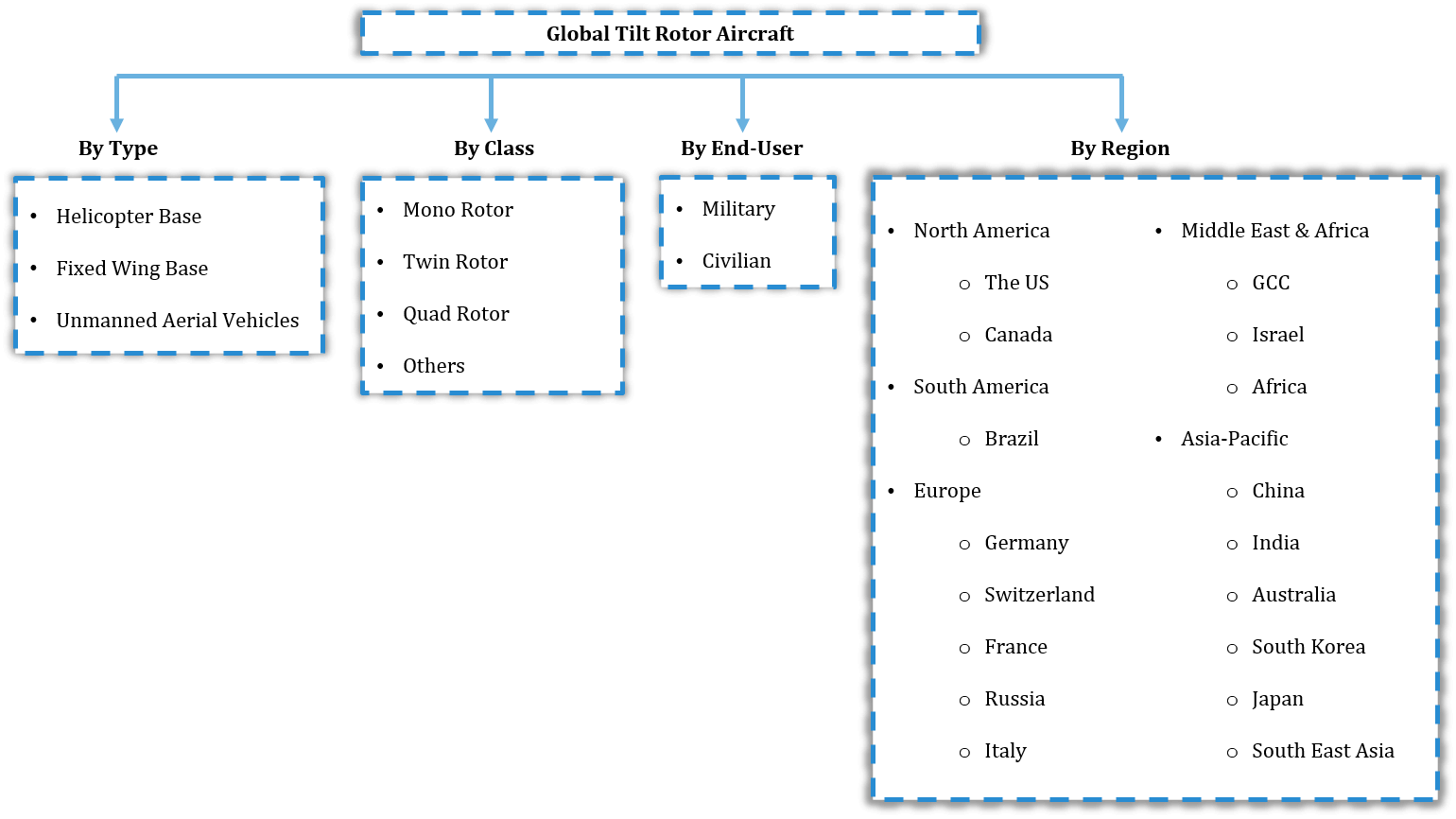
By Type (Helicopter Base, Fixed Wing Base, Unmanned Aerial Vehicles), By Class (Mono Rotor, Twin Rotor, Quad Rotor, Others), By End-User (Military, Civilian), By Region (North America, South America,... ... ica, South America, Europe, Asia-Pacific, Middle East & Africa), By Country (US, Canada, Brazil, Germany, France, Italy, Switzerland, Russia China, Japan, South Korea, India, South East Asia, Australia, GCC, Israel, Africa), By Company (The Boeing Company, Korea Aerospace Research Institute (KARI), Bell Aircraft Corporation, Lockheed Martin Corporation, Honeywell Aerospace, Agusta Westland, GE Aviation, Northrop Grumman Corporation, BAE Systems plc, Raytheon Company, Israel Aerospace Industries etc.) Read more
- Aerospace & Defense
- Jan 2022
- 211
- PDF, Excel, PPT
Market Definition -
Tilt Rotors are a class of aircraft that exhibit capabilities to take off or land vertically. These aircraft can transform the flight from vertical to horizontal by rotating the propellers or fans from horizontal positions like conventional aircraft to vertical positions like a helicopter.
With the swiftly rising defense budgets & increasing focus on strengthening national security with technologically advanced defense equipment, most countries worldwide are actively adopting tilt-rotor aircraft.
Market Insights -
The Global Tilt Rotor Aircraft Market is projected to grow at a CAGR of around 5% during the forecast period, i.e., 2021-26. The growth of the market is driven primarily by swiftly escalating geopolitical tensions & trade wars entwined with massive investment by the governments of different countries worldwide in the development & adoption of Tilt Rotor Aircraft.
| Report Coverage | Details |
|---|---|
| Study Period | Historical Data: 2016-19 |
| Base Year: 2020 | |
| Forecast Period: 2021-26 | |
| CAGR(2021-26) | 5% |
| Regions Covered | North America: USA, Canada |
| Europe: Germany, France, Italy, Russia, Switzerland | |
| Asia-Pacific: China, Japan, South Korea, India, South East Asia, Australia | |
| South America: Brazil | |
| Middle East & Africa: GCC, Israel, Africa | |
| Key Companies Profiled | The Boeing Company, Korea Aerospace Research Institute (KARI), Bell Aircraft Corporation, Lockheed Martin Corporation, Honeywell Aerospace, Agusta Westland, GE Aviation, Northrop Grumman Corporation, BAE Systems plc, Raytheon Company, Israel Aerospace Industries, etc. |
| Unit Denominations | USD Million/Billion |
In addition, rising acquisitions by several countries for the procurement of technologically advanced aircraft across the global defense sector to strengthen national security are further propelling the demand for tilt-rotor aircraft and driving the global market. For instance:
- In June 2020, market giant Bell Boing delivered its 400th V-22 Osprey Tilt Rotor aircraft to the US & Japan militaries.
Such an increasing number of procurements are anticipated to fuel the market growth during the forecast period. Nonetheless, numerous governments are swiftly taking initiatives to develop other tilt-rotor aircraft like Unmanned Aerial Vehicles (UAVs) & contributing to market growth. For instance:
- In 2021, Russian company ZALA Aero launched their Tilt Rotor hybrid drones that can change the configuration based on the task.
Key Trends in the Global Tilt Rotor Aircraft Market
- In October 2021, Italian Aircraft giant Leonardo S.p.A introduced an AW609 tilt-rotor aircraft, powered by Pratt & Whitney engine, for civilian application. This aircraft is highly efficient for Search & Rescue (SAR) & Emergency Medical Services (EMS) operations due to its long-range & Vertical Take-Off & Landing (VTOL) capabilities. As a result, it can potentially replace helicopters in the coming years.
- In September 2018, a prominent Russian defense contractor, Rostec, announced developing an electrically-powered V-22.
Impact of Covid-19 on the Global Tilt Rotor Aircraft Market
In 2020, the Covid-19 pandemic had a decelerating effect on most industries worldwide, where the Global Tilt Rotor Aircraft Market was no exception. The governments of different countries imposed stringent movement restrictions & frequent lockdowns to curb the spread of this dreadful disease.
Consequently, the supply chain of raw materials & transportation of goods across regions were also severely affected, introducing a temporary halt on various business operations. Most countries ceased their airline & maritime operations, making cargo transportation next to impossible.
Additionally, most countries temporarily reduced their defense budget and put their investments in addressing the Covid-19 crisis. Moreover, since the lockdowns lasted for a long while, numerous research & development activities, production, and demand for Tilt Rotor aircraft reduced drastically, owing to which market players observed substantial financial losses.
However, with the gradual improvement in the pandemic situation and the reducing number of Covid-19 cases, governments uplifted restrictions and allowed the recommencement of business operations. As a result, the market is projected to revive & recover from the loss & generate lucrative growth opportunities for the leading players in the coming years.
- Introduction
- Product Definition
- Research Process
- Assumptions
- Market Segmentation
- Preface
- Executive Summary
- Impact of COVID-19 on Global Tilt Rotor Aircraft Market
- Global Tilt Rotor Aircraft Market Outlook, 2016-2026F
- Market Size & Analysis
- Market Revenues
- Market Share & Analysis
- By Type
- Helicopter Base
- Fixed Wing Base
- Unmanned Aerial Vehicles
- By Class
- Mono Rotor
- Twin Rotor
- Quad Rotor
- Others
- By End User
- Military
- Civilian
- By Region
- North America
- South America
- Europe
- Middle East & Africa
- Asia-Pacific
- By Competitors
- Competition Characteristics
- Market Share & Analysis
- Competitive Metrix
- By Type
- Market Size & Analysis
- North America Tilt Rotor Aircraft Market Outlook, 2016-2026F
- Market Size & Analysis
- Market Revenues
- Market Share & Analysis
- By Type
- By Class
- By End User
- By Region
- The US
- Canada
- The US Tilt Rotor Aircraft Market Outlook, 2016-2026F
- Market Size & Analysis
- Market Revenues
- Market Share & Analysis
- By Type
- By Class
- By End User
- Market Size & Analysis
- Canada Tilt Rotor Aircraft Market Outlook, 2016-2026F
- Market Size & Analysis
- Market Revenues
- Market Share & Analysis
- By Type
- By Class
- By End User
- Market Size & Analysis
- Market Size & Analysis
- South America Tilt Rotor Aircraft Market Outlook, 2016-2026F
- Market Size & Analysis
- Market Revenues
- Market Share & Analysis
- By Type
- By Class
- By End User
- By Region
- Brazil
- Others
- Brazil Tilt Rotor Aircraft Market Outlook, 2016-2026F
- Market Size & Analysis
- Market Revenues
- Market Share & Analysis
- By Type
- By Class
- By End User
- Market Size & Analysis
- Market Size & Analysis
- Europe Tilt Rotor Aircraft Market Outlook, 2016-2026F
- Market Size & Analysis
- Market Revenues
- Market Share & Analysis
- By Type
- By Class
- By End User
- By Region
- The UK
- Germany
- France
- Russia
- Italy
- Switzerland
- Others
- The UK Tilt Rotor Aircraft Market Outlook, 2016-2026F
- Market Size & Analysis
- Market Revenues
- Market Share & Analysis
- By Type
- By Class
- By End User
- Market Size & Analysis
- Germany Tilt Rotor Aircraft Market Outlook, 2016-2026F
- Market Size & Analysis
- Market Revenues
- Market Share & Analysis
- By Type
- By Class
- By End User
- Market Size & Analysis
- France Tilt Rotor Aircraft Market Outlook, 2016-2026F
- Market Size & Analysis
- Market Revenues
- Market Share & Analysis
- By Type
- By Class
- By End User
- Market Size & Analysis
- Russia Tilt Rotor Aircraft Market Outlook, 2016-2026F
- Market Size & Analysis
- Market Revenues
- Market Share & Analysis
- By Type
- By Class
- By End User
- Market Size & Analysis
- Italy Tilt Rotor Aircraft Market Outlook, 2016-2026F
- Market Size & Analysis
- Market Revenues
- Market Share & Analysis
- By Type
- By Class
- By End User
- Market Size & Analysis
- Switzerland Tilt Rotor Aircraft Market Outlook, 2016-2026F
- Market Size & Analysis
- Market Revenues
- Market Share & Analysis
- By Type
- By Class
- By End User
- Market Size & Analysis
- Market Size & Analysis
- Middle East & Africa Tilt Rotor Aircraft Market Outlook, 2016-2026F
- Market Size & Analysis
- Market Revenues
- Market Share & Analysis
- By Type
- By Class
- By End User
- By Region
- GCC
- Israel
- Africa
- Others
- GCC Tilt Rotor Aircraft Market Outlook, 2016-2026F
- Market Size & Analysis
- Market Revenues
- Market Share & Analysis
- By Type
- By Class
- By End User
- Market Size & Analysis
- Israel Tilt Rotor Aircraft Market Outlook, 2016-2026F
- Market Size & Analysis
- Market Revenues
- Market Share & Analysis
- By Type
- By Class
- By End User
- Market Size & Analysis
- Africa Tilt Rotor Aircraft Market Outlook, 2016-2026F
- Market Size & Analysis
- Market Revenues
- Market Share & Analysis
- By Type
- By Class
- By End User
- Market Size & Analysis
- Market Size & Analysis
- Asia-Pacific Tilt Rotor Aircraft Market Outlook, 2016-2026F
- Market Size & Analysis
- Market Revenues
- Market Share & Analysis
- By Type
- By Class
- By End User
- By Region
- China
- India
- Japan
- South Korea
- Australia
- South East Asia
- China Tilt Rotor Aircraft Market Outlook, 2016-2026F
- Market Size & Analysis
- Market Revenues
- Market Share & Analysis
- By Type
- By Class
- By End User
- Market Size & Analysis
- India Tilt Rotor Aircraft Market Outlook, 2016-2026F
- Market Size & Analysis
- Market Revenues
- Market Share & Analysis
- By Type
- By Class
- By End User
- Market Size & Analysis
- Japan Tilt Rotor Aircraft Market Outlook, 2016-2026F
- Market Size & Analysis
- Market Revenues
- Market Share & Analysis
- By Type
- By Class
- By End User
- Market Size & Analysis
- South Korea Tilt Rotor Aircraft Market Outlook, 2016-2026F
- Market Size & Analysis
- Market Revenues
- Market Share & Analysis
- By Type
- By Class
- By End User
- Market Size & Analysis
- Australia Tilt Rotor Aircraft Market Outlook, 2016-2026F
- Market Size & Analysis
- Market Revenues
- Market Share & Analysis
- By Type
- By Class
- By End User
- Market Size & Analysis
- South East Asia Tilt Rotor Aircraft Market Outlook, 2016-2026F
- Market Size & Analysis
- Market Revenues
- Market Share & Analysis
- By Type
- By Class
- By End User
- Market Size & Analysis
- Market Size & Analysis
- Global Tilt Rotor Aircraft Government Regulations and Policies
- Global Tilt Rotor Aircraft Market Trends & Insights
- Global Tilt Rotor Aircraft Market Dynamics
- Growth Drivers
- Challenges
- Impact Analysis
- Global Tilt Rotor Aircraft Market Hotspot & Opportunities
- Global Tilt Rotor Aircraft Market Key Strategic Imperatives for Success & Growth
- Competition Outlook
- Competition Matrix
- Target Markets
- Research & Development
- Collaborations & Strategic Alliances
- Key Business Expansion Initiatives
- Business Restructuring- Mergers, Acquisitions, JVs
- Strategic Initiatives
- Company Profiles (Business Description, Product Segments, Business Segments, Financials, Strategic Alliances/ Partnerships, Future Plans
- The Boeing Company
- Korea Aerospace Research Institute (KARI)
- Bell Aircraft Corporation
- Lockheed Martin Corporation
- Honeywell Aerospace
- Agusta Westland
- GE Aviation
- Northrop Grumman Corporation
- BAE Systems plc
- Raytheon Company
- Israel Aerospace Industries
- Competition Matrix
- Disclaimer
MarkNtel Advisors follows a robust and iterative research methodology designed to ensure maximum accuracy and minimize deviation in market estimates and forecasts. Our approach combines both bottom-up and top-down techniques to effectively segment and quantify various aspects of the market. A consistent feature across all our research reports is data triangulation, which examines the market from three distinct perspectives to validate findings. Key components of our research process include:
1. Scope & Research Design At the outset, MarkNtel Advisors define the research objectives and formulate pertinent questions. This phase involves determining the type of research—qualitative or quantitative—and designing a methodology that outlines data collection methods, target demographics, and analytical tools. They also establish timelines and budgets to ensure the research aligns with client goals.
2. Sample Selection and Data Collection In this stage, the firm identifies the target audience and determines the appropriate sample size to ensure representativeness. They employ various sampling methods, such as random or stratified sampling, based on the research objectives. Data collection is carried out using tools like surveys, interviews, and observations, ensuring the gathered data is reliable and relevant.
3. Data Analysis and Validation Once data is collected, MarkNtel Advisors undertake a rigorous analysis process. This includes cleaning the data to remove inconsistencies, employing statistical software for quantitative analysis, and thematic analysis for qualitative data. Validation steps are taken to ensure the accuracy and reliability of the findings, minimizing biases and errors.

4. Data Forecast and FinalizationThe final phase involves forecasting future market trends based on the analyzed data. MarkNtel Advisors utilize predictive modeling and time series analysis to anticipate market behaviors. The insights are then compiled into comprehensive reports, featuring visual aids like charts and graphs, and include strategic recommendations to inform client decision-making
We’d love to understand what matters most to you.