

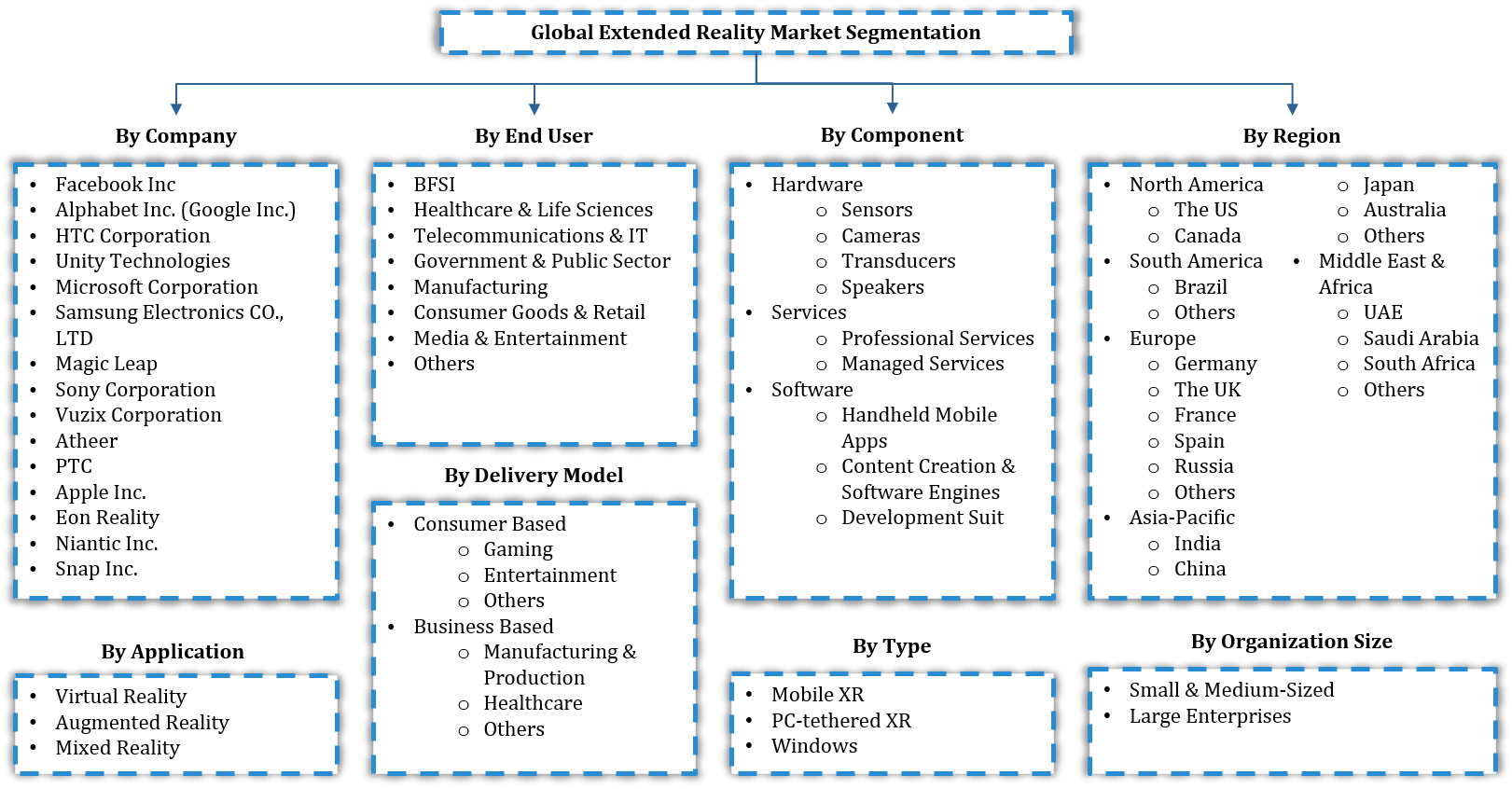
By Component (Hardware [Sensors, Cameras, Transducers, Speakers], Services [Professional Services, Managed Services], Software [Handheld Mobile Apps, Content Creation & Software Engines, Development S... ... gines, Development Suit]), By Type (Mobile XR, PC-tethered XR, Windows), By Delivery Mode (Consumer Based [Gaming, Entertainment, Others], Business Based [Manufacturing & Production, Healthcare, Others]), By Organization Size (Small & Medium-Sized, Large Enterprises), By Application (Virtual Reality, Augmented Reality, Mixed Reality), By End-User (BFSI, Healthcare & Life Sciences, Telecommunications & IT, Government & Public Sector, Manufacturing, Consumer Goods & Retail, Media & Entertainment, Others), By Region (North America, South America, Europe, Asia-Pacific, Middle East and Africa), By Country (U.S, Canada, Mexico, Brazil, Argentina, Italy, Spain, Germany, France, The U.K, China, South Korea, Japan, India, Australia, UAE, Saudi Arabia, South Africa), By Competitors (Facebook Inc, Alphabet Inc. (Google Inc.), HTC Corporation, Unity technologies, Microsoft Corporation, Samsung Electronics CO., LTD, Magic Leap, Sony Corporation, Vuzix Corporation, Atheer, PTC, Apple Inc., Eon Reality, Niantic Inc., Snap Inc.) Read more
- ICT & Electronics
- Mar 2021
- 201
- PDF, Excel, PPT
Market Definition
With the rapid evolution in technology, there exists a great potential to transform ways people work and live. Virtual, Augmented, and mixed reality technologies altogether comprise Extended Reality (ER.) It includes various types of hardware, software, & services. ER aids in blurring the line across physical and simulated worlds. Along with the gaming and entertainment sector, many other industries have started adopting extended reality technologies for various applications. These industries can use extended reality capabilities to their full potential to drive their productivity, enhance customer experience, and streamline their workflow, which can help improve their brand value.
Market Insights
The Global Extended Reality Market is anticipated to grow at a CAGR of around 55% during the forecast period, i.e., 2021-26. The primary factor contributing to the growth of the Global Extended Reality Market is the rising trend of the Industry 4.0, i.e., the surge in the establishment of smart factories. Extended reality uses a combination of Augmented Reality (AR), mixed reality, and Virtual Reality (VR) technologies to enable efficient learning and offer assistance in remote working. For instance:
- The South Korean government announced to expand the number of smart factories & industrial complexes equipped with advanced technologies. Around 30,000 smart factories are expected by 2022 to upgrade the nation's manufacturing industry.
Furthermore, the mounting trend of gesture-based computing, snowballing adoption of 5G networks, and the increasing prevalence of smartphones & connected devices also drive the global market. Extended Reality helps reduce costs, increase productivity, and improve customer experience. Rapid technological advancements in various sectors like marketing, manufacturing, media & entertainment, & IT industries are projected to boost the Extended Reality Market in the coming years.
| Report Coverage | Details |
|---|---|
| Study Period | Historical Data: 2016-19 |
| Base Year: 2020 | |
| Forecast Period: 2021-26 | |
| CAGR (2021-2026) | 55% |
| Regions Covered | North America: USA, Canada, Mexico |
| Europe: Germany, UK, France, Italy, Spain, Russia | |
| Asia-Pacific: China, India, Japan, South Korea, Australia | |
| South America: Brazil, and Argentina | |
| Middle East & Africa: UAE, Saudi Arabia, South Africa | |
| Key Companies Profiled | Facebook Inc, Alphabet Inc. (Google Inc.), HTC Corporation, Unity technologies, Microsoft Corporation, Samsung Electronics CO., LTD, Magic Leap, Sony Corporation, Vuzix Corporation, Atheer, PTC, Apple Inc., Eon Reality, Niantic Inc., Snap Inc. |
| Unit Denominations | USD Million/Billion |
Impact of Covid-19 on the Global Extended Reality Market
The Covid-19 pandemic in 2020 generated the situation of lockdown & stringent movement restrictions that propelled the adoption of extended reality since several organizations became reliant on AR & VR tools for operational continuation. ER combines augmented, virtual, & mixed reality technologies that enable people to virtually do most of their tasks.
With movement restrictions & lockdowns, most businesses adopted work-from-home culture, which boosted virtual conferences & events among them. The leading market players also started heavily investing in ER technology to deliver better solutions to businesses, which further offered profitable opportunities to the market players to cater to a large population base with enhanced solutions.
Furthermore, the lockdown led to the increasing number of people indulging in the virtual environment to support online classes, virtual shopping, & remote working. However, the macro-economic uncertainty had a short-term negative impact on the growth of the Extended Reality Market in 2020.
- Introduction
- Product Definition
- Research Process
- Market Segmentation
- Assumptions
- Preface
- Executive Summary
- Impact of COVID-19 on Global Extended Reality Market
- Global Extended Reality Market Start-up Ecosystem
- Timeline of Entrepreneurial Activity
- List of Prominent Start-ups
- Funding Details
- Key Investors
- Strategic Objectives
- Future Plans
- Geography wise Distribution of Notable Start-ups
- Geography Wise Investor Funding
- Nature of Business Wise Investor Funding Received
- Global Extended Reality Market Trends & Insights
- Global Extended Reality Patents & Intellectual Property Rights Analysis
- By Organization
- By Region
- By Technology
- Global Extended Reality Market Dynamics
- Growth Drivers
- Challenges
- Impact Analysis
- Global Extended Reality Market Policies, Regulations, Product Standards
- Global Extended Reality Market Hotspot & Opportunities
- Global Extended Reality Market Key Strategic Imperatives for Success & Growth
- Global Extended Reality Market Outlook, 2016-2026F
- Market Size & Analysis
- Revenues (USD Million)
- Market Share & Analysis
- By Component
- Hardware
- Sensors
- Cameras
- Transducers
- Speakers
- Services
- Professional Services
- Managed Services
- Software
- Handheld Mobile Apps
- Content Creation & Software Engines
- Development Suit
- Hardware
- By Type
- Mobile XR
- PC-tethered XR
- Windows
- By Delivery Model
- Consumer Based
- Gaming
- Entertainment
- Others
- Business Based
- Manufacturing & Production
- Healthcare
- Others
- Consumer Based
- By Organization Size
- Small & Medium-Sized
- Large Enterprises
- By Application
- Virtual Reality
- Augmented Reality
- Mixed Reality
- By End- Users
- BFSI
- Healthcare & Life Sciences
- Telecommunications & IT
- Government & Public Sector
- Manufacturing
- Consumer Goods & Retail
- Media & Entertainment
- Others (Education, etc.)
- By Region
- North America
- South America
- Europe
- Middle East & Africa
- Asia-Pacific
- By Company
- Competition Characteristics
- Market Share & Analysis
- Competitive Matrix
- By Component
- Market Size & Analysis
- North America Extended Reality Market Outlook, 2016-2026F
- Market Size & Analysis
- Revenues (USD Million)
- Market Share & Analysis
- By Component
- By Type
- By Delivery Model
- By Organization Size
- By Application
- By End-Users
- By Country
- The US Extended Reality Market Outlook, 2016-2026F
- Market Size & Analysis
- Revenues (USD Million)
- Market Share & Analysis
- By Component
- Market Size & Analysis
- Canada Extended Reality Market Outlook, 2016-2026F
- Market Size & Analysis
- Revenues (USD Million)
- Market Share & Analysis
- By Component
- Market Size & Analysis
- Mexico Extended Reality Market Outlook, 2016-2026F
- Market Size & Analysis
- Revenues (USD Million)
- Market Share & Analysis
- By Component
- Market Size & Analysis
- The US Extended Reality Market Outlook, 2016-2026F
- Market Size & Analysis
- South America Extended Reality Market Outlook, 2016-2026F
- Market Size & Analysis
- Revenues (USD Million)
- Market Share & Analysis
- By Component
- By Type
- By Delivery Model
- By Organization Size
- By Application
- By End-Users
- By Country
- Brazil Extended Reality Market Outlook, 2016-2026F
- Market Size & Analysis
- Revenues (USD Million)
- Market Share & Analysis
- By Component
- Market Size & Analysis
- Argentina Extended Reality Market Outlook, 2016-2026F
- Market Size & Analysis
- Revenues (USD Million)
- Market Share & Analysis
- By Component
- Market Size & Analysis
- Brazil Extended Reality Market Outlook, 2016-2026F
- Market Size & Analysis
- Europe Extended Reality Market Outlook, 2016-2026F
- Market Size & Analysis
- Revenues (USD Million)
- Market Share & Analysis
- By Component
- By Type
- By Delivery Model
- By Organization Size
- By Application
- By End-Users
- By Country
- The UK Extended Reality Market Outlook, 2016-2026F
- Market Size & Analysis
- Revenues (USD Million)
- Market Share & Analysis
- By Component
- Market Size & Analysis
- Italy Extended Reality Market Outlook, 2016-2026F
- Market Size & Analysis
- Revenues (USD Million)
- Market Share & Analysis
- By Component
- Market Size & Analysis
- Germany Extended Reality Market Outlook, 2016-2026F
- Market Size & Analysis
- Revenues (USD Million)
- Market Share & Analysis
- By Component
- Market Size & Analysis
- France Extended Reality Market Outlook, 2016-2026F
- Market Size & Analysis
- Revenues (USD Million)
- Market Share & Analysis
- By Component
- Market Size & Analysis
- Spain Extended Reality Market Outlook, 2016-2026F
- Market Size & Analysis
- Revenues (USD Million)
- Market Share & Analysis
- By Component
- Market Size & Analysis
- The UK Extended Reality Market Outlook, 2016-2026F
- Market Size & Analysis
- Middle East & Africa Extended Reality Market Outlook, 2016-2026F
- Market Size & Analysis
- Revenues (USD Million)
- Market Share & Analysis
- By Component
- By Type
- By Delivery Model
- By Organization Size
- By Application
- By End-Users
- By Country
- Saudi Arabia Extended Reality Market Outlook, 2016-2026F
- Market Size & Analysis
- Revenues (USD Million)
- Market Share & Analysis
- By Component
- Market Size & Analysis
- UAE Extended Reality Market Outlook, 2016-2026F
- Market Size & Analysis
- Revenues (USD Million)
- Market Share & Analysis
- By Component
- Market Size & Analysis
- South Africa Extended Reality Market Outlook, 2016-2026F
- Market Size & Analysis
- Revenues (USD Million)
- Market Share & Analysis
- By Component
- Market Size & Analysis
- Saudi Arabia Extended Reality Market Outlook, 2016-2026F
- Market Size & Analysis
- Asia-Pacific Extended Reality Market Outlook, 2016-2026F
- Market Size & Analysis
- Revenues (USD Million)
- Market Share & Analysis
- By Component
- By Type
- By Delivery Model
- By Organization Size
- By Application
- By End-Users
- By Country
- China Extended Reality Market Outlook, 2016-2026F
- Market Size & Analysis
- Revenues (USD Million)
- Market Share & Analysis
- By Component
- Market Size & Analysis
- Japan Extended Reality Market Outlook, 2016-2026F
- Market Size & Analysis
- Revenues (USD Million)
- Market Share & Analysis
- By Component
- Market Size & Analysis
- India Extended Reality Market Outlook, 2016-2026F
- Market Size & Analysis
- Revenues (USD Million)
- Market Share & Analysis
- By Component
- Market Size & Analysis
- South Korea Extended Reality Market Outlook, 2016-2026F
- Market Size & Analysis
- Revenues (USD Million)
- Market Share & Analysis
- By Component
- Market Size & Analysis
- Australia Extended Reality Market Outlook, 2016-2026F
- Market Size & Analysis
- Revenues (USD Million)
- Market Share & Analysis
- By Component
- Market Size & Analysis
- China Extended Reality Market Outlook, 2016-2026F
- Market Size & Analysis
- Competition Outlook
- Competition Matrix
- Target Markets
- Target End Users
- Research & Development
- Strategic Alliances
- Strategic Initiatives
- Company Profiles of Top Companies (Business Description, Product Segments, Business Segments, Financials, Strategic Alliances/ Partnerships, Future Plans)
- Facebook Inc
- Alphabet Inc. (Google Inc.)
- HTC Corporation
- Unity Technologies
- Microsoft Corporation
- Samsung Electronics CO., LTD
- Magic Leap
- Sony Corporation
- Vuzix Corporation
- Atheer
- PTC
- Apple Inc.
- Eon Reality
- Niantic Inc.
- Snap Inc.
- Competition Matrix
- Disclaimer
MarkNtel Advisors follows a robust and iterative research methodology designed to ensure maximum accuracy and minimize deviation in market estimates and forecasts. Our approach combines both bottom-up and top-down techniques to effectively segment and quantify various aspects of the market. A consistent feature across all our research reports is data triangulation, which examines the market from three distinct perspectives to validate findings. Key components of our research process include:
1. Scope & Research Design At the outset, MarkNtel Advisors define the research objectives and formulate pertinent questions. This phase involves determining the type of research—qualitative or quantitative—and designing a methodology that outlines data collection methods, target demographics, and analytical tools. They also establish timelines and budgets to ensure the research aligns with client goals.
2. Sample Selection and Data Collection In this stage, the firm identifies the target audience and determines the appropriate sample size to ensure representativeness. They employ various sampling methods, such as random or stratified sampling, based on the research objectives. Data collection is carried out using tools like surveys, interviews, and observations, ensuring the gathered data is reliable and relevant.
3. Data Analysis and Validation Once data is collected, MarkNtel Advisors undertake a rigorous analysis process. This includes cleaning the data to remove inconsistencies, employing statistical software for quantitative analysis, and thematic analysis for qualitative data. Validation steps are taken to ensure the accuracy and reliability of the findings, minimizing biases and errors.

4. Data Forecast and FinalizationThe final phase involves forecasting future market trends based on the analyzed data. MarkNtel Advisors utilize predictive modeling and time series analysis to anticipate market behaviors. The insights are then compiled into comprehensive reports, featuring visual aids like charts and graphs, and include strategic recommendations to inform client decision-making
We’d love to understand what matters most to you.