

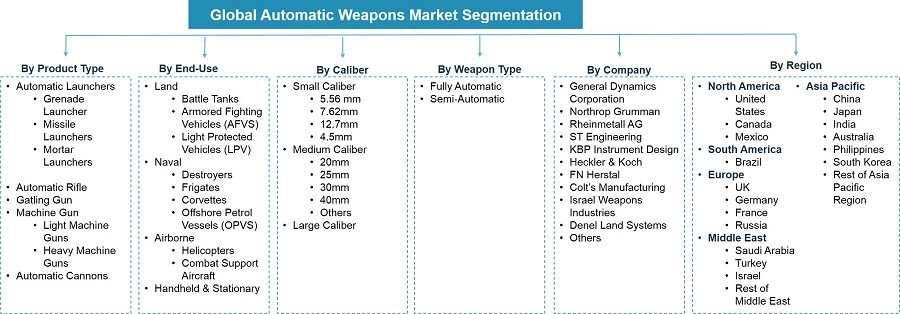
By Product Type (Automatic Launchers, Automatic Rifle, Gatling Gun, Machine Gun, Automatic Cannons), By End-Use (Land, Naval, Airborne, Handheld & Stationary), By Caliber (Small Caliber, Medium Calibe... ... liber, Medium Caliber, Large Caliber), By Weapon Type (Fully Automatic, Semi-Automatic), By Region (North America, South America, Europe, Middle East and Africa, Asia- Pacific), By Country (US, Canada, Mexico, Brazil, Germany, France, UK, Russia, Saudi-Arabia, Israel, Turkey, China, India, Japan, Australia, South Korea, Philippines), By Company Read more
- Aerospace & Defense
- Dec 2019
- 264
- PDF, Excel, PPT
The global automatic weapon market has been witnessing a speedy growth due to the presence of several favorable factors driving the demand for automatic weapons, such as modification of military forces, rising demand for interconnected warfare devices, extensive upgradations in the conventional combat architecture, and proliferating demand for high-precision warfare weapons from the military and defense industries.
| Report Coverage | Details |
| Study Period | Historical Data: 2015-19 |
| Base Year: 2019 | |
| Forecast Period: 2020-25 | |
| Regions Covered | North America |
| Europe | |
| Asia-Pacific | |
| South America | |
| Middle East & Africa | |
| Unit Denominations | USD Million/Billion |
According to MarkNtel Advisors’ research report titled “Global Automatic Weapon Market Analysis, 2020”, the Global Automatic Weapon market is anticipated to grow at a CAGR of around 10% during 2020-25. The allocation of funds in the defense budget by the governments across several developed and developing nations has been continuously increasing over the past few years, which has been acting as a key factor for the growth in the Global Automatic Weapon market.
Automatic Segment Weapon Type is Anticipated to Experience the Highest CAGR
Based on the type of automatic weapon, the market has been segmented into fully automatic and semi-automatic or self-operated weapons. The fully automatic market segmentation is expected to achieve the highest growth rate during 2020-25, owing to the modernization of the military forces, in addition to the convenience, high efficiency, and accurate targeting benefits offered by the fully automatic segment. However, cost-inefficiency, stringent government regulations, and risks associated with the functioning of the segment have been hindering the market growth.
1. Introduction
1.1. Research Process
1.2. Assumption
1.3. Market Segmentation
1.4. Market Definition
2. Executive Summary
3. Expert Verbatim- What our Experts Say?
4. Global Automatic Weapons Market Outlook, 2015-2025F
4.1. Market Potential & Outlook
4.1.1. By Revenues
4.2. Market Segmentation & Outlook
4.2.1. By Product Type
4.2.1.1. Automatic Launchers
4.2.1.1.1. Grenade Launcher
4.2.1.1.2. Missile Launchers
4.2.1.1.3. Mortar Launchers
4.2.1.2. Automatic Rifle
4.2.1.3. Gatling Gun
4.2.1.4. Machine Gun
4.2.1.4.1. Light Machine Guns
4.2.1.4.2. Heavy Machine Guns
4.2.1.5. Automatic Cannons
4.2.2. By End-Use
4.2.2.1. Land
4.2.2.1.1. Battle Tanks
4.2.2.1.2. Armored Fighting Vehicles (AFVS)
4.2.2.1.3. Light Protected Vehicles (LPV)
4.2.2.2. Naval
4.2.2.2.1. Destroyers
4.2.2.2.2. Frigates
4.2.2.2.3. Corvettes
4.2.2.2.4. Offshore Petrol Vessels (OPVS)
4.2.2.3. Airborne
4.2.2.3.1. Helicopters
4.2.2.3.2. Combat Support Aircraft
4.2.2.4. Handheld & Stationary
4.2.3. By Caliber
4.2.3.1. Small Caliber
4.2.3.1.1. 5.56 mm
4.2.3.1.2. 7.62mm
4.2.3.1.3. 12.7mm
4.2.3.1.4. 4.5mm
4.2.3.2. Medium Caliber
4.2.3.2.1. 20mm
4.2.3.2.2. 25mm
4.2.3.2.3. 30mm
4.2.3.2.4. 40mm
4.2.3.2.5. Others
4.2.3.3. Large Caliber
4.2.4. By Weapon Type
4.2.4.1. Fully Automatic
4.2.4.2. Semi-Automatic
4.2.5. By Region
4.2.5.1. North America
4.2.5.2. South America
4.2.5.3. Europe
4.2.5.4. Middle East & Africa
4.2.5.5. Asia-Pacific
4.2.6. By Company
4.2.6.1. Revenue Shares
4.2.6.2. Strategic Factorial Indexing
4.2.6.3. Competitor Placement in Markntel Quadrant
5. North America Automatic Weapons Market Outlook, 2015-2025F
5.1. Market Potential & Outlook
5.1.1. By Revenues
5.2. Market Segmentation & Outlook
5.2.1. By Product Type
5.2.2. By End-Use
5.2.3. By Caliber
5.2.4. By Weapon Type
5.2.5. By Country
5.2.5.1. US
5.2.5.2. Canada
5.2.5.3. Mexico
5.3. The US Automatic Weapons Market Outlook, 2015-2025F
5.3.1. Market Potential & Outlook
5.3.1.1. By Revenues
5.3.2. Market Segmentation & Outlook
5.3.2.1. By Product Type
5.3.2.2. By End-Use
5.3.2.3. By Caliber
5.3.2.4. By Weapon Type
5.4. Canada Automatic Weapons Market Outlook, 2015-2025F
5.4.1. Market Potential & Outlook
5.4.1.1. By Revenues
5.4.2. Market Segmentation & Outlook
5.4.2.1. By Product Type
5.4.2.2. By End-Use
5.4.2.3. By Caliber
5.4.2.4. By Weapon Type
5.5. Mexico Automatic Weapons Market Outlook, 2015-2025F
5.5.1. Market Potential & Outlook
5.5.1.1. By Revenues
5.5.2. Market Segmentation & Outlook
5.5.2.1. By Product Type
5.5.2.2. By End-Use
5.5.2.3. By Caliber
5.5.2.4. By Weapon Type
6. South America Automatic Weapons Market Outlook, 2015-2025F
6.1. Market Potential & Outlook
6.1.1. By Revenues
6.2. Market Segmentation & Outlook
6.2.1. By Product Type
6.2.2. By End-Use
6.2.3. By Caliber
6.2.4. By Weapon Type
6.2.5. By Country
6.2.5.1. Brazil
6.2.5.2. Others
6.3. Brazil Automatic Weapons Market Outlook, 2015-2025F
6.3.1. Market Potential & Outlook
6.3.1.1. By Revenues
6.3.2. Market Segmentation & Outlook
6.3.2.1. By Product Type
6.3.2.2. By End-Use
6.3.2.3. By Caliber
6.3.2.4. By Weapon Type
7. Europe Automatic Weapons Market Outlook, 2015-2025F
7.1. Market Potential & Outlook
7.2. Market Potential & Outlook
7.2.1. By Revenues
7.3. Market Segmentation & Outlook
7.3.1. By Product Type
7.3.2. By End-Use
7.3.3. By Caliber
7.3.4. By Weapon Type
7.3.5. By Country
7.3.5.1. Germany
7.3.5.2. France
7.3.5.3. UK
7.3.5.4. Russia
7.3.5.5. Others
7.4. Germany Automatic Weapons Market Outlook, 2015-2025F
7.4.1. Market Potential & Outlook
7.4.1.1. By Revenues
7.4.2. Market Segmentation & Outlook
7.4.2.1. By Product Type
7.4.2.2. By End-Use
7.4.2.3. By Caliber
7.4.2.4. By Weapon Type
7.5. France Automatic Weapons Market Outlook, 2015-2025F
7.5.1. Market Potential & Outlook
7.5.1.1. By Revenues
7.5.2. Market Segmentation & Outlook
7.5.2.1. By Product Type
7.5.2.2. By Caliber
7.5.2.3. By End-Use
7.5.2.4. By Weapon Type
7.6. UK Automatic Weapons Market Outlook, 2015-2025F
7.6.1. Market Potential & Outlook
7.6.1.1. By Revenues
7.6.2. Market Segmentation & Outlook
7.6.2.1. By Product Type
7.6.2.2. By End-Use
7.6.2.3. By Caliber
7.6.2.4. By Weapon Type
7.7. Russia Automatic Weapons Market Outlook, 2015-2025F
7.7.1. Market Potential & Outlook
7.7.1.1. By Revenues
7.7.2. Market Segmentation & Outlook
7.7.2.1. By Product Type
7.7.2.2. By End-Use
7.7.2.3. By Caliber
7.7.2.4. By Duration of Service
7.7.2.5. By Weapon Type
8. Middle East & Africa Automatic Weapons Market Outlook, 2015-2025F
8.1. Market Potential & Outlook
8.1.1. By Revenues
8.2. Market Segmentation & Outlook
8.2.1. By Product Type
8.2.2. By End-Use
8.2.3. By Caliber
8.2.4. By Weapon Type
8.2.5. By Country
8.2.5.1. Saudi Arabia
8.2.5.2. Israel
8.2.5.3. Turkey
8.2.5.4. Others
8.3. Saudi Arabia Automatic Weapons Market Outlook, 2015-2025F
8.3.1. Market Potential & Outlook
8.3.1.1. By Revenues
8.3.2. Market Segmentation & Outlook
8.3.2.1. By Product Type
8.3.2.2. By End-Use
8.3.2.3. By Caliber
8.3.2.4. By Weapon Type
8.4. Israel Automatic Weapons Market Outlook, 2015-2025F
8.4.1. Market Potential & Outlook
8.4.1.1. By Revenues
8.4.2. Market Segmentation & Outlook
8.4.2.1. By Product Type
8.4.2.2. By End-Use
8.4.2.3. By Caliber
8.4.2.4. By Weapon Type
8.5. Turkey Automatic Weapons Market Outlook, 2015-2025F
8.5.1. Market Potential & Outlook
8.5.1.1. By Revenues
8.5.2. Market Segmentation & Outlook
8.5.2.1. By Product Type
8.5.2.2. By End-Use
8.5.2.3. By Caliber
8.5.2.4. By Weapon Type
9. Asia-Pacific Automatic Weapons Market Outlook, 2015-2025F
9.1. Market Potential & Outlook
9.1.1. By Revenues
9.2. Market Segmentation & Outlook
9.2.1. By Product Type
9.2.2. By End-Use
9.2.3. By Caliber
9.2.4. By Weapon Type
9.2.5. By Country
9.2.5.1. China
9.2.5.2. India
9.2.5.3. Japan
9.2.5.4. Australia
9.2.5.5. South Korea
9.2.5.6. Philippines
9.2.5.7. Others
9.3. China Automatic Weapons Market Outlook, 2015-2025F
9.3.1. Market Potential & Outlook
9.3.1.1. By Revenues
9.3.2. Market Segmentation & Outlook
9.3.2.1. By Product Type
9.3.2.2. By End-Use
9.3.2.3. By Caliber
9.3.2.4. By Weapon Type
9.4. India Automatic Weapons Market Outlook, 2015-2025F
9.4.1. Market Potential & Outlook
9.4.1.1. By Revenues
9.4.2. Market Segmentation & Outlook
9.4.2.1. By Product Type
9.4.2.2. By End-Use
9.4.2.3. By Caliber
9.4.2.4. By Weapon Type
9.5. Japan Automatic Weapons Market Outlook, 2015-2025F
9.5.1. Market Potential & Outlook
9.5.1.1. By Revenues
9.5.2. Market Segmentation & Outlook
9.5.2.1. By Product Type
9.5.2.2. By End-Use
9.5.2.3. By Caliber
9.5.2.4. By Weapon Type
9.6. Australia Automatic Weapons Market Outlook, 2015-2025F
9.6.1. Market Potential & Outlook
9.6.1.1. By Revenues
9.6.2. Market Segmentation & Outlook
9.6.2.1. By Product Type
9.6.2.2. By End-Use
9.6.2.3. By Caliber
9.6.2.4. By Weapon Type
9.7. South Korea Automatic Weapons Market Outlook, 2015-2025F
9.7.1. Market Potential & Outlook
9.7.1.1. By Revenues
9.7.2. Market Segmentation & Outlook
9.7.2.1. By Product Type
9.7.2.2. By End-Use
9.7.2.3. By Caliber
9.7.2.4. By Weapon Type
9.8. Philippines Automatic Weapons Market Outlook, 2015-2025F
9.8.1. Market Potential & Outlook
9.8.1.1. By Revenues
9.8.2. Market Segmentation & Outlook
9.8.2.1. By Product Type
9.8.2.2. By End-Use
9.8.2.3. By Caliber
9.8.2.4. By Weapon Type
10. Global Automatic Weapons Market Policies, Regulations, Product Type Standards
11. Global Automatic Weapons Market Trends & Insights
12. Global Automatic Weapons Market Dynamics
12.1.Growth Drivers
12.2.Challenges
12.3.Impact Analysis
13. Global Automatic Weapons Market Hotspot and Opportunities
14. Global Automatic Weapons Market Key Strategic Imperatives for Success and Growth
15. Competitive Outlook
15.1.Competition Matrix
15.1.1. Product Type Portfolio
15.1.2. Brand Specialization
15.1.3. Target Markets
15.1.4. Target Product Types
15.1.5. Research & Development
15.1.6. Strategic Alliances
15.1.7. Strategic Initiatives
15.2.Company Profiles (Business Description, Product Type Segments, Business Segments, Financials, Strategic Alliances/ Partnerships, Future Plans)
15.2.1. General Dynamics Corporation
15.2.2. Northrop Grumman
15.2.3. Rheinmetall AG
15.2.4. ST Engineering
15.2.5. KBP Instrument Design Bureau
15.2.6. Heckler & Koch AG
15.2.7. FN Herstal
15.2.8. Colt’s Manufacturing Company LLC
15.2.9. Israel Weapons Industries (IWI) Ltd.
15.2.10. Denel Land Systems
16. Disclaimer
MarkNtel Advisors follows a robust and iterative research methodology designed to ensure maximum accuracy and minimize deviation in market estimates and forecasts. Our approach combines both bottom-up and top-down techniques to effectively segment and quantify various aspects of the market. A consistent feature across all our research reports is data triangulation, which examines the market from three distinct perspectives to validate findings. Key components of our research process include:
1. Scope & Research Design At the outset, MarkNtel Advisors define the research objectives and formulate pertinent questions. This phase involves determining the type of research—qualitative or quantitative—and designing a methodology that outlines data collection methods, target demographics, and analytical tools. They also establish timelines and budgets to ensure the research aligns with client goals.
2. Sample Selection and Data Collection In this stage, the firm identifies the target audience and determines the appropriate sample size to ensure representativeness. They employ various sampling methods, such as random or stratified sampling, based on the research objectives. Data collection is carried out using tools like surveys, interviews, and observations, ensuring the gathered data is reliable and relevant.
3. Data Analysis and Validation Once data is collected, MarkNtel Advisors undertake a rigorous analysis process. This includes cleaning the data to remove inconsistencies, employing statistical software for quantitative analysis, and thematic analysis for qualitative data. Validation steps are taken to ensure the accuracy and reliability of the findings, minimizing biases and errors.

4. Data Forecast and FinalizationThe final phase involves forecasting future market trends based on the analyzed data. MarkNtel Advisors utilize predictive modeling and time series analysis to anticipate market behaviors. The insights are then compiled into comprehensive reports, featuring visual aids like charts and graphs, and include strategic recommendations to inform client decision-making
We’d love to understand what matters most to you.