

By Offering (Hardware (Distributed Antenna Systems (DAS), Small Cell Systems, Baseband Units (BBU), Radio Units (RU), Repeaters & Signal Boosters), Software (Network Management Software, Network Orche... ... tware, Network Orchestration & Automation, Network Analytics & Monitoring, Security Software), Services (Consulting & Network Design, Integration & Deployment, Testing & Optimization, Managed Services, Maintenance & Support)), By Spectrum Band (Sub-6 GHz (Low Band (<1 GHz), Mid Band (1–6 GHz)), Millimeter Wave (mmWave)), By Network Type (Public Indoor 5G, Private Indoor 5G), By Ownership Model (Mobile Network Operator (MNO)-Owned, Enterprise-Owned, Neutral Host-Owned), By Application (Enhanced Mobile Broadband (eMBB), Ultra-Reliable Low-Latency Communications (URLLC), Massive Machine-Type Communications (mMTC), Industrial Automation, Smart Building & Facility Management, IoT Connectivity, Others), By Venue Type (Commercial Buildings, Retail & Hospitality Venues, Industrial Facilities, Healthcare Facilities, Educational Institutions, Transportation Hubs, Others), and others Read more
- ICT & Electronics
- Jun 2026
- 215
- PDF, Excel, PPT
Europe Indoor 5G Market Key Takeaways
- Europe indoor 5G market estimated at USD 3.27 billion in 2025, rising from USD 3.46 billion in 2026 to USD 5.77 billion by 2032.
- The industry is projected to witness steady growth at a CAGR of 8.90% during the forecast period.
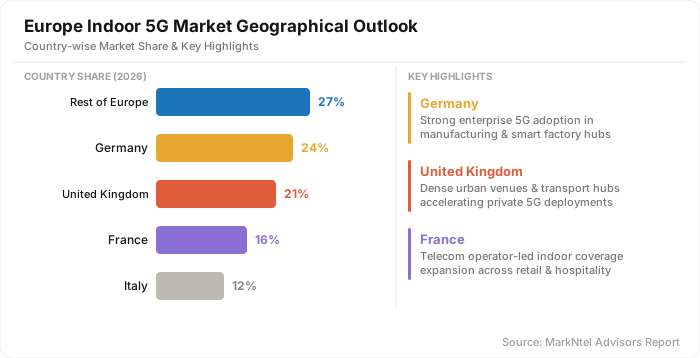
- Germany leads regional demand with approximately a 24% share in 2026.
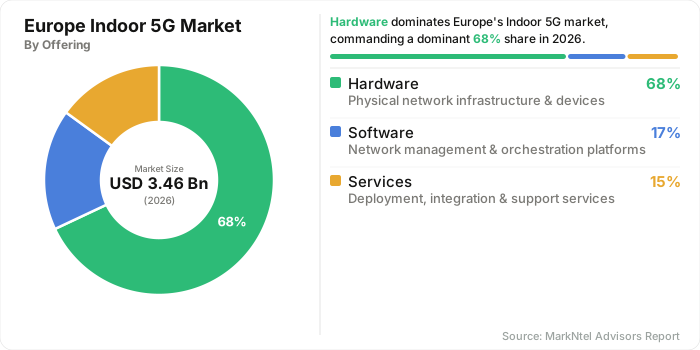
- Hardware dominates the offering segment, contributing nearly 68% of the revenue.
- Commercial buildings account for around 26% of demand in 2026.
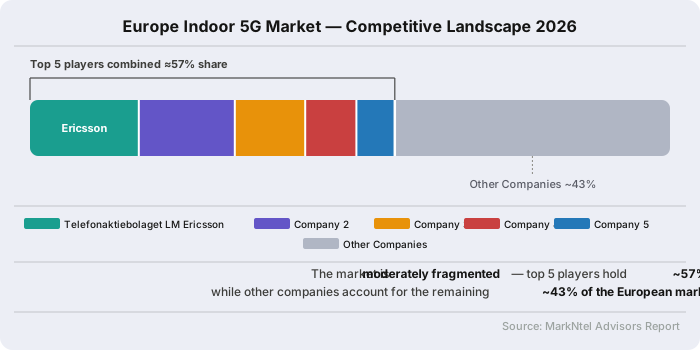
- The industry exhibits a moderately fragmented structure, with the top five players collectively holding about a 57% share while smaller vendors compete through niche and cost-efficient solutions.
Europe Indoor 5G Market Size and Outlook
Europe indoor 5G market size was valued at USD 3.27 billion in 2025 and is projected to grow from USD 3.46 billion in 2026 to USD 5.77 billion by 2032, registering a CAGR of 8.90% during 2026–2032. Growth is driven by rising demand for reliable in-building connectivity across enterprises and public venues. The indoor 5G is increasingly supported by neutral host infrastructure and scalable small cell deployment, enabling efficient capacity expansion and improved coverage within complex indoor environments.
Public policy remains the primary growth engine shaping infrastructure deployment across the region. 5G accounted for 30% of Europe’s mobile connections at the end of 2024, equivalent to approximately 200 million connections, compared with a 24% global average, indicating stronger regional penetration. The European Commission’s Digital Decade Policy Programme targets full 5G coverage across populated areas by 2030, alongside the deployment of at least 10,000 climate-neutral edge nodes, accelerating rollout while supporting network densification and improved indoor connectivity.
Enterprise digitalisation represents the second major demand pillar, underpinned by strong economic value creation. GSMA estimates that 5G will contribute approximately USD 177 billion to the European economy by 2030, with 34% of this value generated from manufacturing and 19% from public administration. Adoption is expected to reach 80% of total mobile connections by 2030, intensifying indoor capacity requirements across factories, healthcare centers, and transport hubs where reliable, high-speed connectivity is essential for automation and real-time operations.
The Europe indoor 5G industry is expected to maintain stable, policy-supported growth driven by enterprise demand and infrastructure evolution. While expansion remains moderate, regulatory alignment and continued investment in advanced connectivity frameworks will reinforce long-term development. Taken together, the market outlook remains resilient, supported by sustained technological adoption, evolving deployment models, and the progressive transformation of indoor network ecosystems across the region, ensuring consistent performance improvements and broader commercial viability.
Europe Indoor 5G Market Key Indicators
- The European Commission's 2026 State of the Digital Decade report found that basic 5G coverage now reaches 96.8% of EU households. While outdoor macro networks are near-ubiquitous, building materials block higher-band signals from penetrating indoors, leaving offices, hospitals, and retail venues underserved; this coverage-versus-capacity gap is the central driver of demand for dedicated indoor 5G and distributed antenna systems across Europe.
- According to the Ericsson Mobility Report, Western Europe's 5G subscription penetration stood at 54% at the end of 2025 and is forecast to climb to around 95% by 2031. As subscribers migrate to data-intensive 5G services, traffic increasingly concentrates at high-footfall indoor locations, compelling operators and neutral host providers to densify coverage inside transport hubs, stadiums, and large commercial buildings.
- The GSMA forecasts 545 million licensed cellular IoT connections across Europe by 2030, with Germany alone accounting for one-quarter of the total and France, Italy, Sweden, and the UK each contributing around 10%. Dense sensor and device populations inside factories, warehouses, and healthcare facilities require stable, high-capacity indoor coverage, positioning in-building 5G as essential infrastructure for industrial and enterprise IoT growth.
- European mobile operators invested more than EUR 160 billion in capital expenditure over the five years to 2024, much of it on 5G, and the GSMA expects annual mobile capex to exceed USD 28.7 billion every year to 2030. Sustained spending funds network densification, including the indoor small cells and shared antenna systems that deliver carrier-grade 5G inside the buildings where most data is consumed.
- As of September 2024, 18 European operators had launched 5G Standalone services, including EE in the UK and Free in France, according to the GSMA. 5G Standalone (5G SA) removes the LTE dependency and enables network slicing, the technical foundation for guaranteed-performance enterprise services delivered indoors, accelerating uptake of private networks and neutral host models in commercial and industrial venues (GSMA).
Europe Indoor 5G Market Scope
| Category | Segments |
|---|---|
| By Offering | Hardware (Distributed Antenna Systems (DAS), Small Cell Systems, Baseband Units (BBU), Radio Units (RU), Repeaters & Signal Boosters), Software (Network Management Software, Network Orchestration & Automation, Network Analytics & Monitoring, Security Software), Services (Consulting & Network Design, Integration & Deployment, Testing & Optimization, Managed Services, Maintenance & Support |
| By Spectrum Band | Sub-6 GHz (Low Band (<1 GHz), Mid Band (1–6 GHz)), Millimeter Wave (mmWave |
| By Network Type | Public Indoor 5G, Private Indoor 5G |
| By Ownership Model | Mobile Network Operator (MNO)-Owned, Enterprise-Owned, Neutral Host-Owned |
| By Application | Enhanced Mobile Broadband (eMBB), Ultra-Reliable Low-Latency Communications (URLLC), Massive Machine-Type Communications (mMTC), Industrial Automation, Smart Building & Facility Management, IoT Connectivity, Others |
| By Venue Type | Commercial Buildings, Retail & Hospitality Venues, Industrial Facilities, Healthcare Facilities, Educational Institutions, Transportation Hubs, Others |
Europe Indoor 5G Market Growth Drivers
Surging Indoor Data Consumption and Enterprise Digitalisation
The most significant growth driver is the relentless rise in indoor data consumption. People spend roughly 90% of their time indoors, and over 80% of all mobile data is now consumed inside buildings, according to Ericsson. Yet most indoor spaces still depend on outdoor macro networks that cannot reliably penetrate modern structures, creating a structural demand for dedicated indoor 5G systems across the Europe Indoor 5G Industry.
The performance gap is widening as buildings become harder to serve. Modern, thermally efficient buildings with steel frames, reinforced concrete, and metallised glass sharply attenuate higher-band 5G signals, while fewer than 60% of users report satisfaction with their indoor coverage and capacity. As enterprises digitalise operations with automation, sensors, and real-time applications, reliable on-premises connectivity becomes mission-critical rather than optional, accelerating investment in small cells and in-building systems.
The opportunity is shifting from basic coverage toward indoor capacity and experience. Operators, neutral-host providers, and enterprises are prioritising high-density venues where dedicated systems are essential, and vendors that pair multi-operator, energy-efficient indoor radios with simple deployment are best placed to capture rising indoor 5G spend. Hardware that lowers total cost of ownership relative to legacy active distributed antenna systems is increasingly decisive in winning these deployments.
Recent Trends
Rising Adoption of Enterprise-Owned Private 5G Networks
A defining trend in the Europe indoor 5G landscape is the shift from operator-led coverage toward enterprise-owned private 5G networks for on-premises environments. Industrial and commercial users increasingly demand deterministic, secure, and high-performance connectivity under direct control. Reflecting this shift, Siemens expanded its enterprise-controlled private 5G footprint in April 2026 across multiple European countries, leveraging locally licensed spectrum to strengthen deployment flexibility.
This transition is further reinforced by a rapidly evolving supplier ecosystem supporting open and interoperable architectures. In 2026, the UK’s Digital Catapult integrated six additional private network and Open RAN specialists into its testing programme, which has evaluated 71 Open RAN products from 26 vendors. This expanding base of providers is accelerating innovation while reducing deployment complexity and costs through open RAN architecture and vendor diversification.
Collectively, these developments signal a structural transformation in network ownership and deployment models. Enterprises across manufacturing, logistics, and large campuses are increasingly commissioning dedicated systems rather than relying solely on public networks. This shift is advancing software-defined networking adoption and modular infrastructure design, positioning the Europe indoor 5G industry toward more flexible, scalable, and enterprise-centric connectivity frameworks.
Europe Indoor 5G Market Opportunities and Challenges
Investment Constraints Reshaping Indoor 5G Deployment and Funding Models
A key challenge in the Europe indoor 5G sector is the region’s persistent telecom investment deficit, which continues to constrain the pace of advanced indoor deployments. According to GSMA Intelligence, Europe requires approximately USD 513 billion in mobile network investment by 2035, while only around USD 292 billion is expected under current spending trajectories, leaving a funding gap of nearly USD 221 billion. This shortfall limits infrastructure depth and delays the rollout of high-performance indoor network infrastructure across enterprise and public environments.
The impact of this underinvestment is most evident in advanced network capabilities and enterprise readiness. Europe continues to lag global leaders in capital intensity and 5G Standalone deployment, restricting access to ultra-low latency and mission-critical applications. Consequently, enterprises and venue owners are increasingly shifting toward self-funded indoor systems and multi-operator frameworks, accelerating the adoption of shared connectivity platforms that reduce dependence on traditional operator-led rollout models.
This structural shift creates a substantial opportunity for vendors and infrastructure providers delivering cost-efficient and scalable solutions. Technologies such as virtualised network architecture enable modular deployments and multi-tenant cost sharing, improving return on investment for stakeholders. Additionally, policy reforms could unlock approximately USD 32 billion through spectrum fee removal, supporting reinvestment into network densification and indoor capacity expansion, thereby strengthening long-term growth prospects across the Europe indoor 5G industry.
Segmentation Insights
Dense Network Deployment Requirements Reinforcing Hardware Dominance
Hardware dominates the Europe indoor 5G demand by offering, accounting for approximately 68% of total revenue, due to its critical role in enabling high-performance network deployment. Components such as small cells, antennas, and distributed antenna systems (DAS) form the physical backbone of indoor connectivity, requiring significant upfront capital investment. The indoor 5G continues to prioritize these assets as enterprises and operators focus on enhancing coverage, capacity, and signal reliability across complex indoor environments.
The dominance of hardware is further reinforced by the need for dense network architectures in high-traffic venues such as airports, commercial complexes, and industrial facilities. Deployment of advanced radio units and integrated access points supports seamless connectivity and traffic management, particularly where macro networks face penetration limitations. Additionally, ongoing investments in radio access equipment and signal distribution systems are essential to meet increasing data consumption and performance expectations.
While software and services are gaining importance, hardware remains the primary revenue contributor due to its foundational role in infrastructure rollout and lifecycle upgrades. Continuous advancements in compact, energy-efficient equipment and multi-band compatibility are strengthening its market position. As indoor connectivity demand expands, hardware-led deployments will continue to anchor investment strategies, ensuring sustained dominance within the Europe indoor 5G ecosystem. Based on the offering, the market segmentation comprises:
- Hardware
- Software
- Services
Commercial Buildings Leading Indoor 5G Demand Driven by Enterprise Connectivity Needs
Commercial buildings represent the largest venue segment in the Europe indoor 5G industry, accounting for approximately 26% of total demand. This dominance is driven by the high concentration of office spaces, mixed-use developments, and corporate campuses that require reliable, high-capacity indoor connectivity. The industry is increasingly shaped by enterprise demand for seamless communication, digital collaboration, and uninterrupted network performance within modern workplace environments.
The segment’s strength is further supported by the growing adoption of smart workplace technologies and connected building systems. Enterprises are integrating IoT-enabled applications, security systems, and automation platforms that depend on robust indoor connectivity. As a result, investments in enterprise mobility solutions and building automation networks are accelerating, particularly in high-density office environments where consistent coverage and low latency are essential for operational efficiency and user experience.
Moreover, the shift toward hybrid work models and digital-first business operations is reinforcing the need for scalable and future-ready connectivity infrastructure within commercial spaces. Property developers and facility managers are prioritizing advanced indoor network capabilities to enhance tenant value and building competitiveness. As demand continues to evolve, commercial buildings are expected to remain a key adoption hub, supported by ongoing investments in connected workplace ecosystems and next-generation communication infrastructure. The report covers the following primary venue types:
- Commercial Buildings
- Retail & Hospitality Venues
- Industrial Facilities
- Healthcare Facilities
- Educational Institutions
- Transportation Hubs
- Others
Europe Indoor 5G Market Geographical Outlook
Germany leads the Europe indoor 5G market, accounting for approximately 24% of the total share, supported by its position as the region’s largest industrial economy and a strong base of manufacturing, automotive, and commercial real estate assets. Germany’s advanced digital ecosystem, where enterprises demand reliable and high-capacity indoor connectivity to support operational efficiency, automation, and large-scale digital transformation across commercial and industrial environments.
The country’s telecom infrastructure maturity further strengthens its leadership position. As of October 2025, around 95% of Germany’s land area was covered by 5G, up from 93% a year earlier, reflecting steady expansion. Key operators, including Deutsche Telekom, Vodafone, and Telefónica have achieved extensive territorial coverage, with Deutsche Telekom reaching approximately 87% and Vodafone and Telefónica each covering around 75–76%, supporting network coverage expansion and consistent indoor performance.
Its dominance is further reinforced by strong enterprise adoption across industrial and commercial sectors. Increasing deployment of smart manufacturing systems, connected buildings, and digital workflows is accelerating demand for advanced indoor connectivity. Investments in industrial connectivity solutions and enterprise-grade wireless systems are enabling businesses to enhance productivity and real-time data capabilities. These factors ensure Germany’s continued leadership and long-term strength in the Europe indoor 5G industry.
Europe Indoor 5G Market Competitive Analysis
The Europe indoor 5G sector is led by Telefonaktiebolaget LM Ericsson, Nokia Corporation, Huawei Technologies Co., Ltd., Samsung Electronics Co., Ltd., and ZTE Corporation, which collectively account for an estimated 57% of total market share. Despite this concentration at the top, the market remains moderately fragmented, supported by a wide base of specialised vendors and system integrators. It is characterised by strong competition across radio, core, and deployment solutions, with established players leveraging scale, R&D, and operator relationships, while smaller firms compete through innovation, cost efficiency, and niche enterprise deployments.
Prominent Companies in Europe Indoor 5G Market
- Telefonaktiebolaget LM Ericsson
- Nokia Corporation
- Huawei Technologies Co., Ltd.
- Samsung Electronics Co., Ltd.
- ZTE Corporation
- CommScope Holding Company, Inc.
- Mavenir Systems, Inc.
- Airspan Networks Holdings Inc.
- JMA Wireless
- Cisco Systems, Inc.
- NEC Corporation
- Comba Telecom Systems Holdings Limited
- Others
Europe Indoor 5G Industry News and Recent Developments:
April 2026: Ericsson and Freshwave Launch Multi-Operator Indoor 5G Solution in the UK
Ericsson and Freshwave launched “5G on Omni,” a neutral-host indoor connectivity platform delivering multi-operator 4G and 5G coverage through a single in-building infrastructure. Powered by Ericsson’s Radio Dot System, the solution enables all major UK mobile operators to provide indoor coverage from day one. The platform is already live at Workspace’s Record Hall in London and is being deployed across additional commercial sites.
Impact Analysis: The development highlights the growing shift toward shared indoor infrastructure models that reduce deployment costs and complexity for property owners and operators. By supporting multiple carriers on a single network, the solution improves commercial viability while accelerating indoor 5G adoption across offices, mixed-use developments, and enterprise facilities. The launch also reinforces the increasing role of neutral-host architectures in addressing indoor coverage challenges and supporting scalable connectivity expansion.
October 2025: Samsung Selected by Vodafone for Large-Scale Open RAN Expansion
Samsung was selected by Vodafone as a primary partner for deploying virtualized RAN (vRAN) and Open RAN solutions across Germany and other European markets. Germany became the first deployment market, with Samsung supplying thousands of Open RAN sites under a multi-year rollout programme. The project includes O-RAN-compliant radios, Massive MIMO technologies, automation capabilities, and AI-enabled network management solutions.
Impact Analysis: This agreement represents one of Europe’s most significant Open RAN deployments and strengthens the transition toward software-driven network architectures. The initiative is expected to increase vendor diversity, reduce reliance on traditional single-vendor systems, and improve network flexibility. For the indoor 5G ecosystem, broader Open RAN adoption can lower deployment costs, enhance interoperability, and accelerate the implementation of advanced enterprise connectivity.
April 2025: Nokia Expands Private 5G Adoption Across Sports and Entertainment Venues
Nokia strengthened its private 5G strategy by promoting dedicated wireless networks for sports arenas, music venues, and large event locations. The initiative focuses on delivering secure, high-capacity connectivity capable of supporting real-time operations, digital fan experiences, broadcasting requirements, and venue management applications. The move reflects growing demand for private wireless infrastructure in high-density indoor environments.
Impact Analysis: The expansion of private 5G into entertainment and event venues broadens the addressable market for indoor wireless solutions beyond traditional industrial applications. As venue operators increasingly prioritize immersive digital experiences and operational efficiency, demand for dedicated indoor networks is expected to rise. This trend creates opportunities for equipment vendors, system integrators, and private network providers while accelerating enterprise-led deployment models.
- Market Segmentation
- Introduction
- Product Definition
- Research Process
- Assumptions
- Executive Summary
- Europe Indoor 5G Market Policies, Regulations, and Product Standards
- Europe Indoor 5G Market Trends & Developments
- Europe Indoor 5G Market Startup Ecosystem
- Europe Indoor 5G Market Dynamics
- Growth Factors
- Challenges
- Europe Indoor 5G Market Hotspot & Opportunities
- Europe Indoor 5G Market Outlook, 2022-2032F
- Market Size & Outlook
- By Revenues (USD Million)
- Market Share & Outlook
- By Offering - Market Size & Forecast 2022-2032, USD Million
- Hardware
- Distributed Antenna Systems (DAS)
- Small Cell Systems
- Baseband Units (BBU)
- Radio Units (RU)
- Repeaters & Signal Boosters
- Software
- Network Management Software
- Network Orchestration & Automation
- Network Analytics & Monitoring
- Security Software
- Services
- Consulting & Network Design
- Integration & Deployment
- Testing & Optimization
- Managed Services
- Maintenance & Support
- Hardware
- By Spectrum Band- Market Size & Forecast 2022-2032, USD Million
- Sub-6 GHz
- Low Band (<1 GHz)
- Mid Band (1–6 GHz)
- Millimeter Wave (mmWave)
- Sub-6 GHz
- By Network Type - Market Size & Forecast 2022-2032, USD Million
- Public Indoor 5G
- Private Indoor 5G
- By Ownership Model- Market Size & Forecast 2022-2032, USD Million
- Mobile Network Operator (MNO)-Owned
- Enterprise-Owned
- Neutral Host-Owned
- By Application - Market Size & Forecast 2022-2032, USD Million
- Enhanced Mobile Broadband (eMBB)
- Ultra-Reliable Low-Latency Communications (URLLC)
- Massive Machine-Type Communications (mMTC)
- Industrial Automation
- Smart Building & Facility Management
- IoT Connectivity
- Others
- By Venue Type - Market Size & Forecast 2022-2032, USD Million
- Commercial Buildings
- Retail & Hospitality Venues
- Industrial Facilities
- Healthcare Facilities
- Educational Institutions
- Transportation Hubs
- Others
- By Country
- The UK
- Germany
- France
- Italy
- Spain
- Benelux
- Rest of Europe
- By Company
- Competition Characteristics
- Market Share & Analysis
- By Offering - Market Size & Forecast 2022-2032, USD Million
- Market Size & Outlook
- The UK Indoor 5G Market Outlook, 2022-2032F
- Market Size & Outlook
- By Revenues (USD Million)
- Market Segmentation & Outlook
- By Offering - Market Size & Forecast 2022-2032, USD Million
- By Spectrum Band- Market Size & Forecast 2022-2032, USD Million
- By Network Type - Market Size & Forecast 2022-2032, USD Million
- By Ownership Model- Market Size & Forecast 2022-2032, USD Million
- By Application - Market Size & Forecast 2022-2032, USD Million
- By Venue Type - Market Size & Forecast 2022-2032, USD Million
- Market Size & Outlook
- Germany Indoor 5G Market Outlook, 2022-2032F
- Market Size & Outlook
- By Revenues (USD Million)
- Market Segmentation & Outlook
- By Offering - Market Size & Forecast 2022-2032, USD Million
- By Spectrum Band- Market Size & Forecast 2022-2032, USD Million
- By Network Type - Market Size & Forecast 2022-2032, USD Million
- By Ownership Model- Market Size & Forecast 2022-2032, USD Million
- By Application - Market Size & Forecast 2022-2032, USD Million
- By Venue Type - Market Size & Forecast 2022-2032, USD Million
- Market Size & Outlook
- France Indoor 5G Market Outlook, 2022-2032F
- Market Size & Outlook
- By Revenues (USD Million)
- Market Segmentation & Outlook
- By Offering - Market Size & Forecast 2022-2032, USD Million
- By Spectrum Band- Market Size & Forecast 2022-2032, USD Million
- By Network Type - Market Size & Forecast 2022-2032, USD Million
- By Ownership Model- Market Size & Forecast 2022-2032, USD Million
- By Application - Market Size & Forecast 2022-2032, USD Million
- By Venue Type - Market Size & Forecast 2022-2032, USD Million
- Market Size & Outlook
- Italy Indoor 5G Market Outlook, 2022-2032F
- Market Size & Outlook
- By Revenues (USD Million)
- Market Segmentation & Outlook
- By Offering - Market Size & Forecast 2022-2032, USD Million
- By Spectrum Band- Market Size & Forecast 2022-2032, USD Million
- By Network Type - Market Size & Forecast 2022-2032, USD Million
- By Ownership Model- Market Size & Forecast 2022-2032, USD Million
- By Application - Market Size & Forecast 2022-2032, USD Million
- By Venue Type - Market Size & Forecast 2022-2032, USD Million
- Market Size & Outlook
- Spain Indoor 5G Market Outlook, 2022-2032F
- Market Size & Outlook
- By Revenues (USD Million)
- Market Segmentation & Outlook
- By Offering - Market Size & Forecast 2022-2032, USD Million
- By Spectrum Band- Market Size & Forecast 2022-2032, USD Million
- By Network Type - Market Size & Forecast 2022-2032, USD Million
- By Ownership Model- Market Size & Forecast 2022-2032, USD Million
- By Application - Market Size & Forecast 2022-2032, USD Million
- By Venue Type - Market Size & Forecast 2022-2032, USD Million
- Market Size & Outlook
- Benelux Indoor 5G Market Outlook, 2022-2032F
- Market Size & Outlook
- By Revenues (USD Million)
- Market Segmentation & Outlook
- By Offering - Market Size & Forecast 2022-2032, USD Million
- By Spectrum Band- Market Size & Forecast 2022-2032, USD Million
- By Network Type - Market Size & Forecast 2022-2032, USD Million
- By Ownership Model- Market Size & Forecast 2022-2032, USD Million
- By Application - Market Size & Forecast 2022-2032, USD Million
- By Venue Type - Market Size & Forecast 2022-2032, USD Million
- Market Size & Outlook
- Europe Indoor 5G Market Key Strategic Imperatives for Success & Growth
- Competitive Outlook
- Company Profiles
- Telefonaktiebolaget LM Ericsson
- Business Description
- Product Portfolio
- Collaborations & Alliances
- Recent Developments
- Financial Details
- Others
- Nokia Corporation
- Business Description
- Product Portfolio
- Collaborations & Alliances
- Recent Developments
- Financial Details
- Others
- Huawei Technologies Co., Ltd.
- Business Description
- Product Portfolio
- Collaborations & Alliances
- Recent Developments
- Financial Details
- Others
- Samsung Electronics Co., Ltd.
- Business Description
- Product Portfolio
- Collaborations & Alliances
- Recent Developments
- Financial Details
- Others
- ZTE Corporation
- Business Description
- Product Portfolio
- Collaborations & Alliances
- Recent Developments
- Financial Details
- Others
- CommScope Holding Company, Inc.
- Business Description
- Product Portfolio
- Collaborations & Alliances
- Recent Developments
- Financial Details
- Others
- Mavenir Systems, Inc.
- Business Description
- Product Portfolio
- Collaborations & Alliances
- Recent Developments
- Financial Details
- Others
- Airspan Networks Holdings Inc.
- Business Description
- Product Portfolio
- Collaborations & Alliances
- Recent Developments
- Financial Details
- Others
- JMA Wireless
- Business Description
- Product Portfolio
- Collaborations & Alliances
- Recent Developments
- Financial Details
- Others
- Cisco Systems, Inc.
- Business Description
- Product Portfolio
- Collaborations & Alliances
- Recent Developments
- Financial Details
- Others
- NEC Corporation
- Business Description
- Product Portfolio
- Collaborations & Alliances
- Recent Developments
- Financial Details
- Others
- Comba Telecom Systems Holdings Limited
- Business Description
- Product Portfolio
- Collaborations & Alliances
- Recent Developments
- Financial Details
- Others
- Others
- Telefonaktiebolaget LM Ericsson
- Company Profiles
- Disclaimer

MarkNtel Advisors follows a robust and iterative research methodology designed to ensure maximum accuracy and minimize deviation in market estimates and forecasts. Our approach combines both bottom-up and top-down techniques to effectively segment and quantify various aspects of the market. A consistent feature across all our research reports is data triangulation, which examines the market from three distinct perspectives to validate findings. Key components of our research process include:
1. Scope & Research Design At the outset, MarkNtel Advisors define the research objectives and formulate pertinent questions. This phase involves determining the type of research—qualitative or quantitative—and designing a methodology that outlines data collection methods, target demographics, and analytical tools. They also establish timelines and budgets to ensure the research aligns with client goals.
2. Sample Selection and Data Collection In this stage, the firm identifies the target audience and determines the appropriate sample size to ensure representativeness. They employ various sampling methods, such as random or stratified sampling, based on the research objectives. Data collection is carried out using tools like surveys, interviews, and observations, ensuring the gathered data is reliable and relevant.
3. Data Analysis and Validation Once data is collected, MarkNtel Advisors undertake a rigorous analysis process. This includes cleaning the data to remove inconsistencies, employing statistical software for quantitative analysis, and thematic analysis for qualitative data. Validation steps are taken to ensure the accuracy and reliability of the findings, minimizing biases and errors.

4. Data Forecast and FinalizationThe final phase involves forecasting future market trends based on the analyzed data. MarkNtel Advisors utilize predictive modeling and time series analysis to anticipate market behaviors. The insights are then compiled into comprehensive reports, featuring visual aids like charts and graphs, and include strategic recommendations to inform client decision-making
We’d love to understand what matters most to you.