

By Infrastructure Approach (Gray Infrastructure, Green Infrastructure, Hybrid Infrastructure, Smart Infrastructure), By System Function (Collection Systems, Conveyance Systems, Storage Systems, Treatm... ... rage Systems, Treatment Systems, Monitoring & Control Systems), By Material Type (Concrete, Plastics (HDPE, PVC), Metal, Geosynthetics), By Drainage Mechanism (Surface Drainage Systems, Subsurface Drainage Systems), By Project Type (New Development Projects, Retrofit & Upgrade Projects), By Application (Flood Mitigation, Stormwater Quality Treatment, Groundwater Recharge & Infiltration, Rainwater Harvesting & Reuse), By End User (Municipal & Government Authorities, Commercial & Institutional, Residential, Industrial), and others Read more
- Environment
- May 2026
- 280
- PDF, Excel, PPT
Asia Pacific Stormwater Infrastructure Market Key Takeaways
- The Asia Pacific Stormwater Infrastructure Market size, valued at USD 4.16 billion in 2025 and USD 5.12 billion in 2026, is projected to reach USD 9.78 billion by 2032, at a CAGR of 11.39%.
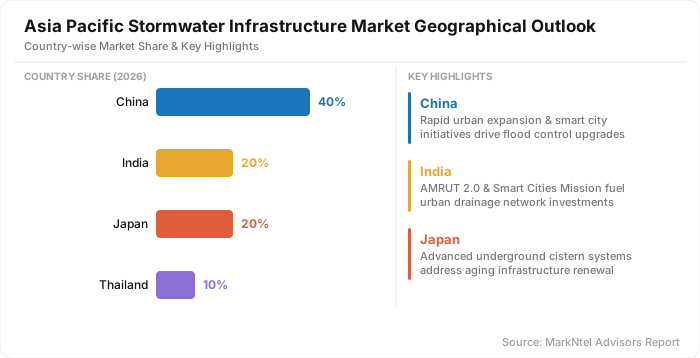
- China dominates the regional landscape, accounting for approximately 40% of the total market share.
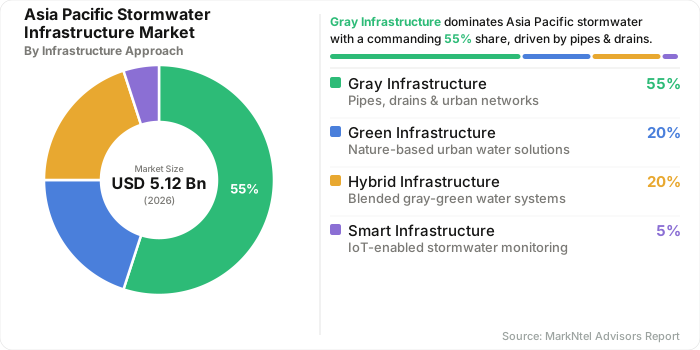
- Gray infrastructure leads by infrastructure approach, capturing nearly 55% share in 2026.
- Municipal and government authorities represent the largest end-user segment, holding about 60% share in 2026.
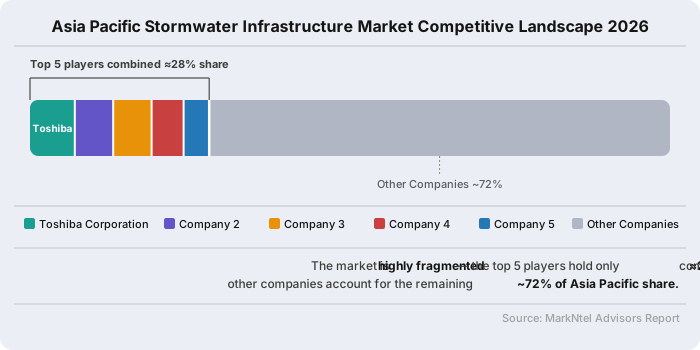
- The market structure remains moderately fragmented, with the top five players collectively accounting for nearly 28% share, reflecting a competitive mix of global firms and regional participants.
Asia Pacific Stormwater Infrastructure Market Size and Outlook
The Asia Pacific stormwater infrastructure market is projected to register a CAGR of 11.39% during the forecast period. This significant growth is supported by the rising frequency of climate-induced flood risks and increasing integration of IoT and smart monitoring technologies, including smart water management systems, driving steady expansion as governments enhance drainage efficiency and strengthen resilience across rapidly urbanizing regions.
According to the Ministry of Land, Infrastructure, Transport and Tourism, Tokyo’s Metropolitan Area Outer Underground Discharge Channel prevented approximately USD 0.99 billion in cumulative flood damage through 2024 . This documented return on large-scale gray infrastructure provides a replicable cost-benefit benchmark, influencing capital allocation decisions by municipal governments across high-density Asian cities seeking effective flood mitigation and long-term infrastructure performance.
In India, large-scale public infrastructure programs are supporting extensive system development. As of July 2024, 841 storm drainage projects, 889 sewerage and septage management projects, and 1,390 water supply projects have been grounded under the AMRUT scheme, alongside 14.9 million sewer connections. Additionally, under the Jal Jeevan Mission, around 151 million rural households have received functional tap water connections, reflecting progress in integrated water infrastructure planning and expansion.
Similarly, the Philippines has proposed approximately USD 4.75 billion for flood control infrastructure under its 2026 National Expenditure Program, covering drainage rehabilitation, flood barriers, pumping systems, and waterway improvements. At the same time, the market, valued at USD 5.12 billion in 2026, is projected to reach USD 9.78 billion by 2032, driven by increasing adoption of IoT-enabled monitoring systems, real-time flood analytics, and automated drainage networks, along with the need to retrofit aging infrastructure and address financing gaps, supporting long-term infrastructure modernization across Asia Pacific economies.
Asia Pacific Stormwater Infrastructure Market Key Indicators
- According to the United Nations Economic and Social Commission for Asia and the Pacific, Asia’s urban population is expected to expand by 50% by 2050, adding nearly 1.2 billion residents. This rapid urban concentration intensifies impervious surface expansion, directly elevating stormwater volumes and drainage stress. As a result, urban flood risk management is becoming a foundational planning priority across the Asia Pacific, reinforcing long-term infrastructure capacity expansion needs.
- In 2025, the World Bank estimated that Indian cities alone will require over USD 2.4 trillion by 2050 to build infrastructure resilient to floods and extreme climate events . This substantial capital requirement highlights the widening infrastructure financing gap, pushing governments toward blended financing models and long-term capital planning frameworks to ensure scalable and resilient stormwater infrastructure deployment across rapidly urbanizing regions.
- China’s nationally driven Sponge City initiative aims to convert 80% of urban built-up areas to capture and reuse 70% of rainwater by 2030 , redefining urban drainage paradigms. This large-scale policy intervention demonstrates how climate-resilient drainage systems can be embedded into city planning through permeable surfaces, storage systems, and ecological design, establishing a replicable framework for other Asia-Pacific economies pursuing sustainable stormwater management transformation.
- The United Nations Development Programme reported in 2024 that climate-induced disasters, including floods, generate annual economic losses of approximately USD 780 billion across the Asia-Pacific. Such recurring financial impacts are accelerating government prioritization of urban resilience investment, positioning stormwater infrastructure as essential, non-discretionary expenditure within national budgets aimed at minimizing long-term economic and social disruptions.
- Japan’s Ministry of Land, Infrastructure, Transport and Tourism documented that Tokyo’s Metropolitan Area Outer Underground Discharge Channel prevented approximately USD 0.99 billion in cumulative flood damage through 2024 . This measurable return highlights the effectiveness of flood control structures in dense urban environments, offering a compelling cost-benefit benchmark that influences infrastructure investment strategies across high-density Asia-Pacific cities.
Asia Pacific Stormwater Infrastructure Market Scope
| Category | Segments |
|---|---|
| By Infrastructure Approach | Gray Infrastructure, Green Infrastructure, Hybrid Infrastructure, Smart Infrastructure |
| By System Function | Collection Systems, Conveyance Systems, Storage Systems, Treatment Systems, Monitoring & Control Systems |
| By Material Type | Concrete, Plastics (HDPE, PVC), Metal, Geosynthetics |
| By Drainage Mechanism | Surface Drainage Systems, Subsurface Drainage Systems |
| By Project Type | New Development Projects, Retrofit & Upgrade Projects |
| By Application | Flood Mitigation, Stormwater Quality Treatment, Groundwater Recharge & Infiltration, Rainwater Harvesting & Reuse |
| By End User | Municipal & Government Authorities, Commercial & Institutional, Residential, Industrial |
Asia Pacific Stormwater Infrastructure Market Growth Drivers
Rising Frequency of Climate-Induced Flood Risks
Rising climate vulnerability across the Asia-Pacific is accelerating the need for urban flood risk management and infrastructure expansion. The Asian Development Bank warns climate change could cut regional GDP by 17% by 2070 and expose nearly 300 million people to coastal flooding, driving urgent adoption of climate-resilient drainage systems to reduce escalating environmental and economic risks.
Simultaneously, increasing fiscal commitments are reinforcing infrastructure scaling across the region. ADB’s allocation of USD 12.3 billion toward climate financing, with nearly 40% directed to adaptation-focused projects, reflects growing prioritization of stormwater runoff control and urban water resilience systems, while supporting adaptive drainage engineering approaches that align infrastructure planning with evolving climate risk scenarios.
At the national level, policy-driven funding mechanisms are strengthening response capabilities and preparedness frameworks. Thailand’s expansion of provincial flood-response funding from USD 1.4 million to approximately USD 2.8 million per province demonstrates a proactive shift toward urban flood mitigation planning, improving coordination between regional and national authorities.
Escalating climate risks, rising public investment, and policy-backed resilience frameworks are structurally reinforcing demand across the Asia Pacific stormwater infrastructure industry, while advancing integrated flood management systems that strengthen and enhance disaster preparedness capabilities, optimize drainage efficiency, and support sustainable development planning across rapidly urbanizing regional economies facing intensifying climate variability.
Recent Trends
Integration of IoT and Smart Monitoring
The adoption of smart water management systems is emerging as a defining trend across the Asia Pacific stormwater infrastructure landscape, driven by rising urban flood risks and the need for data-driven infrastructure optimization. Governments are increasingly deploying real-time flood monitoring technologies to enhance situational awareness, enabling faster response times, improving drainage efficiency, and minimizing urban disruption during high-intensity rainfall events across densely populated and climate-vulnerable metropolitan regions.
A prominent example is Singapore’s Public Utilities Board, which operates an advanced smart drainage grid comprising over 1,000 water-level sensors, more than 500 CCTV cameras, and multiple weather-monitoring instruments deployed across canals and drainage networks. This extensive implementation of digital drainage infrastructure enables predictive insights while supporting IoT-enabled water sensors that continuously track system performance, detect anomalies, and strengthen proactive flood management capabilities across critical urban catchments.
Furthermore, the planned addition of 650 sensors by 2028 highlights a shift toward fully integrated and intelligent monitoring ecosystems across urban drainage systems. These investments are reinforced by predictive flood analytics, allowing authorities to anticipate overflow risks, optimize pumping operations, and reduce infrastructure strain, thereby transforming stormwater systems into intelligent networks across the Asia Pacific stormwater infrastructure industry with enhanced resilience and operational efficiency.
Asia Pacific Stormwater Infrastructure Market Opportunities and Challenges
Aging Drainage Infrastructure Risks Accelerating Rehabilitation and Investment Demand
A significant challenge is aging and structurally vulnerable drainage infrastructure, particularly in developed economies. As reported by The Japan Times, the 2024 Noto earthquake exposed critical weaknesses in Japan’s water systems, where many pipelines exceed 50 years and lack disaster resilience, highlighting the growing infrastructure financing gap for large-scale rehabilitation .
The disruption, which left nearly 135,000 households without water access, underscores the risks associated with outdated systems under extreme events. These failures are accelerating the adoption of public-private infrastructure partnerships, enabling governments to mobilize capital and expertise, while also emphasizing asset lifecycle management and long-term performance across urban drainage networks.
Conversely, rising financial commitments are creating strong opportunities for infrastructure expansion and modernization. The Asian Development Bank approved a USD 125 million loan in 2025 to strengthen stormwater and water supply systems in Assam, India, supporting drainage upgrades, flood diversion infrastructure, and climate-adaptive urban water systems benefiting more than 360,000 residents.
The infrastructure vulnerabilities and expanding financial support mechanisms are accelerating urban resilience investment across the Asia Pacific stormwater infrastructure industry, driving system modernization, improving drainage capacity, and promoting adoption of sustainable solutions, while strengthening long-term climate preparedness and supporting efficient, adaptive infrastructure development across rapidly urbanizing and climate-sensitive regional economies.
Segmentation Insights
Gray Infrastructure Continues to Anchor Stormwater Systems
Gray infrastructure accounts for approximately 55% of the total revenue share within the Asia Pacific stormwater infrastructure industry, reflecting its continued dominance in large-scale flood control and drainage management. Conventional systems, including dikes, canals, and stormwater conveyance systems, remain critical for managing high runoff volumes across densely populated urban environments.
China’s large-scale infrastructure deployment reinforces this dominance, with the Ministry of Water Resources of China reporting over 318,000 kilometres of dikes and 109 billion cubic metres of flood detention capacity by 2024. These assets rely on integrated engineered drainage networks, ensuring efficient system connectivity, overflow control, and operational resilience during extreme precipitation events.
Despite increasing interest in green and hybrid solutions, gray infrastructure remains the backbone of regional flood management strategies. Its compatibility with flood control structures enables governments to address immediate urban flooding risks, particularly in megacities where land constraints limit large-scale deployment of nature-based stormwater management alternatives.
The scalability, reliability, and established performance of gray infrastructure continue to reinforce its leadership across the Asia Pacific stormwater infrastructure market, while supporting high-capacity drainage systems that ensure long-term flood protection and enable adaptive infrastructure planning across rapidly urbanizing regional economies. Based on the infrastructure approach, the scope has been classified into:
- Gray Infrastructure
- Green Infrastructure
- Hybrid Infrastructure
- Smart Infrastructure
Municipal & Government Authorities Dominate the End-User Vertical
Municipal and government authorities account for approximately 50% of the total revenue share, making them the largest contributors within the Asia Pacific stormwater infrastructure market. Their dominance is driven by responsibility for large-scale urban stormwater management and execution of drainage networks required to support expanding populations and mitigate flood risks effectively.
Public sector agencies play a central role in deploying municipal drainage solutions, particularly in high-density cities where infrastructure must manage large runoff volumes and aging systems require continuous upgrades. Governments also lead capital-intensive projects such as stormwater channels, pumping stations, and flood retention facilities, ensuring integrated coverage across metropolitan regions.
In contrast, commercial, residential, and industrial sectors contribute through localized investments but lack the scale and regulatory authority of public entities. Municipal bodies further drive adoption of city flood mitigation systems, supported by policy frameworks, climate adaptation mandates, and long-term infrastructure planning aligned with evolving national resilience.
The centralized funding authority, regulatory control, and large-scale execution capabilities continue to reinforce the leadership of municipal entities across the Asia Pacific stormwater infrastructure Industry, positioning them as primary drivers of infrastructure expansion, improved system capacity, and long-term resilience across rapidly urbanizing regional economies. The key end users mapped in the study include:
- Municipal & Government Authorities
- Commercial & Institutional
- Residential
- Industrial
Asia Pacific Stormwater Infrastructure Market Geographical Outlook
China accounts for approximately 40% of total demand within the Asia Pacific stormwater infrastructure market, reflecting its large-scale urbanization and sustained government-led infrastructure investments. Rapid city expansion and increasing climate risks are driving the adoption of regional flood resilience initiatives, positioning China as a leading contributor to stormwater infrastructure development.
The country’s Sponge City program remains a cornerstone of its strategy, with the Ministry of Housing and Urban-Rural Development of China confirming over 10,000 projects completed across 60 pilot cities by 2026 . These initiatives emphasize national water management policies, integrating permeable pavements, retention systems, and urban wetlands to enhance stormwater absorption, reuse efficiency, and long-term water sustainability outcomes.
In parallel, China approved approximately USD 42.2 billion in infrastructure investments in 2026 under its 15th Five-Year Plan, focusing on underground pipeline networks and ecological resilience projects. These investments are accelerating infrastructure modernization programs, supporting the deployment of smart drainage technologies and advanced runoff management systems to improve system efficiency and climate adaptability.
The strong policy execution, continuous investment flows, and integrated infrastructure strategies reinforce China’s leadership across the stormwater infrastructure demand, positioning it as a key driver of innovation, scalability, and long-term resilience in regional stormwater management systems and future urban infrastructure planning frameworks.
Asia Pacific Stormwater Infrastructure Market Competitive Analysis
Among the key participants, Toshiba Infrastructure Systems & Solutions Corporation, SMEC Holdings Limited, Oriental Consultants Global Co., Ltd., ACO Group, and RELN Pty Ltd collectively represent the leading players, accounting for an estimated 28% of the overall market share. The Asia Pacific Stormwater Infrastructure Industry remains fragmented, characterized by a broad base of regional contractors, specialized manufacturers, and local suppliers. While top players leverage technical expertise and large-scale project execution capabilities to secure strategic contracts, smaller firms sustain competitiveness through localized delivery and cost efficiency, resulting in a moderately competitive and project-driven market structure.
Major Companies in Asia Pacific Stormwater Infrastructure
- ACO Group
- SMEC Holdings Limited
- RELN Pty Ltd
- Everhard Industries Pty Ltd
- Beijing Tidelion S&I Rainwater Harvesting Technology Co. Ltd
- Toshiba Infrastructure Systems & Solutions Corporation
- GRAF China Environmental (Nanjing) Co., Ltd.
- Shenzhen Doctor Rain Rainwater Recycling Co., Ltd.
- ORCA Civil Products Pty. Ltd
- Oriental Consultants Global Co., Ltd.
- Others
Asia Pacific Stormwater Infrastructure Industry News and Recent Developments
March 2026: MMDA and AIIB Launch Metro Manila Sponge City Initiative
The Metropolitan Manila Development Authority and Asian Infrastructure Investment Bank initiated the Metro Manila Sponge City Project in 2026 to strengthen flood mitigation and drainage resilience across the National Capital Region. The initiative integrates nature-based infrastructure, including wetlands, parks, and rainwater impounding systems, with traditional drainage assets under a broader flood management framework.
Impact Analysis: The project reflects a strategic transition toward hybrid stormwater infrastructure models that combine ecological and engineered systems for urban flood resilience. By integrating green-blue infrastructure with conventional drainage networks, the initiative is expected to improve runoff absorption, reduce pressure on pumping facilities, and strengthen inter-agency flood coordination. The development may also accelerate the adoption of sponge-city concepts across Southeast Asia, creating long-term opportunities for smart drainage technologies, ecological retention systems, and climate-adaptive urban infrastructure investments.
February 2026: HJ Heavy Industries Signs KRW 92.2 Billion Contract for Tagum City Flood Control Project in the Philippines
HJ Heavy Industries signed a KRW 92.2 billion contract with the Philippine Department of Public Works and Highways (DPWH) for the Tagum Flood Control Project in Tagum City, Mindanao Island, financed by the Asian Development Bank (ADB). Over a 48-month construction period, HJ Heavy Industries will execute dredging and widening works across 12.4 km of the Tagum river basin, including approximately 1.35 million cubic metres of river dredging and 300,000 cubic metres of earthworks, alongside the construction of three bridges, one automatic floodgate, and one pedestrian overpass.
Impact Analysis: The contract establishes HJ Heavy Industries as an active flood control engineering contractor within the ADB-financed public infrastructure pipeline in Southeast Asia, where multilaterally funded river basin and urban flood management projects constitute the primary commercial pathway for international construction firms. HJ Heavy Industries' 50-year Philippines track record, spanning more than 80 completed projects, strengthens its competitive positioning against regional peers for subsequent ADB-funded flood infrastructure awards across Southeast Asia.
February 2025: ADB Approves USD 200 Million Loan for Kolkata Urban Drainage Infrastructure
The Asian Development Bank approved a USD 200 million loan to expand climate- and disaster-resilient sewerage and drainage systems in Kolkata. The project includes construction of 84 km of trunk pipelines, 176 km of lateral drainage pipelines, 50,000 sewer connections, one sewage treatment plant, and five pumping stations to improve urban flood resilience and sanitation infrastructure.
Impact Analysis: The investment highlights rising multilateral financing support for climate-resilient urban infrastructure across the Asia Pacific. Expansion of sewerage and drainage assets is expected to improve flood management capacity, reduce public health risks, and strengthen long-term infrastructure sustainability within densely populated urban environments. Additionally, the project may encourage further public-sector investments in integrated drainage modernization, supporting broader adoption of resilient water management systems and advanced urban infrastructure planning frameworks across emerging regional economies.
- Market Segmentation
- Introduction
- Product Definition
- Research Process
- Assumptions
- Executive Summary
- Asia Pacific Stormwater Infrastructure Market Policies, Regulations, and Product Standards
- Asia Pacific Stormwater Infrastructure Market Trends & Developments
- Asia Pacific Stormwater Infrastructure Market Dynamics
- Growth Factors
- Challenges
- Asia Pacific Stormwater Infrastructure Market Hotspot & Opportunities
- Asia Pacific Stormwater Infrastructure Market Outlook, 2022-2032F
- Market Size & Outlook
- By Revenues (USD Million)
- Market Share & Analysis
- By Infrastructure Approach- Market Size & Forecast 2022-2032, USD Million
- Gray Infrastructure
- Green Infrastructure
- Hybrid Infrastructure
- Smart Infrastructure
- By System Function - Market Size & Forecast 2022-2032, USD Million
- Collection Systems
- Conveyance Systems
- Storage Systems
- Treatment Systems
- Monitoring & Control Systems
- By Material Type- Market Size & Forecast 2022-2032, USD Million
- Concrete
- Plastics (HDPE, PVC)
- Metal
- Geosynthetics
- By Drainage Mechanism- Market Size & Forecast 2022-2032, USD Million
- Surface Drainage Systems
- Subsurface Drainage Systems
- By Project Type- Market Size & Forecast 2022-2032, USD Million
- New Development Projects
- Retrofit & Upgrade Projects
- By Application - Market Size & Forecast 2022-2032, USD Million
- Flood Mitigation
- Stormwater Quality Treatment
- Groundwater Recharge & Infiltration
- Rainwater Harvesting & Reuse
- By End User- Market Size & Forecast 2022-2032, USD Million
- Municipal & Government Authorities
- Commercial & Institutional
- Residential
- Industrial
- By Country
- China
- India
- Japan
- Singapore
- Thailand
- Australia
- New Zealand
- Rest of Asia-Pacific
- By Company
- Competition Characteristics
- Market Share & Analysis
- By Infrastructure Approach- Market Size & Forecast 2022-2032, USD Million
- Market Size & Outlook
- China Stormwater Infrastructure Market Outlook, 2022-2032F
- Market Size & Outlook
- By Revenues (USD Million)
- Market Share & Analysis
- By Infrastructure Approach- Market Size & Forecast 2022-2032, USD Million
- By System Function - Market Size & Forecast 2022-2032, USD Million
- By Material Type- Market Size & Forecast 2022-2032, USD Million
- By Drainage Mechanism- Market Size & Forecast 2022-2032, USD Million
- By Project Type- Market Size & Forecast 2022-2032, USD Million
- By Application - Market Size & Forecast 2022-2032, USD Million
- By End User- Market Size & Forecast 2022-2032, USD Million
- Market Size & Outlook
- India Stormwater Infrastructure Market Outlook, 2022-2032F
- Market Size & Outlook
- By Revenues (USD Million)
- Market Share & Analysis
- By Infrastructure Approach- Market Size & Forecast 2022-2032, USD Million
- By System Function - Market Size & Forecast 2022-2032, USD Million
- By Material Type- Market Size & Forecast 2022-2032, USD Million
- By Drainage Mechanism- Market Size & Forecast 2022-2032, USD Million
- By Project Type- Market Size & Forecast 2022-2032, USD Million
- By Application - Market Size & Forecast 2022-2032, USD Million
- By End User- Market Size & Forecast 2022-2032, USD Million
- Market Size & Outlook
- Japan Stormwater Infrastructure Market Outlook, 2022-2032F
- Market Size & Outlook
- By Revenues (USD Million)
- Market Share & Analysis
- By Infrastructure Approach- Market Size & Forecast 2022-2032, USD Million
- By System Function - Market Size & Forecast 2022-2032, USD Million
- By Material Type- Market Size & Forecast 2022-2032, USD Million
- By Drainage Mechanism- Market Size & Forecast 2022-2032, USD Million
- By Project Type- Market Size & Forecast 2022-2032, USD Million
- By Application - Market Size & Forecast 2022-2032, USD Million
- By End User- Market Size & Forecast 2022-2032, USD Million
- Market Size & Outlook
- Singapore Stormwater Infrastructure Market Outlook, 2022-2032F
- Market Size & Outlook
- By Revenues (USD Million)
- Market Share & Analysis
- By Infrastructure Approach- Market Size & Forecast 2022-2032, USD Million
- By System Function - Market Size & Forecast 2022-2032, USD Million
- By Material Type- Market Size & Forecast 2022-2032, USD Million
- By Drainage Mechanism- Market Size & Forecast 2022-2032, USD Million
- By Project Type- Market Size & Forecast 2022-2032, USD Million
- By Application - Market Size & Forecast 2022-2032, USD Million
- By End User- Market Size & Forecast 2022-2032, USD Million
- Market Size & Outlook
- Thailand Stormwater Infrastructure Market Outlook, 2022-2032F
- Market Size & Outlook
- By Revenues (USD Million)
- Market Share & Analysis
- By Infrastructure Approach- Market Size & Forecast 2022-2032, USD Million
- By System Function - Market Size & Forecast 2022-2032, USD Million
- By Material Type- Market Size & Forecast 2022-2032, USD Million
- By Drainage Mechanism- Market Size & Forecast 2022-2032, USD Million
- By Project Type- Market Size & Forecast 2022-2032, USD Million
- By Application - Market Size & Forecast 2022-2032, USD Million
- By End User- Market Size & Forecast 2022-2032, USD Million
- Market Size & Outlook
- Australia Stormwater Infrastructure Market Outlook, 2022-2032F
- Market Size & Outlook
- By Revenues (USD Million)
- Market Share & Analysis
- By Infrastructure Approach- Market Size & Forecast 2022-2032, USD Million
- By System Function - Market Size & Forecast 2022-2032, USD Million
- By Material Type- Market Size & Forecast 2022-2032, USD Million
- By Drainage Mechanism- Market Size & Forecast 2022-2032, USD Million
- By Project Type- Market Size & Forecast 2022-2032, USD Million
- By Application - Market Size & Forecast 2022-2032, USD Million
- By End User- Market Size & Forecast 2022-2032, USD Million
- Market Size & Outlook
- New Zealand Stormwater Infrastructure Market Outlook, 2022-2032F
- Market Size & Outlook
- By Revenues (USD Million)
- Market Share & Analysis
- By Infrastructure Approach- Market Size & Forecast 2022-2032, USD Million
- By System Function - Market Size & Forecast 2022-2032, USD Million
- By Material Type- Market Size & Forecast 2022-2032, USD Million
- By Drainage Mechanism- Market Size & Forecast 2022-2032, USD Million
- By Project Type- Market Size & Forecast 2022-2032, USD Million
- By Application - Market Size & Forecast 2022-2032, USD Million
- By End User- Market Size & Forecast 2022-2032, USD Million
- Market Size & Outlook
- Asia Pacific Stormwater Infrastructure Market Key Strategic Imperatives for Success & Growth
- Competitive Outlook
- Company Profiles
- ACO Group
- Business Description
- Product Portfolio
- Collaborations & Alliances
- Recent Developments
- Financial Details
- Others
- SMEC Holdings Limited
- Business Description
- Product Portfolio
- Collaborations & Alliances
- Recent Developments
- Financial Details
- Others
- RELN Pty Ltd
- Business Description
- Product Portfolio
- Collaborations & Alliances
- Recent Developments
- Financial Details
- Others
- Everhard Industries Pty Ltd
- Business Description
- Product Portfolio
- Collaborations & Alliances
- Recent Developments
- Financial Details
- Others
- Beijing Tidelion S&I Rainwater Harvesting Technology Co. Ltd
- Business Description
- Product Portfolio
- Collaborations & Alliances
- Recent Developments
- Financial Details
- Others
- Toshiba Infrastructure Systems & Solutions Corporation
- Business Description
- Product Portfolio
- Collaborations & Alliances
- Recent Developments
- Financial Details
- Others
- GRAF China Environmental (Nanjing) Co., Ltd.
- Business Description
- Product Portfolio
- Collaborations & Alliances
- Recent Developments
- Financial Details
- Others
- Shenzhen Doctor Rain Rainwater Recycling Co., Ltd.
- Business Description
- Product Portfolio
- Collaborations & Alliances
- Recent Developments
- Financial Details
- Others
- ORCA Civil Products Pty. Ltd
- Business Description
- Product Portfolio
- Collaborations & Alliances
- Recent Developments
- Financial Details
- Others
- Oriental Consultants Global Co., Ltd.
- Business Description
- Product Portfolio
- Collaborations & Alliances
- Recent Developments
- Financial Details
- Others
- Others
- ACO Group
- Company Profiles
- Disclaimer

MarkNtel Advisors follows a robust and iterative research methodology designed to ensure maximum accuracy and minimize deviation in market estimates and forecasts. Our approach combines both bottom-up and top-down techniques to effectively segment and quantify various aspects of the market. A consistent feature across all our research reports is data triangulation, which examines the market from three distinct perspectives to validate findings. Key components of our research process include:
1. Scope & Research Design At the outset, MarkNtel Advisors define the research objectives and formulate pertinent questions. This phase involves determining the type of research—qualitative or quantitative—and designing a methodology that outlines data collection methods, target demographics, and analytical tools. They also establish timelines and budgets to ensure the research aligns with client goals.
2. Sample Selection and Data Collection In this stage, the firm identifies the target audience and determines the appropriate sample size to ensure representativeness. They employ various sampling methods, such as random or stratified sampling, based on the research objectives. Data collection is carried out using tools like surveys, interviews, and observations, ensuring the gathered data is reliable and relevant.
3. Data Analysis and Validation Once data is collected, MarkNtel Advisors undertake a rigorous analysis process. This includes cleaning the data to remove inconsistencies, employing statistical software for quantitative analysis, and thematic analysis for qualitative data. Validation steps are taken to ensure the accuracy and reliability of the findings, minimizing biases and errors.

4. Data Forecast and FinalizationThe final phase involves forecasting future market trends based on the analyzed data. MarkNtel Advisors utilize predictive modeling and time series analysis to anticipate market behaviors. The insights are then compiled into comprehensive reports, featuring visual aids like charts and graphs, and include strategic recommendations to inform client decision-making
We’d love to understand what matters most to you.