

By Product (Reagents & Consumables, Instruments, Software, Services), By Technology (Polymerase Chain Reaction (PCR), Microarrays, Sequencing Technologies, RNA Interference (RNAi))......, By Application (Drug Discovery, Clinical Diagnostics, Toxicogenomic, Comparative Transcriptomics), By End User (Pharmaceutical & Biotechnology Companies, Hospitals & Diagnostic Centers, Academic & Research Institutes, Contract Research Organizations (CROs)), and others Read more
- Healthcare
- Jul 2026
- 140
- PDF, Excel, PPT
US RNA Analysis Market Key Takeaways
- The US RNA analysis market, valued at USD 7.77 billion in 2025, is projected to grow to USD 8.17 billion in 2026 and reach USD 15.59 billion by 2032.
- The industry is projected to witness steady growth at a CAGR of 11.37% during the forecast period.
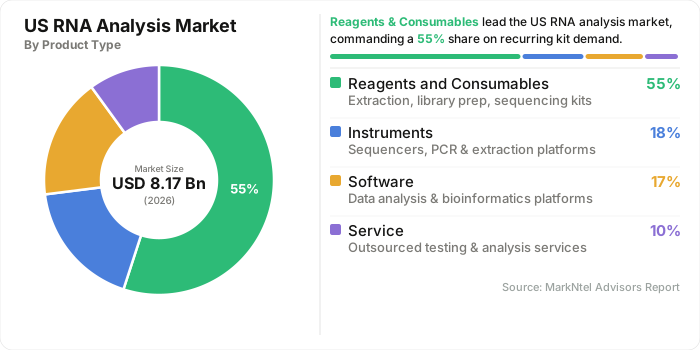
- Reagents and consumables dominate with approximately 55% share in 2026.
- Sequencing technologies lead by technology at approximately 46% share in 2026.
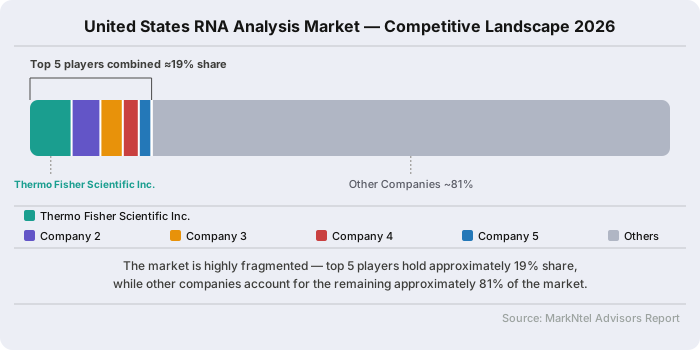
- The market is moderately consolidated, with the top 5 players collectively holding 19% share.
US RNA Analysis Market Size and Outlook
The United States RNA analysis market, valued at USD 7.77 billion in 2025, is projected to grow to USD 8.17 billion in 2026 and reach USD 15.59 billion by 2032, at a CAGR of 11.37% during the forecast period.
This growth is anchored in three converging forces: a sustained rise in oncology-driven molecular diagnostics demand, accelerating pharmaceutical investment in RNA-based therapeutic pipelines, and deepening federal funding commitments to genomic research infrastructure. The American Cancer Society's Cancer Statistics, 2025, published in January 2025, projects 2,041,910 new cancer diagnoses and 618,120 cancer deaths in the United States in 2025 alone. This disease burden sustains persistent clinical demand for RNA biomarker profiling and transcriptomic-based tumor characterization across academic medical centers, hospital systems, and contract research organizations.
Federal investment in RNA biology provides a direct structural underpinning for the market. In June 2024, the National Institutes of Health (NIH), in partnership with the National Science Foundation (NSF), announced approximately USD 15.4 million in joint funding over three years for research into RNA structures, functions, and interactions, alongside the development of RNA-based technologies. Separately, the National Cancer Institute (NCI) launched the RNA Modifications Driving Oncogenesis (RNAMoDO) initiative in 2024, targeting mechanistic research on RNA modifications that drive tumor initiation and progression. These programs channel resources directly into the laboratory consumables, instruments, and bioinformatics platforms that constitute this market.
Industry-led expansion reinforces the public-sector foundation. In April 2025, Thermo Fisher Scientific announced a USD 2 billion investment in US manufacturing and R&D over four years, comprising USD 1.5 billion in capital expenditures and USD 500 million in R&D focused on life science innovation. The FDA has approved 23 RNA-based therapies to date, with over 200 clinical trials currently ongoing across RNA modalities, each generating recurring demand for RNA quantification and sequencing services throughout the development lifecycle. Together, these structural forces position the market for steady expansion through 2032.
US RNA Analysis Market Key Indicators
- The National Institutes of Health received an annual budget of approximately USD 48.9 billion in FY2024, making it the world's largest public biomedical research funding agency. Significant funding is directed toward genomics, transcriptomics, precision medicine, infectious diseases, and cancer research, all of which rely extensively on RNA extraction, RT-PCR, RNA sequencing, and gene expression analysis technologies. Higher NIH funding directly stimulates demand for RNA analysis products across academic and research institutions.
- According to the American Cancer Society, the United States is expected to report approximately 2.04 million new cancer cases in 2025. Growing cancer prevalence increases the adoption of RNA expression profiling, transcriptome sequencing, biomarker discovery, and companion diagnostics for precision oncology, thereby accelerating demand for RNA analysis solutions.
- The Food and Drug Administration approved 46 novel drugs in 2025. Modern drug discovery increasingly incorporates RNA sequencing, transcriptomics, and gene expression profiling during target identification, biomarker validation, and clinical development, creating sustained demand for RNA analysis platforms and reagents.
- The US Consolidated Appropriations Act for FY2026 allocates USD 7.35 billion to the National Cancer Institute (NCI), a USD 128 million increase over the FY2025 level directly expanding federal funding for cancer biology, detection, and diagnosis research programs that depend on transcriptomic and RNA profiling tools.
- By end-2024, more than 17 million SARS-CoV-2 virus genomes had been catalogued globally, with approximately one-third sequenced by US laboratories; the CDC's ongoing pathogen genomic surveillance programs, including the National Wastewater Surveillance System and Traveler-Based Genomic Surveillance, sustain institutionalized RNA sequencing infrastructure for infectious disease monitoring across all 50 US state public health laboratories.
US RNA Analysis Market Scope
| Category | Segments |
|---|---|
| By Product | Reagents & Consumables, Instruments, Software, Services |
| By Technology | Polymerase Chain Reaction (PCR), Microarrays, Sequencing Technologies, RNA Interference (RNAi |
| By Application | Drug Discovery, Clinical Diagnostics, Toxicogenomic, Comparative Transcriptomics |
| By End User | Pharmaceutical & Biotechnology Companies, Hospitals & Diagnostic Centers, Academic & Research Institutes, Contract Research Organizations (CROs |
Growth Drivers
Expanding Adoption of Precision Oncology and RNA-Based Companion Diagnostics
The accelerating integration of RNA sequencing into precision oncology workflows is the primary force driving demand for RNA analysis industry in the United States. Targeted cancer therapies require tumor transcriptome profiling to identify gene fusions, expression signatures, and non-coding RNA alterations that DNA sequencing alone cannot capture, making RNA analysis an indispensable step in treatment selection rather than an optional research tool.
The scale of this clinical integration is measurable. By early 2025, the FDA had approved more than 78 drug/companion diagnostic combinations, with NGS-based assays, many incorporating RNA panels, accounting for a growing share of new approvals. In 2024 specifically, the FDA approved two new NGS-based tumor profiling assays with companion diagnostic claims, including TruSight Oncology Comprehensive and MI Cancer Seek, and expanded Foundation One CDx with four additional companion diagnostic indications.
Additionally, Tempus received FDA clearance for its xR IVD RNA tissue-based assay in September 2025, adding a dedicated RNA companion diagnostic instrument to clinical oncology laboratories. Each new approval mandates RNA profiling as a prerequisite for prescribing, directly multiplying the volume of RNA analysis procedures performed across US cancer centers and generating durable, prescription-linked demand throughout the forecast period.
Recent Trends
Integration of Artificial Intelligence into RNA Sequencing Data Interpretation
A sustained directional shift is underway in the US RNA analysis market, as artificial intelligence and machine learning tools are moving from supplementary research utilities to embedded, workflow-native components of transcriptomic analysis pipelines. Laboratories are routing RNA sequencing outputs through deep learning models capable of identifying gene expression patterns, splicing variants, and disease trajectories at a scale that conventional computational methods cannot match.
In May 2025, Houston-based Biostate AI closed a USD 12 million Series A round led by Accel to build generative AI foundation models trained on RNA sequencing data, having processed over 10,000 samples from more than 150 collaborators, including pilots with Cornell University and the Accelerated Cure Project, within its first two operational quarters. On the spatial transcriptomics front, 10x Genomics introduced Atera in April 2026, a whole-transcriptome in situ spatial biology platform delivering single-cell sensitivity across 18,000 genes per run, with commercial shipments scheduled for the second half of 2026.
As AI-native platforms lower the analytical barrier for complex transcriptomic datasets, adoption will expand beyond specialist genomics centers into clinical research organizations and hospital laboratories, broadening the addressable user base for RNA analysis tools throughout the United States.
US RNA Analysis Market Opportunities and Challenges
Genomic Data Security Regulations Driving Demand for Compliant RNA Analysis Infrastructure
The US Department of Justice's Data Security Program, effective April 8, 2025, under Executive Order 14117, prohibits transactions involving bulk human genomic data with countries of concern, including China, Russia, and Iran, with full security and audit requirements enforced from October 6, 2025. For RNA analysis laboratories engaged in international research collaborations, this regulation mandates compliance infrastructure, legal reviews, access-control systems, and data-transfer audits that constrain cross-border workflows and increase operational costs, particularly for academic genomics centers reliant on foreign sequencing partnerships.
The same regulatory pressure directly opens a commercial pathway for domestically anchored RNA analysis platforms. Industry actors have responded with concrete investment. In January 2025, Tempus AI announced a multi-year collaboration with Genialis built around Genialis's AI foundation model trained on approximately one million RNA sequencing samples, granting access to Tempus's multimodal oncology dataset to develop and validate RNA-based biomarker algorithms across cancer types, with Tempus retaining rights to license validated algorithms through its FDA-cleared xR platform.
Building on this, in February 2026, Tempus launched its HRD-RNA algorithm, an AI-driven, 1,660-gene model identifying Homologous Recombination Deficiency through RNA expression analysis, expanding PARP inhibitor candidate identification beyond patients detectable by traditional DNA-based testing. These actions confirm that compliance-driven demand for secure, domestic RNA infrastructure is translating into durable platform investment across US oncology diagnostics.
Segmentation Insights
Reagents & Consumables Emerge as the Revenue Powerhouse in RNA Analysis
Reagents and consumables account for approximately 55% of the US RNA analysis industry, driven by the consumable-intensive nature of every RNA workflow step from sample lysis and RNA extraction through library preparation and sequencing. Unlike instruments, which represent a one-time capital expenditure, reagents generate recurring procurement cycles tied directly to test volume, making this segment structurally resilient across economic conditions. Each RNA sequencing run requires dedicated extraction kits, reverse transcription reagents, library preparation consumables, and purification columns, all consumed and replenished per experiment.
The dominance of this segment is reinforced by continuous product launches from major suppliers targeting US laboratory workflows. In April 2025, QIAGEN announced plans to launch three new sample preparation instruments by 2026, headlined by the QIAsymphony Connect, a next-generation automated nucleic acid extraction platform processing up to 96 samples per run with enhanced liquid biopsy and oncology workflow capabilities, entering phased commercial launch in 2025.
The instrument anchors recurring reagent consumption across US clinical and research laboratories, as each QIAsymphony run requires proprietary QIAGEN extraction reagent cartridges. As RNA-based diagnostic volumes expand in US oncology and infectious disease programs, consumables procurement will scale proportionally, sustaining segment leadership through 2032. By product type, the market is further segmented into the following sub-categories:
- Reagents & Consumables
- Instruments
- Software
- Services
RNA Analysis Market Led by Sequencing Technologies Revolution
Sequencing technologies, principally next-generation sequencing (NGS), account for approximately 46% of the US RNA analysis market by technology, commanding the largest share among all analytical modalities. NGS enables simultaneous profiling of the entire transcriptome at single-nucleotide resolution, a capability that PCR-based and microarray methods cannot replicate. This technical superiority makes NGS the preferred platform for RNA-seq, single-cell transcriptomics, splice variant detection, fusion transcript identification, and novel RNA discovery applications that are expanding rapidly across US academic, clinical, and pharmaceutical end-users.
Industry investment in NGS-RNA capabilities has intensified measurably. In May 2025, Illumina launched DRAGEN v4.4, the latest version of its secondary analysis software, introducing out-of-the-box oncology applications for clinical research and new multiomics pipelines explicitly supporting Illumina Single Cell 3' RNA Prep and Illumina Protein Prep, alongside a 30% improvement in structural variant calling accuracy compared to the prior version.
This update extends DRAGEN's RNA-seq analysis capabilities into clinical oncology workflows, lowering the bioinformatics barrier for hospital-based laboratories adopting NGS-based transcriptomic testing. As RNA fusion panels and whole-transcriptome assays gain companion diagnostic approvals, NGS platforms will consolidate their lead over microarray and PCR-based alternatives across US RNA analysis workflows. By technologies, the market is further segmented into the following sub-categories:
- Polymerase Chain Reaction (PCR)
- Microarrays
- Sequencing Technologies
- RNA Interference (RNAi)
US RNA Analysis Market Competitive Landscape
The United States RNA analysis market is moderately consolidated, with a few dominant global life science tools companies controlling a large share of sequencing, reagents, and instrumentation. The top 5 players in the U.S. RNA analysis market are Thermo Fisher Scientific Inc., Illumina, Inc., Agilent Technologies, Inc., QIAGEN N.V., and 10x Genomics, Inc., collectively holding a share of 19%.
Major Companies in the United States RNA Analysis Market
- Thermo Fisher Scientific Inc.
- Illumina, Inc.
- Agilent Technologies, Inc.
- Bio-Rad Laboratories, Inc.
- 10x Genomics, Inc.
- Pacific Biosciences of California, Inc.
- Standard BioTools Inc. (formerly Fluidigm Corporation)
- QIAGEN N.V.
- F. Hoffmann-La Roche Ltd
- Oxford Nanopore Technologies plc
United States RNA Analysis Market News and Recent Developments
2024: Element Biosciences Raises USD 277 Million Series D to Commercialize Integrated RNA-DNA Multiomics Platform
In July 2024, San Diego-based Element Biosciences closed an oversubscribed USD 277 million Series D financing round led by Wellington Management, with participation from Samsung Electronics, Fidelity, Foresight Capital, T. Rowe Price, and Venrock, bringing cumulative capital raised to over USD 680 million. The proceeds fund full commercialization of the AVITI sequencer and the launch of AVITI24, the first integrated instrument capable of simultaneously profiling DNA, RNA, proteins, phosphoproteins, and cell morphology in single cells in a single run. The University of Minnesota Genomics Center expanded its AVITI installation to five instruments, citing superior data quality and faster turnaround over incumbent NGS platforms.
Impact Analysis: AVITI24's integrated RNA-protein-DNA workflows increase per-sample reagent consumption volumes relative to single-analyte sequencing runs, structurally expanding the US RNA analysis consumables segment. Multi-institution adoption of the AVITI platform intensifies competitive pressure on incumbent providers and broadens the installed base of instruments driving recurring RNA reagent procurement across US academic and clinical research laboratories.
2026: Element Biosciences Closes Upsized Series E Anchored by USD 175 Million Samsung Investment to Enter Clinical RNA Diagnostics
Element Biosciences announced an upsized Series E financing round anchored by a USD 175 million strategic investment from Samsung Electronics — now the company's largest single shareholder — following the USD 277 million Series D closed in July 2024 and bringing total cumulative capital raised beyond USD 855 million. The proceeds fund commercial launches of AVITI Dx, a clinical cancer diagnostic instrument; tissue profiling capabilities on AVITI24, whose Teton CytoProfiling panels combine 350-plex RNA targets, 50-plex protein markers, and six-plex cell morphology features per run; and the VITARI high-throughput benchtop sequencing system. The round accelerates Element's global commercial expansion across research, translational science, and clinical diagnostic application segments.
Impact Analysis: Samsung's USD 175 million anchor investment accelerates Element's entry into US clinical RNA diagnostic workflows, a segment previously dominated by Illumina — introducing a new competitive axis in platform procurement. The pending AVITI Dx clinical launch expands instrument choice for hospital and reference laboratory buyers, broadening the installed base driving downstream RNA reagent and consumable demand across the US market.
2025: Thermo Fisher Receives FDA Approval for NGS-Based Companion Diagnostic in HER2-Mutant NSCLC
On August 11, 2025, Thermo Fisher Scientific received FDA approval for its Oncomine Dx Target Test as a companion diagnostic to identify patients eligible for HERNEXEOS (zongertinib), developed by Boehringer Ingelheim — the first orally administered targeted therapy for HER2 (ERBB2) tyrosine kinase domain activating mutation-positive non-squamous NSCLC, approved by the FDA on August 8, 2025. The Oncomine Dx Target Test screens tumour samples using NGS technology incorporating both DNA and RNA analysis across a multi-biomarker panel. Since its first FDA approval in 2017, the test has received regulatory clearance across 20 countries for 11 biomarkers and over 20 targeted therapies, with reimbursement coverage spanning more than 550 million lives globally.
Impact Analysis: Each new companion diagnostic approval mandates NGS-based RNA and DNA tumor profiling as a clinical prerequisite for prescribing, converting a single regulatory event into a sustained, prescription-linked volume of RNA analysis procedures across US oncology centers. Expanding Oncomine Dx Target Test indications deepen Thermo Fisher's installed base of clinical NGS instruments, generating durable recurring reagent and consumable demand within hospital laboratory settings.
- Market Segmentation
- Introduction
- Product Definition
- Research Process
- Assumptions
- Executive Summary
- US RNA Analysis Market Policies, Regulations, and Product Standards
- US RNA Analysis Market Trends & Developments
- US RNA Analysis Market Dynamics
- Growth Factors
- Challenges
- US RNA Analysis Market Hotspot & Opportunities
- US RNA Analysis Market Outlook, 2022-2032
- Market Size & Outlook
- By Revenues (USD Million)
- Market Share & Outlook
- By Product- Market Size & Forecast 2022-2032, USD Million
- Reagents & Consumables
- Instruments
- Software
- Services
- By Technology- Market Size & Forecast 2022-2032, USD Million
- Polymerase Chain Reaction (PCR)
- Microarrays
- Sequencing Technologies
- RNA Interference (RNAi)
- By Application- Market Size & Forecast 2022-2032, USD Million
- Drug Discovery
- Clinical Diagnostics
- Toxicogenomic
- Comparative Transcriptomics
- By End User- Market Size & Forecast 2022-2032, USD Million
- Pharmaceutical & Biotechnology Companies
- Hospitals & Diagnostic Centers
- Academic & Research Institutes
- Contract Research Organizations (CROs)
- By Region- Market Size & Forecast 2022-2032, USD Million
- North
- South
- East
- West
- Central
- By Company
- Competition Characteristics
- Market Share & Analysis
- By Product- Market Size & Forecast 2022-2032, USD Million
- Market Size & Outlook
- US Polymerase Chain Reaction (PCR)-based RNA Analysis Market Outlook, 2022-2032
- Market Size & Outlook
- By Revenues (USD Million)
- Market Share & Outlook
- By Technology- Market Size & Forecast 2022-2032, USD Million
- By Application- Market Size & Forecast 2022-2032, USD Million
- By End User- Market Size & Forecast 2022-2032, USD Million
- By Region- Market Size & Forecast 2022-2032, USD Million
- Market Size & Outlook
- US Microarray-based RNA Analysis Market Outlook, 2022-2032
- Market Size & Outlook
- By Revenues (USD Million)
- Market Share & Outlook
- By Technology- Market Size & Forecast 2022-2032, USD Million
- By Application- Market Size & Forecast 2022-2032, USD Million
- By End User- Market Size & Forecast 2022-2032, USD Million
- By Region- Market Size & Forecast 2022-2032, USD Million
- Market Size & Outlook
- US Sequencing-based RNA Analysis Market Outlook, 2022-2032
- Market Size & Outlook
- By Revenues (USD Million)
- Market Share & Outlook
- By Technology- Market Size & Forecast 2022-2032, USD Million
- By Application- Market Size & Forecast 2022-2032, USD Million
- By End User- Market Size & Forecast 2022-2032, USD Million
- By Region- Market Size & Forecast 2022-2032, USD Million
- Market Size & Outlook
- US RNA Interference (RNAi)-based RNA Analysis Market Outlook, 2022-2032
- Market Size & Outlook
- By Revenues (USD Million)
- Market Share & Outlook
- By Technology- Market Size & Forecast 2022-2032, USD Million
- By Application- Market Size & Forecast 2022-2032, USD Million
- By End User- Market Size & Forecast 2022-2032, USD Million
- By Region- Market Size & Forecast 2022-2032, USD Million
- Market Size & Outlook
- US RNA Analysis Market Key Strategic Imperatives for Success & Growth
- Competitive Outlook
- Company Profiles
- Thermo Fisher Scientific Inc.
- Business Description
- Product Portfolio
- Collaborations & Alliances
- Recent Developments
- Financial Details
- Others
- Illumina, Inc.
- Business Description
- Product Portfolio
- Collaborations & Alliances
- Recent Developments
- Financial Details
- Others
- Agilent Technologies, Inc.
- Business Description
- Product Portfolio
- Collaborations & Alliances
- Recent Developments
- Financial Details
- Others
- Bio-Rad Laboratories, Inc.
- Business Description
- Product Portfolio
- Collaborations & Alliances
- Recent Developments
- Financial Details
- Others
- 10x Genomics, Inc.
- Business Description
- Product Portfolio
- Collaborations & Alliances
- Recent Developments
- Financial Details
- Others
- Pacific Biosciences of California, Inc.
- Business Description
- Product Portfolio
- Collaborations & Alliances
- Recent Developments
- Financial Details
- Others
- Standard BioTools Inc. (formerly Fluidigm Corporation)
- Business Description
- Product Portfolio
- Collaborations & Alliances
- Recent Developments
- Financial Details
- Others
- QIAGEN N.V.
- Business Description
- Product Portfolio
- Collaborations & Alliances
- Recent Developments
- Financial Details
- Others
- F. Hoffmann-La Roche Ltd
- Business Description
- Product Portfolio
- Collaborations & Alliances
- Recent Developments
- Financial Details
- Others
- Oxford Nanopore Technologies plc
- Business Description
- Product Portfolio
- Collaborations & Alliances
- Recent Developments
- Financial Details
- Others
- Thermo Fisher Scientific Inc.
- Company Profiles
- Disclaimer

MarkNtel Advisors follows a robust and iterative research methodology designed to ensure maximum accuracy and minimize deviation in market estimates and forecasts. Our approach combines both bottom-up and top-down techniques to effectively segment and quantify various aspects of the market. A consistent feature across all our research reports is data triangulation, which examines the market from three distinct perspectives to validate findings. Key components of our research process include:
1. Scope & Research Design At the outset, MarkNtel Advisors define the research objectives and formulate pertinent questions. This phase involves determining the type of research—qualitative or quantitative—and designing a methodology that outlines data collection methods, target demographics, and analytical tools. They also establish timelines and budgets to ensure the research aligns with client goals.
2. Sample Selection and Data Collection In this stage, the firm identifies the target audience and determines the appropriate sample size to ensure representativeness. They employ various sampling methods, such as random or stratified sampling, based on the research objectives. Data collection is carried out using tools like surveys, interviews, and observations, ensuring the gathered data is reliable and relevant.
3. Data Analysis and Validation Once data is collected, MarkNtel Advisors undertake a rigorous analysis process. This includes cleaning the data to remove inconsistencies, employing statistical software for quantitative analysis, and thematic analysis for qualitative data. Validation steps are taken to ensure the accuracy and reliability of the findings, minimizing biases and errors.

4. Data Forecast and FinalizationThe final phase involves forecasting future market trends based on the analyzed data. MarkNtel Advisors utilize predictive modeling and time series analysis to anticipate market behaviors. The insights are then compiled into comprehensive reports, featuring visual aids like charts and graphs, and include strategic recommendations to inform client decision-making
FILL THE FORM TO INQUIRE BEFORE BUYING THIS REPORT
We offer flexible licensing options to cater to varying organizational needs. Choose the pricing pack that best suits your requirements:
Buy Now Talk to our Consultant
 Request Customization