

By System Type (Point-of-Use (POU) Systems, Point-of-Entry (POE) Systems, Industrial RO Systems), By Membrane Material (Thin Film Composite (TFC), Cellulose Acetate (CA), Others),......By Capacity (Less than 50 GPD, 50–200 GPD, 201–1,000 GPD, Above 1,000 GPD), By End User (Residential, Commercial, Industrial), By Application (Drinking Water Purification, Industrial Process Water Treatment, Wastewater Reuse & Recycling, Desalination, Boiler Feed Water Treatment, Laboratory & Ultrapure Water), and others Read more
- Environment
- Aug 2026
- 160
- PDF, Excel, PPT
US Reverse Osmosis System Market Key Takeaways
- The United States reverse osmosis system Market was valued at USD 2.45 billion in 2025 and reached USD 2.58 billion in 2026. The market is projected to attain USD 3.53 billion by 2032.
- The industry is projected to witness steady growth at a CAGR of 5.36% during the forecast period (2026–2032).
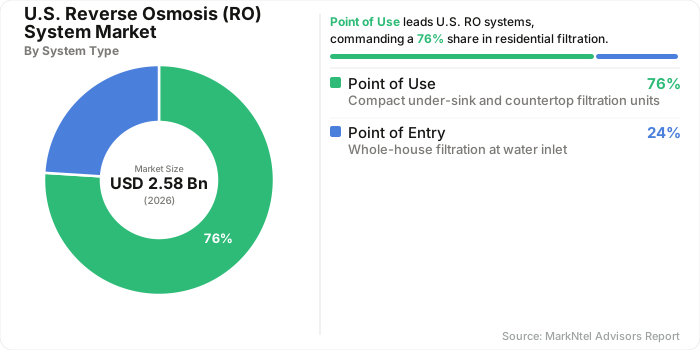
- Point-of-Use (POU) systems dominate the market, accounting for approximately 76% of total revenue.
- Thin film composite (TFC) membranes hold approximately a 92% share of the membrane material segment.
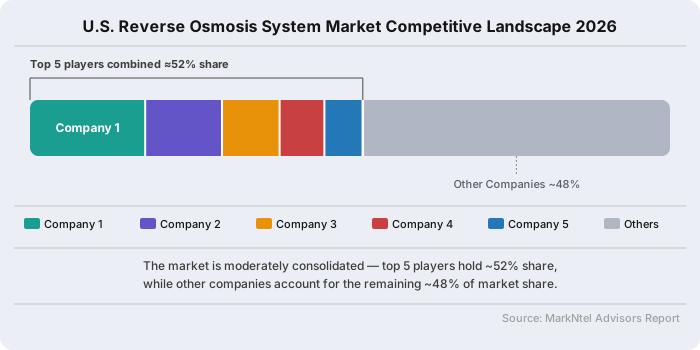
- The market is moderately consolidated, with the top five companies accounting for approximately 52% of total market revenue.
US Reverse Osmosis System Market Size and Outlook
The reverse osmosis system market in the United States reached USD 2.58 billion in 2026, up from USD 2.45 billion in 2025, and is projected to reach USD 3.53 billion by 2032, with a CAGR of 5.36% during the forecast period of 2026-32.
Market growth is primarily driven by the U.S. Environmental Protection Agency's (EPA) National Primary Drinking Water Regulation (NPDWR), finalized on April 10, 2024, which established enforceable Maximum Contaminant Levels (MCLs) of 4 parts per trillion (ppt) for PFOA and PFOS while recognizing reverse osmosis as a Best Available Technology (BAT) for PFAS removal in public water systems.
Residential demand is accelerating as awareness of PFAS contamination continues to increase. According to the Environmental Working Group (EWG), PFAS has been detected in drinking water supplies serving more than 110 million Americans, prompting homeowners to install point-of-use reverse osmosis systems ahead of the EPA's 2029 compliance deadline rather than waiting for municipal treatment upgrades.
Commercial and institutional demand is also strengthening through strategic corporate investments. On January 6, 2026, A. O. Smith Corporation completed its USD 470 million acquisition of Leonard Valve Company, expanding its integrated water management and purification portfolio for hospitals, schools, and institutional facilities across North America.
Federal infrastructure investment continues to support utility-scale deployment of reverse osmosis technology. The Infrastructure Investment and Jobs Act (IIJA) allocated an enormous amount to the Drinking Water and Clean Water State Revolving Funds, while Fiscal Year 2026 appropriations maintained USD 3.04 billion for EPA water infrastructure programs, ensuring continued state-level funding for advanced membrane treatment and water purification projects.
The combination of regulatory compliance requirements, rising residential adoption, ongoing federal infrastructure funding, and corporate investment in advanced purification technologies is expected to sustain long-term market growth as utilities and consumers prepare for the EPA's 2029 PFAS compliance deadline.
US Reverse Osmosis System Industry Key Indicators
- The EPA's Lead and Copper Rule Improvements, finalized on October 8, 2024, lowered the lead action level from 15 to 10 parts per billion and require replacement of an estimated 9 million lead service lines within 10 years. Until replacement is completed, many older homes are expected to rely on point-of-use reverse osmosis systems to reduce lead exposure.
- As of July 21, 2026, 45.77% of the Lower 48 states remained under drought conditions, according to NOAA's National Integrated Drought Information System. Persistent water scarcity across the Southern Plains and Western states is accelerating investments in reverse osmosis (RO)-based water reuse, desalination, and potable water reuse systems to strengthen long-term municipal and industrial water security.
- The U.S. CHIPS and Science Act provides USD 39 billion in incentives to expand domestic semiconductor manufacturing through 2032. Every new fabrication facility requires dedicated ultrapure water treatment systems powered by reverse osmosis, positioning demand for industrial-grade RO membranes and water purification infrastructure to grow in parallel with semiconductor fab construction throughout the decade.
US Reverse Osmosis System Market Scope
| Category | Segments |
|---|---|
| By System Type | Point-of-Use (POU) Systems, Point-of-Entry (POE) Systems, Industrial RO Systems |
| By Membrane Material | Thin Film Composite (TFC), Cellulose Acetate (CA), Others |
| By Capacity | Less than 50 GPD, 50–200 GPD, 201–1,000 GPD, Above 1,000 GPD |
| By End User | Residential, Commercial, Industrial |
| By Application | Drinking Water Purification, Industrial Process Water Treatment, Wastewater Reuse & Recycling, Desalination, Boiler Feed Water Treatment, Laboratory & Ultrapure Water |
US Reverse Osmosis System Market Growth Drivers
Federal PFAS Enforcement Accelerating Point-of-Use Reverse Osmosis Adoption
Federal regulation of per- and polyfluoroalkyl substances (PFAS) is becoming a major driver of reverse osmosis (RO) system adoption across the United States. Under the U.S. Environmental Protection Agency's (EPA) Fifth Unregulated Contaminant Monitoring Rule (UCMR 5), approximately 8% of participating public water systems reported PFOA concentrations exceeding the 4 parts-per-trillion (ppt) limit, while 8.9% exceeded the corresponding PFOS threshold, based on monitoring data from more than 10,000 public water systems nationwide.
To provide utilities with additional time for infrastructure upgrades, the EPA extended the enforceable compliance deadline for PFOA and PFOS from 2029 to 2031, as announced in the Federal Register on May 20, 2026. During this transition period, households served by non-compliant water systems are expected to increasingly rely on point-of-use reverse osmosis systems to reduce PFAS exposure. The extended compliance timeline also creates a sustained replacement and upgrade cycle for certified residential RO systems, supporting long-term demand from both homeowners and water treatment equipment manufacturers.
Recent Trends
Rising Adoption of AI-Enabled Predictive Maintenance and Digital Optimization in Reverse Osmosis Systems
The U.S. reverse osmosis systems market is witnessing a growing shift from traditional time-based maintenance to AI-enabled predictive maintenance and digital optimization, enabling operators to improve system reliability, reduce operating costs, and maximize membrane performance. Instead of relying on fixed maintenance schedules and manual inspections, utilities and industrial facilities are increasingly deploying AI-powered platforms that continuously analyze real-time and historical operating data to optimize cleaning cycles, membrane replacement, and overall system efficiency.
Reflecting this trend, DuPont Water Solutions launched its RO Operations Advisor on April 23, 2026, an AI-enabled digital solution that provides system-specific recommendations based on historical plant performance. The platform is designed to reduce unplanned downtime while improving water recovery, energy efficiency, and membrane utilization. According to DuPont, the solution can deliver up to 20% reductions in operating expenses through lower energy and chemical consumption and optimized membrane replacement schedules.
As sensor technologies, cloud connectivity, and machine learning become increasingly integrated into RO operations, AI-driven optimization is evolving from a value-added feature into a standard capability, supporting more efficient, data-driven management of municipal, commercial, and industrial RO systems.
US Reverse Osmosis System Opportunities and Challenges
High Inland Brine Disposal Costs Driving Growth in On-Site PFAS Concentrate Destruction Technology
The EPA's PFAS drinking water rule identifies reverse osmosis (RO) and nanofiltration (NF) as best available technologies for PFAS removal, but the high cost of disposing concentrated brine reject streams continues to restrict their adoption across inland U.S. regions. Unlike coastal facilities, inland utilities and industrial operators must transport PFAS-contaminated concentrate to specialized hazardous-waste disposal sites, creating high logistical and operational costs despite the superior contaminant removal performance of membrane-based treatment.
This challenge is simultaneously creating a major growth opportunity for on-site PFAS concentrate destruction technologies that eliminate the need for offsite hazardous-waste transport. Reflecting this trend, 374Water Inc. (NASDAQ: SCWO) expanded its Iron Bridge Regional Water Reclamation Facility site in Orlando in mid-2026 by adding 88,000 gallons of onsite tank storage across a facility exceeding 35,000 square feet, with the expanded site expected to generate USD 3 million to USD 5 million in annual revenue. As on-site destruction technologies mature and scale, they are expected to reduce disposal costs, improve regulatory compliance, and enable wider inland deployment of RO systems across municipal and industrial water treatment applications.
Segmentation Insights
Point-of-Use (POU) Systems Capture Approximately 76% Share Through Compact Design and Rising PFAS-Driven Adoption
Owing to their compact design, ease of installation, and cost-effective operation. Installed directly under sinks or at individual water outlets, POU systems require minimal plumbing modifications compared with Point-of-Entry (POE) systems, making them the preferred choice for residential households, apartments, and small commercial establishments. Growing consumer concerns over PFAS, lead, microplastics, and other drinking water contaminants have further accelerated the adoption of POU RO systems, while regulatory acceptance of certified POU units for PFAS treatment has strengthened market demand.
Continuous product innovation is reinforcing this leadership. For example, Culligan's Aquasential Tankless Reverse Osmosis System delivers more than 600 gallons of filtered water and provides up to 20 times higher daily output than conventional tank-based RO systems while occupying approximately two-thirds less under-sink space. The combination of higher water recovery, compact footprints, lower upfront costs, and simplified installation is expected to sustain the dominance of POU systems throughout the forecast period. By system type the market is further segmented into the following sub-categories:
- Point-of-Use (POU) Systems
- Point-of-Entry (POE) Systems
- Industrial RO Systems
Thin Film Composite (TFC) Membranes Capture Approximately 92% Share Through Superior Performance and Continuous Material Innovation
Driven by their superior salt rejection, higher chemical resistance, and longer operational lifespan compared with cellulose acetate (CA) membranes. Their polyamide-based construction enables operation across a wider pH range, allowing more effective clean-in-place (CIP) procedures to control scaling and biofouling without compromising membrane integrity. According to DuPont's technical documentation, FilmTec FT30 TFC membranes offer greater pH stability than cellulose acetate membranes, extending service life while reducing maintenance requirements, making them the preferred choice across municipal, commercial, and industrial reverse osmosis applications.
Manufacturers continue to strengthen TFC's technological leadership through ongoing product innovation. Toray Industries announced the launch of its TSW-K/M/V series of TFC-based reverse osmosis membrane elements for seawater desalination on June, 2026, delivering up to 55% lower salt permeability than its previous-generation models and enabling desalination facilities to transition from two-pass to single-pass treatment. As leading manufacturers continue directing R&D investments toward advanced polyamide TFC formulations rather than legacy CA chemistry, TFC membranes are expected to maintain their dominant position across the U.S. reverse osmosis systems market. By membrane material the market is further segmented into the following sub-categories:
- Thin Film Composite (TFC)
- Cellulose Acetate (CA)
- Other
US Reverse Osmosis System Competitive Landscape
The U.S. Reverse Osmosis System Market is moderately consolidated, with the top five players accounting for approximately 52% of the total market share in 2025. The leading companies include DuPont Water Solutions, Veolia Water Technologies & Solutions, Hydranautics (Nitto Group), Aquatech International, and Kovalus Separation Solutions.
Major Companies in the U.S. Reverse Osmosis (RO) System Market
- DuPont Water Solutions
- Veolia Water Technologies & Solutions
- Hydranautics (Nitto Group)
- Aquatech International
- Kovalus Separation Solutions
- Evoqua Water Technologies (Xylem)
- Pentair plc
- A.O. Smith Corporation
- Culligan International Company
- APEC Water Systems
US Reverse Osmosis System News and Recent Developments
June 2025: DuPont Launches High-Efficiency RO Membrane for Dairy Processing
DuPont launched the FilmTec Hypershell XP RO-8038 reverse osmosis element for U.S. dairy membrane applications at the Membrane Technology Forum USA. Designed for concentrating and polishing milk, whey, and lactose process streams, the new membrane delivers up to 50% higher productivity and flow or 50% lower energy consumption at the same operating flux compared with conventional dairy membrane elements.
Impact Analysis: The launch reinforces DuPont's leadership in high-performance industrial RO membranes while accelerating innovation in application-specific membrane technologies. Improved energy efficiency and productivity enhance the competitiveness of RO systems in the U.S. food and beverage sector, driving wider adoption of advanced membranes for industrial process water treatment.
November 2025: Parker Hannifin Expands Filtration Portfolio Through Filtration Group Acquisition
Parker Hannifin announced a definitive agreement to acquire Filtration Group Corporation from Madison Industries in a USD 9.25 billion cash-free, debt-free transaction. Filtration Group, with approximately 7,500 employees and expected USD 2 billion in 2025 sales, strengthens Parker's industrial filtration portfolio and expands its engineered filtration capabilities across multiple end-use industries.
Impact Analysis: The acquisition strengthens the U.S. filtration supply chain by expanding engineered filtration and aftermarket capabilities that support commercial and industrial RO systems. Improved component availability, broader service networks, and enhanced operational scale are expected to benefit RO system integrators while increasing competitive pressure and raising entry barriers for smaller filtration suppliers.
July 2025: Texas Approves Funding for Seawater Reverse Osmosis Desalination Plant
The Texas Water Development Board approved USD 64.655 million in financing for the Laguna Madre Water District to construct a 5.0 MGD seawater reverse osmosis plant in Cameron County. The project includes a seawater intake pump station and infrastructure to connect desalinated water to the existing distribution network, helping diversify water supplies amid recurring Rio Grande shortages.
Impact Analysis: The funding strengthens public investment in coastal desalination infrastructure, creating long-term opportunities for RO equipment suppliers, membrane manufacturers, and EPC contractors while encouraging similar state-backed seawater RO projects across water-stressed regions of Texas.
2026: Aqualia Wins Contract for Modular Brackish Water RO Plant in Texas
Aqualia secured a USD 175 million contract to design, construct, and operate a 24 MGD modular brackish water reverse osmosis plant in Corpus Christi, Texas, with drinking water production of up to 21 MGD. Built using prefabricated, factory-tested RO containers, the project will deliver an initial 4 MGD within 11 months and reach full capacity within 24 months under a five-year operating contract.
Impact: The project accelerates adoption of modular RO infrastructure, enabling faster deployment for drought-response projects while creating long-term opportunities for modular equipment suppliers and private RO plant operators through recurring service contracts.
- Market Segmentation
- Introduction
- Product Definition
- Research Process
- Assumptions
- Executive Summary
- US Reverse Osmosis System Market Policies, Regulations, and Product Standards
- US Reverse Osmosis System Market Trends & Developments
- US Reverse Osmosis System Market Dynamics
- Growth Factors
- Challenges
- US Reverse Osmosis System Market Hotspot & Opportunities
- US Reverse Osmosis System Market Outlook, 2022-2032
- Market Size & Outlook
- By Revenues (USD Million)
- Market Segmentation & Outlook
- By System Type- Market Size & Forecast 2022-2032, USD Million
- Point-of-Use (POU) Systems
- Point-of-Entry (POE) Systems
- Industrial RO Systems
- By Membrane Material- Market Size & Forecast 2022-2032, USD Million
- Thin Film Composite (TFC)
- Cellulose Acetate (CA)
- Others
- By Capacity- Market Size & Forecast 2022-2032, USD Million
- Less than 50 GPD
- 50–200 GPD
- 201–1,000 GPD
- Above 1,000 GPD
- By End User- Market Size & Forecast 2022-2032, USD Million
- Residential
- Commercial
- Industrial
- By Application- Market Size & Forecast 2022-2032, USD Million
- Drinking Water Purification
- Industrial Process Water Treatment
- Wastewater Reuse & Recycling
- Desalination
- Boiler Feed Water Treatment
- Laboratory & Ultrapure Water
- By Region- Market Size & Forecast 2022-2032, USD Million
- North
- South
- East
- West
- Central
- By Company
- Competition Characteristics
- Market Share & Analysis
- By System Type- Market Size & Forecast 2022-2032, USD Million
- Market Size & Outlook
- US Point-of-Use (POU) Reverse Osmosis System Market Outlook, 2022-2032
- Market Size & Outlook
- By Revenues (USD Million)
- Market Segmentation & Outlook
- By Product Type- Market Size & Forecast 2022-2032, USD Million
- By Stage- Market Size & Forecast 2022-2032, USD Million
- By Membrane Material- Market Size & Forecast 2022-2032, USD Million
- By Capacity- Market Size & Forecast 2022-2032, USD Million
- By End User- Market Size & Forecast 2022-2032, USD Million
- By Application- Market Size & Forecast 2022-2032, USD Million
- By region- Market Size & Forecast 2022-2032, USD Million
- Market Size & Outlook
- US Point-of-Entry (POE) Reverse Osmosis System Market Outlook, 2022-2032
- Market Size & Outlook
- By Revenues (USD Million)
- Market Segmentation & Outlook
- By Product Type- Market Size & Forecast 2022-2032, USD Million
- By Stage- Market Size & Forecast 2022-2032, USD Million
- By Membrane Material- Market Size & Forecast 2022-2032, USD Million
- By Capacity- Market Size & Forecast 2022-2032, USD Million
- By End User- Market Size & Forecast 2022-2032, USD Million
- By Application- Market Size & Forecast 2022-2032, USD Million
- By region- Market Size & Forecast 2022-2032, USD Million
- Market Size & Outlook
- US Industrial Reverse Osmosis System Market Outlook, 2022-2032
- Market Size & Outlook
- By Revenues (USD Million)
- Market Segmentation & Outlook
- By Product Type- Market Size & Forecast 2022-2032, USD Million
- By Stage- Market Size & Forecast 2022-2032, USD Million
- By Membrane Material- Market Size & Forecast 2022-2032, USD Million
- By Capacity- Market Size & Forecast 2022-2032, USD Million
- By End User- Market Size & Forecast 2022-2032, USD Million
- By Application- Market Size & Forecast 2022-2032, USD Million
- By region- Market Size & Forecast 2022-2032, USD Million
- Market Size & Outlook
- US Reverse Osmosis System Market Key Strategic Imperatives for Success & Growth
- Competitive Outlook
- Company Profiles
- DuPont Water Solutions
- Business Description
- Product Portfolio
- Collaborations & Alliances
- Recent Developments
- Financial Details
- Others
- Veolia Water Technologies & Solutions
- Business Description
- Product Portfolio
- Collaborations & Alliances
- Recent Developments
- Financial Details
- Others
- Hydranautics (Nitto Group)
- Business Description
- Product Portfolio
- Collaborations & Alliances
- Recent Developments
- Financial Details
- Others
- Aquatech International
- Business Description
- Product Portfolio
- Collaborations & Alliances
- Recent Developments
- Financial Details
- Others
- Kovalus Separation Solutions
- Business Description
- Product Portfolio
- Collaborations & Alliances
- Recent Developments
- Financial Details
- Others
- Evoqua Water Technologies (Xylem)
- Business Description
- Product Portfolio
- Collaborations & Alliances
- Recent Developments
- Financial Details
- Others
- Pentair plc
- Business Description
- Product Portfolio
- Collaborations & Alliances
- Recent Developments
- Financial Details
- Others
- A.O. Smith Corporation
- Business Description
- Product Portfolio
- Collaborations & Alliances
- Recent Developments
- Financial Details
- Others
- Culligan International Company
- Business Description
- Product Portfolio
- Collaborations & Alliances
- Recent Developments
- Financial Details
- Others
- APEC Water Systems
- Business Description
- Product Portfolio
- Collaborations & Alliances
- Recent Developments
- Financial Details
- Others
- DuPont Water Solutions
- Company Profiles
- Disclaimer

MarkNtel Advisors follows a robust and iterative research methodology designed to ensure maximum accuracy and minimize deviation in market estimates and forecasts. Our approach combines both bottom-up and top-down techniques to effectively segment and quantify various aspects of the market. A consistent feature across all our research reports is data triangulation, which examines the market from three distinct perspectives to validate findings. Key components of our research process include:
1. Scope & Research Design At the outset, MarkNtel Advisors define the research objectives and formulate pertinent questions. This phase involves determining the type of research—qualitative or quantitative—and designing a methodology that outlines data collection methods, target demographics, and analytical tools. They also establish timelines and budgets to ensure the research aligns with client goals.
2. Sample Selection and Data Collection In this stage, the firm identifies the target audience and determines the appropriate sample size to ensure representativeness. They employ various sampling methods, such as random or stratified sampling, based on the research objectives. Data collection is carried out using tools like surveys, interviews, and observations, ensuring the gathered data is reliable and relevant.
3. Data Analysis and Validation Once data is collected, MarkNtel Advisors undertake a rigorous analysis process. This includes cleaning the data to remove inconsistencies, employing statistical software for quantitative analysis, and thematic analysis for qualitative data. Validation steps are taken to ensure the accuracy and reliability of the findings, minimizing biases and errors.

4. Data Forecast and FinalizationThe final phase involves forecasting future market trends based on the analyzed data. MarkNtel Advisors utilize predictive modeling and time series analysis to anticipate market behaviors. The insights are then compiled into comprehensive reports, featuring visual aids like charts and graphs, and include strategic recommendations to inform client decision-making
FILL THE FORM TO INQUIRE BEFORE BUYING THIS REPORT
We offer flexible licensing options to cater to varying organizational needs. Choose the pricing pack that best suits your requirements:
Buy Now Talk to our Consultant
 Request Customization