

By Product Type (Portable/Point-of-Use (POU) Systems, Centralized/Stationary Systems), By Technology (Mixed Bed Ion Exchange Systems, Two-Bed Ion Exchange Systems, Electrodeionizat......ion (EDI) Systems), By Capacity (Low Capacity (<10 m³/hr), Medium Capacity (10–100 m³/hr), High Capacity (>100 m³/hr)), By Application (Process Water Purification, Laboratory Water Purification, Rinse Water Purification, Boiler Feed Water Treatment, Critical/High-Purity Water Production, Others), By End User (Pharmaceutical & Biotechnology, Semiconductor & Electronics, Healthcare & Clinical Laboratories, Power Generation, Chemical & Petrochemical, Food & Beverage, Automotive, Academic & Research Institutions, Others), and others Read more
- Environment
- Aug 2026
- 170
- PDF, Excel, PPT
US Deionized Water System Market Key Takeaways
- The US deionized water system market was valued at USD 2.01 billion in 2025 and is projected to grow from USD 2.16 billion in 2026 to USD 3.35 billion by 2032, registering a CAGR of 7.59% during 2026–2032.
- By technology, mixed bed ion exchange systems dominate the market, accounting for 68.3% share in 2026.
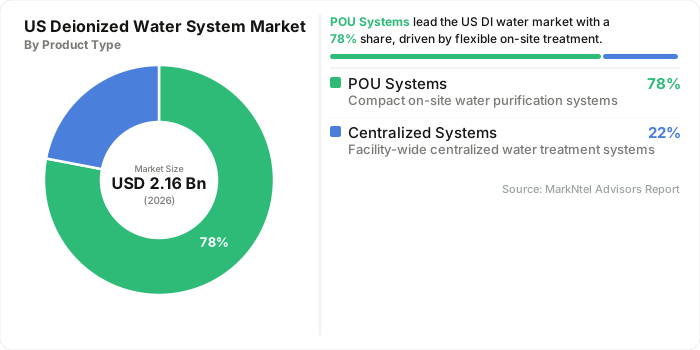
- By product type, centralized/stationary systems hold the largest market share at approximately 78.0% in 2026.
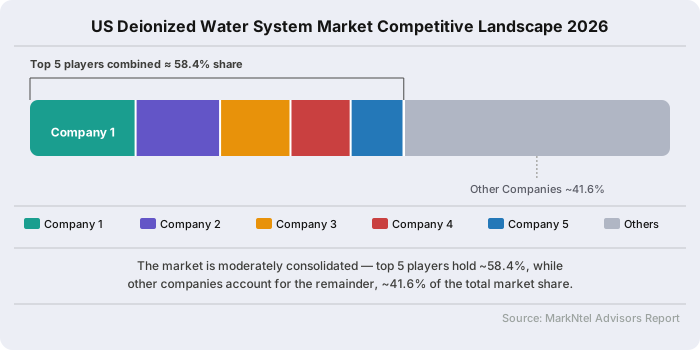
- The market is moderately consolidated, with the top five companies collectively accounting for 58.4% of the market share in 2026.
US Deionized Water System Market Size and Outlook
The deionized water system market in the United States is valued at USD 2.01 billion in 2025 and is projected to reach USD 2.16 billion in 2026, before expanding to USD 3.35 billion by 2032, registering a CAGR of 7.59% during 2026–2032.
Market growth is driven by expanding domestic semiconductor manufacturing, biopharmaceutical production, industrial water reuse initiatives, and federal programs such as the CHIPS and Science Act, which continue to accelerate investments in advanced manufacturing facilities requiring high-purity water systems.
The market outlook is further supported by rising demand for ultrapure process water across strategic manufacturing industries. According to the Semiconductor Industry Association (SIA), the United States accounted for approximately 50% of global semiconductor manufacturing equipment spending in 2024, reflecting continued investment in advanced fabrication infrastructure requiring high-performance industrial water treatment systems. The expansion of these capital-intensive facilities continues to strengthen demand for industrial water purification systems and advanced deionization technologies.
The long-term growth trajectory is also reinforced by tightening industrial sustainability and water efficiency priorities. According to the U.S. Environmental Protection Agency (EPA), the National Water Reuse Action Plan (WRAP) continues to advance federal initiatives that promote water recycling and reuse across industrial sectors, supporting greater adoption of advanced treatment technologies for process water recovery and resource efficiency. The expanding emphasis on water reuse and operational resilience continues to create favorable conditions for investment in deionized water systems across the United States.
US Deionized Water System Market Key Indicators
- According to the CHIPS Program Office of the U.S. Department of Commerce, the agency has awarded up to USD 30.7 billion in direct funding across 40 commercial semiconductor manufacturing projects as of January 2025, alongside USD 7.15 billion in loans supporting 35 companies and 52 projects nationwide. These investments continue to accelerate construction of advanced fabrication facilities requiring large-scale RO-IX pretreatment, CEDI polishing, and centralized ultrapure water systems, creating a robust long-term demand pipeline for deionized water systems.
- As reported by the National Institute of Standards and Technology (NIST), a typical semiconductor fabrication facility consumes 2–10 million gallons of ultrapure water per day, while approximately 20–25% of incoming raw water is lost during ultrapure water production. The high water demand and recovery requirements continue to drive deployment of high-capacity centralized RO-IX, CEDI, and mixed-bed deionization systems across the expanding U.S. semiconductor manufacturing sector.
- The Semiconductor Industry Association (SIA) states that global semiconductor sales reached USD 791.7 billion in 2025, representing 25.6% year-on-year growth, while first-quarter 2026 sales totaled USD 298.5 billion, up 25.0% from the same period of the previous year. Continued growth in semiconductor production supports sustained capital investment in fabrication utilities, reinforcing demand for centralized and skid-mounted deionized water treatment infrastructure.
- As per the U.S. Department of Energy (DOE), the United States is forecast to operate 13 new battery cell gigafactories by 2025, establishing electric vehicle battery electrode and cell manufacturing as an emerging industrial off-taker segment for high-volume process water. This buildout diversifies the domestic deionized water systems demand base beyond its traditional semiconductor and pharmaceutical anchors.
US Deionized Water System Market Scope
| Category | Segments |
|---|---|
| By Product Type | Portable/Point-of-Use (POU) Systems, Centralized/Stationary Systems |
| By Technology | Mixed Bed Ion Exchange Systems, Two-Bed Ion Exchange Systems, Electrodeionization (EDI) Systems |
| By Capacity | Low Capacity (<10 m³/hr), Medium Capacity (10–100 m³/hr), High Capacity (>100 m³/hr |
| By Application | Process Water Purification, Laboratory Water Purification, Rinse Water Purification, Boiler Feed Water Treatment, Critical/High-Purity Water Production, Others |
| By End User | Pharmaceutical & Biotechnology, Semiconductor & Electronics, Healthcare & Clinical Laboratories, Power Generation, Chemical & Petrochemical, Food & Beverage, Automotive, Academic & Research Institutions, Others |
US Deionized Water System Market Growth Drivers
Domestic Semiconductor Manufacturing Expansion Drives Deionized Water Demand
The continued expansion of domestic semiconductor manufacturing under federal industrial policy directly increases demand for industrial deionized water systems and ultrapure water infrastructure, as advanced wafer fabrication facilities require large-scale high-purity process water throughout manufacturing operations. In January 2025, the U.S. Department of Energy (DOE) announced a Notice of Intent for up to USD 725 million to strengthen domestic production of battery critical materials, battery components, and advanced manufacturing capabilities. This investment supports broader advanced manufacturing growth, accelerating deployment of RO-IX systems and continuous electrodeionization (CEDI) technologies across new production facilities.
Simultaneously, federal support for domestic manufacturing continues to reinforce long-term investment in industrial water purification infrastructure. In January 2025, the U.S. Department of Energy's Office of Manufacturing and Energy Supply Chains issued a Notice of Intent to reopen the Battery Manufacturing and Recycling Grants Program, building on a program providing USD 3 billion for commercial-scale battery manufacturing and recycling projects. The construction of new advanced manufacturing plants continues to increase adoption of centralized deionized water plants, mixed-bed polishing systems, and automated high-purity water treatment solutions for continuous industrial operations.
Recent Trends
Integration of Advanced Membrane and Filtration Technologies
The demand for high-purity water systems continues to increase across advanced manufacturing industries as production processes require increasingly stringent water quality standards to ensure product reliability and process precision. According to reports on TSMC's Arizona semiconductor facility, as of September 2025, wafer fabrication requires water with less than 1 part per trillion dissolved solids, while facilities producing approximately 40,000 wafers per month consume up to 4.8 million gallons of ultrapure water daily. Achieving these purity levels drives the deployment of mixed-bed ion-exchange and continuous electrodeionization (CEDI) systems, integrated with reverse osmosis pretreatment, to ensure consistent ultrapure water production.
The trend is further reinforced by continuous innovation in industrial water treatment technologies that improve purification efficiency while reducing operational costs. In September 2024, DuPont Water Solutions launched the next-generation FilmTec™ Fortilife™ XC-N nanofiltration membrane, engineered to enhance contaminant removal and improve energy efficiency for industrial water treatment applications. The new membrane technology strengthens upstream pretreatment performance, enabling more efficient operation of industrial deionized water systems and supporting semiconductor, pharmaceutical, and EV battery manufacturing facilities with increasingly demanding high-purity water requirements.
US Deionized Water System Market Opportunities and Challenges
Industrial Wastewater Challenges Drive Deionized Water Adoption
The increasing volume of industrial wastewater, coupled with more stringent federal discharge requirements, continues to challenge high water-consuming industries, including power generation and advanced manufacturing. According to the U.S. Environmental Protection Agency (EPA), the Effluent Limitations Guidelines (ELGs) program regulates approximately 40,000 direct dischargers and 129,000 indirect dischargers nationwide, while in May 2024, the EPA issued a supplemental rule strengthening wastewater discharge standards for the Steam Electric Power Generating Category under 40 CFR Part 423. The evolving regulatory framework increases compliance costs and encourages industrial facilities to adopt more efficient water treatment and reuse strategies.
The same regulatory pressure is creating significant opportunities for industrial water reuse technologies that maximize water recovery while reducing freshwater demand. In April 2026, DuPont Water Solutions launched the FilmTec™ Fortilife™ XC220 and XC-Max UHP reverse osmosis membrane elements, specifically engineered for Minimal Liquid Discharge (MLD) and Zero Liquid Discharge (ZLD) industrial applications to achieve higher water recovery and improved brine concentration. The advanced membrane technology enhances the performance of downstream high-purity deionized water systems, enabling industrial facilities to recycle process wastewater, improve operational efficiency, and comply with increasingly stringent environmental regulations.
Segmentation Insights
Centralized Systems Anchor Industrial High-Purity Water Infrastructure
Centralized/Stationary Systems account for an estimated 78.0% of the U.S. deionized water system industry in 2026, driven by their ability to continuously supply high volumes of high-purity water systems required across semiconductor fabrication, power generation, and pharmaceutical manufacturing facilities. According to SEMI, global 300 mm semiconductor fab equipment spending is projected to increase by 18% to USD 133 billion in 2026, reflecting continued investment in advanced wafer fabrication capacity. The expansion of large-scale manufacturing facilities continues to strengthen demand for centralized industrial and commercial water purification systems, which provide higher treatment capacity, operational reliability, and continuous process water supply compared with portable or point-of-use systems.
The continued construction of advanced manufacturing campuses further reinforces the leadership of centralized treatment infrastructure. In November 2024, the U.S. Department of Commerce finalized a CHIPS and Science Act award of up to USD 7.86 billion to Intel Corporation to support semiconductor fabrication and advanced packaging projects across Arizona, New Mexico, Ohio, and Oregon. These large-scale facilities require dedicated centralized deionized water plants incorporating reverse osmosis, ion exchange, and continuous electrodeionization technologies, supporting long-term equipment, engineering, and lifecycle service demand while reinforcing the segment's dominant revenue position. Based on Product Type, the industry is segmented into:
- Portable/Point-of-Use (POU) Systems
- Centralized/Stationary Systems
Mixed Bed Ion Exchange Sets the Benchmark for Deionized Water
Mixed Bed Ion Exchange Systems account for an estimated 68.3% of the U.S. deionized water system market in 2026, driven by their ability to consistently deliver ultrapure water for critical industrial applications. Their superior polishing performance makes them the preferred technology across semiconductor manufacturing, pharmaceutical production, biotechnology, and laboratory water purification. According to ASTM International, ASTM D1193 specifies Type I reagent water with a maximum conductivity of 0.056 μS/cm at 25°C (18.2 MΩ·cm resistivity), reinforcing the widespread adoption of mixed-bed deionization systems as the industry-standard final polishing technology.
The widespread deployment of integrated high-purity water systems across regulated industries further reinforces the leadership of mixed-bed ion exchange technology. According to Evoqua Water Technologies' 2024 High-Purity Water System Package documentation, the company's modular skid-mounted platform for laboratory and bioprocessing applications incorporates the SUPER 30 mixed-bed ion exchange polisher as the final deionization stage, positioned upstream of ultraviolet disinfection and absolute final filtration. This commercial system architecture demonstrates the continued reliance on advanced water polishing technologies, reinforcing mixed-bed ion exchange as the preferred solution for achieving consistent ultrapure water quality across pharmaceutical, biotechnology, and laboratory applications. By the Technology, the industry is segmented into:
- Mixed Bed Ion Exchange Systems
- Two-Bed Ion Exchange Systems
- Electrodeionization (EDI) Systems
US Deionized Water System Market Competitive Analysis
The U.S. deionized water system industry is moderately consolidated, with the top five companies collectively accounting for 58.4% of market revenue in 2026. Competition is driven by integrated high-purity water systems, proprietary purification technologies, engineering expertise, and long-term lifecycle service capabilities, enabling suppliers to strengthen their presence across semiconductor, pharmaceutical, biotechnology, power generation, and laboratory applications.
Top Companies in the U.S. Deionized Water System industry:
- Veolia Water Technologies
- Evoqua Water Technologies
- Kurita Water Industries Ltd.
- Aquatech International LLC
- Merck Millipore (MilliporeSigma)
- Thermo Fisher Scientific Inc.
- Pall Corporation
- Ovivo
- US Water Systems
- Culligan International
US Deionized Water System Industry News and Recent Developments
April 2025: Merck Breaks Ground on USD 1 Billion Biologics Center of Excellence in Delaware 3
In April 2025, Merck commenced construction of a USD 1 billion Biologics Center of Excellence in Wilmington, Delaware, to expand commercial manufacturing capacity for next-generation biologics and antibody-drug conjugates. The approximately 470,000-square-foot facility is designed to support advanced biopharmaceutical production under current Good Manufacturing Practice (cGMP) standards, requiring robust high-purity utility infrastructure.
Impact Analysis: The investment increases demand for pharmaceutical water purification systems capable of producing consistent USP-grade process water. It also reinforces long-term opportunities for deionized water system suppliers supporting regulated biologics manufacturing and high-purity process utilities.
June 2025: Aquatech Acquires Century Water to Establish Global Center of Excellence for Semiconductor and Pharmaceutical Water Services
Aquatech International announced on June 9, 2025, the acquisition of Singapore-based Century Water, a specialist engineering firm with over 40 major installations worldwide in ultrapure process water and wastewater recycling for the semiconductor and pharmaceutical sectors. Century Water becomes Aquatech's dedicated center of excellence for high-tech industries, integrating its microelectronics specialists into Aquatech's global O&M service infrastructure.
Impact Analysis: This acquisition consolidates specialized ultrapure water engineering talent under a single platform, strengthening Aquatech's position in bidding for long-term semiconductor and pharmaceutical O&M contracts. It signals continued industry consolidation around companies capable of delivering decade-scale service relationships rather than one-time equipment sales.
- Market Segmentation
- Introduction
- Product Definition
- Research Process
- Assumptions
- Executive Summary
- US Deionized Water System Market Policies, Regulations, and Product Standards
- US Deionized Water System Market Trends & Developments
- US Deionized Water System Market Dynamics
- Growth Factors
- Challenges
- US Deionized Water System Market Hotspot & Opportunities
- US Deionized Water System Market Outlook, 2022-2032
- Market Size & Outlook
- By Revenues (USD Million)
- Market Share & Analysis
- By Product Type- Market Size & Forecast 2022-2032, USD Million
- Portable/Point-of-Use (POU) Systems
- Centralized/Stationary Systems
- By Technology- Market Size & Forecast 2022-2032, USD Million
- Mixed Bed Ion Exchange Systems
- Two-Bed Ion Exchange Systems
- Electrodeionization (EDI) Systems
- By Capacity - Market Size & Forecast 2022-2032, USD Million
- Low Capacity (<10 m³/hr)
- Medium Capacity (10–100 m³/hr)
- High Capacity (>100 m³/hr)
- By Application- Market Size & Forecast 2022-2032, USD Million
- Process Water Purification
- Laboratory Water Purification
- Rinse Water Purification
- Boiler Feed Water Treatment
- Critical/High-Purity Water Production
- Others
- By End User- Market Size & Forecast 2022-2032, USD Million
- Pharmaceutical & Biotechnology
- Semiconductor & Electronics
- Healthcare & Clinical Laboratories
- Power Generation
- Chemical & Petrochemical
- Food & Beverage
- Automotive
- Academic & Research Institutions
- Others
- By Region- Market Size & Forecast 2022-2032, USD Million
- Northeast
- Midwest
- South
- West
- By Company
- Competition Characteristics
- Market Share & Analysis
- By Product Type- Market Size & Forecast 2022-2032, USD Million
- Market Size & Outlook
- US Mixed Bed Ion Exchange System Market Outlook, 2022-2032
- Market Size & Outlook
- By Revenues (USD Million)
- Market Segmentation & Analysis
- By Technology- Market Size & Forecast 2022-2032, USD Million
- By Application- Market Size & Forecast 2022-2032, USD Million
- By End User- Market Size & Forecast 2022-2032, USD Million
- By Region- Market Size & Forecast 2022-2032, USD Million
- Market Size & Outlook
- US Two-Bed Ion Exchange System Market Outlook, 2022-2032
- Market Size & Outlook
- By Revenues (USD Million)
- Market Segmentation & Analysis
- By Technology- Market Size & Forecast 2022-2032, USD Million
- By Application- Market Size & Forecast 2022-2032, USD Million
- By End User- Market Size & Forecast 2022-2032, USD Million
- By Region- Market Size & Forecast 2022-2032, USD Million
- Market Size & Outlook
- US Electrodeionization (EDI) System Market Outlook, 2022-2032
- Market Size & Outlook
- By Revenues (USD Million)
- Market Segmentation & Analysis
- By Technology- Market Size & Forecast 2022-2032, USD Million
- By Application- Market Size & Forecast 2022-2032, USD Million
- By End User- Market Size & Forecast 2022-2032, USD Million
- By Region- Market Size & Forecast 2022-2032, USD Million
- Market Size & Outlook
- US Deionized Water System Market Key Strategic Imperatives for Success & Growth
- Competitive Outlook
- Company Profiles
- Veolia Water Technologies
- Business Description
- Product Portfolio
- Collaborations & Alliances
- Recent Developments
- Financial Details
- Others
- Evoqua Water Technologies
- Business Description
- Product Portfolio
- Collaborations & Alliances
- Recent Developments
- Financial Details
- Others
- Kurita Water Industries Ltd.
- Business Description
- Product Portfolio
- Collaborations & Alliances
- Recent Developments
- Financial Details
- Others
- Aquatech International LLC
- Business Description
- Product Portfolio
- Collaborations & Alliances
- Recent Developments
- Financial Details
- Others
- Merck Millipore (MilliporeSigma)
- Business Description
- Product Portfolio
- Collaborations & Alliances
- Recent Developments
- Financial Details
- Others
- Thermo Fisher Scientific Inc.
- Business Description
- Product Portfolio
- Collaborations & Alliances
- Recent Developments
- Financial Details
- Others
- Pall Corporation
- Business Description
- Product Portfolio
- Collaborations & Alliances
- Recent Developments
- Financial Details
- Others
- Ovivo
- Business Description
- Product Portfolio
- Collaborations & Alliances
- Recent Developments
- Financial Details
- Others
- US Water Systems
- Business Description
- Product Portfolio
- Collaborations & Alliances
- Recent Developments
- Financial Details
- Others
- Culligan International
- Business Description
- Product Portfolio
- Collaborations & Alliances
- Recent Developments
- Financial Details
- Others
- Veolia Water Technologies
- Company Profiles
- Disclaimer

MarkNtel Advisors follows a robust and iterative research methodology designed to ensure maximum accuracy and minimize deviation in market estimates and forecasts. Our approach combines both bottom-up and top-down techniques to effectively segment and quantify various aspects of the market. A consistent feature across all our research reports is data triangulation, which examines the market from three distinct perspectives to validate findings. Key components of our research process include:
1. Scope & Research Design At the outset, MarkNtel Advisors define the research objectives and formulate pertinent questions. This phase involves determining the type of research—qualitative or quantitative—and designing a methodology that outlines data collection methods, target demographics, and analytical tools. They also establish timelines and budgets to ensure the research aligns with client goals.
2. Sample Selection and Data Collection In this stage, the firm identifies the target audience and determines the appropriate sample size to ensure representativeness. They employ various sampling methods, such as random or stratified sampling, based on the research objectives. Data collection is carried out using tools like surveys, interviews, and observations, ensuring the gathered data is reliable and relevant.
3. Data Analysis and Validation Once data is collected, MarkNtel Advisors undertake a rigorous analysis process. This includes cleaning the data to remove inconsistencies, employing statistical software for quantitative analysis, and thematic analysis for qualitative data. Validation steps are taken to ensure the accuracy and reliability of the findings, minimizing biases and errors.

4. Data Forecast and FinalizationThe final phase involves forecasting future market trends based on the analyzed data. MarkNtel Advisors utilize predictive modeling and time series analysis to anticipate market behaviors. The insights are then compiled into comprehensive reports, featuring visual aids like charts and graphs, and include strategic recommendations to inform client decision-making
FILL THE FORM TO INQUIRE BEFORE BUYING THIS REPORT
We offer flexible licensing options to cater to varying organizational needs. Choose the pricing pack that best suits your requirements:
Buy Now Talk to our Consultant
 Request Customization