

UAE District Cooling Market Share - By Production Technique (Free Cooling, Absorption Cooling, Electric Chillers, Others), By Application (Hospitality, Healthcare, Commercial & Ret......ail, Government & Transportation, Industrial, Residential) and Others Read more
- Environment
- Mar 2025
- 92
- PDF, Excel, PPT
Market Definition
District cooling system delivers chilled water and space conditioning to consumers. Such systems are used in various locations, including homes, shopping centers, lodging facilities, dining establishments, cold storage warehouses, workplaces, companies, campuses, and military sites.
Market Insights & Analysis: UAE District Cooling Market (2025-30)
The UAE District Cooling Market size was valued at 4 million tons in 2024 & is estimated to surpass 5.68 million tons by 2030. Along with this, the industry is also projected to grow at a CAGR of around 6.02% during the forecast period, i.e., 2025-30.. The UAE is taking the lead in the development of district cooling as a significant energy-efficient utility sector chosen by the governments of the Gulf nations. The Middle East and Africa region is crucial to reversing climate change and advancing global efforts to cut carbon emissions. In arid climates, cooling is a constant and energy-intensive operation, hence district cooling offers significant energy savings.
In the region's new and developing megacities, where district cooling has established a firm footing, this benefit is being realized. Since, 70% of the total electricity consumption goes into air conditioning in Dubai, the government is planning to meet its 40% cooling needs from district cooling by 2030. The use of district cooling in Dubai alone has been found to save close to 650GWh of electricity in 2020.
| Report Coverage | Details |
|---|---|
| Historical Years | 2020–23 |
| Forecast Years | 2025–30 |
| Market Value in 2024 | 4 Million Tons |
| Market Value by 2030 | 5.68 Million Tons |
| CAGR (2025–30) | 6.02% |
| Top Key Players | Empower, Tabreed, Emirates District Cooling(Emicool), Pal Cooling Holding LLC, and Others |
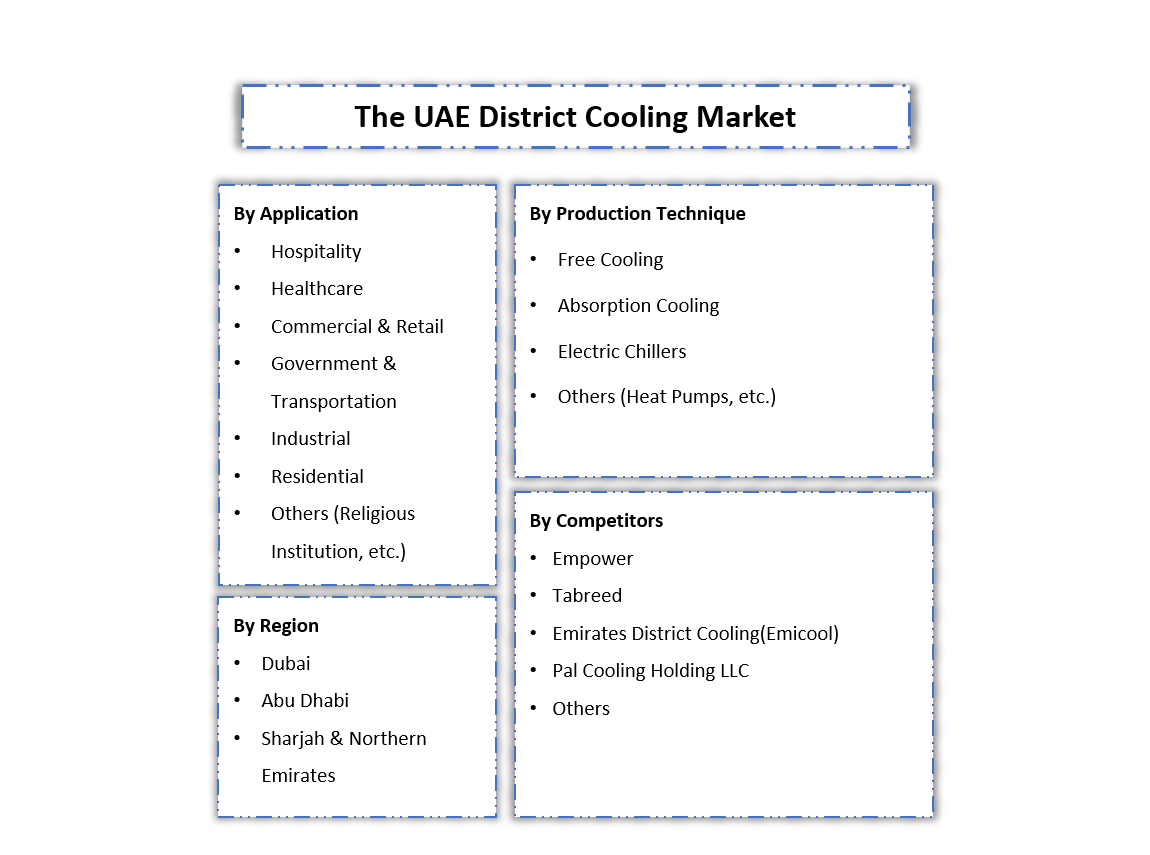
| Segmentation | By Production Technique (Free Cooling, Absorption Cooling, Electric Chillers, Others), By Application (Hospitality, Healthcare, Commercial & Retail, Government & Transportation, Industrial, Residential) and Others |
| Key Report Highlights |
|
*Boost strategic growth with in-depth market analysis - Get a free sample preview today!
Moreover, due to a robust project pipeline sector, the UAE district cooling industry saw little to no operating delays, in contrast to other markets that experienced adverse effects or delays due to government restrictions and lockdowns enforced to stop the spread of COVID-19. The market is expected to be further boosted by robust construction activities, projects, and company partnerships for technical progress across the nation. Moreover, with the new set of rules to be introduced, the district cooling industry wiould likely become more effective & customer-focused as it would promote transparency & establish stakeholder accountability. Additionally, it would enable consumers to understand the cost-effectiveness of district cooling, in turn, instigating demand, further impacting the UAE District Cooling Market size.
UAE District Cooling Market Driver:
Associated Cost-Efficiency and Long-Term Service - Due to the accompanying cost-efficiency and long-term service, many businesses in the country are implementing district cooling systems. As a result of using 50% less energy than air conditioners, district cooling systems require less initial expenditure and ongoing maintenance. Airports, business buildings, university campuses, and residential towers are examples of large-scale establishments in the UAE that benefit significantly from district cooling. The system is based on a central cooling plant that cools its grid using a network of insulated underground pipes transporting chilled water. In addition, the equipment's ability to run without issue for up to 30 years encourages the adoption of new technologies, thereby propelling industry growth further.
- Market Segmentation
- Introduction
- Product Definition
- Research Process
- Assumptions
- Executive Summary
- The UAE District Cooling Market Trends & Insights
- The UAE District Cooling Market Dynamics
- Growth Drivers
- Challenges
- The UAE District Cooling Market Growth Hotspot & Opportunities
- The UAE Upcoming Projects & their Execution Time Frame
- The UAE District Cooling Market Porter’s Five Forces Analysis
- The UAE District Cooling Market PESTEL Analysis
- The UAE District Cooling Market SWOT Analysis
- Digital Transformation in the UAE District Cooling Market
- The UAE District Cooling Market Value Chain
- The UAE District Cooling Market Supply Analysis
- The UAE District Cooling Policy & Regulation
- By Energy Strategy
- The UAE District Cooling Market, By Projects, 2025
- New Renewable Energy Projects
- Solar
- Wind
- Others
- Ongoing & Upcoming Cooling Plants
- New Renewable Energy Projects
- The UAE District Cooling Market Analysis, 2020- 2030F
- Market Size & Outlook
- By Revenues (USD Million)
- By Volume (Tons of Refrigeration)
- Market Share & Outlook
- By Production Technique
- Free Cooling
- Absorption Cooling
- Electric Chillers
- Others (Heat Pumps, etc.)
- By Application
- Hospitality
- Healthcare
- Commercial & Retail
- Government & Transportation
- Industrial
- Residential
- Others (Religious Institution, etc.)
- By Region
- Dubai
- Abu Dhabi
- Sharjah & Northern Emirates
- By Company
- Market Share (USD Million/Tone of RT)
- Competition Characteristics
- By Production Technique
- Market Size & Outlook
- Dubai District Cooling Market Analysis, 2020- 2030F
- Market Size & Outlook
- By Revenues (USD Million)
- By Volume (Tons of Refrigeration)
- Market Share & Outlook
- By Production Technique
- By Application
- Market Size & Outlook
- Abu Dhabi District Cooling Market Analysis, 2020- 2030F
- Market Size & Outlook
- By Revenues (USD Million)
- By Volume (Tons of Refrigeration)
- Market Share & Outlook
- By Production Technique
- By Application
- Market Size & Outlook
- Sharjah & Northern Emirates District Cooling Market Analysis, 2020- 2030F
- Market Size & Outlook
- By Revenues (USD Million)
- By Volume (Tons of Refrigeration)
- Market Share & Outlook
- By Production Technique
- By Application
- Market Size & Outlook
- The UAE District Cooling Market Key Strategic Imperatives for Success & Growth
- Competitive Benchmarking
- Competition Matrix
- Operating & Revenue Model
- Product Portfolio
- Target Markets
- Pricing Analysis
- Target End Users
- Research & Development
- Strategic Alliances
- Strategic Initiatives
- Company Profiles (Business Description, Product Offering, Strategic Alliances or Partnerships, Target Clients etc.)
- Empower
- Tabreed
- Emirates District Cooling(Emicool)
- Pal Cooling Holding LLC
- Others
- Competition Matrix
- Disclaimer
MarkNtel Advisors follows a robust and iterative research methodology designed to ensure maximum accuracy and minimize deviation in market estimates and forecasts. Our approach combines both bottom-up and top-down techniques to effectively segment and quantify various aspects of the market. A consistent feature across all our research reports is data triangulation, which examines the market from three distinct perspectives to validate findings. Key components of our research process include:
1. Scope & Research Design At the outset, MarkNtel Advisors define the research objectives and formulate pertinent questions. This phase involves determining the type of research—qualitative or quantitative—and designing a methodology that outlines data collection methods, target demographics, and analytical tools. They also establish timelines and budgets to ensure the research aligns with client goals.
2. Sample Selection and Data Collection In this stage, the firm identifies the target audience and determines the appropriate sample size to ensure representativeness. They employ various sampling methods, such as random or stratified sampling, based on the research objectives. Data collection is carried out using tools like surveys, interviews, and observations, ensuring the gathered data is reliable and relevant.
3. Data Analysis and Validation Once data is collected, MarkNtel Advisors undertake a rigorous analysis process. This includes cleaning the data to remove inconsistencies, employing statistical software for quantitative analysis, and thematic analysis for qualitative data. Validation steps are taken to ensure the accuracy and reliability of the findings, minimizing biases and errors.

4. Data Forecast and FinalizationThe final phase involves forecasting future market trends based on the analyzed data. MarkNtel Advisors utilize predictive modeling and time series analysis to anticipate market behaviors. The insights are then compiled into comprehensive reports, featuring visual aids like charts and graphs, and include strategic recommendations to inform client decision-making
FILL THE FORM TO INQUIRE BEFORE BUYING THIS REPORT
We offer flexible licensing options to cater to varying organizational needs. Choose the pricing pack that best suits your requirements:
Buy Now Talk to our Consultant
 Request Customization