

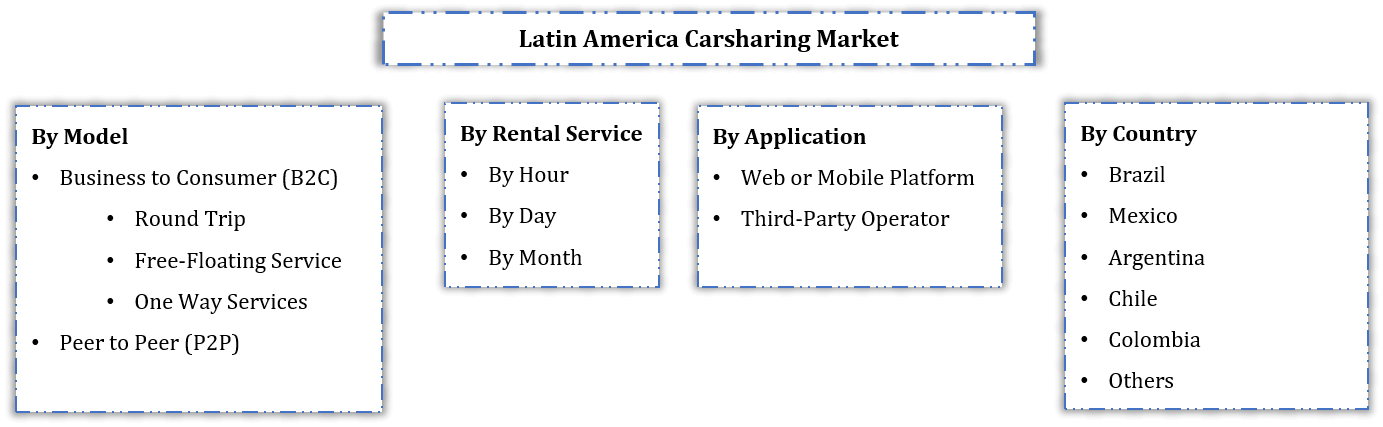
By Vehicle Type (Hatchback, Sedan, SUV), By Trip Type (One-Way Trips, Round Trips), By Propulsion Type (Internal Combustion Engine (ICE), Hybrid Electric Vehicle (HEV), Battery Ele......ctric Vehicle (BEV)), By End User (Individual Consumers, Business & Corporate Users, Government & Institutional Users), By Pricing Model (Pay-as-You-Go, Membership + Usage Fee, Monthly Subscription/Prepaid Package, Corporate Contract Pricing), By Service Model (Free-Floating, Station-Based, Peer-to-Peer), and others Read more
- ICT & Electronics
- Aug 2026
- 244
- PDF, Excel, PPT
Latin America Carsharing Market Key Takeaways
- The Latin America carsharing market size was valued at USD 101 million in 2025 and is projected to grow from USD 105 million in 2026 to USD 142 million by 2032.
- The industry is projected to grow at a steady CAGR of 5.16% during 2026-2032.
- Brazil holds the largest share of about 28% in 2026.
- By model, peer-to-peer holds a significant share of about 62% in 2026.
- By vehicle type, SUVs seized a significant share of about 45% in 2026.
- The industry is moderately fragmented. However, the top five players collectively account for nearly 45% share.
Latin America Carsharing Market Size and Outlook
The carsharing market size in Latin America was valued at USD 101 million in 2025 and is projected to grow from USD 105 million in 2026 to USD 142 million by 2032. Along with this, the market is estimated to grow at a CAGR of around 5.16% during the forecast period, i.e., 2026-32.
The demand for car sharing in Latin America is gaining momentum as urban consumers increasingly seek flexible, app-based alternatives to private vehicle ownership. Demand is supported by congestion, rising ownership costs, smartphone adoption, and growing acceptance of shared mobility. Policy initiatives such as Brazil’s MOVER program, which promotes automotive decarbonization and technological development, further support market development.
Future opportunities lie in electric car-sharing fleets, digital platforms, fleet optimization, and integration with urban mobility networks. Brazil, Chile, Argentina, and Colombia offer particularly attractive opportunities. Over the long term, increasing urbanization, electrification, and digitalization are expected to strengthen car sharing as a complementary mobility solution.
Latin America Carsharing Market Key Indicators
- Ford Argentina’s partnership with MyKeego demonstrates the growing adoption of digital car-sharing models in Latin America. Launched as a fully digital service, Ford Go enables users to reserve and access shared vehicles through an application, supported by 24/7 parking locations. The partnership illustrates increasing collaboration between automakers and mobility startups to establish technology-enabled shared-vehicle services, supporting the expansion of car-sharing infrastructure and consumer accessibility in Argentina.
- Brazil's charging infrastructure is expanding alongside electric vehicle adoption, improving the feasibility of electric car-sharing operations. By May 2026, Brazil had 25,429 public and semi-public charging points, up 20.7% from 21,060 in February 2026. The plug-in EV fleet reached 505,806 vehicles, equivalent to approximately 19.9 vehicles per charging point. Continued charging-network expansion reduces a major operational barrier to deploying EVs in shared fleets.
- Uber’s Q4 2025 results demonstrate the rapid normalization of app-based, on-demand mobility. Uber recorded 202 million monthly active platform consumers, while quarterly trips increased 22% year-on-year to 3.75 billion and gross bookings reached USD 54.1 billion. This widespread use of digital mobility platforms familiarizes consumers with app-based vehicle access, payments, and location services, creating favorable conditions for car-sharing adoption in Latin America.
Latin America Carsharing Market Scope
| Category | Segments |
|---|---|
| By Vehicle Type | Hatchback, Sedan, SUV |
| By Trip Type | One-Way Trips, Round Trips |
| By Propulsion Type | Internal Combustion Engine (ICE), Hybrid Electric Vehicle (HEV), Battery Electric Vehicle (BEV |
| By End User | Individual Consumers, Business & Corporate Users, Government & Institutional Users |
| By Pricing Model | Pay-as-You-Go, Membership + Usage Fee, Monthly Subscription/Prepaid Package, Corporate Contract Pricing |
| By Service Model | Free-Floating, Station-Based, Peer-to-Peer |
Latin America Carsharing Market Growth Drivers
Rising Cost of Private Vehicle Ownership Drives Car-Sharing Adoption in Latin America
The high cost of private vehicle ownership is a major growth driver for the Latin America carsharing market, particularly in Brazil, the region’s largest automotive market. Vehicle ownership involves not only the purchase price but also fuel, insurance, taxes, maintenance, financing, and depreciation. Brazil’s insurance regulator, SUSEP, explicitly identifies fuel, IPVA, insurance, maintenance, inspections, and financing payments as recurring costs that must be considered when purchasing a car.
The financial burden is substantial. In 2026, maintaining a popular passenger car in Brazil was estimated at approximately USD 220–365 per month, including fuel, insurance, IPVA, maintenance, and depreciation. In addition, entry-level new vehicles in Brazil increasingly cost more than approximately USD 22,000, making initial ownership more expensive for consumers.
This creates a favorable value proposition for car-sharing: consumers can pay only when they need a vehicle rather than continuously paying ownership-related expenses. The opportunity is particularly relevant for occasional urban drivers who may otherwise leave a privately owned vehicle unused for long periods. Consequently, increasing ownership costs are encouraging consumers in major Latin American cities to consider shared vehicles as a more flexible and cost-efficient mobility option.
- Market Segmentation
- Introduction
- Product Definition
- Research Process
- Assumptions
- Executive Summary
- Latin America Carsharing Market Policies, Regulations, and Product Standards
- Latin America Carsharing Market Trends & Developments
- Latin America Carsharing Market Dynamics
- Growth Factors
- Challenges
- Latin America Carsharing Market Hotspot & Opportunities
- Latin America Carsharing Market Outlook, 2022-2032
- Market Size & Outlook
- By Revenues (USD Million)
- Market Segmentation & Outlook
- By Vehicle Type- Market Size & Forecast 2022-2032, USD Million
- Hatchback
- Sedan
- SUV
- By Trip Type- Market Size & Forecast 2022-2032, USD Million
- One-Way Trips
- Round Trips
- By Propulsion Type- Market Size & Forecast 2022-2032, USD Million
- Internal Combustion Engine (ICE)
- Hybrid Electric Vehicle (HEV)
- Battery Electric Vehicle (BEV)
- By End User- Market Size & Forecast 2022-2032, USD Million
- Individual Consumers
- Business & Corporate Users
- Government & Institutional Users
- By Pricing Model- Market Size & Forecast 2022-2032, USD Million
- Pay-as-You-Go
- Membership + Usage Fee
- Monthly Subscription/Prepaid Package
- Corporate Contract Pricing
- By Service Model- Market Size & Forecast 2022-2032, USD Million
- Free-Floating
- Station-Based
- Peer-to-Peer
- By Country
- Brazil
- Argentina
- Chile
- Colombia
- Peru
- Ecuador
- Rest of Latin America
- By Company
- Competition Characteristics
- Market Share & Analysis
- By Vehicle Type- Market Size & Forecast 2022-2032, USD Million
- Market Size & Outlook
- Brazil Carsharing Market Outlook, 2022-2032
- Market Size & Outlook
- By Revenues (USD Million)
- Market Segmentation & Outlook
- By Vehicle Type- Market Size & Forecast 2022-2032, USD Million
- By Trip Type- Market Size & Forecast 2022-2032, USD Million
- By Propulsion Type- Market Size & Forecast 2022-2032, USD Million
- By End User- Market Size & Forecast 2022-2032, USD Million
- By Pricing Model- Market Size & Forecast 2022-2032, USD Million
- By Service Model- Market Size & Forecast 2022-2032, USD Million
- Market Size & Outlook
- Argentina Carsharing Market Outlook, 2022-2032
- Market Size & Outlook
- By Revenues (USD Million)
- Market Segmentation & Outlook
- By Vehicle Type- Market Size & Forecast 2022-2032, USD Million
- By Trip Type- Market Size & Forecast 2022-2032, USD Million
- By Propulsion Type- Market Size & Forecast 2022-2032, USD Million
- By End User- Market Size & Forecast 2022-2032, USD Million
- By Pricing Model- Market Size & Forecast 2022-2032, USD Million
- By Service Model- Market Size & Forecast 2022-2032, USD Million
- Market Size & Outlook
- Chile Carsharing Market Outlook, 2022-2032
- Market Size & Outlook
- By Revenues (USD Million)
- Market Segmentation & Outlook
- By Vehicle Type- Market Size & Forecast 2022-2032, USD Million
- By Trip Type- Market Size & Forecast 2022-2032, USD Million
- By Propulsion Type- Market Size & Forecast 2022-2032, USD Million
- By End User- Market Size & Forecast 2022-2032, USD Million
- By Pricing Model- Market Size & Forecast 2022-2032, USD Million
- By Service Model- Market Size & Forecast 2022-2032, USD Million
- Market Size & Outlook
- Colombia Carsharing Market Outlook, 2022-2032
- Market Size & Outlook
- By Revenues (USD Million)
- Market Segmentation & Outlook
- By Vehicle Type- Market Size & Forecast 2022-2032, USD Million
- By Trip Type- Market Size & Forecast 2022-2032, USD Million
- By Propulsion Type- Market Size & Forecast 2022-2032, USD Million
- By End User- Market Size & Forecast 2022-2032, USD Million
- By Pricing Model- Market Size & Forecast 2022-2032, USD Million
- By Service Model- Market Size & Forecast 2022-2032, USD Million
- Market Size & Outlook
- Peru Carsharing Market Outlook, 2022-2032
- Market Size & Outlook
- By Revenues (USD Million)
- Market Segmentation & Outlook
- By Vehicle Type- Market Size & Forecast 2022-2032, USD Million
- By Trip Type- Market Size & Forecast 2022-2032, USD Million
- By Propulsion Type- Market Size & Forecast 2022-2032, USD Million
- By End User- Market Size & Forecast 2022-2032, USD Million
- By Pricing Model- Market Size & Forecast 2022-2032, USD Million
- By Service Model- Market Size & Forecast 2022-2032, USD Million
- Market Size & Outlook
- Ecuador Carsharing Market Outlook, 2022-2032
- Market Size & Outlook
- By Revenues (USD Million)
- Market Segmentation & Outlook
- By Vehicle Type- Market Size & Forecast 2022-2032, USD Million
- By Trip Type- Market Size & Forecast 2022-2032, USD Million
- By Propulsion Type- Market Size & Forecast 2022-2032, USD Million
- By End User- Market Size & Forecast 2022-2032, USD Million
- By Pricing Model- Market Size & Forecast 2022-2032, USD Million
- By Service Model- Market Size & Forecast 2022-2032, USD Million
- Market Size & Outlook
- Latin America Carsharing Market Key Strategic Imperatives for Success & Growth
- Competitive Outlook
- Company Profiles
- Turbi Participações Ltda.
- Business Description
- Product Portfolio
- Collaborations & Alliances
- Recent Developments
- Financial Details
- Others
- TripWip S.A.S.
- Business Description
- Product Portfolio
- Collaborations & Alliances
- Recent Developments
- Financial Details
- Others
- MyKeego S.A.S.
- Business Description
- Product Portfolio
- Collaborations & Alliances
- Recent Developments
- Financial Details
- Others
- Equirent S.A.S.
- Business Description
- Product Portfolio
- Collaborations & Alliances
- Recent Developments
- Financial Details
- Others
- Joycar Tecnologia e Mobilidade Ltda.
- Business Description
- Product Portfolio
- Collaborations & Alliances
- Recent Developments
- Financial Details
- Others
- Rentennials S.A.S.
- Business Description
- Product Portfolio
- Collaborations & Alliances
- Recent Developments
- Financial Details
- Others
- KINTO Mobility S.A.
- Business Description
- Product Portfolio
- Collaborations & Alliances
- Recent Developments
- Financial Details
- Others
- A3 Electric Mobility SpA
- Business Description
- Product Portfolio
- Collaborations & Alliances
- Recent Developments
- Financial Details
- Others
- Turbi Participações Ltda.
- Company Profiles
- Disclaimer
MarkNtel Advisors follows a robust and iterative research methodology designed to ensure maximum accuracy and minimize deviation in market estimates and forecasts. Our approach combines both bottom-up and top-down techniques to effectively segment and quantify various aspects of the market. A consistent feature across all our research reports is data triangulation, which examines the market from three distinct perspectives to validate findings. Key components of our research process include:
1. Scope & Research Design At the outset, MarkNtel Advisors define the research objectives and formulate pertinent questions. This phase involves determining the type of research—qualitative or quantitative—and designing a methodology that outlines data collection methods, target demographics, and analytical tools. They also establish timelines and budgets to ensure the research aligns with client goals.
2. Sample Selection and Data Collection In this stage, the firm identifies the target audience and determines the appropriate sample size to ensure representativeness. They employ various sampling methods, such as random or stratified sampling, based on the research objectives. Data collection is carried out using tools like surveys, interviews, and observations, ensuring the gathered data is reliable and relevant.
3. Data Analysis and Validation Once data is collected, MarkNtel Advisors undertake a rigorous analysis process. This includes cleaning the data to remove inconsistencies, employing statistical software for quantitative analysis, and thematic analysis for qualitative data. Validation steps are taken to ensure the accuracy and reliability of the findings, minimizing biases and errors.

4. Data Forecast and FinalizationThe final phase involves forecasting future market trends based on the analyzed data. MarkNtel Advisors utilize predictive modeling and time series analysis to anticipate market behaviors. The insights are then compiled into comprehensive reports, featuring visual aids like charts and graphs, and include strategic recommendations to inform client decision-making
FILL THE FORM TO INQUIRE BEFORE BUYING THIS REPORT
We offer flexible licensing options to cater to varying organizational needs. Choose the pricing pack that best suits your requirements:
Buy Now Talk to our Consultant
 Request Customization