

By Instrument Type (Handheld Instruments, Electrosurgical Instruments, Laparoscopic Instruments, Surgical Scopes, Cutting and Dissecting Instruments, Others), By Application (Neuro......surgery, Plastic & Reconstructive Surgery, Wound Closure, Obstetrics & Gynecology, Cardiovascular, Orthopedic, Others), By End User (Hospitals & Clinics, Ambulatory Surgery Centers, Others), and others Read more
- Healthcare
- Jul 2026
- 140
- PDF, Excel, PPT
India Surgical Instruments Market Key Takeaways
- The India surgical instruments market was valued at USD 0.394 billion in 2025 and is projected to grow from USD 0.428 billion in 2026 to USD 0.703 billion by 2032.
- The industry is projected to witness steady growth at a CAGR of 8.54% during the forecast period (2026–2032).
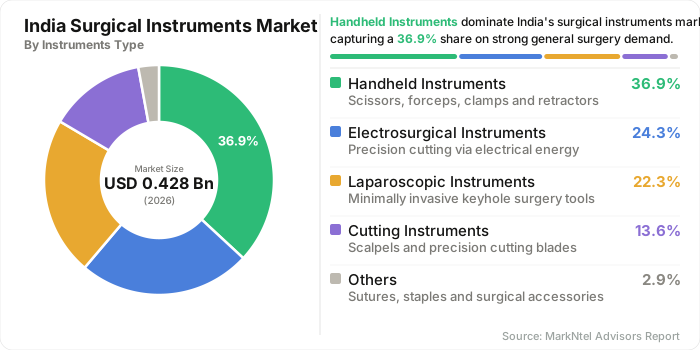
- Handheld instruments dominate the market by instrument type, accounting for approximately 38% of the total revenue.
- Cardiovascular surgery represents the leading application segment with a 22% market share.
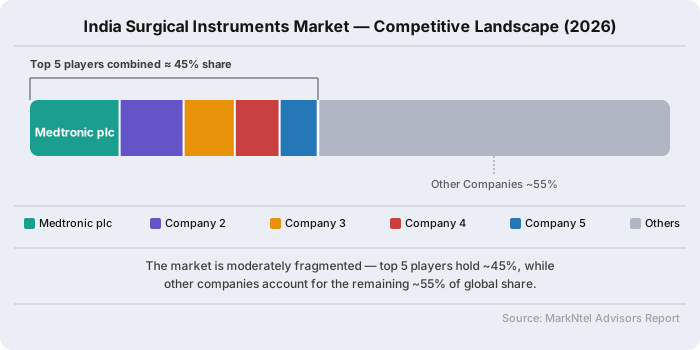
- The market is moderately fragmented, with the top five companies accounting for approximately 45% of the total market share.
India Surgical Instruments Market Size and Outlook
The Indian Surgical Instruments Market was valued at USD 0.394 billion in 2025 and is projected to grow from USD 0.428 billion in 2026 to USD 0.703 billion by 2032, registering a CAGR of 8.54% during the forecast period (2026–2032).
This significant growth is supported by increasing procedure volumes driven by wider healthcare access and insurance coverage expansion. Under Ayushman Bharat Pradhan Mantri Jan Arogya Yojana (PM-JAY), the National Health Authority has expanded cashless treatment access across empaneled hospitals, enabling greater utilization of secondary and tertiary care procedures. By September 2025, PM-JAY had facilitated more than 10 crore hospital admissions since its inception, increasing demand for surgical consumables, instruments, and operating room equipment across participating healthcare facilities.
Government-led medical device ecosystem development has accelerated domestic manufacturing capabilities for surgical equipment. The Department of Pharmaceuticals continues implementing the National Medical Device Policy 2023, along with supporting programs such as the Production Linked Incentive Scheme for Medical Devices, Medical Device Parks Scheme, and assistance programs for medical device clusters. These initiatives aim to improve manufacturing infrastructure, encourage indigenous product development, and strengthen India’s position in the medical technology supply chain.
For surgical instrument manufacturers, regulatory compliance has become increasingly important as CDSCO continues transitioning medical devices toward a risk-based licensing framework. Under the existing framework, devices are categorized into Class A, B, C, and D based on associated risk levels, with higher-risk categories requiring approval from the Central Licensing Authority. In 2025, CDSCO updates also highlighted the need for manufacturers and importers to verify device classification status before obtaining manufacturing or import licenses, improving compliance transparency across the medical device ecosystem.
Industry growth is further supported by innovation-focused programs and export-oriented opportunities. Additionally, the India–UK Free Trade Agreement announced in 2025 provided improved market access for Indian medical device exports, including surgical instruments, by reducing trade barriers and supporting international competitiveness.
India Surgical Instruments Market Key Indicators
- According to the Ministry of Commerce (DGCIS), reported in Parliament on July 29, 2025, imports of surgical instruments over the preceding five years cumulatively reached USD 951 million; this sustained import reliance signals a large, underserved domestic demand base that expanding local manufacturers can convert into surgical instrument sales.
- According to the ICMR National Centre for Disease Informatics and Research (NCDIR), India is projected to record 1.57 million new cancer cases, increasing the volume of oncological surgeries and driving sustained demand for surgical scissors, forceps, staplers, electrosurgical instruments, and other specialty surgical tools.
- According to the Press Information Bureau (September 2025), the Union Cabinet approved 10,023 additional undergraduate and postgraduate medical seats with an investment of approximately USD 1.8 billion (INR 15,034 crore) under Phase III of the Centrally Sponsored Scheme. India also expanded its medical education network to 808 medical colleges and 123,700 MBBS seats in 2025–26, strengthening the future surgical workforce and increasing long-term demand for surgical training instruments, operating room equipment, and advanced surgical instruments across teaching hospitals.
India Surgical Instruments Market Scope
| Category | Segments |
|---|---|
| By Instrument Type | Handheld Instruments, Electrosurgical Instruments, Laparoscopic Instruments, Surgical Scopes, Cutting and Dissecting Instruments, Others |
| By Application | Neurosurgery, Plastic & Reconstructive Surgery, Wound Closure, Obstetrics & Gynecology, Cardiovascular, Orthopedic, Others |
| By End User | Hospitals & Clinics, Ambulatory Surgery Centers, Others |
India Surgical Instruments Market Growth Drivers
Expansion of Government Healthcare Financing Supporting Surgical Instrument Demand Across Tier-2 and Tier-3 Healthcare Facilities
The expansion of government healthcare financing is a significant driver for the Indian surgical instruments industry by improving access to secondary and tertiary care procedures across underserved regions. The Ayushman Bharat Pradhan Mantri Jan Arogya Yojana (PM-JAY) provides health coverage of approximately USD 6,000 per family annually for secondary and tertiary hospitalization to over 42 crore eligible beneficiaries, increasing patient access to surgical treatments across public and private empanelled hospitals. This expansion is creating sustained demand for hospital surgical equipment in India, including cost-effective surgical tools and consumable instruments.
The government’s continued healthcare spending is strengthening medical service delivery capacity beyond metropolitan areas. The Union Budget 2025–26 allocated approximately USD 11.5 billion to the Ministry of Health and Family Welfare, supporting healthcare infrastructure development and service expansion. Increased funding for healthcare delivery is encouraging hospitals in tier-2 and tier-3 cities to improve operating room capabilities and procure essential surgical instruments in the Indian market.
As government-funded healthcare access expands, healthcare providers are increasingly prioritizing affordable, durable, and standardized surgical instruments to manage higher procedure volumes. This shift is supporting growth opportunities for domestic manufacturers and suppliers of the surgical devices market in India, particularly in cost-sensitive healthcare segments.
Recent Trends
Adoption of Minimally Invasive and Robotic-Assisted Surgeries Transforming Surgical Instrument Demand in India
The India surgical instruments market is undergoing a significant transformation with the increasing adoption of minimally invasive and robotic-assisted surgeries, driving demand for advanced laparoscopic instruments, robotic graspers, scissors, and precision surgical tools.
In 2025, Meril Life Sciences launched the Mizzo Endo 4000 soft-tissue robotic surgical system, incorporating advanced visualization, artificial intelligence-based assistance, and telesurgery capabilities for complex procedures. This product development is accelerating the shift toward technology-enabled surgical workflows and increasing requirements for compatible robotic surgical instruments and accessories.
In 2026, healthcare providers further expanded robotic surgery capabilities through institutional investments in advanced surgical platforms. Apollo Hospitals launched its Institute of Robotics & Telesurgery in Chennai, focusing on robotic surgery, digital operating room capabilities, and remote surgical collaboration. Additionally, P. D. Hinduja Hospital adopted Smith+Nephew’s CORI Surgical System in 2026 to enhance robotic-assisted orthopedic procedures. These deployments are strengthening demand for robotic surgical instruments in India and minimally invasive surgical devices.
The continued integration of robotic platforms is expected to reshape procurement patterns as hospitals prioritize precision, efficiency, and improved clinical outcomes. This trend is supporting long-term growth opportunities for manufacturers developing advanced laparoscopic instruments in India, robotic surgical tools, and next-generation surgical technologies.
India Surgical Instruments Market Opportunities and Challenges
Persistent Import Dependence Creates Strong Opportunities for Domestic Surgical Instrument Manufacturing
India's continued reliance on imported surgical instruments remains one of the most significant structural characteristics of the market, while creating substantial opportunities for domestic manufacturers. According to a Rajya Sabha reply by the Ministry of Chemicals and Fertilizers on July 29, 2025, the government stated that India's medical device sector continues to depend on imports for nearly 70% of its requirements, based on its November 2024 assessment. High-precision surgical instruments, advanced electrosurgical devices, and specialized minimally invasive surgical tools remain among the most import-dependent categories, exposing healthcare providers to exchange-rate fluctuations, higher procurement costs, and global supply chain disruptions.
The persistent import gap is accelerating investments in indigenous manufacturing and component localization. To strengthen domestic production, the government introduced a dedicated Component Manufacturing Scheme for Medical Devices, encouraging local production of critical components used in high-value medical technologies. At the industry level, Meril Life Sciences expanded its manufacturing capabilities in Vapi while introducing indigenous robotic surgical platforms, reflecting the industry's transition toward manufacturing advanced surgical technologies within India.
The investment environment has also remained favorable, with the Department for Promotion of Industry and Internal Trade (DPIIT) reporting cumulative FDI of approximately USD 4.24 billion in the medical and surgical appliances sector between April 2000 and December 2025. As localization increases, Indian manufacturers are well-positioned to reduce import dependence, strengthen supply chain resilience, and capture a larger share of the Indian Surgical Instruments Market.
Segmentation Insights
Handheld Surgical Instruments Dominate India’s Surgical Instruments Industry Through Broad Clinical Adoption
Handheld instruments represent the leading segment in the surgical instruments industry in India, accounting for approximately 38% share, due to their extensive use across routine and specialized surgical procedures, including general surgery, orthopedic, cardiovascular, and gynecological interventions. Forceps, retractors, dilators, and graspers remain essential components of operating rooms because they support fundamental surgical functions such as tissue handling, exposure, and manipulation.
The segment’s leadership is supported by continuous product innovation and portfolio expansion by established medical technology companies. B. Braun introduced advanced Aesculap surgical instrument solutions, focusing on ergonomic designs, precision handling, and improved durability for hospital-based surgical applications. Similarly, Stryker’s surgical instrument portfolio includes specialized handheld tools designed for orthopedic and general surgical procedures, supporting adoption among healthcare institutions.
Growing preference for reusable, durable, and precision-engineered instruments is strengthening procurement demand across hospitals and specialty centers. The dominance of handheld instruments is expected to continue as these tools remain indispensable across a wide range of surgical applications, while advanced segments such as electrosurgical and laparoscopic instruments complement rather than replace their core role in surgical workflows. By type of instruments, the market is further segmented into the following sub-categories:
- Handheld Instruments
- Electrosurgical Instruments
- Laparoscopic Instruments
- Cutting & Dissecting Instruments
- Surgical Scopes
- Others
Advanced Cardiovascular Surgical Technologies Strengthen Demand for Precision Instruments
The Cardiovascular segment leads the application landscape of the India surgical instruments market, accounting for approximately 22% share, due to the extensive use of specialized instruments in coronary artery bypass surgery, valve procedures, and vascular interventions. Cardiovascular surgeries require high-precision tools such as vascular clamps, cardiac retractors, surgical forceps, and anastomosis devices, supporting consistent demand from cardiac hospitals and specialty centers.
Innovation in cardiovascular surgical technologies is strengthening segment adoption. Getinge’s Heartstring III Proximal Seal System, a clampless anastomotic device used during coronary artery bypass grafting (CABG), enables surgeons to perform proximal anastomosis while reducing manipulation of the ascending aorta. This innovation supports the shift toward precision-focused cardiovascular procedures by improving surgical control and reducing procedural complexity.
Additionally, SS Innovations’ SSi Mantra 3 robotic surgical system enabled robotic-assisted cardiac telesurgery procedures in 2025, including robotic-assisted internal mammary artery harvesting and totally endoscopic coronary artery bypass procedures. Such developments are increasing the demand for specialized robotic surgical instruments used in advanced cardiovascular interventions. The growing adoption of technology-driven cardiac procedures is expected to sustain demand for advanced cardiovascular surgical instruments in India. By application, the market is further segmented into the following sub-categories:
- Neurosurgery
- Plastic & Reconstructive Surgery
- Wound Closure
- Obstetrics & Gynecology
- Cardiovascular
- Orthopedic
- Others
India Surgical Instruments Market Competitive Landscape
The India Surgical Instruments Market is characterized by a moderately fragmented competitive landscape, with global medical technology leaders, domestic manufacturers, and specialized surgical instrument suppliers. The top five players in the Indian Surgical Instruments Market are Johnson & Johnson MedTech (Ethicon), Medtronic plc, Stryker Corporation, B. Braun Melsungen AG, and Olympus Corporation, collectively accounting for approximately 45% of the market share.
Major Companies for the India Surgical Instruments Market
- Johnson & Johnson MedTech (Ethicon)
- Medtronic plc
- Stryker Corporation
- B. Braun Melsungen AG
- Olympus Corporation
- Karl Storz SE & Co. KG
- Meril Life Sciences
- Zimmer Biomet Holdings
- CONMED Corporation
- Terumo Corporation
India Surgical Instruments Market News and Recent Developments
2025: Stryker Opens 140,000 Sq. Ft. R&D Facility in Whitefield, Bengaluru
In September 2025, Stryker opened a new research and development centre in Whitefield, Bengaluru. The 140,000-square-foot facility adds to the company's existing 220,000-square-foot R&D campus in Gurgaon and integrates teams across robotics, artificial intelligence, digital health, and product security. Stryker's earlier India R&D centre has over 1,100 employees and is one of the company's leading strategic innovation hubs, established more than 15 years ago.
Impact Analysis: Expanded engineering capacity in India shortens development cycles for next-generation surgical and neurotechnology instruments, strengthening Stryker's supply pipeline into a high-growth market. The investment reinforces competitive positioning by embedding product development close to end-users, enabling faster localization of designs and deepening penetration across India's orthopedic and medical-surgical demand base.
2026: Stryker Launches Trident II Acetabular System in India for Advancing Hip Replacement Surgeries
In April 2026, Stryker introduced the Trident II Acetabular System in India to enhance total hip arthroplasty (THA). The system incorporates Tritanium In-Growth Technology, PureFix Hydroxyapatite (HA) technology, and compatibility with Mako SmartRobotics, enabling improved implant fixation, surgical precision, and joint stability across diverse patient anatomies. The launch expands the availability of advanced orthopedic surgical technologies for Indian surgeons and hospitals.
Market Impact Analysis: The product launch strengthens the adoption of technology-enabled orthopedic surgeries, increasing demand for specialized surgical instruments used in hip replacement procedures, including orthopedic reamers, acetabular impactors, alignment tools, and implant insertion instruments. It also supports the broader transition toward precision-driven and robotic-assisted orthopedic surgery, encouraging hospitals to upgrade surgical infrastructure and advanced instrument sets.
2026: Stryker and Max Smart Hospital Partner to Advance Robotic-Arm Assisted Joint Replacement Training
News Explanation: In May 2026, Stryker Corporation partnered with Max Smart Super Specialty Hospital, Saket, to establish a dedicated center for surgeon training, clinical education, and robotic-arm-assisted joint replacement in India. The collaboration focuses on expanding hands-on training using Stryker's Mako SmartRobotics™ platform, enabling orthopedic surgeons to strengthen expertise in robotic-assisted hip and knee replacement procedures while promoting standardized clinical practices.
Market Impact Analysis: The partnership is expected to accelerate the adoption of robotic-assisted orthopedic surgery by improving surgeon proficiency and expanding the clinical use of advanced robotic technologies. As more hospitals integrate robotic joint replacement programs, demand is expected to increase for robotic surgical instruments, precision orthopedic tools, navigation-enabled surgical systems, and specialized operating room equipment, supporting the long-term growth of the Indian Surgical Instruments Market.
2025): MicroPort Orthopedics Launches SkyWalker™ Orthopedic Robotic System at Yenepoya Specialty Hospital, India
In September 2025, MicroPort Orthopedics, in collaboration with Yenepoya Specialty Hospital, Mangaluru, introduced South Asia's first SkyWalker™ Orthopedic Robotic System. The platform integrates the Evolution® Medial-Pivot Knee System with robotic-assisted technology to deliver sub-millimeter precision during total knee replacement procedures, improving implant positioning and surgical accuracy.
Market Impact Analysis: The installation is expected to increase demand for robotic-compatible orthopedic surgical instruments, including precision bone preparation tools, alignment guides, cutting instruments, and procedure-specific instrument sets. The adoption of robotic orthopedic platforms is also encouraging hospitals to modernize operating rooms and invest in advanced surgical technologies, supporting the long-term growth of the India Surgical Instruments Market.
- Market Segmentation
- Introduction
- Product Definition
- Research Process
- Assumptions
- Executive Summary
- India Surgical Instruments Market Policies, Regulations, and Product Standards
- India Surgical Instruments Market Trends & Developments
- India Surgical Instruments Market Dynamics
- Growth Factors
- Challenges
- India Surgical Instruments Market Hotspot & Opportunities
- India Surgical Instruments Market Outlook, 2022-2032
- Market Size & Outlook
- By Revenues (USD Million)
- Market Share & Outlook
- By Instrument Type- Market Size & Forecast 2022-2032, USD Million
- Handheld Instruments
- Electrosurgical Instruments
- Laparoscopic Instruments
- Surgical Scopes
- Cutting and Dissecting Instruments
- Others
- By Application- Market Size & Forecast 2022-2032, USD Million
- Neurosurgery
- Plastic & Reconstructive Surgery
- Wound Closure
- Obstetrics & Gynecology
- Cardiovascular
- Orthopedic
- Others
- By End User - Market Size & Forecast 2022-2032, USD Million
- Hospitals & Clinics
- Ambulatory Surgery Centers
- Others
- By Region - Market Size & Forecast 2022-2032, USD Million
- North
- South
- East
- West
- Central
- By Company
- Competition Characteristics
- Market Share & Analysis
- By Instrument Type- Market Size & Forecast 2022-2032, USD Million
- Market Size & Outlook
- India Handheld Surgical Instruments Market Outlook, 2022-2032
- Market Size & Outlook
- By Revenues (USD Million)
- Market Share & Outlook
- By Application- Market Size & Forecast 2022-2032, USD Million
- By End User - Market Size & Forecast 2022-2032, USD Million
- By Region - Market Size & Forecast 2022-2032, USD Million
- Market Size & Outlook
- India Electrosurgical Surgical Instruments Market Outlook, 2022-2032
- Market Size & Outlook
- By Revenues (USD Million)
- Market Share & Outlook
- By Application- Market Size & Forecast 2022-2032, USD Million
- By End User - Market Size & Forecast 2022-2032, USD Million
- By Region - Market Size & Forecast 2022-2032, USD Million
- Market Size & Outlook
- India Laparoscopic Surgical Instruments Market Outlook, 2022-2032
- Market Size & Outlook
- By Revenues (USD Million)
- Market Share & Outlook
- By Application- Market Size & Forecast 2022-2032, USD Million
- By End User - Market Size & Forecast 2022-2032, USD Million
- By Region - Market Size & Forecast 2022-2032, USD Million
- Market Size & Outlook
- India Surgical Scopes Instruments Market Outlook, 2022-2032
- Market Size & Outlook
- By Revenues (USD Million)
- Market Share & Outlook
- By Application- Market Size & Forecast 2022-2032, USD Million
- By End User - Market Size & Forecast 2022-2032, USD Million
- By Region - Market Size & Forecast 2022-2032, USD Million
- Market Size & Outlook
- India Cutting & Dissecting Instruments Market Outlook, 2022-2032
- Market Size & Outlook
- By Revenues (USD Million)
- Market Share & Outlook
- By Application- Market Size & Forecast 2022-2032, USD Million
- By End User - Market Size & Forecast 2022-2032, USD Million
- By Region - Market Size & Forecast 2022-2032, USD Million
- Market Size & Outlook
- India Surgical Instruments Market Key Strategic Imperatives for Success & Growth
- Competitive Outlook
- Company Profiles
- Johnson & Johnson MedTech (Ethicon)
- Business Description
- Product Portfolio
- Collaborations & Alliances
- Recent Developments
- Financial Details
- Others
- Medtronic plc
- Business Description
- Product Portfolio
- Collaborations & Alliances
- Recent Developments
- Financial Details
- Others
- Stryker Corporation
- Business Description
- Product Portfolio
- Collaborations & Alliances
- Recent Developments
- Financial Details
- Others
- B. Braun Melsungen AG
- Business Description
- Product Portfolio
- Collaborations & Alliances
- Recent Developments
- Financial Details
- Others
- Olympus Corporation
- Business Description
- Product Portfolio
- Collaborations & Alliances
- Recent Developments
- Financial Details
- Others
- Karl Storz SE & Co. KG
- Business Description
- Product Portfolio
- Collaborations & Alliances
- Recent Developments
- Financial Details
- Others
- Meril Life Sciences
- Business Description
- Product Portfolio
- Collaborations & Alliances
- Recent Developments
- Financial Details
- Others
- Zimmer Biomet Holdings
- Business Description
- Product Portfolio
- Collaborations & Alliances
- Recent Developments
- Financial Details
- Others
- CONMED Corporation
- Business Description
- Product Portfolio
- Collaborations & Alliances
- Recent Developments
- Financial Details
- Others
- Terumo Corporation
- Business Description
- Product Portfolio
- Collaborations & Alliances
- Recent Developments
- Financial Details
- Others
- Johnson & Johnson MedTech (Ethicon)
- Company Profiles
- Disclaimer

MarkNtel Advisors follows a robust and iterative research methodology designed to ensure maximum accuracy and minimize deviation in market estimates and forecasts. Our approach combines both bottom-up and top-down techniques to effectively segment and quantify various aspects of the market. A consistent feature across all our research reports is data triangulation, which examines the market from three distinct perspectives to validate findings. Key components of our research process include:
1. Scope & Research Design At the outset, MarkNtel Advisors define the research objectives and formulate pertinent questions. This phase involves determining the type of research—qualitative or quantitative—and designing a methodology that outlines data collection methods, target demographics, and analytical tools. They also establish timelines and budgets to ensure the research aligns with client goals.
2. Sample Selection and Data Collection In this stage, the firm identifies the target audience and determines the appropriate sample size to ensure representativeness. They employ various sampling methods, such as random or stratified sampling, based on the research objectives. Data collection is carried out using tools like surveys, interviews, and observations, ensuring the gathered data is reliable and relevant.
3. Data Analysis and Validation Once data is collected, MarkNtel Advisors undertake a rigorous analysis process. This includes cleaning the data to remove inconsistencies, employing statistical software for quantitative analysis, and thematic analysis for qualitative data. Validation steps are taken to ensure the accuracy and reliability of the findings, minimizing biases and errors.

4. Data Forecast and FinalizationThe final phase involves forecasting future market trends based on the analyzed data. MarkNtel Advisors utilize predictive modeling and time series analysis to anticipate market behaviors. The insights are then compiled into comprehensive reports, featuring visual aids like charts and graphs, and include strategic recommendations to inform client decision-making
FILL THE FORM TO INQUIRE BEFORE BUYING THIS REPORT
We offer flexible licensing options to cater to varying organizational needs. Choose the pricing pack that best suits your requirements:
Buy Now Talk to our Consultant
 Request Customization