

By Product Type (Fish, Shrimp & Prawns, Other Seafood), By Form (Fresh/Chilled, Frozen, Canned, Processed), By Source (Aquaculture, Capture Fisheries), By Distribution Channel (Off......-Trade (Supermarkets/Hypermarkets, Convenience Stores, Online Retail, Traditional Fish Markets, Specialty Seafood Stores, Others), On-Trade (Hotels, Restaurants, Catering)), and others Read more
- Food & Beverages
- Aug 2026
- 150
- PDF, Excel, PPT
India Seafood Market Key Takeaways
- The India seafood market stood at around USD 13.90 billion in 2025 and is anticipated to expand from USD 14.91 billion in 2026 to USD 22.69 billion by 2032.
- The industry is projected to witness steady growth at a CAGR of 7.25% over the forecast period.
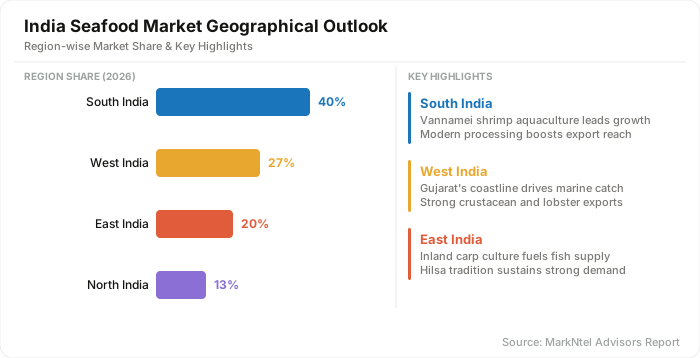
- South India led the regional segment with a 40% share in 2026.
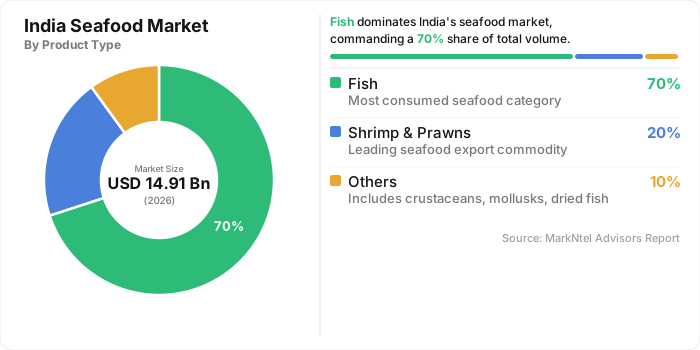
- Fish led the product type segment with a 70% share in 2026.
- Off-trade led the distribution channel segment with a 65% share in 2026.
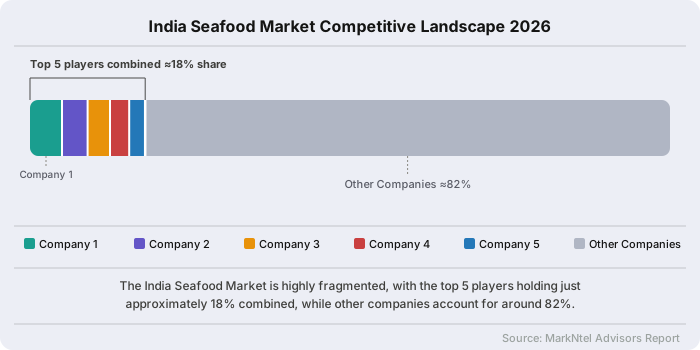
- The industry is highly fragmented, with the top five leading players accounting for approximately 18% of the total market share.
India Seafood Market Size and Outlook
Across India’s coastal and riverine states, fish has long been a dietary staple rather than a discretionary food choice, with the country’s 11,099-km coastline and extensive inland water resources supporting a large production base that has historically remained fragmented and informal. This structure is gradually becoming more organized as government-backed investments in aquaculture, cold-chain infrastructure, and seafood processing strengthen the industry’s production and distribution capabilities.
Reflecting this transformation, fish production increased from 95.79 lakh tonnes in FY 2013-14 to 197.75 lakh tonnes in FY 2024-25, representing a 106% increase, driven by the Blue Revolution and PMMSY, according to the Ministry of Fisheries, Animal Husbandry and Dairying. As higher production increasingly connects with improved infrastructure and processing capacity, the seafood value chain is expanding beyond traditional consumption toward organized domestic retail and export markets.
Supported by these developments, the seafood market in India was valued at USD 13.90 billion in 2025, is projected to reach USD 14.91 billion in 2026, and is expected to attain USD 22.69 billion by 2032, registering a CAGR of 7.25% during the forecast period.
India Seafood Market Key Indicators
- The GST Council reduced GST on fish oils, fish extracts, and prepared or preserved fish and shrimp products from 12% to 5% in September 2025. Lower taxation on value-added seafood is improving cost competitiveness and supporting broader domestic consumption.
- The Union Budget 2026–27 allocated a record USD 332.75 million to the fisheries sector, reflecting continued government investment in aquaculture, fisheries infrastructure, processing, and value-chain development. Higher public spending is strengthening sectoral capacity and supporting the modernization of India's seafood industry.
- Under the Fisheries and Aquaculture Infrastructure Development Fund (FIDF), 225 projects worth approximately USD 805.5 million have been approved, covering fishing harbours, fish landing centers, processing units, cold storage, and related infrastructure. Expanding these facilities is strengthening post-harvest handling and organized seafood distribution.
- India’s marine product exports increased 11.08% year-on-year to USD 0.90 billion in October 2025, from USD 0.81 billion in October 2024. Sustained external demand is strengthening export revenues while encouraging processing capacity and international market integration.
- Average aquaculture productivity has reached 4.77 tonnes per hectare, reflecting improvements in farming efficiency and technology adoption. Higher yields per hectare are increasing the availability of farmed seafood, strengthening raw-material supply for processors and supporting expansion across domestic and export markets.
- Kisan Credit Card benefits have reached 4.39 lakh fishers, while insurance coverage extends to 3.3 million beneficiaries, according to government data. Greater access to formal finance and risk protection is improving financial resilience and supporting participation in organized fisheries value chains.
India Seafood Market Scope
| Category | Segments |
|---|---|
| By Product Type | Fish, Shrimp & Prawns, Other Seafood |
| By Form | Fresh/Chilled, Frozen, Canned, Processed |
| By Source | Aquaculture, Capture Fisheries |
| By Distribution Channel | Off-Trade (Supermarkets/Hypermarkets, Convenience Stores, Online Retail, Traditional Fish Markets, Specialty Seafood Stores, Others), On-Trade (Hotels, Restaurants, Catering |
India Seafood Market Growth Drivers
Rising Domestic Seafood Consumption
Domestic seafood consumption is expanding as fish becomes increasingly integrated into Indian diets and remains an accessible source of animal protein. The Department of Fisheries reported that per-capita fish consumption increased from 5–6 kg to 12–13 kg, indicating a substantial broadening of the domestic consumption base. At the same time, India is the world’s second-largest aquaculture producer, accounts for approximately 8% of global fish production, and supports nearly 30 million fishers and fish farmers at the primary level.
This combination of stronger consumption and a growing production base is improving seafood availability across domestic markets. As fish becomes a more regular part of household diets, demand is gradually extending beyond traditional fresh purchases toward chilled, frozen, and processed formats. Greater availability is also encouraging retailers, foodservice operators, and processors to expand product choices and reach more consumers. As these consumption patterns continue to evolve, higher purchase frequency and broader seafood adoption are expected to increase domestic demand, supporting sustained expansion across the seafood value chain.
Recent Trends
Growing Focus on Seafood Traceability
India's seafood industry is increasingly adopting digital traceability as food-safety requirements, international standards, and demand for supply-chain transparency reshape operating practices. In November 2025, the Department of Fisheries released the National Framework on Traceability in Fisheries and Aquaculture 2025, establishing a phased digital system covering fisheries and aquaculture value chains. By integrating digital tools for compliance, quality assurance, and information sharing, the framework is strengthening seafood traceability while improving transparency and facilitating access to domestic and international markets.
This shift gained further importance in 2026 as traceability and certification became increasingly important for maintaining access to international seafood markets. A June 2026 national seafood-export workshop in Visakhapatnam, convened by the Department of Fisheries with the Ministry of Commerce and Industry, featured dedicated technical sessions on traceability and catch certification for meeting evolving global standards. Integration with ReALCRaft, vessel monitoring, SHAPHARI certification, and digital catch and health certificates is strengthening coordination across production, landing, processing, and exports. As these systems become more widely embedded, they are expected to improve quality assurance, buyer confidence, and market access, supporting more transparent and higher-value seafood trade.
India Seafood Market Opportunities and Challenges
U.S. Tariff Pressures on Frozen Shrimp Exports Leading to Greater Investment in Value-Added Seafood Processing
The United States, India's largest seafood export market by value, has become a growing source of pressure as higher tariff barriers affect Indian shrimp exports. According to MPEDA's FY2025–26 data, shipments to the U.S. declined 19.51% in volume and 14.22% in dollar value, even as India's overall seafood exports reached a record level. Frozen shrimp accounted for 93.55% of India's seafood export value to the U.S., highlighting the industry's significant exposure to a single product category and export destination. This concentration increases vulnerability to changes in trade conditions and strengthens the need for exporters to develop more resilient revenue streams.
Against this backdrop, greater value addition is emerging as a practical way to reduce reliance on conventional frozen-shrimp exports. Under MPEDA's Technology Development for Specific Value-Added Marine Products (TDSVMP) Scheme, USD 12.4 million in financial assistance was provided to 89 seafood processing units between FY2021–22 and FY2025–26 for value-added infrastructure, including cooked, peeled, and ready-to-cook product lines. As processors expand these offerings, higher-value products can improve differentiation, broaden market opportunities, and reduce exposure to tariff-sensitive commodity exports, creating a clear opportunity for greater investment in seafood processing and value addition.
Segmentation Insights
Fish Commands the Product Type Segment with a 70% Share Through Its Dominant Production and Domestic Consumption Base
Fish leads the product type segment due to India's extensive inland fisheries and aquaculture base, which provides a large and consistent supply for domestic consumption. According to the Department of Fisheries, inland fish production increased from 6.1 million tonnes to 147.37 lakh tonnes, while total fish production reached approximately 19.78 million tonnes in FY2024–25. This substantial production base ensures broad fish availability across domestic markets and supports its high contribution to seafood consumption.
The strength of this segment is further supported by continued government efforts to expand inland aquaculture, improve farming productivity, and strengthen production infrastructure. These measures are increasing the availability and reliability of farmed fish while supporting a broader network of producers across the country. The combination of a large production base, widespread cultivation, and strong domestic availability underpins fish's dominant position in India's seafood product mix. Based on product type, the market is segmented into:
- Fish
- Shrimp & Prawns
- Other Seafood
Off-Trade Commands the Distribution Channel with a 65% Share Through Predominant Household Consumption
Off-trade leads the distribution channel because seafood is widely purchased through consumer-facing retail outlets for household preparation. Government-supported infrastructure is strengthening this channel, with 6,896 fish retail markets and kiosks and 27,189 fish transportation and handling units approved under PMMSY as of March 2026. These facilities are improving the availability and movement of fresh and frozen seafood from production areas to household-facing retail markets.
The expansion of these facilities is also making seafood distribution more accessible and organized by strengthening retail infrastructure, transportation, and handling capabilities. Continued investment in consumer-facing fish markets and supporting logistics is improving the ability of retailers to serve household demand across different locations. This expanding retail ecosystem, combined with the established role of household seafood purchasing, provides the foundation for off-trade's strong contribution to seafood distribution. Based on distribution channel, the market has been segmented into:
- On-Trade
- Off-Trade
India Seafood Market Geographical Outlook
South India accounts for approximately 40% of the India seafood industry, supported by its strong concentration of fisheries, aquaculture, seafood processing, and export infrastructure. Andhra Pradesh is a major contributor to this regional strength, producing 55.39 lakh tonnes of aquaculture in FY2025–26 and remaining India's largest fish producer and seafood exporter. The state's extensive coastal aquaculture base and established processing ecosystem provide substantial production capacity, while Visakhapatnam serves as an important export gateway for seafood shipments.
This regional advantage is being reinforced by continued investment in aquaculture capacity and technology. In November 2025, Kings Infra Ventures signed an MoU with the Andhra Pradesh government to develop a USD 282 million aquaculture technology park near Srikakulam, incorporating advanced farming, processing, and research infrastructure and targeting the training of around 5,000 aquaculture professionals over five years. These investments are strengthening production capabilities and technological capacity across the region, supporting its substantial contribution to India's seafood industry.
India Seafood Market Competitive Analysis
The India seafood industry is highly fragmented, with Devi Sea Foods, Apex Frozen Foods, Gadre Marine Export, Nekkanti Sea Foods, and Avanti Frozen Foods collectively accounting for an estimated 18% share, while numerous regional processors, exporters, aquaculture companies, and smaller seafood businesses compete across domestic and export markets.
Key Players of Seafood in India
- Devi Sea Foods Private Limited
- Apex Frozen Foods Limited
- Gadre Marine Export Private Limited
- Nekkanti Sea Foods Private Limited
- Falcon Marine Exports Private Limited
- Kader Exports Private Limited
- Sandhya Aqua Exports Private Limited
- Asvini Fisheries Private Limited
- Sagar Grandhi Exports Private Limited
- Avanti Frozen Foods Private Limited
- Others
India Seafood Industry News and Recent Developments
April 2026: Avanti Feeds Approves USD 3 Million Investment in Thai Union Feedmill Ecuador
Avanti Feeds Limited, the parent company of Avanti Frozen Foods, approved a USD 3 million investment on April, 2026, to acquire a 10% stake in Thai Union Feedmill Ecuador S.A.S., a new aquaculture feed manufacturing and distribution venture in Ecuador. The investment expands Avanti's international presence in shrimp aquaculture and strengthens its long-standing partnership with Thai Union Feed Mill Public Company Limited.
Impact Analysis: The investment expands Avanti's aquaculture feed footprint beyond India and provides exposure to Ecuador's established shrimp-farming industry. It also diversifies the company's geographic revenue base and strengthens its position across the international shrimp aquaculture value chain.
February 2026: Devi Sea Foods Named Official Partner of India's First World Seafood Congress
Devi Sea Foods was named the Lanyard & Badge Partner for the World Seafood Congress 2026, held in Chennai as the first edition of the biennial global forum hosted in India. The event was organized with the International Association of Fish Inspectors, the National Fisheries Development Board, and the Department of Fisheries, Government of India.
Impact Analysis: The partnership highlights the increasing international visibility of India's seafood industry and provides Devi Sea Foods with greater engagement opportunities across the global seafood ecosystem. Hosting the congress in India also strengthens the country's position as an important hub for seafood trade, technology, standards, and industry collaboration.
- Market Segmentation
- Introduction
- Product Definition
- Research Process
- Assumptions
- Executive Summary
- India Seafood Market Policies, Regulations, and Product Standards
- India Seafood Market Trends & Developments
- India Seafood Production Trend 2022-2032
- India Seafood Production Trend, By Product Type
- Fish
- Shrimp & Prawns
- Other Seafood
- Company-Wise Production Plants and Statistics
- Installed Production Capacity
- Actual Production
- Planned Production Target
- India Seafood Production Trend, By Product Type
- India Seafood Market Import Export Landscape
- India Seafood Market Dynamics
- Growth Factors
- Challenges
- India Seafood Market Hotspot & Opportunities
- India Seafood Market Outlook, 2022-2032
- Market Size & Outlook
- By Revenues (USD Million)
- By Volume (Thousand Tons)
- Market Segmentation & Outlook
- By Product Type- Market Size & Forecast 2022-2032, USD Million & Thousand Tons
- Fish
- Shrimp & Prawns
- Other Seafood
- By Form- Market Size & Forecast 2022-2032, USD Million & Thousand Tons
- Fresh/Chilled
- Frozen
- Canned
- Processed
- By Source- Market Size & Forecast 2022-2032, USD Million & Thousand Tons
- Aquaculture
- Capture Fisheries
- By Distribution Channel- Market Size & Forecast 2022-2032, USD Million & Thousand Tons
- Off-Trade
- Supermarkets/Hypermarkets
- Convenience Stores
- Online Retail
- Traditional Fish Markets
- Specialty Seafood Stores
- Others
- On-Trade
- Hotels
- Restaurants
- Catering
- Off-Trade
- By Region- Market Size & Forecast 2022-2032, USD Million & Thousand Tons
- North India
- South India
- West India
- East India
- By Company
- Competition Characteristics
- Market Share & Analysis
- By Product Type- Market Size & Forecast 2022-2032, USD Million & Thousand Tons
- Market Size & Outlook
- India Fish Market Outlook, 2022-2032
- Market Size & Outlook
- By Revenues (USD Million)
- By Volume (Thousand Tons)
- Market Segmentation & Outlook
- By Form- Market Size & Forecast 2022-2032, USD Million & Thousand Tons
- By Source- Market Size & Forecast 2022-2032, USD Million & Thousand Tons
- By Distribution Channel- Market Size & Forecast 2022-2032, USD Million & Thousand Tons
- By Region- Market Size & Forecast 2022-2032, USD Million & Thousand Tons
- Market Size & Outlook
- India Shrimp & Prawns Market Outlook, 2022-2032
- Market Size & Outlook
- By Revenues (USD Million)
- By Volume (Thousand Tons)
- Market Segmentation & Outlook
- By Form- Market Size & Forecast 2022-2032, USD Million & Thousand Tons
- By Source- Market Size & Forecast 2022-2032, USD Million & Thousand Tons
- By Distribution Channel- Market Size & Forecast 2022-2032, USD Million & Thousand Tons
- By Region- Market Size & Forecast 2022-2032, USD Million & Thousand Tons
- Market Size & Outlook
- India Seafood Market Key Strategic Imperatives for Success & Growth
- Competitive Outlook
- Company Profiles
- Devi Sea Foods Private Limited
- Business Description
- Product Portfolio
- Collaborations & Alliances
- Recent Developments
- Financial Details
- Others
- Apex Frozen Foods Limited
- Business Description
- Product Portfolio
- Collaborations & Alliances
- Recent Developments
- Financial Details
- Others
- Gadre Marine Export Private Limited
- Business Description
- Product Portfolio
- Collaborations & Alliances
- Recent Developments
- Financial Details
- Others
- Nekkanti Sea Foods Private Limited
- Business Description
- Product Portfolio
- Collaborations & Alliances
- Recent Developments
- Financial Details
- Others
- Falcon Marine Exports Private Limited
- Business Description
- Product Portfolio
- Collaborations & Alliances
- Recent Developments
- Financial Details
- Others
- Kader Exports Private Limited
- Business Description
- Product Portfolio
- Collaborations & Alliances
- Recent Developments
- Financial Details
- Others
- Sandhya Aqua Exports Private Limited
- Business Description
- Product Portfolio
- Collaborations & Alliances
- Recent Developments
- Financial Details
- Others
- Asvini Fisheries Private Limited
- Business Description
- Product Portfolio
- Collaborations & Alliances
- Recent Developments
- Financial Details
- Others
- Sagar Grandhi Exports Private Limited
- Business Description
- Product Portfolio
- Collaborations & Alliances
- Recent Developments
- Financial Details
- Others
- Avanti Frozen Foods Private Limited
- Business Description
- Product Portfolio
- Collaborations & Alliances
- Recent Developments
- Financial Details
- Others
- Devi Sea Foods Private Limited
- Company Profiles
- Disclaimer

MarkNtel Advisors follows a robust and iterative research methodology designed to ensure maximum accuracy and minimize deviation in market estimates and forecasts. Our approach combines both bottom-up and top-down techniques to effectively segment and quantify various aspects of the market. A consistent feature across all our research reports is data triangulation, which examines the market from three distinct perspectives to validate findings. Key components of our research process include:
1. Scope & Research Design At the outset, MarkNtel Advisors define the research objectives and formulate pertinent questions. This phase involves determining the type of research—qualitative or quantitative—and designing a methodology that outlines data collection methods, target demographics, and analytical tools. They also establish timelines and budgets to ensure the research aligns with client goals.
2. Sample Selection and Data Collection In this stage, the firm identifies the target audience and determines the appropriate sample size to ensure representativeness. They employ various sampling methods, such as random or stratified sampling, based on the research objectives. Data collection is carried out using tools like surveys, interviews, and observations, ensuring the gathered data is reliable and relevant.
3. Data Analysis and Validation Once data is collected, MarkNtel Advisors undertake a rigorous analysis process. This includes cleaning the data to remove inconsistencies, employing statistical software for quantitative analysis, and thematic analysis for qualitative data. Validation steps are taken to ensure the accuracy and reliability of the findings, minimizing biases and errors.

4. Data Forecast and FinalizationThe final phase involves forecasting future market trends based on the analyzed data. MarkNtel Advisors utilize predictive modeling and time series analysis to anticipate market behaviors. The insights are then compiled into comprehensive reports, featuring visual aids like charts and graphs, and include strategic recommendations to inform client decision-making
FILL THE FORM TO INQUIRE BEFORE BUYING THIS REPORT
We offer flexible licensing options to cater to varying organizational needs. Choose the pricing pack that best suits your requirements:
Buy Now Talk to our Consultant
 Request Customization