

By Product Type (Milk, Yogurt, Cheese, Creamers, Others), By Plant Source (Fruits, Vegetables, Seeds & Nuts, Others), By Nature (Organic, Conventional), By Distribution Channel (Su......permarkets & Hypermarkets, Convenience Stores, Specialty Stores, Online Retail, Foodservice, Others), By End User (Household Consumption, Foodservice & HoReCa, Food Processing Industry, Others), and others Read more
- Food & Beverages
- Jul 2026
- 140
- PDF, Excel, PPT
India Plant-Based Dairy Products Market Key Takeaways
- The India plant-based dairy products market was valued at USD 29 million in 2025 and is projected to grow from USD 32 million in 2026 to USD 57 million by 2032.
- The industry is projected to witness steady growth at a CAGR of approximately 10.09% during 2026–2032.
- By product type, plant-based milk dominates the industry with an estimated 89% share in 2026.
- Seeds & nuts-based products are the leading source in the market, accounting for a 60% share.
- By region, West India leads the market with an estimated 42% share in 2026.
- The market remains moderately fragmented, with the top five players accounting for approximately 33% market share.
India Plant-Based Dairy Products Market Size & Outlook
The India plant-based dairy products market was valued at USD 29 million in 2025 and is projected to reach USD 32 million in 2026 and USD 57 million by 2032, growing at a CAGR of 10.09% during 2026–2032.
The market expansion is strongly supported by rising lactose intolerance awareness and increasing preference for functional, clean-label diets among urban consumers. According to ICMR–National Institute of Nutrition (ICMR-NIN, 2024), dairy digestion sensitivity remains widely prevalent across Indian adults, particularly in metropolitan populations, indirectly strengthening demand for lactose-free dairy alternatives in India. This is further reinforced by growing health consciousness and the shift toward low-cholesterol, protein-fortified beverages replacing conventional dairy in tea, coffee, and breakfast applications.
A key structural driver is the concentration of premium food consumption in Tier 1 cities such as Mumbai, Delhi NCR, Bengaluru, and Pune, where organized retail penetration and café culture are significantly higher. These cities account for a disproportionate share of premium packaged food demand, accelerating adoption of clean-label plant-based beverages in India. Additionally, the Food Safety and Standards Authority of India (FSSAI, 2024–2025) has strengthened regulatory clarity around plant-based labeling, improving consumer confidence and accelerating mainstream acceptance of dairy alternatives across retail channels.
Looking ahead, the plant-based dairy products industry in India is expected to evolve from a substitution-driven category into a functional nutrition ecosystem. Continuous innovation in oat, soy, and almond-based formulations, combined with improved taste engineering and protein fortification, will further enhance category penetration. As quick-commerce expands, café integration deepens, and retail availability strengthens, plant-based milk adoption in India is expected to transition into a mainstream dietary habit across urban India.
India Plant-Based Dairy Products Market Key Indicators
- According to the Good Food Institute India (GFI India), more than 223 plant-based dairy SKUs from 45+ brands are commercially available in India as of 2024. The expanding product portfolio reflects increasing commercialization of plant-based milk, yogurt, cheese, butter, and other dairy alternatives, enabling wider product accessibility across modern retail and online channels while intensifying product innovation and category competition.
- The Agricultural and Processed Food Products Export Development Authority (APEDA) reports that India exported 368,155 metric tons of certified organic products valued at approximately USD 665.97 million during 2024–25. The expansion of India's certified organic supply chain improves the availability of traceable soy, oats, coconut, almonds, and other plant-derived ingredients, supporting premium organic plant-based dairy products and strengthening domestic manufacturing capabilities.
- According to the Ministry of Agriculture & Farmers Welfare (2024), India is the world’s largest producer of coconuts, contributing approximately 30.37% of global coconut production, with cultivation spread across 2,165.20 thousand hectares out of a global 12,390 thousand hectares, and an annual output of nearly 21,373.62 million nuts, providing a strong raw material foundation for plant-based dairy products in India, particularly supporting coconut-based milk, cream, and functional dairy alternative formulations across food and beverage applications.
- APEDA further highlights that India remains one of the world's largest producers of soybeans, rice, pulses, and coconuts, providing a strong domestic agricultural base for plant-derived dairy ingredients. The broad availability of locally sourced raw materials supports supply-chain resilience, manufacturing scalability, and product affordability for the plant-based dairy industry.
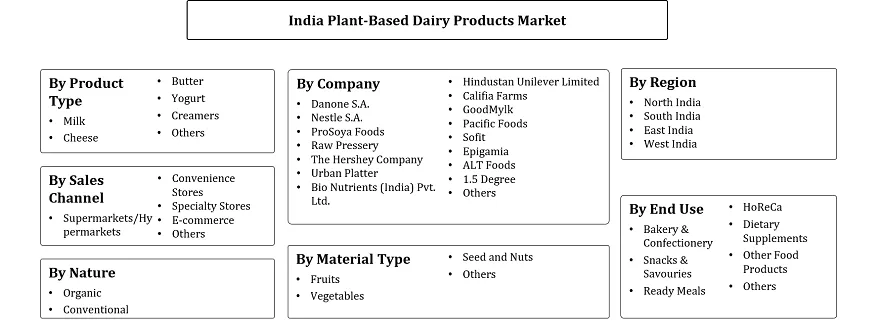
India Plant-Based Dairy Products Market Scope
| Category | Segments |
|---|---|
| By Product Type | Milk, Yogurt, Cheese, Creamers, Others |
| By Plant Source | Fruits, Vegetables, Seeds & Nuts, Others |
| By Nature | Organic, Conventional |
| By Distribution Channel | Supermarkets & Hypermarkets, Convenience Stores, Specialty Stores, Online Retail, Foodservice, Others |
| By End User | Household Consumption, Foodservice & HoReCa, Food Processing Industry, Others |
India Plant-Based Dairy Products Market Growth Driver
Rising Prevalence of Lactose Intolerance and Shift Toward Dairy-Free Nutrition
The plant-based dairy products market in India is experiencing strong growth due to the increasing prevalence of lactose intolerance and dairy sensitivity, particularly across urban populations. According to the National Institute of Nutrition (ICMR-NIN, 2024), lactose malabsorption remains highly prevalent among Indian adults, with significantly reduced lactase activity observed across a large share of the population, driving dietary avoidance of conventional dairy products. This physiological trend is accelerating demand for plant-based alternatives such as soy milk, almond milk, and oat milk as functional substitutes in daily nutrition.
In response to this shift, food manufacturers are expanding dairy-free portfolios to address digestive health concerns and evolving consumer preferences. In 2024, multiple Indian FMCG and health-focused brands expanded offerings in plant-based beverages and yogurt alternatives, targeting lactose-sensitive and flexitarian consumers in metro cities. This is further strengthening the adoption of plant-based milk alternatives, vegan yogurt, and dairy-free nutrition solutions, positioning them as mainstream dietary components rather than niche health products.
- Market Segmentation
- Introduction
- Product Definition
- Research Process
- Assumptions
- Executive Summary
- India Plant-Based Dairy Products Market Trends (2022–2032)
- India Plant-Based Dairy Production Trend by Product Type
- Plant-Based Milk
- Plant-Based Yogurt
- Plant-Based Cheese
- Plant-Based Creamers
- Plant-Based Ice Cream & Frozen Desserts
- India Plant-Based Dairy Production Trend by Product Type
- India Plant-Based Dairy Products Pricing Analysis (2022–2032)
- India Plant-Based Dairy Products Pricing Trend (2022–2032)
- India Plant-Based Dairy Products Pricing Trend by Product Type (2022–2032)
- Plant-Based Milk
- Plant-Based Yogurt
- Plant-Based Cheese
- Plant-Based Creamers
- India Plant-Based Dairy Products Market Policies, Regulations & Product Standards
- India Plant-Based Dairy Products Market Trends & Developments
- India Plant-Based Dairy Products Market Dynamics
- Growth Drivers
- Challenges
- India Plant-Based Dairy Products Market Hotspots & Opportunities
- India Plant-Based Dairy Products Market Outlook, 2022–2032
- Market Size & Outlook
- By Revenue (USD Million)
- Market Segmentation & Outlook
- By Product Type– Market Size & Forecast, 2022–2032, USD Million
- Milk
- Yogurt
- Cheese
- Creamers
- Others
- By Plant Source– Market Size & Forecast, 2022–2032, USD Million
- Fruits
- Vegetables
- Seeds & Nuts
- Others
- By Nature– Market Size & Forecast, 2022–2032, USD Million
- Organic
- Conventional
- By Distribution Channel– Market Size & Forecast, 2022–2032, USD Million
- Supermarkets & Hypermarkets
- Convenience Stores
- Specialty Stores
- Online Retail
- Foodservice
- Others
- By End User – Market Size & Forecast, 2022–2032, USD Million
- Household Consumption
- Foodservice & HoReCa
- Food Processing Industry
- Others
- By Region
- North India
- South India
- East India
- West India
- By Company
- Competition Characteristics
- Market Segmentation & Outlook
- By Product Type– Market Size & Forecast, 2022–2032, USD Million
- Market Size & Outlook
- India Plant-Based Milk Market Outlook, 2022–2032
- Market Size & Outlook
- By Revenue (USD Million)
- Market Segmentation & Outlook
- By Plant Source – Market Size & Forecast, 2022–2032, USD Million
- By Nature – Market Size & Forecast, 2022–2032, USD Million
- By Distribution Channel – Market Size & Forecast, 2022–2032, USD Million
- By End User – Market Size & Forecast, 2022–2032, USD Million
- By Region– Market Size & Forecast, 2022–2032, USD Million
- Market Size & Outlook
- India Plant-Based Yogurt Market Outlook, 2022–2032
- Market Size & Outlook
- By Revenue (USD Million)
- Market Segmentation & Outlook
- By Plant Source – Market Size & Forecast, 2022–2032, USD Million
- By Nature – Market Size & Forecast, 2022–2032, USD Million
- By Distribution Channel – Market Size & Forecast, 2022–2032, USD Million
- By End User – Market Size & Forecast, 2022–2032, USD Million
- By Region– Market Size & Forecast, 2022–2032, USD Million
- Market Size & Outlook
- India Plant-Based Cheese Market Outlook, 2022–2032
- Market Size & Outlook
- By Revenue (USD Million)
- Market Segmentation & Outlook
- By Plant Source – Market Size & Forecast, 2022–2032, USD Million
- By Nature – Market Size & Forecast, 2022–2032, USD Million
- By Distribution Channel – Market Size & Forecast, 2022–2032, USD Million
- By End User – Market Size & Forecast, 2022–2032, USD Million
- By Region– Market Size & Forecast, 2022–2032, USD Million
- Market Size & Outlook
- India Plant-Based Creamers Market Outlook, 2022–2032
- Market Size & Outlook
- By Revenue (USD Million)
- Market Segmentation & Outlook
- By Plant Source – Market Size & Forecast, 2022–2032, USD Million
- By Nature – Market Size & Forecast, 2022–2032, USD Million
- By Distribution Channel – Market Size & Forecast, 2022–2032, USD Million
- By End User – Market Size & Forecast, 2022–2032, USD Million
- By Region– Market Size & Forecast, 2022–2032, USD Million
- Market Size & Outlook
- India Plant-Based Dairy Products Market Key Strategic Imperatives for Success & Growth
- Competitive Outlook
- Company Profiles
- Danone S.A.
- Business Description
- Product Portfolio
- Strategic Alliances & Partnerships
- Recent Developments
- Financial Details
- Others
- Nestlé S.A.
- Business Description
- Product Portfolio
- Strategic Alliances & Partnerships
- Recent Developments
- Financial Details
- Others
- ProSoya Foods (India) Pvt. Ltd.
- Business Description
- Product Portfolio
- Strategic Alliances & Partnerships
- Recent Developments
- Financial Details
- Others
- Wingreens Farms Private Limited (Raw Pressery)
- Business Description
- Product Portfolio
- Strategic Alliances & Partnerships
- Recent Developments
- Financial Details
- Others
- The Hershey Company
- Business Description
- Product Portfolio
- Strategic Alliances & Partnerships
- Recent Developments
- Financial Details
- Others
- Urban Platter Foods Private Limited
- Business Description
- Product Portfolio
- Strategic Alliances & Partnerships
- Recent Developments
- Financial Details
- Others
- Bio Nutrients (India) Private Limited
- Business Description
- Product Portfolio
- Strategic Alliances & Partnerships
- Recent Developments
- Financial Details
- Others
- Califia Farms, LLC
- Business Description
- Product Portfolio
- Strategic Alliances & Partnerships
- Recent Developments
- Financial Details
- Others
- Hershey India Private Limited (Sofit brand)
- Business Description
- Product Portfolio
- Strategic Alliances & Partnerships
- Recent Developments
- Financial Details
- Others
- Hindustan Unilever Limited
- Business Description
- Product Portfolio
- Strategic Alliances & Partnerships
- Recent Developments
- Financial Details
- Others
- Disclaimer
MarkNtel Advisors follows a robust and iterative research methodology designed to ensure maximum accuracy and minimize deviation in market estimates and forecasts. Our approach combines both bottom-up and top-down techniques to effectively segment and quantify various aspects of the market. A consistent feature across all our research reports is data triangulation, which examines the market from three distinct perspectives to validate findings. Key components of our research process include:
1. Scope & Research Design At the outset, MarkNtel Advisors define the research objectives and formulate pertinent questions. This phase involves determining the type of research—qualitative or quantitative—and designing a methodology that outlines data collection methods, target demographics, and analytical tools. They also establish timelines and budgets to ensure the research aligns with client goals.
2. Sample Selection and Data Collection In this stage, the firm identifies the target audience and determines the appropriate sample size to ensure representativeness. They employ various sampling methods, such as random or stratified sampling, based on the research objectives. Data collection is carried out using tools like surveys, interviews, and observations, ensuring the gathered data is reliable and relevant.
3. Data Analysis and Validation Once data is collected, MarkNtel Advisors undertake a rigorous analysis process. This includes cleaning the data to remove inconsistencies, employing statistical software for quantitative analysis, and thematic analysis for qualitative data. Validation steps are taken to ensure the accuracy and reliability of the findings, minimizing biases and errors.

4. Data Forecast and FinalizationThe final phase involves forecasting future market trends based on the analyzed data. MarkNtel Advisors utilize predictive modeling and time series analysis to anticipate market behaviors. The insights are then compiled into comprehensive reports, featuring visual aids like charts and graphs, and include strategic recommendations to inform client decision-making
FILL THE FORM TO INQUIRE BEFORE BUYING THIS REPORT
We offer flexible licensing options to cater to varying organizational needs. Choose the pricing pack that best suits your requirements:
Buy Now Talk to our Consultant
 Request Customization