

By Production Technology (Membrane Cell Process, Diaphragm Cell Process, Mercury Cell Process), By Supply Form (Liquefied Chlorine, Gaseous Chlorine), By Distribution Mode (Pipelin......e Supply, Ton Containers, Cylinders, Bulk Tankers), By Application (Water & Wastewater Treatment, Ethylene Dichloride (EDC) Production, Organic Chemicals Manufacturing, Inorganic Chemicals Manufacturing, Pulp & Paper Bleaching, Disinfection & Sanitization, Others), By End User (Chemical Industry, Water & Wastewater Utilities, Pulp & Paper Industry, Pharmaceutical Industry, Textile Industry, Electronics & Semiconductor Industry, Metallurgical Industry, Others), and others Read more
- Chemicals
- Aug 2026
- 125
- PDF, Excel, PPT
India Chlorine Gas Market Key Takeaways
- India chlorine gas market size was valued at USD 1.12 billion in 2025 and is projected to grow from USD 1.31 billion in 2026 to USD 2.37 billion by 2032.
- The industry is projected to reflect sustain growth at a steady CAGR of 10.39% during 2026-2032.
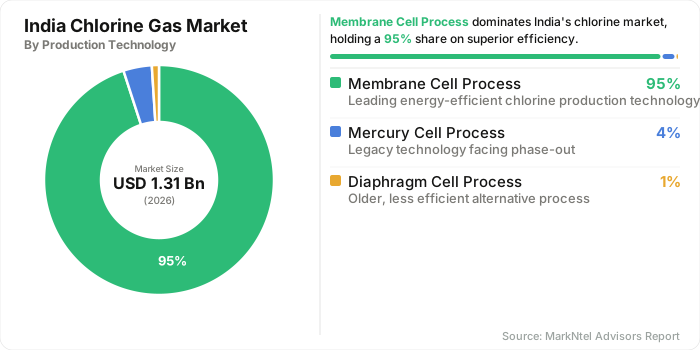
- By production technology, membrane cell process holds a significant share of about 95% in 2026.
- By end user, chemical industry seized a significant share of about 38% in 2026.
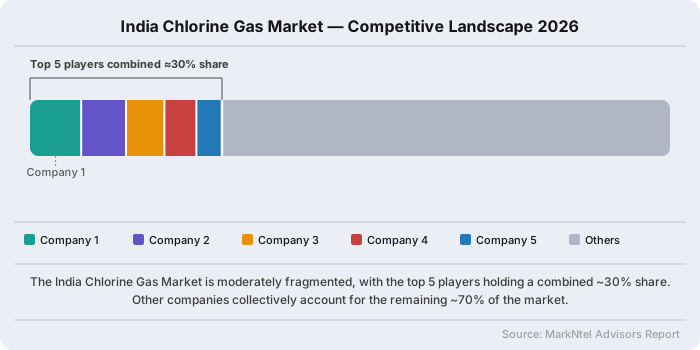
- The industry is moderately fragmented. However, the top five players collectively account for nearly 30% share.
India Chlorine Gas Market Size and Outlook
The chlorine gas market size in India was valued at USD 1.12 billion in 2025 and is projected to grow from USD 1.31 billion in 2026 to USD 2.37 billion by 2032. Along with this, the market is estimated to grow at a CAGR of around 10.39% during the forecast period, i.e., 2026-32.
The market is expected to experience sustained growth, driven by expanding demand from water treatment, pharmaceuticals, PVC manufacturing, pulp and paper, textiles, and specialty chemicals. Chlorine remains an indispensable industrial chemical for water disinfection and the production of chlorinated intermediates, while rapid urbanization and industrialization continue to support consumption. Government initiatives such as Jal Jeevan Mission and AMRUT 2.0 are expanding access to safe drinking water and modern sanitation infrastructure, increasing the requirement for chlorine-based water treatment chemicals across municipalities and industries.
The market outlook is further supported by the expansion of downstream chlorine derivatives and specialty chemical manufacturing. In January 2026, DCM Shriram Limited announced progress on its greenfield epichlorohydrin (ECH) plant, along with investments in aluminium chloride and calcium chloride production facilities. These projects enable greater utilization of chlorine within high-value downstream products instead of merchant sales, improving profitability, strengthening domestic specialty chemical manufacturing, and reducing dependence on imported intermediates. Such investments are expected to increase demand for chlorine while enhancing value addition across the chlor-alkali value chain.
Another factor shaping the market is India's increasing focus on sustainable and energy-efficient chlor-alkali production. Under the Carbon Credit Trading Scheme (CCTS), the chlor-alkali sector has been assigned a 3.09% greenhouse gas emissions intensity reduction target for FY2025–26, encouraging manufacturers to adopt cleaner production technologies and improve operational efficiency. Simultaneously, rising investments in PVC, agrochemicals, pharmaceuticals, and water treatment chemicals are expected to support long-term chlorine consumption. With continued industrial investments, downstream integration, and supportive environmental policies, the India chlorine gas market is well positioned for stable and sustainable growth over the forecast period.
India Chlorine Gas Market Key Indicators
- India’s chlorine production reached 4.448 million tonnes in FY2024–25, rising from 4.087 million tonnes in FY2023–24, an increase of approximately 8.8%. This growth indicates an expanding production base and stronger output from India’s chlor-alkali industry. Chlorine is produced mainly as a co-product of caustic soda manufacturing and is subsequently consumed in PVC, chemical intermediates, water treatment, pharmaceuticals, and other industries. Rising production is therefore an important indicator of the expanding supply base and industrial demand for chlorine.
- India’s caustic soda capacity reached 6.404 million tonnes per annum in FY2024–25, according to AMAI. Because chlorine is generated as a co-product during chlor-alkali electrolysis, expansion of caustic soda capacity directly influences the potential availability of chlorine. This makes the chlor-alkali capacity base one of the most important structural indicators for the chlorine market. Growth in caustic soda production facilities can therefore increase chlorine supply and encourage downstream chemical integration.
- India produced 5.020 million tonnes of caustic soda in FY2024–25, with 78.4% capacity utilization, according to the Alkali Manufacturers Association of India (AMAI). The source also reports installed caustic soda capacity of 6.404 million tonnes per annum as of 31 March 2025. Because caustic soda and chlorine are co-products of the chlor-alkali process, the scale of caustic soda production provides an important indicator of the industrial system generating chlorine.
- PVC is an important downstream indicator for chlorine demand because chlorine is used to produce ethylene dichloride (EDC) and vinyl chloride monomer (VCM), which are key intermediates in PVC manufacturing. According to AMAI, India had 1.636 million tonnes of installed PVC capacity and produced 1.536 million tonnes in FY2024–25, representing 94% capacity utilization. This strong production base supports chlorine demand through PVC-related value chains, including pipes, cables, construction materials, and infrastructure applications.
- Water disinfection remains an important application for chlorine and chlorine-based chemicals. The Government of India’s Jal Jeevan Mission states that drinking-water disinfection is generally carried out using gaseous chlorine or chlorine compounds and recommends adjusting post-chlorination to maintain approximately 0.2–0.5 mg/L of residual chlorine at the consumer end. As India expands drinking-water supply and treatment infrastructure, chlorine-based disinfection remains an important tool for pathogen control and maintaining water safety.
India Chlorine Gas Market Scope
| Category | Segments |
|---|---|
| By Production Technology | Membrane Cell Process, Diaphragm Cell Process, Mercury Cell Process |
| By Supply Form | Liquefied Chlorine, Gaseous Chlorine |
| By Distribution Mode | Pipeline Supply, Ton Containers, Cylinders, Bulk Tankers |
| By Application | Water & Wastewater Treatment, Ethylene Dichloride (EDC) Production, Organic Chemicals Manufacturing, Inorganic Chemicals Manufacturing, Pulp & Paper Bleaching, Disinfection & Sanitization, Others |
| By End User | Chemical Industry, Water & Wastewater Utilities, Pulp & Paper Industry, Pharmaceutical Industry, Textile Industry, Electronics & Semiconductor Industry, Metallurgical Industry, Others |
India Chlorine Gas Market Growth Drivers
Expanding Municipal Water and Wastewater Treatment Infrastructure Accelerates Chlorine Gas Demand in India
The expansion of municipal water and wastewater treatment infrastructure is strengthening demand for chlorine gas in India because chlorine remains an important disinfectant for treating drinking water and controlling pathogens in sewage-treatment systems. Government investment is rapidly expanding this demand base. In March 2025, the Ministry of Housing and Urban Affairs reported that AMRUT 2.0 had approved 592 sewerage and septage projects worth approximately USD 8.0 billion, covering 6,739 MLD of new or augmented sewage-treatment capacity, including 2,093 MLD for recycling and reuse.
The pipeline of future infrastructure will further support chlorine consumption. Under the Namami Gange Programme, India had taken up projects to create or rehabilitate 6,173 MLD of STP capacity, with the National Mission for Clean Ganga targeting 7,000 MLD of cumulative treatment capacity by December 2026. Additionally, the 2025 government update recorded 15 new sewerage projects sanctioned for 329 MLD and 11 projects completed for 359 MLD during the year.
Consequently, the continued expansion of municipal water purification, sewage treatment, recycling, and river-cleaning infrastructure will create sustained institutional demand for chlorine gas. As treatment capacity expands beyond 2025, chlorine gas consumption is expected to increase alongside India’s long-term water-security and sanitation investments.
Recent Trends
Transition Toward Energy-Efficient Membrane Cell Electrolysis Technology
The India chlorine gas market is increasingly shifting toward membrane cell electrolysis technology, as manufacturers focus on improving energy efficiency, reducing emissions, and complying with stringent environmental regulations. Chlorine gas is produced as a co-product during the electrolysis of brine to manufacture caustic soda, making the choice of production technology critical to overall plant economics. Compared with older diaphragm and mercury cell processes, membrane cell technology consumes significantly less electricity, delivers higher-purity chlorine and caustic soda, and eliminates the environmental risks associated with mercury use. As electricity accounts for nearly 50–60% of chlor-alkali production costs, producers are prioritizing investments in modern membrane-cell systems to improve competitiveness and lower operating expenses.
A key example of this trend is TGV SRAAC Limited's expansion project announced in July 2025, under which the company awarded thyssenkrupp nucera a contract to expand its chlor-alkali plant in Kurnool, Andhra Pradesh. The project will increase caustic soda production capacity by 50%, from 1,000 tonnes per day (TPD) to 1,500 TPD, using thyssenkrupp nucera's advanced BiTAC® membrane electrolysis technology. Once operational, the facility is expected to produce approximately 500,000 tonnes of caustic soda annually, while proportionally increasing chlorine gas output for downstream applications such as PVC manufacturing, water treatment, pharmaceuticals, and specialty chemicals.
The adoption of energy-efficient membrane technology not only strengthens domestic chlorine production capacity but also supports India's long-term sustainability goals by lowering electricity consumption, reducing greenhouse gas emissions, and improving overall operational reliability across the chlor-alkali industry.
India Chlorine Gas Market Opportunities and Challenges
Chlorine Leakage Risks Drive Demand for Safer On-Site Disinfection and Handling Technologies
The high toxicity of chlorine gas is a major challenge for India’s chlorine gas market because accidental leaks can endanger workers and nearby communities, while the safe storage, transportation, and use of chlorine require specialized infrastructure and emergency-response systems. For instance, in September 2025, a chlorine gas leak from a sewage-treatment plant in Chandrapur, Maharashtra, caused severe respiratory distress among hundreds of residents. At least 12 people were hospitalized, while approximately 400 families were evacuated to temporary shelters. The incident highlights the serious safety risks associated with chlorine handling at treatment facilities.
However, this challenge is creating an opportunity for safer, decentralized, and automated disinfection technologies. The need to reduce exposure to bulk chlorine gas can encourage municipalities and industrial users to adopt on-site electrochlorination, automated dosing, real-time leak detection, remote monitoring, and emergency scrubber systems. For example, a decentralized electrochlorination pilot near Pune demonstrated a solar-powered system capable of serving approximately 6,000 people and treating 300 m³ of water per day, while maintaining an average residual chlorine level of 0.1 mg/L at the farthest tap. This demonstrates how on-site generation can provide effective disinfection while reducing dependence on bulk chlorine storage and transportation
Consequently, chlorine’s toxicity and leakage risks can accelerate investments in safer chlorine-management technologies, creating a technology-driven opportunity that supports innovation and growth across India’s chlorine gas market ecosystem.
Segmentation Insights
Membrane Cell Process Dominates with Nearly 95% Revenue Share Due to Superior Efficiency and Cleaner Production
The membrane cell process holds nearly 95% share of India’s chlorine gas industry revenue, primarily because it is the dominant technology used in the country’s chlor-alkali industry. The process offers high operational efficiency, produces high-purity chlorine and caustic soda, and avoids the mercury contamination associated with mercury-cell technology. It also generally provides better energy performance and supports compliance with stricter environmental and safety requirements, making it the preferred choice for both existing plant modernization and new capacity additions.
India’s chlor-alkali producers have increasingly adopted membrane-based electrolysis to improve productivity and reduce the environmental burden associated with older technologies. The technology is particularly important because chlorine is produced as a co-product of caustic soda manufacturing, meaning that the expansion and modernization of chlor-alkali facilities directly supports chlorine availability.
Consequently, the strong installed base of membrane-cell technology, combined with continued investments in efficient chlor-alkali production, reinforces its leading position in India’s Chlorine Gas industry. Its dominance is expected to continue as producers priorities energy efficiency, cleaner production, and capacity expansion. Based on production technology, the scope has been segmented into:
- Membrane Cell Process
- Diaphragm Cell Process
- Mercury Cell Process
Chemical Industry Holds a Dominant 38% Share Due to Extensive Downstream Applications
The chemical industry holds the dominant position in India’s Chlorine Gas market, accounting for an estimated 38% share, because chlorine is a critical feedstock for numerous high-volume chemical manufacturing processes. It is widely used to produce ethylene dichloride (EDC) and polyvinyl chloride (PVC), as well as hydrochloric acid, chloromethanes, chlorinated solvents, and other chemical intermediates. Chlorine is also an important input for pharmaceutical ingredients, agrochemicals, dyes, pigments, and specialty chemicals.
The segment’s dominance is further strengthened by the integrated structure of India’s chlor-alkali industry, where chlorine is generated alongside caustic soda and is often consumed by downstream chemical units located near production facilities. This integration helps reduce the need to transport and store Chlorine Gas over long distances because of its hazardous nature.
Consequently, continued expansion of PVC, construction chemicals, pharmaceuticals, agrochemicals, and specialty chemical manufacturing is expected to sustain strong industrial demand for chlorine. The broad diversity of chemical applications therefore keeps the chemical industry as the largest end-user segment. Based on end user, the market is categorized into
- Chemical Industry
- Water & Wastewater Utilities
- Pulp & Paper Industry
- Pharmaceutical Industry
- Textile Industry
- Electronics & Semiconductor Industry
- Metallurgical Industry
- Others
India Chlorine Gas Market Competitive Analysis
The India chlorine gas market is moderately fragmented, with the top five companies Grasim Industries Limited, Gujarat Alkalies and Chemicals Limited, DCM Shriram Limited, Chemplast Sanmar Limited, and Meghmani Finechem Limited collectively accounting for approximately 30% of the market revenue.
Major Companies in India Chlorine Gas Industry
- Grasim Industries Limited
- Gujarat Alkalies and Chemicals Limited
- DCM Shriram Limited
- Chemplast Sanmar Limited
- Meghmani Finechem Limited
- DCW Limited
- Epigral Limited
- Nirma Limited
- The Andhra Sugars Limited
- Chemfab Alkalis Limited
- Others
India Chlorine Gas Industry News and Recent Developments:
2025: Indian Peroxide Announces New Chlor-Alkali Plant
Indian Peroxide announced a 400 tonnes-per-day chlor-alkali plant at its Dahej, Gujarat, manufacturing complex in December 2025. The facility is scheduled for commissioning by October 2026 and is designed for future expansion to 800 tonnes per day. The project will add new domestic chlor-alkali production capacity and increase the potential supply of chlorine as a co-product.
Impact Analysis: The new 400 TPD chlor-alkali plant strengthens India's domestic production base by increasing future availability of chlorine and caustic soda for downstream industries. The project is expected to reduce dependence on imported chlor-alkali products, support growing demand from water treatment, PVC, and chemical manufacturing sectors, and improve regional supply reliability. Its planned expansion to 800 TPD also provides long-term scalability to meet rising industrial consumption.
July 2025: TGV SRAAC Awards Chlor-Alkali Expansion Contract to thyssenkrupp nucera
In July 2025, TGV SRAAC awarded thyssenkrupp nucera a contract to expand its chlor-alkali facility in Kurnool, Andhra Pradesh. The project will increase caustic soda production capacity by 50%, from 1,000 TPD to 1,500 TPD, using the company's energy-efficient BiTAC® membrane electrolysis technology. As chlorine gas is co-produced during caustic soda manufacturing, the expansion will significantly increase domestic chlorine availability for PVC, water treatment, and industrial chemical applications while improving energy efficiency and operational sustainability.
Impact Analysis: The capacity expansion reinforces India's chlor-alkali manufacturing capabilities by increasing chlorine availability through higher caustic soda production. The adoption of advanced membrane electrolysis technology improves energy efficiency and lowers operating costs while supporting sustainability goals. The additional chlorine output will benefit downstream industries such as PVC, water treatment, pharmaceuticals, and specialty chemicals, helping meet rising domestic demand with improved production efficiency.
September 2025: DCM Shriram and Aarti Industries Sign Long-Term Chlorine Supply Partnership
In September 2025, DCM Shriram and Aarti Industries entered a long-term strategic agreement to supply chlorine to Aarti's upcoming chemical complex in Jhagadia, Gujarat. The collaboration includes the construction of a dedicated underground chlorine pipeline, enabling Aarti to increase chlorine procurement from 150 TPD to approximately 350 TPD. The project enhances safe chlorine transportation, strengthens downstream specialty chemical manufacturing, and improves chlorine utilization across India's chlor-alkali value chain.
Impact Analysis: The long-term supply partnership improves integration across India's chlor-alkali value chain by ensuring a secure and efficient chlorine supply for downstream specialty chemical production. The dedicated pipeline minimizes transportation risks associated with chlorine handling while lowering logistics costs. Increased chlorine utilization also enhances operational efficiency for producers and supports the expansion of high-value chemical manufacturing within the domestic market.
- Market Segmentation
- Introduction
- Product Definition
- Research Process
- Assumptions
- Executive Summary
- India Chlorine Gas Market Policies, Regulations, and Product Standards
- India Chlorine Gas Market Trends & Developments
- India Chlorine Gas Market Dynamics
- Growth Factors
- Challenges
- India Chlorine Gas Market Value Chain Analysis
- India Chlorine Gas Market Production Capacity & Plant Expansion Analysis
- India Chlorine Gas Market Import & Export Analysis
- India Chlorine Gas Market Hotspot & Opportunities
- India Chlorine Gas Market Outlook, 2022-2032
- Market Size & Outlook
- By Revenues (USD Million)
- By Quantity Sold (Thousand Tons)
- Market Segmentation & Outlook
- By Production Technology- Market Size & Forecast 2022-2032, USD Million & Thousand Tons
- Membrane Cell Process
- Diaphragm Cell Process
- Mercury Cell Process
- By Supply Form- Market Size & Forecast 2022-2032, USD Million & Thousand Tons
- Liquefied Chlorine
- Gaseous Chlorine
- By Distribution Mode- Market Size & Forecast 2022-2032, USD Million & Thousand Tons
- Pipeline Supply
- Ton Containers
- Cylinders
- Bulk Tankers
- By Application- Market Size & Forecast 2022-2032, USD Million & Thousand Tons
- Water & Wastewater Treatment
- Ethylene Dichloride (EDC) Production
- Organic Chemicals Manufacturing
- Inorganic Chemicals Manufacturing
- Pulp & Paper Bleaching
- Disinfection & Sanitization
- Others
- By End User- Market Size & Forecast 2022-2032, USD Million & Thousand Tons
- Chemical Industry
- Water & Wastewater Utilities
- Pulp & Paper Industry
- Pharmaceutical Industry
- Textile Industry
- Electronics & Semiconductor Industry
- Metallurgical Industry
- Others
- By Region
- North
- South
- East
- West
- By Company
- Competition Characteristics
- Market Share & Analysis
- By Production Technology- Market Size & Forecast 2022-2032, USD Million & Thousand Tons
- Market Size & Outlook
- India Chlorine Gas Market for Water & Wastewater Treatment Outlook, 2022-2032
- Market Size & Outlook
- By Revenues (USD Million)
- By Quantity Sold (Thousand Tons)
- Market Segmentation & Outlook
- By Production Technology- Market Size & Forecast 2022-2032, USD Million & Thousand Tons
- By Supply Form- Market Size & Forecast 2022-2032, USD Million & Thousand Tons
- By Distribution Mode- Market Size & Forecast 2022-2032, USD Million & Thousand Tons
- By Application- Market Size & Forecast 2022-2032, USD Million & Thousand Tons
- By End User- Market Size & Forecast 2022-2032, USD Million & Thousand Tons
- Market Size & Outlook
- India Chlorine Gas Market for Ethylene Dichloride (EDC) Production Outlook, 2022-2032
- Market Size & Outlook
- By Revenues (USD Million)
- By Quantity Sold (Thousand Tons)
- Market Segmentation & Outlook
- By Production Technology- Market Size & Forecast 2022-2032, USD Million & Thousand Tons
- By Supply Form- Market Size & Forecast 2022-2032, USD Million & Thousand Tons
- By Distribution Mode- Market Size & Forecast 2022-2032, USD Million & Thousand Tons
- By Application- Market Size & Forecast 2022-2032, USD Million & Thousand Tons
- By End User- Market Size & Forecast 2022-2032, USD Million & Thousand Tons
- Market Size & Outlook
- India Chlorine Gas Market Organic Chemicals Manufacturing Outlook, 2022-2032
- Market Size & Outlook
- By Revenues (USD Million)
- By Quantity Sold (Thousand Tons)
- Market Segmentation & Outlook
- By Production Technology- Market Size & Forecast 2022-2032, USD Million & Thousand Tons
- By Supply Form- Market Size & Forecast 2022-2032, USD Million & Thousand Tons
- By Distribution Mode- Market Size & Forecast 2022-2032, USD Million & Thousand Tons
- By Application- Market Size & Forecast 2022-2032, USD Million & Thousand Tons
- By End User- Market Size & Forecast 2022-2032, USD Million & Thousand Tons
- Market Size & Outlook
- India Chlorine Gas Market Inorganic Chemicals Manufacturing Outlook, 2022-2032
- Market Size & Outlook
- By Revenues (USD Million)
- By Quantity Sold (Thousand Tons)
- Market Segmentation & Outlook
- By Production Technology- Market Size & Forecast 2022-2032, USD Million & Thousand Tons
- By Supply Form- Market Size & Forecast 2022-2032, USD Million & Thousand Tons
- By Distribution Mode- Market Size & Forecast 2022-2032, USD Million & Thousand Tons
- By Application- Market Size & Forecast 2022-2032, USD Million & Thousand Tons
- By End User- Market Size & Forecast 2022-2032, USD Million & Thousand Tons
- Market Size & Outlook
- India Chlorine Gas Market for Pulp & Paper Bleaching Outlook, 2022-2032
- Market Size & Outlook
- By Revenues (USD Million)
- By Quantity Sold (Thousand Tons)
- Market Segmentation & Outlook
- By Production Technology- Market Size & Forecast 2022-2032, USD Million & Thousand Tons
- By Supply Form- Market Size & Forecast 2022-2032, USD Million & Thousand Tons
- By Distribution Mode- Market Size & Forecast 2022-2032, USD Million & Thousand Tons
- By Application- Market Size & Forecast 2022-2032, USD Million & Thousand Tons
- By End User- Market Size & Forecast 2022-2032, USD Million & Thousand Tons
- Market Size & Outlook
- India Chlorine Gas Market for Disinfection & Sanitization Outlook, 2022-2032
- Market Size & Outlook
- By Revenues (USD Million)
- By Quantity Sold (Thousand Tons)
- Market Segmentation & Outlook
- By Production Technology- Market Size & Forecast 2022-2032, USD Million & Thousand Tons
- By Supply Form- Market Size & Forecast 2022-2032, USD Million & Thousand Tons
- By Distribution Mode- Market Size & Forecast 2022-2032, USD Million & Thousand Tons
- By Application- Market Size & Forecast 2022-2032, USD Million & Thousand Tons
- By End User- Market Size & Forecast 2022-2032, USD Million & Thousand Tons
- Market Size & Outlook
- India Chlorine Gas Market Key Strategic Imperatives for Success & Growth
- Competitive Outlook
- Company Profiles
- Grasim Industries Limited
- Business Description
- Product Portfolio
- Collaborations & Alliances
- Recent Developments
- Financial Details
- Others
- Gujarat Alkalies and Chemicals Limited
- Business Description
- Product Portfolio
- Collaborations & Alliances
- Recent Developments
- Financial Details
- Others
- DCM Shriram Limited
- Business Description
- Product Portfolio
- Collaborations & Alliances
- Recent Developments
- Financial Details
- Others
- Chemplast Sanmar Limited
- Business Description
- Product Portfolio
- Collaborations & Alliances
- Recent Developments
- Financial Details
- Others
- Meghmani Finechem Limited
- Business Description
- Product Portfolio
- Collaborations & Alliances
- Recent Developments
- Financial Details
- Others
- DCW Limited
- Business Description
- Product Portfolio
- Collaborations & Alliances
- Recent Developments
- Financial Details
- Others
- Epigral Limited
- Business Description
- Product Portfolio
- Collaborations & Alliances
- Recent Developments
- Financial Details
- Others
- Nirma Limited
- Business Description
- Product Portfolio
- Collaborations & Alliances
- Recent Developments
- Financial Details
- Others
- The Andhra Sugars Limited
- Business Description
- Product Portfolio
- Collaborations & Alliances
- Recent Developments
- Financial Details
- Others
- Chemfab Alkalis Limited
- Business Description
- Product Portfolio
- Collaborations & Alliances
- Recent Developments
- Financial Details
- Others
- Others
- Grasim Industries Limited
- Company Profiles
- Disclaimer

MarkNtel Advisors follows a robust and iterative research methodology designed to ensure maximum accuracy and minimize deviation in market estimates and forecasts. Our approach combines both bottom-up and top-down techniques to effectively segment and quantify various aspects of the market. A consistent feature across all our research reports is data triangulation, which examines the market from three distinct perspectives to validate findings. Key components of our research process include:
1. Scope & Research Design At the outset, MarkNtel Advisors define the research objectives and formulate pertinent questions. This phase involves determining the type of research—qualitative or quantitative—and designing a methodology that outlines data collection methods, target demographics, and analytical tools. They also establish timelines and budgets to ensure the research aligns with client goals.
2. Sample Selection and Data Collection In this stage, the firm identifies the target audience and determines the appropriate sample size to ensure representativeness. They employ various sampling methods, such as random or stratified sampling, based on the research objectives. Data collection is carried out using tools like surveys, interviews, and observations, ensuring the gathered data is reliable and relevant.
3. Data Analysis and Validation Once data is collected, MarkNtel Advisors undertake a rigorous analysis process. This includes cleaning the data to remove inconsistencies, employing statistical software for quantitative analysis, and thematic analysis for qualitative data. Validation steps are taken to ensure the accuracy and reliability of the findings, minimizing biases and errors.

4. Data Forecast and FinalizationThe final phase involves forecasting future market trends based on the analyzed data. MarkNtel Advisors utilize predictive modeling and time series analysis to anticipate market behaviors. The insights are then compiled into comprehensive reports, featuring visual aids like charts and graphs, and include strategic recommendations to inform client decision-making
FILL THE FORM TO INQUIRE BEFORE BUYING THIS REPORT
We offer flexible licensing options to cater to varying organizational needs. Choose the pricing pack that best suits your requirements:
Buy Now Talk to our Consultant
 Request Customization