

By Component (Hardware, Software, Services), By AI Technology (Machine Learning (ML), Deep Learning, Computer Vision, Natural Language Processing (NLP), Generative AI), By Vehicle......Autonomy Level (Level 0 (No Automation), Level 1 (Driver Assistance), Level 2 (Partial Automation), Level 3 (Conditional Automation), Level 4 (High Automation), Level 5 (Full Automation)), By Vehicle Type (Passenger Vehicles, Light Commercial Vehicles (LCVs), Heavy Commercial Vehicles (HCVs), Buses & Coaches, Robotaxis & Autonomous Shuttles, Off-Highway Vehicles), By Propulsion Type (Internal Combustion Engine (ICE) Vehicles, Hybrid Electric Vehicles (HEVs), Plug-in Hybrid Electric Vehicles (PHEVs), Battery Electric Vehicles (BEVs), Fuel Cell Electric Vehicles (FCEVs)), By Connectivity Type (Connected Vehicles, Non-Connected Vehicles), By Sales Channel (OEM (Integrated AI Systems), Aftermarket AI Solutions), By Application (Advanced Driver Assistance Systems (ADAS), Autonomous Driving, Driver & Occupant Monitoring Systems, Intelligent Infotainment Systems, Predictive Maintenance, Fleet Management & Route Optimization, Insurance Telematics & Risk Analytics, Energy & Battery Management, Cybersecurity & Threat Detection, Vehicle Personalization & Recommendation Systems), By End User (Automotive OEMs, Tier-1 Automotive Suppliers, Mobility-as-a-Service (MaaS) Providers, Fleet Operators, Insurance Companies), and others Read more
- Automotive
- May 2026
- 150
- PDF, Excel, PPT
India Automotive AI Market Key Takeaways
- The India Automotive AI market size was valued at USD 0.82 billion in 2025 and is projected to grow from USD 0.97 billion in 2026 to USD 2.66 billion by 2032, with a CAGR of 18.31% estimated for the period 2026–2032.
- A significant share of approximately 38% is held by the computer vision segment within AI technology.
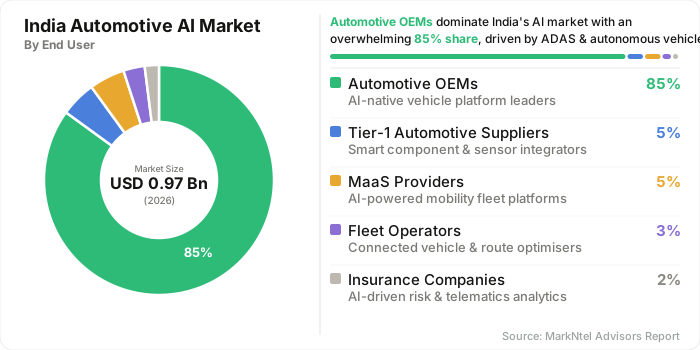
- A substantial share of nearly 85% in 2026 has been captured by the automotive OEMs segment by end user.
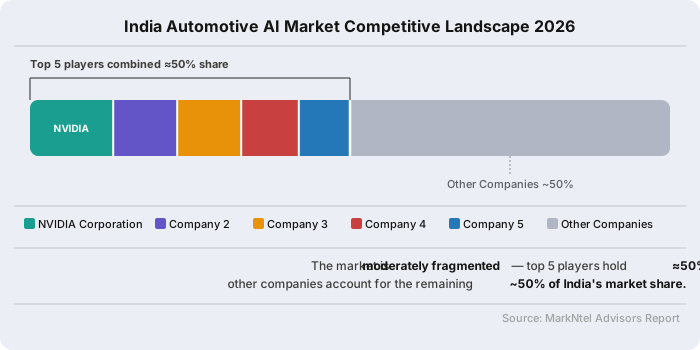
- The industry is considered to be moderately fragmented, with nearly 50% of the total market share being collectively accounted for by the top five players.
India Automotive AI Market Size and Outlook
The India Automotive AI Industry is anticipated to expand at a CAGR of approximately 18.31% during 2026–2032, supported by increasing integration of advanced technologies and the expanding digital transformation of the automotive ecosystem.
India’s position as the world’s third-largest automobile market, with a total industry size of USD 185.75 billion in 2025 provides a strong commercial foundation for AI adoption. The scale of production and sales enables cost-efficient deployment of intelligent systems, accelerating the adoption of AI-powered mobility intelligence across both domestic and export-oriented manufacturing.
Rising consumer preference for premium and feature-rich vehicles is further strengthening this trend. According to the Society of Indian Automobile Manufacturers, utility vehicles accounted for nearly 65% of passenger vehicle sales in 2024, highlighting a structural shift toward vehicles equipped with advanced driver assistance systems and connected technologies .
Export competitiveness is also playing a critical role in shaping market expansion. Passenger vehicle exports reached approximately 0.77 million units in 2024, pushing manufacturers to adopt AI-driven quality control, smart manufacturing, and predictive analytics to meet global standards . Simultaneously, the two-wheeler segment, with sales of 19.6 million units, is creating new opportunities for AI telematics solutions, particularly in rider behavior analytics, smart navigation, and connected vehicle ecosystems.
Government initiatives are further accelerating AI integration, as the Production Linked Incentive scheme, with an outlay of USD 3.61 billion, is promoting advanced automotive technologies, including EV control systems and intelligent components.
Furthermore, safety-driven regulations are also acting as a major growth factor, as it was found that nearly 170,000 annual road fatalities were reported by the Ministry of Road Transport and Highways, which is mandating AI-enabled ADAS features for commercial vehicles starting in 2026. This regulatory push is accelerating the adoption of intelligent safety systems and reinforcing the role of AI in improving road safety outcomes.
In parallel, collaborations such as the expansion of AI solutions by Tata Consultancy Services with NVIDIA are advancing automotive AI software providers, enabling the deployment of digital twins, computer vision systems, and autonomous simulation technologies across manufacturing operations.
In conclusion, the convergence of large-scale automotive production, evolving consumer preferences, strong export performance, policy support, and safety regulations is positioning the India Automotive AI Industry for sustained growth, with the market projected to expand from USD 0.97 billion in 2026 to USD 2.66 billion by 2032, alongside continued expansion expected throughout the forecast period.
India Automotive AI Market Key Indicators
- Data released by the Society of Indian Automobile Manufacturers (SIAM) shows that total vehicle production across passenger vehicles, two-wheelers, three-wheelers, and quadricycles reached 1.92 million units in December 2024 . This high-volume manufacturing ecosystem strengthens the foundation for scalable deployment of AI technologies, reinforcing growth across the India Automotive AI Market as OEMs integrate intelligence into production and vehicle systems.
- India’s passenger vehicle sales touched an all-time high of 4.3 million units in 2024, as reported by the Society of Indian Automobile Manufacturers . This milestone is pushing automakers to embed advanced digital capabilities such as ADAS and connected systems, accelerating the evolution of the India Connected Vehicle AI Market through enhanced safety features and intelligent driving experiences.
- The Government of India approved the IndiaAI Mission with a total allocation of approximately USD 1.25 billion, as reported by the Press Information Bureau. This investment focuses on building large-scale AI compute infrastructure, including over 10,000 GPUs, significantly improving access to high-performance computing and accelerating innovation within the India Automotive AI Software Market.
- As highlighted in the Economic Survey 2025, nationwide 5G rollout across 779 districts by October 2024 has created a robust digital backbone for next-generation mobility. This extensive connectivity enables real-time data exchange, supporting V2X communication and over-the-air updates, thereby strengthening the India Smart Mobility AI Industry through seamless integration of AI-driven vehicle intelligence and cloud-based automotive systems.
- India’s 5G ecosystem continued to expand rapidly, reaching over 518,000 base stations and surpassing 400 million subscribers by early 2026 , as per data presented by the Ministry of Communications. Such dense network coverage enables high-speed data transmission essential for real-time analytics, directly benefiting the India Intelligent Mobility Market by supporting AI-powered fleet management and connected mobility platforms.
- According to the National Association of Software and Service Companies (NASSCOM), digital technologies are projected to account for 40% of India’s manufacturing expenditure by 2025 . This structural shift highlights the growing reliance on intelligent systems, driving adoption within the India AI in the Automotive Industry across production lines, supply chains, and aftermarket service optimization.
India Automotive AI Market Scope
| Category | Segments |
|---|---|
| By Component | Hardware, Software, Services |
| By AI Technology | Machine Learning (ML), Deep Learning, Computer Vision, Natural Language Processing (NLP), Generative AI |
| By Vehicle Autonomy Level | Level 0 (No Automation), Level 1 (Driver Assistance), Level 2 (Partial Automation), Level 3 (Conditional Automation), Level 4 (High Automation), Level 5 (Full Automation |
| By Vehicle Type | Passenger Vehicles, Light Commercial Vehicles (LCVs), Heavy Commercial Vehicles (HCVs), Buses & Coaches, Robotaxis & Autonomous Shuttles, Off-Highway Vehicles |
| By Propulsion Type | Internal Combustion Engine (ICE) Vehicles, Hybrid Electric Vehicles (HEVs), Plug-in Hybrid Electric Vehicles (PHEVs), Battery Electric Vehicles (BEVs), Fuel Cell Electric Vehicles (FCEVs |
| By Connectivity Type | Connected Vehicles, Non-Connected Vehicles |
| By Sales Channel | OEM (Integrated AI Systems), Aftermarket AI Solutions |
| By Application | Advanced Driver Assistance Systems (ADAS), Autonomous Driving, Driver & Occupant Monitoring Systems, Intelligent Infotainment Systems, Predictive Maintenance, Fleet Management & Route Optimization, Insurance Telematics & Risk Analytics, Energy & Battery Management, Cybersecurity & Threat Detection, Vehicle Personalization & Recommendation Systems |
| By End User | Automotive OEMs, Tier-1 Automotive Suppliers, Mobility-as-a-Service (MaaS) Providers, Fleet Operators, Insurance Companies |
India Automotive AI Market Growth Drivers
Rising EV Adoption in the Automotive Industry
The rapid expansion of the electric vehicle market in India is emerging as a major catalyst for AI deployment across the automotive ecosystem. According to the Society of Indian Automobile Manufacturers, total EV registrations reached 1.97 million units in 2024, reflecting a 16.9% year-on-year increase, while electric passenger vehicle registrations surpassed 100,000 units. This surge is significantly accelerating the integration of intelligent technologies such as AI-based battery management systems, predictive diagnostics, and autonomous assistance.
In parallel, electric two-wheeler registrations rose sharply by 21.2% to approximately 1.15 million units during the same period . This high-volume electrification segment is pushing manufacturers to embed advanced analytics for energy optimization, route intelligence, and connected operations, thereby strengthening the broader connected vehicle ecosystem in India.
Supporting this momentum, the Government of India is advancing domestic battery manufacturing through the Advanced Chemistry Cell (ACC) Production Linked Incentive (PLI) scheme, with an allocation of approximately USD 2.2 billion. This initiative is fostering localized battery ecosystems that generate large-scale operational data, creating strong foundations for AI in EV battery management systems in India and predictive maintenance capabilities.
The convergence of EV adoption, policy support, and data-driven infrastructure is accelerating the integration of AI across India’s automotive landscape, positioning electric mobility as a key enabler of next-generation intelligent transportation systems.
Recent Trends
Integration of Generative AI Transforming In-Vehicle User Experience
The integration of generative artificial intelligence and advanced language models is redefining how drivers interact with vehicles, shifting automotive human-machine interfaces (HMI) from basic command systems to intelligent conversational platforms.
Increasing consumer demand for seamless, intuitive, and context-aware interactions is accelerating the adoption of generative AI in the automotive industry, particularly in next-generation infotainment and digital cockpit environments. Unlike traditional rule-based voice assistants, modern AI systems enable multi-turn conversations, contextual understanding, and real-time responsiveness, significantly enhancing the overall driving experience.
A major development reinforcing this trend was observed when Mercedes-Benz Group AG partnered with Google Cloud to expand the deployment of an advanced Automotive AI Agent integrated into the MBUX Virtual Assistant. Built using Gemini on Vertex AI, the system supports dynamic conversational navigation, real-time information retrieval across over 250 million global points of interest, and persistent contextual memory throughout a journey . This innovation highlights the rapid evolution of automotive NLP systems in India and intelligent voice-enabled interfaces within connected vehicles.
As automakers continue to prioritize personalized digital experiences, the rise of AI-powered assistants is becoming central to differentiation strategies, further advancing AI-powered infotainment systems in India across both premium and mass-market segments.
The emergence of generative AI-driven conversational interfaces is transforming in-vehicle experiences, establishing intelligent HMI systems as a critical trend shaping the future of India's automotive AI market.
India Automotive AI Market Opportunities and Challenges
Regulatory Compliance Driving Secure Automotive AI Systems
The Digital Personal Data Protection Act, 2023, is significantly increasing compliance requirements across India’s Automotive AI Market, impacting OEMs, telematics providers, and mobility platforms. Connected vehicles continuously process sensitive data such as location, driving patterns, and voice inputs, necessitating explicit user consent, strict data usage limitations, and robust security frameworks. The regulation imposes penalties of up to approximately USD 30 million per violation, compelling companies to redesign data architectures and strengthen cybersecurity systems. This is intensifying automotive AI data privacy concerns, as organizations must balance regulatory compliance with seamless data-driven functionalities, leading to higher operational and technological costs.
At the same time, these regulatory developments are creating opportunities for innovation in privacy-focused AI systems. Automakers are increasingly adopting decentralized processing models, enabling real-time data analysis within vehicles and reducing reliance on cloud-based infrastructure. This transition is accelerating the adoption of automotive edge AI, particularly for applications such as driver monitoring and ADAS.
A notable example is the 2026 launch of an AI-enabled Cognitive Digital Twin platform by Tata Consulting Engineers, showcasing the rise of simulation-driven automotive intelligence. These advancements are further supporting AI cybersecurity in connected cars.
In summary, while data protection regulations raise compliance complexity, they are also driving the evolution of secure, decentralized automotive AI solutions in India.
Segmentation Insights
Computer Vision Leading Automotive AI Technology
Computer vision contributes approximately 38% of the total revenue in the India Automotive AI market, establishing it as the leading AI technology segment. Its dominance is largely driven by the increasing deployment of vision-based systems across safety, driver assistance, and semi-autonomous functionalities. It enables real-time processing of visual inputs from cameras and sensors, allowing vehicles to interpret complex road environments, detect obstacles, and enhance driver awareness with high accuracy.
A notable instance reinforcing this dominance is the introduction of Level 2 ADAS features by Mahindra & Mahindra in its Scorpio-N model. The system incorporates functionalities such as lane keep assist, traffic sign recognition, adaptive cruise control, and automatic emergency braking, all of which rely extensively on automotive computer vision in India. Such advancements highlight how automakers are prioritizing perception-based intelligence to improve safety standards and driving efficiency.
The rising adoption of camera-driven ADAS solutions is also supporting the expansion of AI-powered ADAS systems in India, particularly as regulatory focus on vehicle safety intensifies. Moreover, computer vision plays a foundational role in enabling self-driving technology in India, especially in navigating complex and dynamic traffic conditions.
The strong alignment of computer vision with safety-critical applications and real-time decision-making continues to reinforce its leading position within India’s automotive AI industry. Based on AI technology, the scope has been classified into:
- Machine Learning (ML)
- Deep Learning
- Computer Vision
- Natural Language Processing (NLP)
- Generative AI
Automotive OEMs Dominate the End User Vertical
Automotive OEMs account for approximately 85% of the total revenue share in the India Automotive AI industry, making them the dominant end-user segment. Their leadership is supported by continuous investments in connected mobility, software-defined vehicle architectures, and AI-enabled digital ecosystems.
OEMs are increasingly integrating intelligent technologies across infotainment, telematics, predictive diagnostics, and advanced driver assistance systems to enhance safety, personalization, and vehicle performance.
A major industry development supporting this dominance is the AI-led software-defined vehicle strategy introduced by Tata Motors in 2025. The company expanded its acti.ev architecture and Arcade.ev digital platform to enable over-the-air updates, predictive maintenance, adaptive vehicle intelligence, and connected infotainment experiences. Tata Motors stated that its EV platforms are evolving into “smart digital platforms,” reflecting the growing implementation of software-defined vehicles in India and intelligent mobility ecosystems.
In parallel, OEMs are accelerating the adoption of AI-powered infotainment systems in India to deliver personalized in-cabin experiences and connected services. The increasing deployment of cloud-connected telematics and digital cockpit technologies is also strengthening AI telematics solutions in India across passenger and electric vehicle portfolios.
The continuous investments in software-defined mobility, connected ecosystems, and AI-enabled customer experiences continue to position automotive OEMs as the leading revenue-generating end-user segment within India’s automotive AI market. The market evaluation includes the following core end-user groups:
- Automotive OEMs
- Tier-1 Automotive Suppliers
- Mobility-as-a-Service (MaaS) Providers
- Fleet Operators
- Insurance Companies
India Automotive AI Market Competitive Analysis
The India Automotive AI Industry exhibits a moderately fragmented structure, supported by the presence of global technology companies, automotive component suppliers, and a growing base of domestic innovators. These players operate across key segments, including ADAS, autonomous driving, connected vehicles, and AI-powered infotainment, forming a multi-layered ecosystem comprising semiconductor providers, Tier-1 suppliers, cloud platforms, and OEM-driven AI solutions. Leading companies such as NVIDIA Corporation, Qualcomm Incorporated, Robert Bosch GmbH, Continental AG, and Intel Corporation collectively contribute an estimated 50% of the overall market share.
Key Players in India Automotive AI Industry
- NVIDIA Corporation
- Qualcomm Incorporated
- Intel Corporation
- Robert Bosch GmbH
- Continental AG
- Aptiv PLC
- Mercedes-Benz Group AG
- ZF Friedrichshafen AG
- Microsoft Corporation
- Amazon Web Services, Inc.
- Others
India Automotive AI Industry News and Recent Developments
April 2026: JSW Motors and Tata Elxsi Launch Pune R&D Hub for AI and Connected Vehicle Solutions
JSW Motors and Tata Elxsi established the JNEXT Technology Center in Pune to develop AI-powered, software-defined, and connected mobility solutions for new-energy vehicles. The facility focuses on digital twins, cloud-based vehicle platforms, predictive maintenance, 5G-enabled systems, and intelligent customer experience applications for next-generation EVs.
Impact Analysis: The development strengthens India’s automotive AI ecosystem by accelerating localization of software-defined vehicle technologies and connected mobility platforms. It enhances domestic R&D capabilities in AI-enabled vehicle engineering, supports EV innovation, and positions India as a growing hub for intelligent mobility solutions. The initiative is also expected to boost the adoption of AI-driven diagnostics, predictive maintenance, and over-the-air vehicle software systems across future automotive platforms.
February 2026: Mobileye Leads ADAS Show 2026 at Launch of India’s First Dedicated ADAS Test City
Mobileye partnered with the Automotive Research Association of India (ARAI) during the launch of India’s first dedicated ADAS Test City in Pune. The facility was designed for real-world testing and validation of AI-driven ADAS and autonomous driving technologies tailored specifically for Indian traffic and road environments.
Impact Analysis: The launch significantly improves India’s autonomous mobility testing infrastructure and supports the development of India-specific AI safety systems. It enables OEMs and technology firms to validate ADAS solutions under local driving conditions involving mixed traffic, pedestrians, potholes, and two-wheelers. The initiative is expected to accelerate commercialization of AI-powered safety technologies and encourage the broader deployment of intelligent driving systems in Indian vehicles.
January 2026: Matter Announces India’s First AI-Defined Vehicle Platform for Electric Two-Wheelers
Matter introduced India’s first AI-Defined Vehicle (AIDV) platform during Technology Day 3.0. The platform integrates artificial intelligence into core vehicle architecture for real-time performance optimization, energy management, predictive diagnostics, rider safety, and adaptive vehicle intelligence across future electric motorcycles and scooters.
Impact Analysis: The launch marks a major transition toward software-centric and AI-native electric mobility in India’s two-wheeler industry. By embedding AI directly into vehicle control systems, Matter is expanding the role of intelligent mobility beyond premium passenger vehicles into mass-market EV segments. The platform could accelerate the adoption of predictive maintenance, adaptive energy optimization, and intelligent rider-assistance technologies within India’s rapidly growing electric two-wheeler market.
- Market Segmentation
- Introduction
- Product Definition
- Research Process
- Assumptions
- Executive Summary
- India Automotive AI Market Policies, Regulations, and Product Standards
- India Automotive AI Market Trends & Developments
- India Automotive AI Market Dynamics
- Growth Factors
- Challenges
- India Automotive AI Market Hotspot & Opportunities
- F
- f
- India Automotive AI Market Outlook, 2022-2032F
- Market Size & Outlook
- By Revenues (USD Million)
- Market Share & Outlook
- By Component
- Hardware
- AI Accelerators & Automotive SoCs
- GPUs / NPUs / Edge AI Chips
- Sensors
- Cameras
- Radar
- LiDAR
- Ultrasonic Sensors
- High-Performance Computing (HPC) Units
- Software
- Perception Software
- Autonomous Driving Software Stack
- AI Middleware & Operating Systems
- Predictive Analytics Software
- Generative AI & In-Vehicle AI Assistant Software
- Services
- AI System Integration
- Simulation & Validation Services
- OTA (Over-the-Air) Update Services
- Consulting & Support Services
- Hardware
- By AI Technology
- Machine Learning (ML)
- Deep Learning
- Computer Vision
- Natural Language Processing (NLP)
- Generative AI
- By Vehicle Autonomy Level
- Level 0 (No Automation)
- Level 1 (Driver Assistance)
- Level 2 (Partial Automation)
- Level 3 (Conditional Automation)
- Level 4 (High Automation)
- Level 5 (Full Automation)
- By Vehicle Type
- Passenger Vehicles
- Light Commercial Vehicles (LCVs)
- Heavy Commercial Vehicles (HCVs)
- Buses & Coaches
- Robotaxis & Autonomous Shuttles
- Off-Highway Vehicles
- By Propulsion Type
- Internal Combustion Engine (ICE) Vehicles
- Hybrid Electric Vehicles (HEVs)
- Plug-in Hybrid Electric Vehicles (PHEVs)
- Battery Electric Vehicles (BEVs)
- Fuel Cell Electric Vehicles (FCEVs)
- By Connectivity Type
- Connected Vehicles
- Non-Connected Vehicles
- By Sales Channel
- OEM (Integrated AI Systems)
- Aftermarket AI Solutions
- By Application
- Advanced Driver Assistance Systems (ADAS)
- Autonomous Driving
- Driver & Occupant Monitoring Systems
- Intelligent Infotainment Systems
- Predictive Maintenance
- Fleet Management & Route Optimization
- Insurance Telematics & Risk Analytics
- Energy & Battery Management
- Cybersecurity & Threat Detection
- Vehicle Personalization & Recommendation Systems
- By End User
- Automotive OEMs
- Tier-1 Automotive Suppliers
- Mobility-as-a-Service (MaaS) Providers
- Fleet Operators
- Insurance Companies
- By Region
- North
- South
- East
- West
- By Company
- Competition Characteristics
- Market Share & Analysis
- By Component
- Market Size & Outlook
- India Machine Learning (ML) Market Outlook, 2022-2032
- Market Size & Outlook
- By Revenues (USD Million)
- Market Share & Outlook
- By AI Technology
- By Vehicle Autonomy Level
- By Vehicle Type
- By Propulsion Type
- By Connectivity Type
- By Sales Channel
- By Application
- By End User
- By Region
- Market Size & Outlook
- India Deep Learning Market Outlook, 2022-2032
- Market Size & Outlook
- By Revenues (USD Million)
- Market Share & Outlook
- By AI Technology
- By Vehicle Autonomy Level
- By Vehicle Type
- By Propulsion Type
- By Connectivity Type
- By Sales Channel
- By Application
- By End User
- By Region
- Market Size & Outlook
- India Computer Vision Market Outlook, 2022-2032
- Market Size & Outlook
- By Revenues (USD Million)
- Market Share & Outlook
- By AI Technology
- By Vehicle Autonomy Level
- By Vehicle Type
- By Propulsion Type
- By Connectivity Type
- By Sales Channel
- By Application
- By End User
- By Region
- Market Size & Outlook
- India Natural Language Processing (NLP) Market Outlook, 2022-2032
- Market Size & Outlook
- By Revenues (USD Million)
- Market Share & Outlook
- By AI Technology
- By Vehicle Autonomy Level
- By Vehicle Type
- By Propulsion Type
- By Connectivity Type
- By Sales Channel
- By Application
- By End User
- By Region
- Market Size & Outlook
- India Generative AI Market Outlook, 2022-2032
- Market Size & Outlook
- By Revenues (USD Million)
- Market Share & Outlook
- By AI Technology
- By Vehicle Autonomy Level
- By Vehicle Type
- By Propulsion Type
- By Connectivity Type
- By Sales Channel
- By Application
- By End User
- By Region
- Market Size & Outlook
- India Automotive AI Market Key Strategic Imperatives for Success & Growth
- Competitive Outlook
- Company Profiles
- NVIDIA Corporation
- Business Description
- Product Portfolio
- Collaborations & Alliances
- Recent Developments
- Financial Details
- Others
- Qualcomm Incorporated
- Business Description
- Product Portfolio
- Collaborations & Alliances
- Recent Developments
- Financial Details
- Others
- Intel Corporation
- Business Description
- Product Portfolio
- Collaborations & Alliances
- Recent Developments
- Financial Details
- Others
- Robert Bosch GmbH
- Business Description
- Product Portfolio
- Collaborations & Alliances
- Recent Developments
- Financial Details
- Others
- Continental AG
- Business Description
- Product Portfolio
- Collaborations & Alliances
- Recent Developments
- Financial Details
- Others
- Aptiv PLC
- Business Description
- Product Portfolio
- Collaborations & Alliances
- Recent Developments
- Financial Details
- Others
- Mercedes-Benz Group AG
- Business Description
- Product Portfolio
- Collaborations & Alliances
- Recent Developments
- Financial Details
- Others
- ZF Friedrichshafen AG
- Business Description
- Product Portfolio
- Collaborations & Alliances
- Recent Developments
- Financial Details
- Others
- Microsoft Corporation
- Business Description
- Product Portfolio
- Collaborations & Alliances
- Recent Developments
- Financial Details
- Others
- Amazon Web Services, Inc.
- Business Description
- Product Portfolio
- Collaborations & Alliances
- Recent Developments
- Financial Details
- Others
- Others
- NVIDIA Corporation
- Company Profiles
- Disclaimer

MarkNtel Advisors follows a robust and iterative research methodology designed to ensure maximum accuracy and minimize deviation in market estimates and forecasts. Our approach combines both bottom-up and top-down techniques to effectively segment and quantify various aspects of the market. A consistent feature across all our research reports is data triangulation, which examines the market from three distinct perspectives to validate findings. Key components of our research process include:
1. Scope & Research Design At the outset, MarkNtel Advisors define the research objectives and formulate pertinent questions. This phase involves determining the type of research—qualitative or quantitative—and designing a methodology that outlines data collection methods, target demographics, and analytical tools. They also establish timelines and budgets to ensure the research aligns with client goals.
2. Sample Selection and Data Collection In this stage, the firm identifies the target audience and determines the appropriate sample size to ensure representativeness. They employ various sampling methods, such as random or stratified sampling, based on the research objectives. Data collection is carried out using tools like surveys, interviews, and observations, ensuring the gathered data is reliable and relevant.
3. Data Analysis and Validation Once data is collected, MarkNtel Advisors undertake a rigorous analysis process. This includes cleaning the data to remove inconsistencies, employing statistical software for quantitative analysis, and thematic analysis for qualitative data. Validation steps are taken to ensure the accuracy and reliability of the findings, minimizing biases and errors.

4. Data Forecast and FinalizationThe final phase involves forecasting future market trends based on the analyzed data. MarkNtel Advisors utilize predictive modeling and time series analysis to anticipate market behaviors. The insights are then compiled into comprehensive reports, featuring visual aids like charts and graphs, and include strategic recommendations to inform client decision-making
FILL THE FORM TO INQUIRE BEFORE BUYING THIS REPORT
We offer flexible licensing options to cater to varying organizational needs. Choose the pricing pack that best suits your requirements:
Buy Now Talk to our Consultant
 Request Customization