

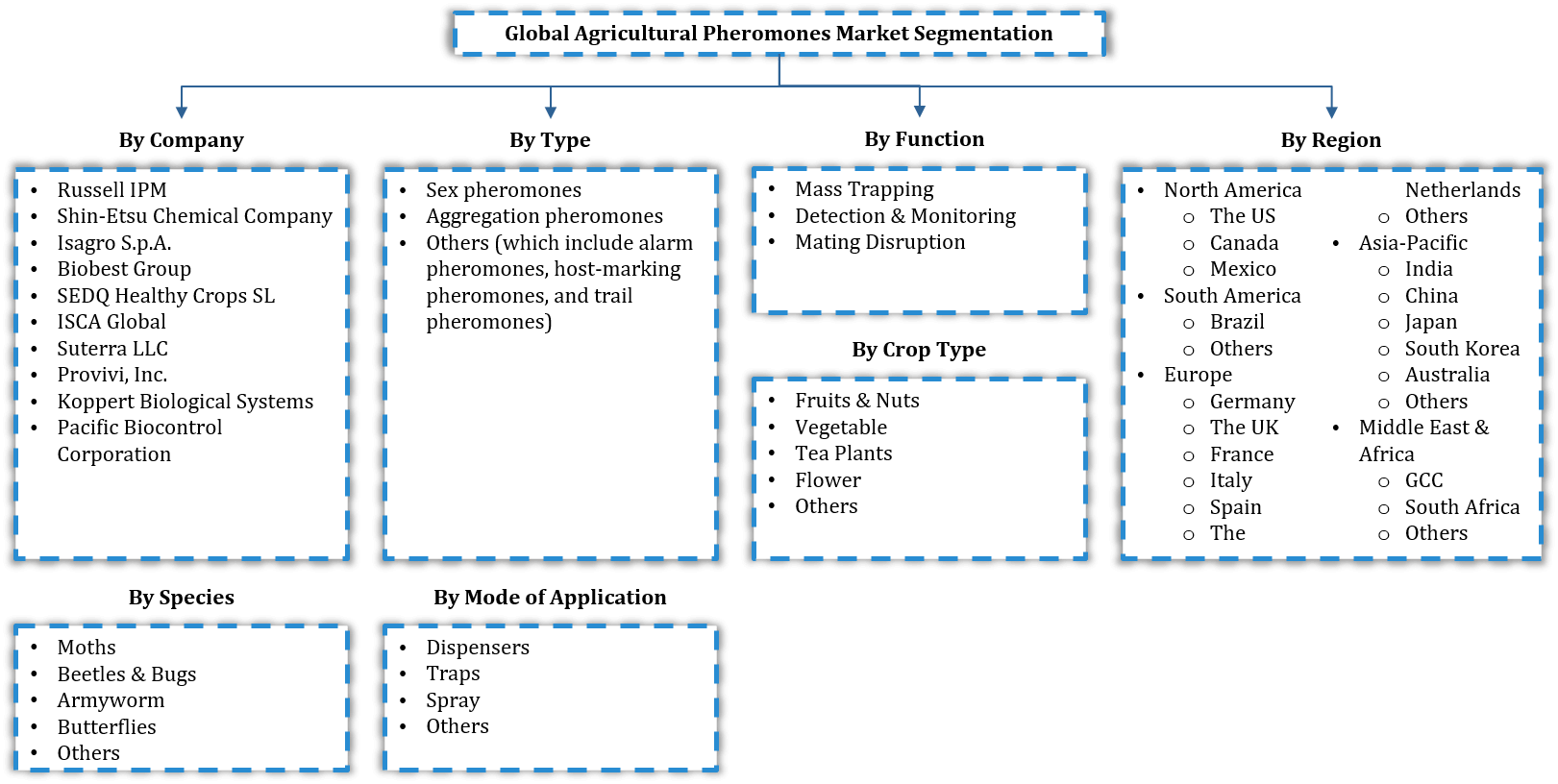
Agricultural Pheromones Market- By Type (Sex pheromones, Aggregation pheromones, Others), By Mode of Application (Dispensers, Traps, Spray, Others), By Species (Moths, Beetles & Bu......gs, Armyworm, Butterflies, Others), By Crop Type (Fruits & Nuts, Vegetable, Tea Plants, Flower, Others), By Function (Mass Trapping, Detection & Monitoring, Mating Disruption), and others Read more
- Environment
- Jan 2024
- 211
- PDF, Excel, PPT
Market Definition
Agricultural pheromones are chemical signals used by insects to communicate with each other. These pheromones are often released by an adult insect to attract a mate, mark a territory, or repel predators. They are also used to disrupt the mating habits of insect pests, such as aphids and moths, by making them less likely to reproduce. Agricultural pheromones are often used in combination with other pest control methods, such as biological control and insecticides, to maximize their effectiveness.
Market Insights & Analysis: Global Agricultural Pheromones Market (2024-30)
The Global Agricultural Pheromones Market size was valued at USD 3.5 Billion in 2022 and is projected to grow at a CAGR of around 14% during the forecast period, i.e., 2024-30. The industry is predominantly driven by the incessant need to ramp up agricultural productivity owing to the fast-growing population worldwide. Given this, the adoption of sustainable agriculture practices has surged in the past few years, including pest control usage. Factors like chronic climate change, increased crop protection product usage in fruits, vegetables, and row crops, and the negative impact of pesticides on human health have called for numerous investigations on a variety of biological, chemical, and mechanical techniques to prevent the harmful effects of pesticides and limit the further expansion of pests.
| Report Coverage | Details |
|---|---|
| Study Period | Historical Data: 2019-22 |
| Base Year: 2023 | |
| Forecast Period: 2024-30 | |
| CAGR (2024-2030) | 14% |
| Regions Covered | North America: USA, Canada, Mexico |
| Europe: Germany, UK, France, Italy, Spain, The Netherlands, Other | |
| Asia-Pacific: China, India, Japan, South Korea, Australia, Other | |
| South America: Brazil, Other | |
| Middle East & Africa: GCC, South Africa, Other | |
| Key Companies Profiled | Russell IPM, Shin-Etsu Chemical Company, Isagro S.p.A., Biobest Group, SEDQ Healthy Crops SL, ISCA Global, Suterra LLC, Provivi, Inc., Koppert Biological Systems, Pacific Biocontrol Corporation, etc. |
| Market value (2022) | USD 3.5 Billion |
The US Environmental Protection Agency (US EPA) has registered several chemical compositions for use in commercial, residential, and agricultural settings. Because of their beneficial effects on health & growing popularity, pheromones used in agriculture are increasingly being consumed. Thus leading to the augmented demand for agricultural pheromones in the historical period.
Moreover, the agricultural pheromones industry has a high potential in emerging markets, such as China and India, as the climatic conditions in the Asia-Pacific region are conducive to insect growth. Other than this, the simple accessibility of pest control goods in the nations, as mentioned earlier, has boosted the size of the Global Agricultural Pheromones Market. With technological advancements proliferating within agricultural techniques, agricultural pheromones are swiftly slithering into various pest management techniques as synthetic replicas of natural pheromones, aiding aggregation or attracting insects.
Therefore, the surging inclination toward organic agriculture due to the high demand for high-value crops and integrated pest control solutions will likely influence market growth in the forecast period. The agricultural pheromones industry, however, is being severely constrained by factors like the high cost of the active chemicals used in pheromone production, the drawn-out research and development process, and the high startup and maintenance costs incurred by farmers when setting up insect pheromone traps.
- Introduction
- Product Definition
- Research Process
- Assumptions
- Market Segmentation
- Preface
- Executive Summary
- Impact of COVID-19 on Global Agricultural Pheromones Market
- Global Agricultural Pheromones Market Outlook, 2019-2030F
- Market Size & Analysis
- Market Revenues
- Market Share & Analysis
- By Type
- Sex pheromones
- Aggregation pheromones
- Others (which include alarm pheromones, host-marking pheromones, and trail pheromones)
- By Mode of Application
- Dispensers
- Traps
- Spray
- Others
- By Species
- Moths
- Beetles & Bugs
- Armyworm
- Butterflies
- Others
- By Crop Type
- Fruits & Nuts
- Vegetable
- Tea Plants
- Flower
- Others
- By Function
- Mass Trapping
- Detection & Monitoring
- Mating Disruption
- By Region
- North America
- South America
- Europe
- Middle East & Africa
- Asia-Pacific
- By Competitors
- Competition Characteristics
- Market Share & Analysis
- Competitive Metrix
- By Type
- Market Size & Analysis
- North America Agricultural Pheromones Market Outlook, 2019-2030F
- Market Size & Analysis
- Market Revenues
- Market Share & Analysis
- By Type
- By Mode of Application
- By Species
- By Crop Type
- By Function
- By Country
- The US
- Canada
- Mexico
- The US Agricultural Pheromones Market Outlook, 2019-2030F
- Market Size & Analysis
- Market Revenues
- Market Share & Analysis
- By Type
- By Mode of Application
- Market Size & Analysis
- Canada Agricultural Pheromones Market Outlook, 2019-2030F
- Market Size & Analysis
- Market Revenues
- Market Share & Analysis
- By Type
- By Mode of Application
- Market Size & Analysis
- Mexico Agricultural Pheromones Market Outlook, 2019-2030F
- Market Size & Analysis
- Market Revenues
- Market Share & Analysis
- By Type
- By Mode of Application
- Market Size & Analysis
- Market Size & Analysis
- South America Agricultural Pheromones Market Outlook, 2019-2030F
- Market Size & Analysis
- Market Revenues
- Market Share & Analysis
- By Type
- By Mode of Application
- By Species
- By Crop Type
- By Function
- By Country
- Brazil
- Others
- Brazil Agricultural Pheromones Market Outlook, 2019-2030F
- Market Size & Analysis
- Market Revenues
- Market Share & Analysis
- By Type
- By Mode of Application
- Market Size & Analysis
- Market Size & Analysis
- Europe Agricultural Pheromones Market Outlook, 2019-2030F
- Market Size & Analysis
- Market Revenues
- Market Share & Analysis
- By Type
- By Mode of Application
- By Species
- By Crop Type
- By Function
- By Country
- Germany
- The UK
- France
- Italy
- Spain
- The Netherlands
- Others
- Germany Agricultural Pheromones Market Outlook, 2019-2030F
- Market Size & Analysis
- Market Revenues
- Market Share & Analysis
- By Type
- By Mode of Application
- Market Size & Analysis
- The UK Agricultural Pheromones Market Outlook, 2019-2030F
- Market Size & Analysis
- Market Revenues
- Market Share & Analysis
- By Type
- By Mode of Application
- Market Size & Analysis
- France Agricultural Pheromones Market Outlook, 2019-2030F
- Market Size & Analysis
- Market Revenues
- Market Share & Analysis
- By Type
- By Mode of Application
- Market Size & Analysis
- Italy Agricultural Pheromones Market Outlook, 2019-2030F
- Market Size & Analysis
- Market Revenues
- Market Share & Analysis
- By Type
- By Mode of Application
- Market Size & Analysis
- Spain Agricultural Pheromones Market Outlook, 2019-2030F
- Market Size & Analysis
- Market Revenues
- Market Share & Analysis
- By Type
- By Mode of Application
- Market Size & Analysis
- The Netherlands Agricultural Pheromones Market Outlook, 2019-2030F
- Market Size & Analysis
- Market Revenues
- Market Share & Analysis
- By Type
- By Mode of Application
- Market Size & Analysis
- Market Size & Analysis
- Middle East & Africa Agricultural Pheromones Market Outlook, 2019-2030F
- Market Size & Analysis
- Market Revenues
- Market Share & Analysis
- By Type
- By Mode of Application
- By Species
- By Crop Type
- By Function
- By Country
- GCC
- South Africa
- Others
- GCC Agricultural Pheromones Market Outlook, 2019-2030F
- Market Size & Analysis
- Market Revenues
- Market Share & Analysis
- By Type
- By Mode of Application
- Market Size & Analysis
- South Africa Agricultural Pheromones Market Outlook, 2019-2030F
- Market Size & Analysis
- Market Revenues
- Market Share & Analysis
- By Type
- By Mode of Application
- Market Size & Analysis
- Market Size & Analysis
- Asia-Pacific Agricultural Pheromones Market Outlook, 2019-2030F
- Market Size & Analysis
- Market Revenues
- Market Share & Analysis
- By Type
- By Mode of Application
- By Species
- By Crop Type
- By Function
- By Country
- China
- India
- Japan
- South Korea
- Australia
- Others
- China Agricultural Pheromones Market Outlook, 2019-2030F
- Market Size & Analysis
- Market Revenues
- Market Share & Analysis
- By Type
- By Mode of Application
- Market Size & Analysis
- India Agricultural Pheromones Market Outlook, 2019-2030F
- Market Size & Analysis
- Market Revenues
- Market Share & Analysis
- By Type
- By Mode of Application
- Market Size & Analysis
- Japan Agricultural Pheromones Market Outlook, 2019-2030F
- Market Size & Analysis
- Market Revenues
- Market Share & Analysis
- By Type
- By Mode of Application
- Market Size & Analysis
- South Korea Agricultural Pheromones Market Outlook, 2019-2030F
- Market Size & Analysis
- Market Revenues
- Market Share & Analysis
- By Type
- By Mode of Application
- Market Size & Analysis
- Australia Agricultural Pheromones Market Outlook, 2019-2030F
- Market Size & Analysis
- Market Revenues
- Market Share & Analysis
- By Type
- By Mode of Application
- Market Size & Analysis
- Market Size & Analysis
- Global Agricultural Pheromones Market Government Regulations and Policies
- Global Agricultural Pheromones Value Chain Analysis
- Global Agricultural Pheromones Market Trends & Insights
- Global Agricultural Pheromones Market Dynamics
- Growth Drivers
- Challenges
- Impact Analysis
- Global Agricultural Pheromones Market Hotspot & Opportunities
- Global Agricultural Pheromones Market Key Strategic Imperatives for Success & Growth
- Competition Outlook
- Competition Matrix
- Target Markets
- Research & Development
- Collaborations & Strategic Alliances
- Key Business Expansion Initiatives
- Business Restructuring- Mergers, Acquisitions, JVs
- Strategic Initiatives
- Company Profiles (Business Description, Product Segments, Business Segments, Financials, Strategic Alliances/ Partnerships, Future Plans)
- Russell IPM
- Shin-Etsu Chemical Company
- Isagro S.p.A.
- Biobest Group
- SEDQ Healthy Crops SL
- ISCA Global
- Suterra LLC
- Provivi, Inc.
- Koppert Biological Systems
- Pacific Biocontrol Corporation
- Competition Matrix
- Disclaimer
MarkNtel Advisors follows a robust and iterative research methodology designed to ensure maximum accuracy and minimize deviation in market estimates and forecasts. Our approach combines both bottom-up and top-down techniques to effectively segment and quantify various aspects of the market. A consistent feature across all our research reports is data triangulation, which examines the market from three distinct perspectives to validate findings. Key components of our research process include:
1. Scope & Research Design At the outset, MarkNtel Advisors define the research objectives and formulate pertinent questions. This phase involves determining the type of research—qualitative or quantitative—and designing a methodology that outlines data collection methods, target demographics, and analytical tools. They also establish timelines and budgets to ensure the research aligns with client goals.
2. Sample Selection and Data Collection In this stage, the firm identifies the target audience and determines the appropriate sample size to ensure representativeness. They employ various sampling methods, such as random or stratified sampling, based on the research objectives. Data collection is carried out using tools like surveys, interviews, and observations, ensuring the gathered data is reliable and relevant.
3. Data Analysis and Validation Once data is collected, MarkNtel Advisors undertake a rigorous analysis process. This includes cleaning the data to remove inconsistencies, employing statistical software for quantitative analysis, and thematic analysis for qualitative data. Validation steps are taken to ensure the accuracy and reliability of the findings, minimizing biases and errors.

4. Data Forecast and FinalizationThe final phase involves forecasting future market trends based on the analyzed data. MarkNtel Advisors utilize predictive modeling and time series analysis to anticipate market behaviors. The insights are then compiled into comprehensive reports, featuring visual aids like charts and graphs, and include strategic recommendations to inform client decision-making
FILL THE FORM TO INQUIRE BEFORE BUYING THIS REPORT
We offer flexible licensing options to cater to varying organizational needs. Choose the pricing pack that best suits your requirements:
Buy Now Talk to our Consultant
 Request Customization