

By Detector Type (Hardware (Handheld Detectors, Fixed Detectors, UAV-Based Detectors), Software, Services), By Technology (Optical Gas Imaging (OGI), Acoustic Detection, Laser-Base......d Detection, IoT-Based Monitoring, AI & Predictive Analytics, Drone-Based Inspection, others), By Equipment Type (Pipelines, Valves, Pumps, Compressors, Storage Tanks, Flanges & Connectors, Pressure Relief Devices), By Leak Type (Gas Leaks, Liquid Leaks, Steam Leaks, Vacuum Leaks), By End Users (Oil & Gas Industry, Chemical Plants, Water Treatment Plants, Power Plants, Mining & Slurry, Commercial, Residential, Others), and others Read more
- Buildings, Construction, Metals & Mining
- Jun 2026
- 225
- PDF, Excel, PPT
GCC Leak Detection and Repair Market Report Key Takeaways
- The GCC Leak Detection and Repair Market was valued at USD 908 million in 2025 and is projected to reach USD 1,244 million by 2032.
- The market is expected to grow from USD 956 million in 2026 at a CAGR of 4.49% through 2032, supported by regulatory compliance initiatives.
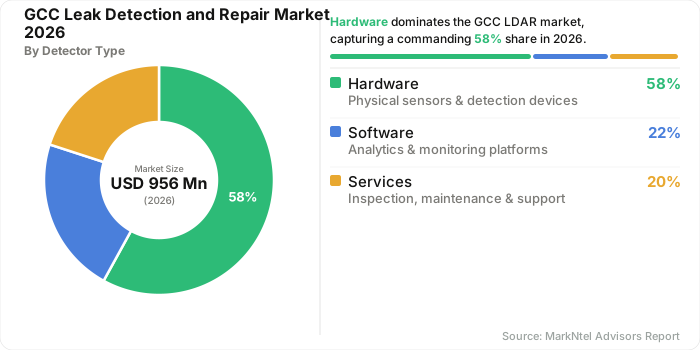
- By detector type, the hardware segment leads the market with a 58% share, driven by widespread deployment of monitoring and detection equipment.
- By technology category, optical gas imaging holds the leading position with a 33% market share, owing to its accuracy and real-time leak detection capabilities.
- Saudi Arabia dominates the GCC market with a 45% share, supported by extensive oil and gas infrastructure, emission reduction programs, and investments.
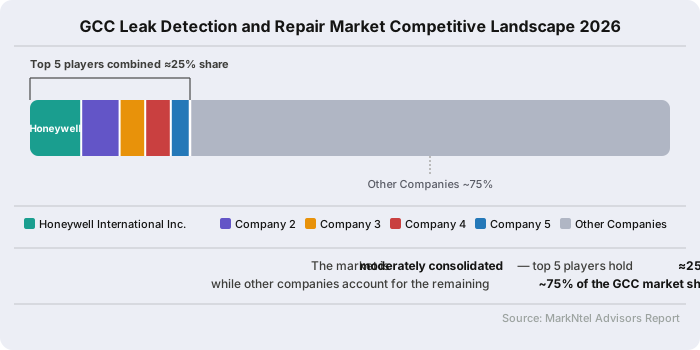
- The market exhibits a moderately consolidated structure, with the top five players collectively accounting for 25% of total market revenue in 2026.
GCC Leak Detection and Repair Market Size and Outlook
The GCC Leak Detection and Repair Market was valued at USD 908 Million in 2025, to 956 Million in 2026 and is forecast to reach USD 1244 Million by 2032, growing at a CAGR of 4.49%. This growth is firmly grounded in the region's scale of energy infrastructure investment.
The Middle East committed approximately USD 130 billion to oil and gas supply in 2025, accounting for around 15% of the global total, with Saudi Arabia's upstream spending alone reaching USD 40 billion nearly 15% above 2015 levels. Each new pipeline, compressor station, and processing facility added through this spending brings additional components that must be monitored and maintained under LDAR programs, directly expanding the equipment base that drives market demand across all six GCC member states.
Building on this infrastructure base, regulatory action is now converting what was once discretionary spending into a compliance obligation. The UAE's Federal Decree Law No. 11 of 2024 came into force on 30 May 2025, requiring all entities including those in free zones to measure, report, and reduce GHG emissions, with full compliance due by 30 May 2026 and penalties of up to AED 2 million for non-compliance.
This makes continuous leak monitoring a legal necessity, not just an operational best practice, for every industrial operator in the UAE. Additionally, the IEA's Global Methane Tracker 2025 identified LDAR as the single most cost-effective methane abatement measure in the region, noting that 95% of achievable emissions savings from LDAR would come at no net cost to operators finding that removes the financial barrier and further accelerates adoption across the region.
Moreover, leading national oil companies are already acting on these signals through measurable programs. Saudi Aramco reported an 11.4% reduction in upstream methane emissions in 2024 versus 2023, driven by its multi-layer LDAR program combining satellite, airborne, and ground-level detection technology. Furthermore, in May 2025, Honeywell inaugurated a dedicated gas detector assembly line at the Masdar Innovation Centre in Abu Dhabi, manufacturing detection solutions for the regional oil, gas, chemical, and utilities sectors a localization step that lowers procurement costs for GCC operators and supports faster deployment across facilities.
Looking ahead, export-linked methane rules are set to sustain demand well into the forecast period. The EU's Methane Regulation (EU) 2024/1787 will require GCC exporters to submit verified methane intensity data from 2028, compelling operators to build continuous monitoring systems ahead of that deadline. GCC states, including Saudi Arabia, the UAE, Qatar, and Oman, have committed under the Oil and Gas Decarbonization Charter launched at COP28 to achieve near-zero upstream methane emissions and end routine flaring by 2030. Together , these overlapping compliance timelines, combined with record capital expenditure and proven cost savings, create a durable and expanding demand base through 2032.
GCC Leak Detection and Repair Market Key Indicators
- According to Saudi Aramco, the Jafurah unconventional gas field the largest of its kind outside the United States commenced initial production in 2025 and will be supported by approximately 1,500 km of dedicated main transfer pipelines, flow lines, and gas-gathering pipelines upon full development, with lifecycle investment expected to exceed USD 100 billion by 2030. The addition of this entirely new pipeline network introduces hundreds of thousands of leak-prone components valves, flanges, compressors, and connectors that require continuous LDAR monitoring from commissioning, directly expanding the serviceable equipment base for detection and repair in Saudi Arabia.
- Aramco's Master Gas System Phase 3 expansion part of a USD 100 billion gas infrastructure program will add 4,000 km of new gas pipelines and 200 million cubic feet per day of additional transmission capacity by 2028, integrating gas from the Jafurah field into the national network. Expanding a pipeline grid at this scale multiplies the number of regulated inspection points across the Kingdom, generating proportional growth in demand for fixed and portable gas leak detection systems and scheduled LDAR survey contracts.
- According to the GCC Regional Water Authority data, GCC countries collectively account for approximately 60% of global desalination capacity, operating over 400 desalination plants across the region as of 2023, with Saudi Arabia advancing a 587 km BOOT-model transmission pipeline linking Jubail to Buraydah to move 650,000 m³ per day to inland cities. Expanding high-pressure desalinated water transmission networks across water-scarce GCC states creates a growing need for pressure-based and acoustic leak detection solutions to protect costly desalinated water from distribution losses.
GCC Leak Detection and Repair Market Scope
| Category | Segments |
|---|---|
| By Detector Type | Hardware (Handheld Detectors, Fixed Detectors, UAV-Based Detectors), Software, Services |
| By Technology | Optical Gas Imaging (OGI), Acoustic Detection, Laser-Based Detection, IoT-Based Monitoring, AI & Predictive Analytics, Drone-Based Inspection, others |
| By Equipment Type | Pipelines, Valves, Pumps, Compressors, Storage Tanks, Flanges & Connectors, Pressure Relief Devices |
| By Leak Type | Gas Leaks, Liquid Leaks, Steam Leaks, Vacuum Leaks |
| By End Users | Oil & Gas Industry, Chemical Plants, Water Treatment Plants, Power Plants, Mining & Slurry, Commercial, Residential, Others |
GCC Leak Detection and Repair Industry Growth Drivers
Rapid Expansion of GCC Petrochemical and Downstream Chemical Capacity Multiplying LDAR Equipment Base
The GCC petrochemical sector is one of the most consequential structural drivers of LDAR demand in the region, and its continued physical expansion is the primary reason the equipment base subject to mandatory leak monitoring keeps growing. Petrochemical plants house the densest concentration of LDAR-regulated components valves, pump seals, flanges, agitators, and pressure-relief devices per square kilometre of any industrial facility.
Every new cracker, polymer unit, or derivatives plant that comes online adds thousands of monitored components to the regional LDAR inventory, generating immediate demand for detection instruments, survey services, and repair execution contracts. According to the Gulf Petrochemicals and Chemicals Association (GPCA), the GCC chemical industry collectively held a total production capacity of 156.2 million tonnes as of 2024, accounting for 6% of global petrochemical production capacity, with Saudi Arabia commanding a 74.2% share of regional output.
This base is actively expanding. For instance, company’s initiatives like, Borouge jointly owned by ADNOC and Borealis is ramping up its Borouge 4 complex at Ruwais, it will add 1.4 million tonnes of polyethylene capacity and bring the total site output to 6.4 million tonnes per annum, making it the world's largest single-site polyolefin complex. Additional expansion contracts awarded in 2025 are expected to push total capacity beyond 6.6 million tonnes per annum by 2028.
Simultaneously, QatarEnergy and Chevron Phillips Chemical are executing the USD 6 billion Ras Laffan Petrochemical Project, featuring an ethane cracker with a capacity of 2.08 million tonnes per annum of ethylene the largest in the Middle East.
For market participants, this capacity build-out translates into a structurally expanding order pipeline. Each new complex requires an LDAR component inventory to be established from commissioning, followed by recurring survey cycles, repair contracts, and instrument refresh programs. Vendors with regional service infrastructure and established NOC relationships are best positioned to capture this systematic, recurring demand as GCC downstream production continues its Phase 4 expansion into crude-oil-to-chemicals and specialty derivative production through 2032.
Recent Trends
Shift from Periodic Manual Inspections to Continuous, IoT-Enabled LDAR Monitoring Across GCC Industrial Sites
GCC oil and gas operators are progressively moving away from scheduled manual inspection campaigns toward persistent, sensor-based monitoring that treats leak detection as a continuous operational function rather than a periodic compliance activity. Traditional LDAR programs relied on technicians conducting fixed-interval site surveys with handheld detectors, capturing leak conditions only at the moment of inspection and allowing fugitive emissions to accumulate undetected between visits.
Continuous monitoring systems networks of fixed IoT gas sensors installed at critical process points detect abnormal concentration patterns in real time and trigger automatic alerts the moment predefined thresholds are crossed, materially compressing the time between leak occurrence and repair.
This shift is quantifiably underway in the GCC. Dubai Electricity and Water Authority already operates over 10,000 smart sensors monitoring more than 3,000 km of pipeline with machine learning-based leak identification accuracy approaching 94%.
This trend is going to persist as GCC operators align programs with OGMP 2.0 measurement-based reporting requirements, continuous monitoring is becoming a technical prerequisite rather than an operational preference, permanently expanding demand for fixed detection infrastructure and real-time data management services across the region.
GCC Leak Detection and Repair Industry Opportunities and Challenges
Extreme Operating Temperatures Constraining Standard LDAR Sensor Accuracy, Creating Demand for Heat-Rated Detection Systems
The GCC's extreme ambient climate presents a structural challenge for standard LDAR detection equipment that constrains program reliability and raises total operational cost. Electrochemical and semiconductor gas sensors the instruments most widely deployed in fixed and portable LDAR configurations are rated for operation typically up to 40°C to 50°C.
According to the Observer Research Foundation, Dubai, Doha, and Riyadh were ranked among the cities with the most dangerous summer heat globally in 2024, with maximum temperatures projected to increase by approximately 0.6°C per decade through the end of the century, potentially exceeding 55°C under a business-as-usual scenario. At these temperatures, uncalibrated or under-specified sensors produce drift errors, false negatives, and shortened service intervals, directly undermining the detection accuracy and compliance defensibility of LDAR programs a particularly acute problem at unmanned upstream sites where manual recalibration is logistically expensive.
This constraint creates a well-defined commercial opportunity for manufacturers capable of supplying heat-resilient, high-tolerance detection systems engineered for Gulf operating conditions. For instance, in 2025, the two companies began local assembly of MSA's General Monitors S5000 Gas Monitors at Sherbiny's Al-Khobar facility, approved under Saudi Aramco's In-Kingdom Total Value Add (IKTVA) program. The initiative has already achieved over 51% localization for integrated safety systems, with a target of 70% by 2027, and the S5000 incorporates MSA's TruCal® and Adaptive Environmental Compensation (AEC) technologies that extend calibration intervals up to 24 months and provide real-time drift correction directly addressing the sensor-degradation challenge posed by GCC heat conditions.
Therefore, the GCC's extreme heat conditions, while constraining standard sensor reliability, are accelerating demand for climate-adapted, locally assembled LDAR detection systems aligned with regional NOC procurement frameworks. Vendors that invest in heat-rated technology and localization programs are best positioned to capture durable, compliance-driven procurement cycles across the region's growing industrial base.
Segmentation Analysis
Hardware Leads as the Dominant Component in the GCC Leak Detection and Repair Market
Hardware accounts for approximately 58% of the GCC Leak Detection and Repair market in 2026, reflecting the foundational role of physical detection instruments in every regulatory inspection cycle, continuous monitoring installation, and emergency response program across the region's oil, gas, and petrochemical facilities.
Within hardware, handheld detectors hold the leading position due to GCC LDAR compliance protocols require technicians to survey individual regulated components valves, flanges, pump seals, and connectors one by one, a workflow that demands portable, multi-gas capable instruments above all else.
For instance, In April 2025, MSA Safety launched the ALTAIR io360, a wireless four-gas area monitor featuring a 50–60 day battery runtime, IP68 weather resistance, and cloud connectivity via the Safety io Grid platform, specifically designed for perimeter and oil and gas site monitoring and actively marketed to Middle Eas t customers through MSA's regional portal.
This development reflects a broader industry move toward connected hardware that combines the portability of handheld instruments with continuous data transmission, enabling GCC operators to bridge the gap between periodic manual surveys and real-time monitoring without deploying separate fixed infrastructure. As NOC procurement frameworks increasingly require digital emissions records, demand for connected hardware platforms will sustain hardware's segment leadership through 2032. By detector type the market is divided into following sub-categories:
- Hardware
- Handheld Detectors
- Fixed Detectors
- UAV-Based Detectors
- Software
- Services
Optical Gas Imaging Leads as the Dominant Detection Technology in the GCC Leak Detection and Repair industry
Optical Gas Imaging (OGI) holds the leading position in the GCC leak detection and repair market by technology with a market share of 33% as it is the only detection method that visualizes hydrocarbon and methane plumes in real time without requiring direct contact with equipment a critical operational advantage across GCC refineries, gas plants, and petrochemical complexes where component density per site is exceptionally high.
OGI allows a single technician to survey large numbers of regulated components per shift, making it the most cost-effective method for meeting the survey frequency obligations embedded in OGMP 2.0 Level 3 and above reporting tiers. In July 2024, Emerson's Rosemount Incus Ultrasonic Gas Leak Detector gained renewed regional traction, specifically addressing the GCC's extreme-heat challenge: the device operates across –40°C to +85°C, covers a 40-metre detection radius through four independent acoustic sensors, and requires no field calibration for its operational lifetime directly solving the sensor-drift and recalibration cost problems that limit conventional OGI and electrochemical instruments at unmanned outdoor GCC sites.
Together, OGI's unmatched visualisation capability, its alignment with measurement-based compliance frameworks, and the emergence of complementary acoustic and IoT-enabled sub-segments signal a technology landscape that is broadening rather than replacing its core instrument ensuring OGI retains segment leadership while driving cumulative hardware and software spending upward across GCC industrial assets through 2032. By technology category the market is further segmented into following sub-categories:
- Optical Gas Imaging (OGI)
- Acoustic Detection
- Laser-Based Detection
- IoT-Based Monitoring
- AI & Predictive Analytics
- Drone-Based Inspection
- others
GCC Leak Detection and Repair Industry Geographical Analysis
Saudi Arabia holds approximately 45% of the GCC Leak Detection and Repair market in 2026, a position underpinned by the sheer scale and density of its hydrocarbon infrastructure the largest LDAR-regulated asset base in the region by a wide margin. Saudi Aramco manages over various number of oil and gas fields and operates six major gas processing facilities across the Kingdom, with total gas processing capacity reaching approximately 19.6 billion standard cubic feet per day as of end-2025.
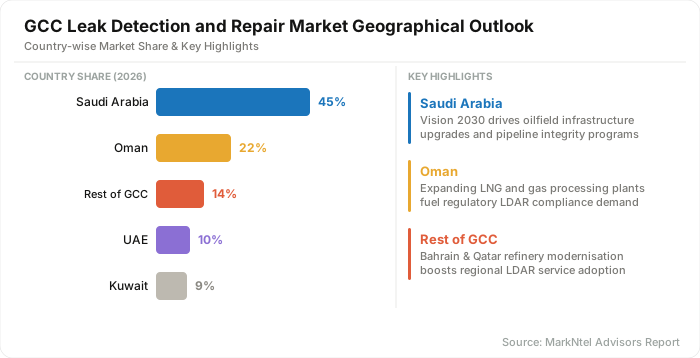
This infrastructure footprint translates directly into the region's densest concentration of LDAR-monitored components valves, flanges, compressors, pump seals, and connectors generating the highest per-country volume of detection surveys, repair contracts, and instrument procurement across the GCC. At the country level, Saudi Aramco's Fadhili gas plant is undergoing a capacity expansion from 2.5 billion cubic feet per day, with contracts awarded in April 2024 for commissioning by end-2027.
Simultaneously, the Tanajib gas plant entered service in December 2025 with a raw gas processing capacity target of 2.6 billion cubic feet per day in 2026, adding a new , fully operational processing complex to Saudi Arabia's LDAR inventory.
Looking ahead, Aramco's pipeline of 110 projects between 2024 and 2026 comprising 67 oil, gas, and petrochemical developments, 20 pipeline construction projects, and 23 infrastructure investments ensures that Saudi Arabia's LDAR equipment base will continue expanding at a rate unmatched by any other GCC member state through the forecast horizon .
As new gas processing facilities come online, existing assets undergo capacity expansions, and NOC procurement frameworks increasingly mandate localized, continuous detection programs, Saudi Arabia will remain the primary demand engine for Leak detection and repair equipment, inspection services, and digital monitoring solutions across the GCC Leak detection and Repair Industry during forecast period of 2032.
GCC Leak Detection and Repair Industry Competitive Landscape
The GCC Leak Detection and Repair market exhibits a moderately consolidated structure, characterized by the presence of large multinational technology providers, specialized leak detection equipment manufacturers, and regional engineering/service companies. With top 5 players Honeywell, Emerson Electric Co., Teledyne FLIR, Pure Technologies (Xylem), PipeTech Saudi Arabia sharing a combined share of 25%.
Major Companies in GCC leak and Repair Industry:
- International Aramoon
- Blue Gold Technology
- PipeTech Saudi Arabia
- Arabian Technical Solutions
- Supreme International
- Dutco Tennant LLC (Water Leak Detection Technologies)
- VackerGlobal (Vacker UAE) – Gas Leak Detection Technologies
- Pure Technologies (Xylem KSA)
- Teledyne FLIR
- Ion Science
- Honeywell
- Bacharach
- Emerson Electric Co.
- Agilent Technologies
- ClampOn AS
GCC Leak Detection and Repair Industry News and Recent Developments
2024: MSA Safety Secures Major Gas Detection Contract with Leading Middle East Oil Producer
MSA Safety secured a significant contract in Q4 2024 to supply fixed and portable gas detection systems to a leading oil producer in the Middle East, supporting large-scale safety upgrades across multiple facilities. The contract covers deployment of MSA's fixed and portable gas detection portfolio including the General Monitors S5000 Gas Monitor featuring TruCal® and Adaptive Environmental Compensation (AEC) sensor technologies that extend calibration intervals to up to 24 months and provide real-time drift correction across an undisclosed number of sites operated by the regional NOC. MSA's Middle East presence is further reinforced by its Al-Khobar assembly facility, operating under Saudi Aramco's IKTVA program, which achieved over 51% localization for integrated safety systems in 2025 with a target of 70% by 2027, enabling faster delivery and regional technical support across GCC customer sites.
Impact analysis: MSA Safety's combination of a major regional supply contract and an IKTVA-compliant local assembly infrastructure positions it as one of the most deeply embedded international gas detection suppliers in the GCC, with a structural supply chain advantage that import-only competitors cannot readily replicate. The contract establishes a precedent for large-scale, multi-facility fixed and portable gas detector procurement by GCC NOCs — a procurement model that, if adopted across other regional operators, would significantly accelerate demand for connected, heat-rated detection hardware aligned with the region's tightening emissions compliance requirements.
2025: Baker Hughes Deploys Cordant APM Suite Across Saudi Aramco's Master Gas System Booster Stations
Baker Hughes secured a multi-year contract with China Petroleum Engineering & Construction Corporation (CPECC), acting on behalf of Saudi Aramco, to deploy its Cordant™ Asset Performance Management (APM) suite across four Booster Gas Compression Stations (BGCS) in Saudi Arabia the first enterprise deployment of Cordant in the Kingdom. The award, booked in Q2 2025, covers three APM modules Asset Health, Asset Strategy, and Asset Defect Elimination applied to gas compression infrastructure supporting the Master Gas System Phase 3, a 4,000 km pipeline expansion. The Cordant platform uses AI and physics-based analytics to deliver predictive maintenance insights and prescriptive repair strategies, with the stated objective of reducing unplanned downtime and extending equipment life across critical gas processing assets. The contract builds on an earlier 2024 Baker Hughes award to supply 17 centrifugal compressors for the same Master Gas System Phase 3 expansion.
Impact Analysis: The deployment of AI-driven asset performance management across Saudi Arabia's primary gas transmission backbone directly expands the addressable scope of predictive leak detection across the Kingdom's most heavily monitored gas infrastructure. By embedding digital defect elimination into Aramco's standard operations at four BGCS facilities, Baker Hughes establishes a replicable commercial model that links predictive maintenance with LDAR-adjacent leak prevention strengthening its competitive positioning in the GCC's rapidly growing digital oilfield services segment and setting a precedent that rival operators across the UAE, Qatar, and Kuwait are likely to benchmark against.
2025: Bridger Photonics Launches Drone-Based Gas Mapping LiDAR for Offshore and LNG Facility Inspection
Bridger Photonics expanded its Gas Mapping LiDAR® (GML) system from crewed aircraft to drone-based deployment, specifically targeting offshore oil and gas platforms, LNG export terminals, and remote gas distribution infrastructure environments previously underserved by aerial methane monitoring due to restricted airspace, safety perimeters, and logistics constraints. The drone-based GML system retains the same high-resolution, quantitative methane detection and localization capability as its aircraft-borne predecessor, delivering near-instantaneous data return and enabling operators to minimize on-site personnel exposure in hazardous environments. The system supports OGMP 2.0 reporting workflows and generates audit-ready, quantified emissions data at the component level. Bridger's GML technology received formal EPA approval in January 2025 as an Alternative Test Method under the NSPS OOOOb standard, confirming detection thresholds at 1 kg/hr through 15 kg/hr at 90% probability of detection.
Impact analysis: Bridger's drone-based GML system expands the commercially viable perimeter of aerial LDAR inspection into offshore and LNG environments that are directly relevant to GCC operators particularly for Qatar's offshore gas fields and the UAE's offshore ADNOC assets, where conventional aircraft-based surveys face access restrictions. EPA OOOOb approval provides a regulatory benchmark that GCC NOCs operating under OGMP 2.0 or EU Methane Regulation-aligned MRV frameworks can reference when qualifying the technology for their own verification programs, lowering adoption barriers and accelerating procurement cycles across the region.
- Market Segmentation
- Introduction
- Product Definition
- Research Process
- Assumptions
- Executive Summary
- GCC Leak Detection and Repair Market Policies, Regulations, and Product Standards
- GCC Leak Detection and Repair Market Trends & Developments
- GCC Leak Detection and Repair Market Dynamics
- Growth Factors
- Challenges
- GCC Leak Detection and Repair Market Hotspot & Opportunities
- GCC Leak Detection and Repair Market Outlook, 2022-2032F
- Market Size & Outlook
- By Revenues (USD Million)
- Market Share & Analysis
- By Detector Type- Market Size & Forecast 2022-2032, USD Million
- Hardware
- Handheld Detectors
- Fixed Detectors
- UAV-Based Detectors
- Software
- Services
- Hardware
- By Technology- Market Size & Forecast 2022-2032, USD Million
- Optical Gas Imaging (OGI)
- Acoustic Detection
- Laser-Based Detection
- IoT-Based Monitoring
- AI & Predictive Analytics
- Drone-Based Inspection
- others
- By Equipment Type- Market Size & Forecast 2022-2032, USD Million
- Pipelines
- Valves
- Pumps
- Compressors
- Storage Tanks
- Flanges & Connectors
- Pressure Relief Devices
- By Leak Type- Market Size & Forecast 2022-2032, USD Million
- Gas Leaks
- Liquid Leaks
- Steam Leaks
- Vacuum Leaks
- By End Users- Market Size & Forecast 2022-2032, USD Million
- Oil & Gas Industry
- Chemical Plants
- Water Treatment Plants
- Power Plants
- Mining & Slurry
- Commercial
- Residential
- Others
- By Country
- Saudi Arabia
- Oman
- Kuwait
- Bahrain
- UAE
- Qatar
- By Company
- Competition Characteristics
- Market Share & Analysis
- By Detector Type- Market Size & Forecast 2022-2032, USD Million
- Market Size & Outlook
- Saudi Arabia Leak Detection and Repair Market Outlook, 2022-2032F
- Market Size & Outlook
- By Revenues (USD Million)
- Market Share & Analysis
- By Detector Type- Market Size & Forecast 2022-2032, USD Million
- By Technology- Market Size & Forecast 2022-2032, USD Million
- By Equipment Type- Market Size & Forecast 2022-2032, USD Million
- By Leak Type- Market Size & Forecast 2022-2032, USD Million
- By End Users- Market Size & Forecast 2022-2032, USD Million
- Market Size & Outlook
- Oman Leak Detection and Repair Market Outlook, 2022-2032F
- Market Size & Outlook
- By Revenues (USD Million)
- Market Share & Analysis
- By Detector Type- Market Size & Forecast 2022-2032, USD Million
- By Technology- Market Size & Forecast 2022-2032, USD Million
- By Equipment Type- Market Size & Forecast 2022-2032, USD Million
- By Leak Type- Market Size & Forecast 2022-2032, USD Million
- By End Users- Market Size & Forecast 2022-2032, USD Million
- Market Size & Outlook
- Kuwait Leak Detection and Repair Market Outlook, 2022-2032F
- Market Size & Outlook
- By Revenues (USD Million)
- Market Share & Analysis
- By Detector Type- Market Size & Forecast 2022-2032, USD Million
- By Technology- Market Size & Forecast 2022-2032, USD Million
- By Equipment Type- Market Size & Forecast 2022-2032, USD Million
- By Leak Type- Market Size & Forecast 2022-2032, USD Million
- By End Users- Market Size & Forecast 2022-2032, USD Million
- Market Size & Outlook
- Bahrain Leak Detection and Repair Market Outlook, 2022-2032F
- Market Size & Outlook
- By Revenues (USD Million)
- Market Share & Analysis
- By Detector Type- Market Size & Forecast 2022-2032, USD Million
- By Technology- Market Size & Forecast 2022-2032, USD Million
- By Equipment Type- Market Size & Forecast 2022-2032, USD Million
- By Leak Type- Market Size & Forecast 2022-2032, USD Million
- By End Users- Market Size & Forecast 2022-2032, USD Million
- Market Size & Outlook
- UAE Leak Detection and Repair Market Outlook, 2022-2032F
- Market Size & Outlook
- By Revenues (USD Million)
- Market Share & Analysis
- By Detector Type- Market Size & Forecast 2022-2032, USD Million
- By Technology- Market Size & Forecast 2022-2032, USD Million
- By Equipment Type- Market Size & Forecast 2022-2032, USD Million
- By Leak Type- Market Size & Forecast 2022-2032, USD Million
- By End Users- Market Size & Forecast 2022-2032, USD Million
- Market Size & Outlook
- GCC Leak Detection and Repair Market Key Strategic Imperatives for Success & Growth
- Competitive Outlook
- Company Profiles
- International Aramoon
- Business Description
- Product Portfolio
- Collaborations & Alliances
- Recent Developments
- Financial Details
- Others
- Blue Gold Technology
- Business Description
- Product Portfolio
- Collaborations & Alliances
- Recent Developments
- Financial Details
- Others
- PipeTech Saudi Arabia
- Business Description
- Product Portfolio
- Collaborations & Alliances
- Recent Developments
- Financial Details
- Others
- Arabian Technical Solutions
- Business Description
- Product Portfolio
- Collaborations & Alliances
- Recent Developments
- Financial Details
- Others
- Supreme International
- Business Description
- Product Portfolio
- Collaborations & Alliances
- Recent Developments
- Financial Details
- Others
- Dutco Tennant LLC
- Business Description
- Product Portfolio
- Collaborations & Alliances
- Recent Developments
- Financial Details
- Others
- VackerGlobal (Vacker UAE)
- Business Description
- Product Portfolio
- Collaborations & Alliances
- Recent Developments
- Financial Details
- Others
- Pure Technologies (Xylem KSA)
- Business Description
- Product Portfolio
- Collaborations & Alliances
- Recent Developments
- Financial Details
- Others
- Teledyne FLIR
- Business Description
- Product Portfolio
- Collaborations & Alliances
- Recent Developments
- Financial Details
- Others
- Ion Science
- Business Description
- Product Portfolio
- Collaborations & Alliances
- Recent Developments
- Financial Details
- Others
- Honeywell
- Business Description
- Product Portfolio
- Collaborations & Alliances
- Recent Developments
- Financial Details
- Others
- Bacharach
- Business Description
- Product Portfolio
- Collaborations & Alliances
- Recent Developments
- Financial Details
- Others
- Emerson Electric Co.
- Business Description
- Product Portfolio
- Collaborations & Alliances
- Recent Developments
- Financial Details
- Others
- Agilent Technologies
- Business Description
- Product Portfolio
- Collaborations & Alliances
- Recent Developments
- Financial Details
- Others
- ClampOn AS
- Business Description
- Product Portfolio
- Collaborations & Alliances
- Recent Developments
- Financial Details
- Others
- International Aramoon
- Company Profiles
- Disclaimer

MarkNtel Advisors follows a robust and iterative research methodology designed to ensure maximum accuracy and minimize deviation in market estimates and forecasts. Our approach combines both bottom-up and top-down techniques to effectively segment and quantify various aspects of the market. A consistent feature across all our research reports is data triangulation, which examines the market from three distinct perspectives to validate findings. Key components of our research process include:
1. Scope & Research Design At the outset, MarkNtel Advisors define the research objectives and formulate pertinent questions. This phase involves determining the type of research—qualitative or quantitative—and designing a methodology that outlines data collection methods, target demographics, and analytical tools. They also establish timelines and budgets to ensure the research aligns with client goals.
2. Sample Selection and Data Collection In this stage, the firm identifies the target audience and determines the appropriate sample size to ensure representativeness. They employ various sampling methods, such as random or stratified sampling, based on the research objectives. Data collection is carried out using tools like surveys, interviews, and observations, ensuring the gathered data is reliable and relevant.
3. Data Analysis and Validation Once data is collected, MarkNtel Advisors undertake a rigorous analysis process. This includes cleaning the data to remove inconsistencies, employing statistical software for quantitative analysis, and thematic analysis for qualitative data. Validation steps are taken to ensure the accuracy and reliability of the findings, minimizing biases and errors.

4. Data Forecast and FinalizationThe final phase involves forecasting future market trends based on the analyzed data. MarkNtel Advisors utilize predictive modeling and time series analysis to anticipate market behaviors. The insights are then compiled into comprehensive reports, featuring visual aids like charts and graphs, and include strategic recommendations to inform client decision-making
FILL THE FORM TO INQUIRE BEFORE BUYING THIS REPORT
We offer flexible licensing options to cater to varying organizational needs. Choose the pricing pack that best suits your requirements:
Buy Now Talk to our Consultant
 Request Customization