

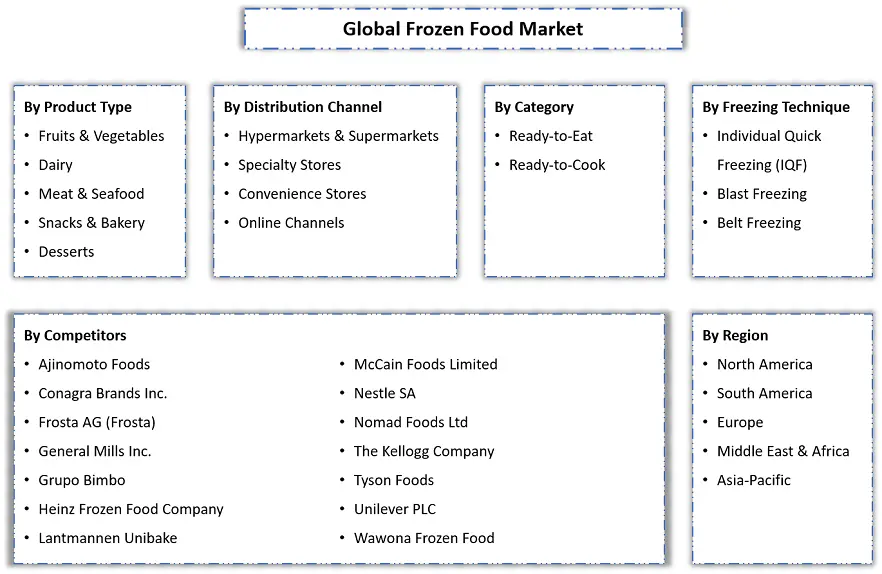
Frozen Food Market - By Category (Frozen Ready-to-Eat Meals, Frozen Ready-to-Cook), By Product Type (Frozen Fruits & Vegetables, Frozen Dairy, Frozen Meat & Seafood, Frozen Snacks......& Bakery, Frozen Desserts), By Distribution Channel (Hypermarkets & Supermarkets, Specialty Stores, Convenience Stores, Online Channels), By Freezing Technique (Individual Quick Freezing (IQF), Blast Freezing, Belt Freezing), and Others Read more
- Food & Beverages
- Feb 2024
- 201
- PDF, Excel, PPT
Market Definition
Frozen food products are manufactured in a way that preserves their freshness & goodness for a longer duration under low temperatures. They can include an extensive range of meat & seafood, fruits & vegetables, dairy products, desserts, and snacks & beverages. These types of food are mainly ready-to-cook & ready-to-eat and are gaining swift momentum worldwide, especially among the working population.
Market Insights & Analysis: Frozen Food Market (2025-30)
The Global Frozen Food Market size is valued at around USD 290 billion in 2024 & is projected to reach USD 384 billion by 2030. The market is also estimated to grow at a CAGR of around 5.78% during the forecast period, i.e., 2025-30. The growth of the market is driven primarily by the increasing population & its massive food requirements, coupled with the burgeoning number of working people, i.e., propelling the demand for frozen food as a convenient option with minimal or no preparation time.
| Report Coverage | Details |
|---|---|
| Historical Years | 2020-23 |
|
Base Years
|
2024
|
|
Forecast Years
|
2025-30
|
| Market Value in 2024 | USD 290 Billion |
| Market Value in 2030 | USD 384 Billion |
| CAGR (2025-30) | 5.78% |
| Leading Region | Europe |
| Top Key Players | Ajinomoto Foods, Conagra Brands Inc., Frosta AG (Frosta), General Mills Inc., Grupo Bimbo, Heinz Frozen Food Company, Lantmannen Unibake, McCain Foods Limited, Nestle SA, Nomad Foods Ltd., The Kellogg Company, Tyson Foods, Unilever PLC, Wawona Frozen Food |
| Key Report Highlights |
|
*Boost strategic growth with in-depth market analysis - Get a free sample preview today!
Owing to the hectic lifestyle & changing food preferences of people, the demand for frozen food is escalating swiftly and generating lucrative growth opportunities for food manufacturers to introduce extensive menus for consumers. Besides, the emerging trend of veganism is another aspect stimulating the demand for frozen fruits & vegetables worldwide, thereby driving the frozen food global market. Moreover, increasing inflow of tourists in different corners of the world is also portraying a rising demand for frozen food across cafes, restaurants, hotels, etc.
Furthermore, the easy availability of ready-to-cook & ready-to-eat frozen food across numerous sales channels, coupled with the growing inclination & expenditure of people on frozen food due to its extended shelf life, are other prominent factors projected to promote the growth of the frozen food industry through 2030.
- Introduction
- Product Definition
- Research Process
- Market Segmentation
- Assumptions
- Preface
- Executive Summary
- Impact of Covid-19 on Global Frozen Food Market
- Global Frozen Food Market Trends & Insights
- Global Frozen Food Market Dynamics
- Drivers
- Challenges
- Global Frozen Food Market Regulations & Policies
- Global Frozen Food Market Supply Chain Analysis
- Global Frozen Food Market Hotspots & Opportunities
- Global Frozen Food Market Outlook, 2020-2030F
- Market Size & Analysis
- By Revenues (USD Billion)
- Market Share & Analysis
- By Category
- Ready-to-Eat
- Ready-to-Cook
- Others
- By Product Type
- Fruits & Vegetables
- Dairy
- Meat & Seafood
- Snacks & Bakery
- Desserts
- Others
- By Distribution Channel
- Hypermarkets & Supermarkets
- Specialty Stores
- Convenience Stores
- Online Channels
- Others
- By Freezing Technique
- Individual Quick Freezing (IQF)
- Blast Freezing
- Belt Freezing
- Others
- By Region
- North America
- South America
- Europe
- Middle East & Africa
- Asia-Pacific
- By Company
- Competition Characteristics
- Market Share of Leading Companies, By Revenues
- By Category
- Market Size & Analysis
- North America Frozen Food Market Outlook, 2020-2030F
- Market Size & Analysis
- By Revenues (USD Billion)
- Market Share & Analysis
- By Category
- By Product Type
- By Distribution Channel
- By Freezing Technique
- By Country
- The US
- Canada
- Mexico
- Rest of the North America
- Market Size & Analysis
- South America Frozen Food Market Outlook, 2020-2030F
- Market Size & Analysis
- By Revenues (USD Billion)
- Market Share & Analysis
- By Category
- By Product Type
- By Distribution Channel
- By Freezing Technique
- By Country
- Brazil
- Argentina
- Rest of South America
- Market Size & Analysis
- Europe Frozen Food Market Outlook, 2020-2030F
- Market Size & Analysis
- By Revenues (USD Billion)
- Market Share & Analysis
- By Category
- By Product Type
- By Distribution Channel
- By Freezing Technique
- By Country
- Germany
- The UK
- France
- Italy
- Spain
- Rest of Europe
- Market Size & Analysis
- Middle East & Africa Frozen Food Market Outlook, 2020-2030F
- Market Size & Analysis
- By Revenues (USD Billion)
- Market Share & Analysis
- By Category
- By Product Type
- By Distribution Channel
- By Freezing Technique
- By Country
- UAE
- Saudi Arabia
- South Africa
- Rest of Middle East & Africa
- Market Size & Analysis
- Asia-Pacific Frozen Food Market Outlook, 2020-2030F
- Market Size & Analysis
- By Revenues (USD Billion)
- Market Share & Analysis
- By Category
- By Product Type
- By Distribution Channel
- By Freezing Technique
- By Country
- China
- Japan
- India
- Australia
- Rest of Asia-Pacific
- Market Size & Analysis
- Global Frozen Food Market Key Strategic Imperatives for Growth & Success
- Competition Outlook
- Competition Matrix
- Brand Specialization
- Target Markets
- Target End Users
- Research & Development
- Strategic Alliances
- Strategic Initiatives
- Competition Matrix
- Company Profiles
- Ajinomoto Foods
- Conagra Brands Inc.
- Frosta AG (Frosta)
- General Mills Inc.
- Grupo Bimbo
- Heinz Frozen Food Company
- Lantmannen Unibake
- McCain Foods Limited
- Nestle SA
- Nomad Foods Ltd
- The Kellogg Company
- Tyson Foods
- Unilever PLC
- Wawona Frozen Food
- Others
- Disclaimer
MarkNtel Advisors follows a robust and iterative research methodology designed to ensure maximum accuracy and minimize deviation in market estimates and forecasts. Our approach combines both bottom-up and top-down techniques to effectively segment and quantify various aspects of the market. A consistent feature across all our research reports is data triangulation, which examines the market from three distinct perspectives to validate findings. Key components of our research process include:
1. Scope & Research Design At the outset, MarkNtel Advisors define the research objectives and formulate pertinent questions. This phase involves determining the type of research—qualitative or quantitative—and designing a methodology that outlines data collection methods, target demographics, and analytical tools. They also establish timelines and budgets to ensure the research aligns with client goals.
2. Sample Selection and Data Collection In this stage, the firm identifies the target audience and determines the appropriate sample size to ensure representativeness. They employ various sampling methods, such as random or stratified sampling, based on the research objectives. Data collection is carried out using tools like surveys, interviews, and observations, ensuring the gathered data is reliable and relevant.
3. Data Analysis and Validation Once data is collected, MarkNtel Advisors undertake a rigorous analysis process. This includes cleaning the data to remove inconsistencies, employing statistical software for quantitative analysis, and thematic analysis for qualitative data. Validation steps are taken to ensure the accuracy and reliability of the findings, minimizing biases and errors.

4. Data Forecast and FinalizationThe final phase involves forecasting future market trends based on the analyzed data. MarkNtel Advisors utilize predictive modeling and time series analysis to anticipate market behaviors. The insights are then compiled into comprehensive reports, featuring visual aids like charts and graphs, and include strategic recommendations to inform client decision-making
FILL THE FORM TO INQUIRE BEFORE BUYING THIS REPORT
We offer flexible licensing options to cater to varying organizational needs. Choose the pricing pack that best suits your requirements:
Buy Now Talk to our Consultant
 Request Customization