

By Growing Method (Hydroponics, Aeroponics, Aquaponics), By Cultivation Method (Organic, Conventional), By Crop Type (Leafy Greens, Tomatoes, Cucumbers, Peppers, Herbs, Strawberrie......s & Berries, Microgreens, Flowers & Ornamentals, Others (Mushrooms, Specialty Crops)), By Facility Type (Greenhouses, Vertical Farms, Indoor Farms, Container Farms, Research & Pilot Facilities), By Component (Lighting Systems, Climate Control Systems, Sensors and Automation, Irrigation & Nutrient Delivery), By End User (Commercial Growers, Research Institutions, Greenhouse Operators, Urban Farming Enterprises), and others Read more
- Environment
- Aug 2026
- 145
- PDF, Excel, PPT
France Controlled Environment Agriculture Market Key Takeaways
- The France controlled environment agriculture market was valued at USD 288 million in 2025 and is projected to grow from USD 341 million in 2026 to USD 524 million by 2032, registering a CAGR of 7.4% during 2026–2032.
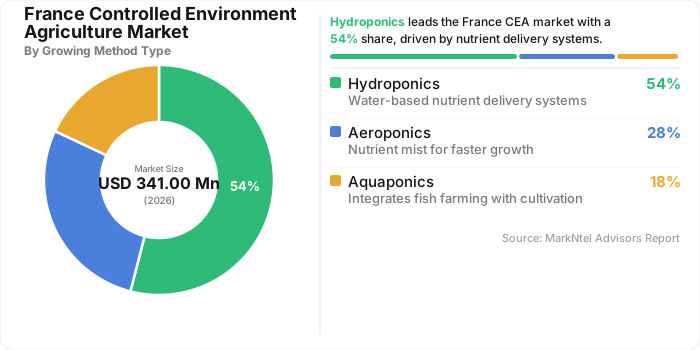
- Hydroponics remains the dominant growing-method segment, accounting for approximately 54% share in 2026.
- By component, climate control systems lead the market with a 34% share in 2026.
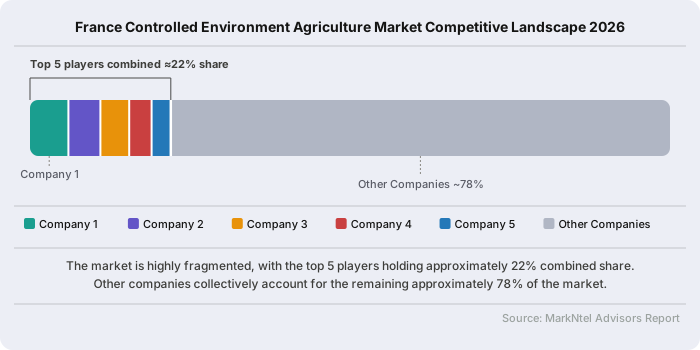
- The market is moderately fragmented, with the top five players collectively accounting for 22% share in 2026.
France Controlled Environment Agriculture Market Size & Outlook
The controlled environment agriculture market in France was valued at approximately USD 288 million in 2025 and is projected to grow from USD 341 million in 2026 to USD 524 million by 2032, registering an estimated 7.4% CAGR during 2026–2032.
The market covers commercial greenhouse production, protected horticulture, soilless cultivation, and increasingly automated controlled-environment production. According to FranceAgriMer, government greenhouse investment-support programs focus on renovating existing heated greenhouses, developing high-performance glasshouses, and supporting decarbonized greenhouse facilities. These initiatives are strengthening capital expenditure across the sector. FranceAgriMer also identifies high production costs, labor availability, aging greenhouse infrastructure, and competitiveness as key structural challenges affecting protected vegetable production.
Domestic supply gaps provide additional growth opportunities, with self-sufficiency rates reported at 72% for cucumbers and 58% for tomatoes. Resource efficiency further supports controlled-environment cultivation, with INRAE evaluation data indicating that controlled-environment glasshouses can achieve up to 90% lower water consumption per kilogram of produce compared with open-field cultivation, improving production resilience against seasonal drought conditions.
France Controlled Environment Agriculture Market Key Indicators
- According to the French Ministry of Agriculture and Food Sovereignty, France allocated approximately USD 467 million in direct capital grants under the Fruit and Vegetable Sovereignty Plan in late 2024 to accelerate greenhouse modernization, directly supporting commercial investments in automated climate-control and irrigation systems.
- As per FranceAgriMer quarterly trade statistics for 2025, off-season fresh tomato imports into France exceeded 320,000 metric tons annually, highlighting a domestic supply gap and creating opportunities for hydroponic and high-productivity glasshouse expansions.
- According to the French Agency for Ecological Transition (ADEME) energy benchmarks published in 2024, modernization of heated glasshouses using thermal screens and heat-recovery systems can reduce gas consumption by approximately 35%–45% per square meter, creating a strong technical and economic incentive for greenhouse operators to upgrade energy-efficiency infrastructure.
- The French Energy Regulatory Commission (CRE), an October 2024 deliberation established a solar-production premium of approximately USD 0.13/Wc for agrivoltaic greenhouse and shade-structure installations exceeding 500 kWc, creating a direct financial incentive for greenhouse operators to integrate photovoltaic generation with protected cultivation.
France Controlled Environment Agriculture Market Demand–Supply Gap Analysis
France has a structural dependence on imported fresh produce, creating an opportunity for controlled environment agriculture (CEA) to strengthen domestic supply. According to FranceAgriMer, France imported 3.62 million metric tons of fresh fruits and 2.07 million metric tons of fresh vegetables in 2024, totaling approximately 5.69 million metric tons. During the same year, France exported around 0.99 million metric tons of fresh fruits and 1.19 million metric tons of fresh vegetables, resulting in approximately 3.51 million metric tons of net imports.
The supply gap is particularly relevant for CEA-compatible crops. France produced approximately 673,600 MT of tomatoes, 170,400 MT of cucumbers, and 71,400 MT of strawberries in 2024. However, it imported approximately 616,200 MT of tomatoes, 77,900 MT of cucumbers, and 55,600 MT of strawberries. Morocco supplied about 472,000 MT of French tomato imports, while Spain accounted for approximately 59,100 MT of cucumber imports and 39,000 MT of strawberry imports, highlighting substantial external supply dependence.
France’s government targets a 5-percentage-point increase in fruit and vegetable sovereignty by 2030 and 10 percentage points by 2035, supported by investment in modernization, innovation, and agricultural equipment.
Consequently, the CEA opportunity is concentrated in high-value greenhouse crops such as tomatoes, cucumbers, peppers, and strawberries, while vertical farming is more applicable to leafy greens, herbs, and microgreens. Demand is expected for automated climate control, fertigation, LED lighting, heat pumps, sensors, and energy-management systems as France seeks to increase domestic production while improving resource and energy efficiency.
France Controlled Environment Agriculture Market Scope
| Category | Segments |
|---|---|
| By Growing Method | Hydroponics, Aeroponics, Aquaponics |
| By Cultivation Method | Organic, Conventional |
| By Crop Type | Leafy Greens, Tomatoes, Cucumbers, Peppers, Herbs, Strawberries & Berries, Microgreens, Flowers & Ornamentals, Others (Mushrooms, Specialty Crops |
| By Facility Type | Greenhouses, Vertical Farms, Indoor Farms, Container Farms, Research & Pilot Facilities |
| By Component | Lighting Systems, Climate Control Systems, Sensors and Automation, Irrigation & Nutrient Delivery |
| By End User | Commercial Growers, Research Institutions, Greenhouse Operators, Urban Farming Enterprises |
France Controlled Environment Agriculture Market Growth Driver
State Funding Fuels France’s High-Tech Greenhouse Boom
The primary catalyst driving the controlled environment agriculture industry in France is the government's strategic focus on strengthening domestic fruit and vegetable production through agricultural technology modernization. According to the French Ministry of Agriculture and Food Sovereignty, the agricultural and agri-food component of France 2030 represents approximately USD 2.7 billion, while USD 117 million was specifically mobilized for innovative equipment and solutions for the fruit and vegetable sector, including innovative and decarbonized greenhouse infrastructure.
The investment momentum is further reinforced through targeted direct-support programs administered by FranceAgriMer. The government launched five investment-support windows totaling approximately USD 117 million, including approximately USD 35 million for innovative greenhouse solutions and USD 12 million for innovative irrigation solutions. These programs are designed to accelerate the deployment of resource-efficient agricultural technologies, including solutions focused on water optimization, energy efficiency, climate adaptation, and innovative greenhouse infrastructure.
Recent Trend
AI-Driven LED Optimization Reshapes Smart Greenhouses
French greenhouse producers are increasingly transitioning from conventional high-pressure sodium (HPS) luminaires toward intelligent, dynamic LED lighting systems integrated with real-time crop and microclimate monitoring. According to research published in 2024, shifting to photoperiod-responsive LED lighting can reduce electricity consumption by approximately 40% in greenhouse tomato production while improving photosynthetically active radiation (PAR) efficiency by approximately 22%. This transition is gaining importance as greenhouse operators seek to manage energy-intensive lighting requirements while maintaining optimal crop growth and productivity.
Commercial engineering vendors are increasingly commercializing sensor-driven light optimization systems tailored to modern greenhouse environments. In January 2025, RED Horticulture launched its proprietary MYRED AI lighting platform across Western France, enabling automated adjustment of light intensity and spectral ratios based on plant physiological requirements and ambient solar radiation. This integration allows commercial glasshouse operators to optimize supplemental lighting, reduce unnecessary energy consumption, and maintain targeted crop-growth conditions, positioning dynamic photon delivery as an emerging standard for future greenhouse retrofits across Southern and Western France.
France Controlled Environment Agriculture Market Opportunities and Challenges
Operational Cost Pressure Accelerates Autonomous Greenhouse Robotics
France's greenhouse operators face increasing pressure from high modernization costs, funding constraints, and shortages of skilled agricultural labor, creating a growing opportunity for automation and robotics. Under the France 2030 greenhouse support program administered by FranceAgriMer, eligible expenditure per application is subject to a minimum threshold of approximately USD 58,000 and a maximum of approximately USD 580,000, limiting the amount of subsidized investment that individual operators can claim for greenhouse modernization. This constraint can be particularly challenging for small and mid-sized growers requiring extensive upgrades to aging greenhouse infrastructure.
At the same time, persistent labor shortages for repetitive greenhouse activities such as de-leafing, pruning, harvesting, and crop maintenance are encouraging growers to adopt autonomous technologies. The opportunity is demonstrated by Aisprid, a Saint-Malo-based agricultural robotics company that secured approximately USD 10.4 million in Series A funding in January 2025, including support connected to the France 2030 program. The company had deployed approximately 30 autonomous tomato de-leafing robots across France's five largest tomato cooperatives in 2024. This development highlights the increasing commercial potential for robotics-as-a-service, autonomous crop-maintenance systems, and AI-enabled greenhouse automation as French growers seek to reduce labor dependency and improve operational productivity.
Segmentation Insights
Hydroponics Precision Cultivation Powers Commercial CEA
Hydroponics represents the leading growing method in France’s controlled environment agriculture market, accounting for 54% of the industry in 2026. Its dominance is supported by commercial scalability, consistent crop yields, resource efficiency, and compatibility with retailer quality requirements. According to CTIFL trials, closed-loop hydroponic gutter systems can produce up to 55 kg/m² of tomatoes annually, compared with approximately 12 kg/m² under conventional soil cultivation, while using around 85% less water per unit of output.
The method is further supported by precision fertigation, substrate innovation, and demand for consistent low-pesticide produce. Stone wool and coconut coir substrates enable controlled nutrient delivery and efficient root-zone management, while standardized hydroponic systems support predictable year-round production. Growing retailer requirements for consistent quality and traceable produce are encouraging commercial growers and producer cooperatives to invest in scalable hydroponic infrastructure, positioning hydroponics as the dominant growing-method segment in France’s controlled environment agriculture market. Based on Growing Method, the industry is segmented into:
- Hydroponics
- Aeroponics
- Aquaponics
Climate Control Smart Automation Drives Greenhouse Efficiency
Climate Control Systems represent the leading component segment in France’s controlled environment agriculture market, accounting for 34% of the market in 2026, making it the largest component segment. Its dominance is driven by the capital-intensive requirement to regulate temperature, humidity, CO₂ concentration, ventilation, and airflow throughout the production cycle. According to AFNOR Group's NF EN 13031-1, greenhouse environmental management requires coordinated heating, ventilation, thermal screening, and humidity-control systems, reinforcing climate-control infrastructure as a core investment for commercial greenhouse operators.
Demand is further supported by the transition toward automated, energy-intelligent climate management. In 2024, Priva introduced Priva ECO, a Digital Twin and machine-learning solution that analyzes greenhouse energy use, energy prices, weather conditions, and forecasts before sending optimized operating scenarios to the Priva Connext climate computer. The integration of energy optimization, predictive control, automated climate management, and real-time environmental data is increasing the functionality and value of climate-control infrastructure, supporting its leading industry share in France's CEA market. Based on Component, the industry is segmented into:
- Lighting Systems
- Climate Control Systems
- Sensors and Automation
- Irrigation & Nutrient Delivery
France Controlled Environment Agriculture Market Competitive Analysis
The France controlled environment agriculture market is moderately fragmented, with the top five companies Richel Group, Priva Holding B.V., RED Horticulture, Certhon, and Ridder collectively accounting for an estimated 22% of market share in 2026
Top Companies in the France controlled environment agriculture industry:
- BASF SE
- Richel Group
- Priva Holding B.V.
- RED Horticulture
- Certhon
- Ridder
- Signify
- Grodan
- Netafim
- Royal Brinkman
- KUBO Group
France Controlled Environment Agriculture Industry News and Recent Developments
December 2025: Tom d'Aqui Deploys AI-Assisted Autonomous Greenhouse Control
Ridder reported that French tomato cooperative Tom d'Aqui was combining the Hortimax Pro climate computer with Blue Radix's Crop Controller to connect greenhouse climate and water data with autonomous crop-control algorithms. The system enables continuous adjustments to climate and irrigation, reducing reliance on manual crop-manager intervention and strengthening the adoption of AI-enabled automation in commercial French greenhouse production.
Impact Analysis: The development reinforces integrated greenhouse automation as a core CEA technology category and demonstrates the transition of AI-based crop control from an emerging technology toward operational deployment in commercial French greenhouse facilities.
January 2025: Priva and Blue Radix Expand AI-Driven Greenhouse Automation Collaboration
Priva announced an expanded collaboration with Blue Radix focused on AI-driven and autonomous greenhouse growing. The initiative addresses growers' requirements for more precise and predictable production while responding to the shortage of experienced greenhouse personnel. The collaboration integrates digital technologies across the greenhouse ecosystem to improve operational control and support autonomous decision-making.
Impact Analysis: The development supports demand for connected climate computers, predictive crop-management software, and interoperable greenhouse platforms, increasing the technology content of future greenhouse projects and accelerating the adoption of AI-enabled automation across French controlled environment agriculture.
- Market Segmentation
- Introduction
- Research Process
- Assumption
- Market Definition
- Executive Summary
- France Controlled Environment Agriculture Market Trends & Developments
- France Controlled Environment Agriculture Market Dynamics
- Growth Drivers
- Challenges
- France Controlled Environment Agriculture Market Policies & Regulations,
- France Controlled Environment Agriculture Market Hotspot & Opportunities
- France Controlled Environment Agriculture Market Outlook, 2022-2032F
- Market Size and Analysis
- By Revenues (USD Million)
- Market Share & Analysis
- By Growing Method- (USD Million)
- Hydroponics
- Aeroponics
- Aquaponics
- By Cultivation Method- (USD Million)
- Organic
- Conventional
- By Crop Type- (USD Million)
- Leafy Greens
- Tomatoes
- Cucumbers
- Peppers
- Herbs
- Strawberries & Berries
- Microgreens
- Flowers & Ornamentals
- Others (Mushrooms, Specialty Crops)
- By Facility Type- (USD Million)
- Greenhouses
- Vertical Farms
- Indoor Farms
- Container Farms
- Research & Pilot Facilities
- By Component- (USD Million)
- Lighting Systems
- Climate Control Systems
- Sensors and Automation
- Irrigation & Nutrient Delivery
- By End User- (USD Million)
- Commercial Growers
- Research Institutions
- Greenhouse Operators
- Urban Farming Enterprises
- By Region
- North
- South
- East
- West
- By Company
- Competition Characteristics
- Market Share & Analysis
- By Growing Method- (USD Million)
- Market Size and Analysis
- France Organic Controlled Environment Agriculture Market Outlook, 2022-2032F
- Market Size and Analysis
- By Revenues (USD Million)
- Market Share and Analysis
- By Growing Method- (USD Million)
- By Crop Type- (USD Million)
- By Facility Type- (USD Million)
- By Component- (USD Million)
- By End User- (USD Million)
- Market Size and Analysis
- France Conventional Controlled Environment Agriculture Market Outlook, 2022-2032F
- Market Size and Analysis
- By Revenues (USD Million)
- Market Share and Analysis
- By Growing Method- (USD Million)
- By Crop Type- (USD Million)
- By Facility Type- (USD Million)
- By Component- (USD Million)
- By End User- (USD Million)
- Market Size and Analysis
- France Controlled Environment Agriculture Market Strategic Imperatives for Success & Growth
- Competitive Outlook
- Company Profiles
- Richel Group
- Business Description
- Product Portfolio
- Strategic Alliances or Partnerships
- Recent Developments
- Financial Details
- Others
- Priva Holding B.V.
- Business Description
- Product Portfolio
- Strategic Alliances or Partnerships
- Recent Developments
- Financial Details
- Others
- RED Horticulture
- Business Description
- Product Portfolio
- Strategic Alliances or Partnerships
- Recent Developments
- Financial Details
- Others
- Certhon
- Business Description
- Product Portfolio
- Strategic Alliances or Partnerships
- Recent Developments
- Financial Details
- Others
- Ridder
- Business Description
- Product Portfolio
- Strategic Alliances or Partnerships
- Recent Developments
- Financial Details
- Others
- Signify
- Business Description
- Product Portfolio
- Strategic Alliances or Partnerships
- Recent Developments
- Financial Details
- Others
- Grodan
- Business Description
- Product Portfolio
- Strategic Alliances or Partnerships
- Recent Developments
- Financial Details
- Others
- Netafim
- Business Description
- Product Portfolio
- Strategic Alliances or Partnerships
- Recent Developments
- Financial Details
- Others
- Royal Brinkman
- Business Description
- Product Portfolio
- Strategic Alliances or Partnerships
- Recent Developments
- Financial Details
- Others
- KUBO Group
- Business Description
- Product Portfolio
- Strategic Alliances or Partnerships
- Recent Developments
- Financial Details
- Others
- Others
- Richel Group
- Company Profiles
- Disclaimer

MarkNtel Advisors follows a robust and iterative research methodology designed to ensure maximum accuracy and minimize deviation in market estimates and forecasts. Our approach combines both bottom-up and top-down techniques to effectively segment and quantify various aspects of the market. A consistent feature across all our research reports is data triangulation, which examines the market from three distinct perspectives to validate findings. Key components of our research process include:
1. Scope & Research Design At the outset, MarkNtel Advisors define the research objectives and formulate pertinent questions. This phase involves determining the type of research—qualitative or quantitative—and designing a methodology that outlines data collection methods, target demographics, and analytical tools. They also establish timelines and budgets to ensure the research aligns with client goals.
2. Sample Selection and Data Collection In this stage, the firm identifies the target audience and determines the appropriate sample size to ensure representativeness. They employ various sampling methods, such as random or stratified sampling, based on the research objectives. Data collection is carried out using tools like surveys, interviews, and observations, ensuring the gathered data is reliable and relevant.
3. Data Analysis and Validation Once data is collected, MarkNtel Advisors undertake a rigorous analysis process. This includes cleaning the data to remove inconsistencies, employing statistical software for quantitative analysis, and thematic analysis for qualitative data. Validation steps are taken to ensure the accuracy and reliability of the findings, minimizing biases and errors.

4. Data Forecast and FinalizationThe final phase involves forecasting future market trends based on the analyzed data. MarkNtel Advisors utilize predictive modeling and time series analysis to anticipate market behaviors. The insights are then compiled into comprehensive reports, featuring visual aids like charts and graphs, and include strategic recommendations to inform client decision-making
FILL THE FORM TO INQUIRE BEFORE BUYING THIS REPORT
We offer flexible licensing options to cater to varying organizational needs. Choose the pricing pack that best suits your requirements:
Buy Now Talk to our Consultant
 Request Customization