

By Technology (Microfiltration (MF), Ultrafiltration (UF), Nanofiltration (NF), Reverse Osmosis (RO), Membrane Bioreactor (MBR)), By Membrane Material (Polymeric Membranes, Ceramic...... Membranes, Composite & Hybrid Membranes), By Module Configuration (Hollow Fiber, Spiral Wound, Tubular, Plate & Frame, Flat Sheet), By Application (Water & Wastewater, Food & Beverages, Pharmaceutical, Industrial Processing, Others), and others Read more
- Environment
- Aug 2026
- 160
- PDF, Excel, PPT
China Membrane Filtration Market Key Takeaways
- The China membrane filtration market was valued at USD 3.45 billion in 2025 and is projected to grow from USD 3.74 billion in 2026 to USD 6.15 billion by 2032.
- The industry is projected to witness steady growth at a CAGR of 8.70% during 2026–2032.
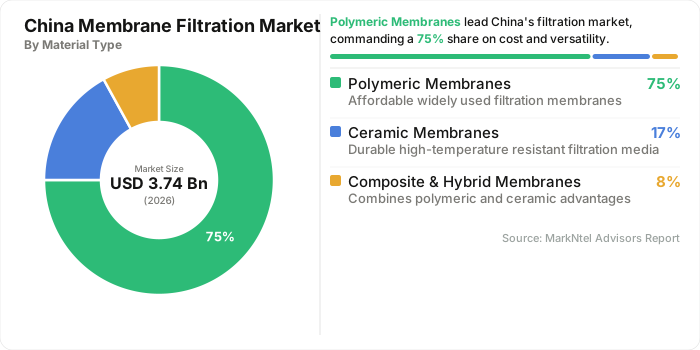
- Polymeric membranes remain the dominant membrane material segment, accounting for nearly 75% of the market in 2026.
- By technology, reverse osmosis leads the market with a 39% share in 2026.
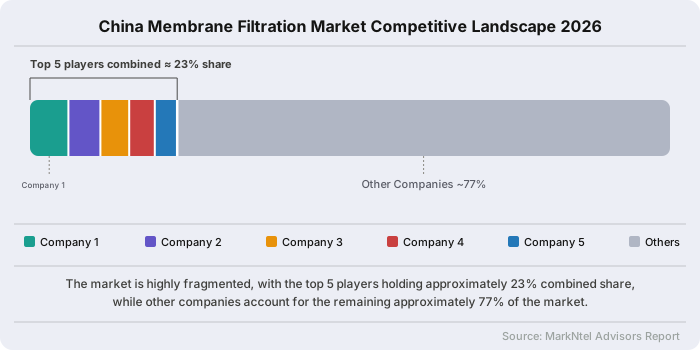
- The market is highly fragmented, with the top 5 players collectively accounting for 23% share in 2026.
China Membrane Filtration Market Size & Outlook
The China membrane filtration market was valued at USD 3.45 billion in 2025 and is projected to grow from USD 3.74 billion in 2026 to USD 6.15 billion by 2032, registering a CAGR of 8.70% during the forecast period (2026–2032).
This growth trajectory is structurally underpinned by China's national wastewater resource utilization strategy. As per the National Development and Reform Commission (NDRC), Ministry of Housing and Urban-Rural Development (MOHURD), and Ministry of Ecology and Environment (MEE), the country aims to achieve a sewage treatment rate exceeding 95% in county-level cities and a reclaimed water utilization rate above 25% in water-scarce prefecture-level cities by 2025, directly accelerating investments in membrane-based tertiary treatment, industrial wastewater reuse, and municipal water recycling infrastructure.
Further supporting market expansion, China's reclaimed water utilization reached approximately 21.34 billion cubic meters, according to the latest national statistical baseline, demonstrating significant capacity for further reuse development as national water recycling targets continue to advance. Simultaneously, Beijing OriginWater Technology Co., Ltd. operates a million production capacity annually, highlighting the domestic industry's manufacturing scale and reinforcing long-term supply capacity for China's expanding membrane filtration market.
China Membrane Filtration Market Key Indicators
- According to the National Development and Reform Commission (NDRC), Ministry of Housing and Urban-Rural Development (MOHURD), and Ministry of Ecology and Environment (MEE), the City and Township Sewage Treatment and Resource Utilization Development Plan calls for expanding sewage treatment capacity by 12 million cubic meters per day and renovating 45,000 kilometers of sewage collection networks. This large-scale infrastructure expansion directly increases demand for membrane bioreactor (MBR) and ultrafiltration (UF) membrane filtration systems across municipal wastewater treatment facilities.
- According to MIIT, China's electronic information manufacturing industry generated total revenue of USD 2.27 trillion in 2024, a 7.3% year-on-year increase, reflecting the scale of the high-purity-water-dependent manufacturing base that membrane filtration technologies serve.
- The National Development and Reform Commission (NDRC) and the Ministry of Housing and Urban-Rural Development (MOHURD), China's 14th Five-Year Plan for Urban Wastewater Treatment and Resource Utilization targets the addition of 15 million cubic meters per day of reclaimed water production capacity by 2025, while mandating a recycled water utilization rate exceeding 25% in water-scarce cities. These national targets continue to accelerate investments in membrane-based tertiary treatment and water reuse infrastructure.
- According to UN Comtrade, China imported more than USD 1.3 billion worth of filtration and purification machinery for liquids (HS 842121) in 2024. The sustained import value highlights robust domestic demand for advanced filtration technologies and complements ongoing investments in locally manufactured membrane filtration systems.
China Membrane Filtration Market Scope
| Category | Segments |
|---|---|
| By Technology | Microfiltration (MF), Ultrafiltration (UF), Nanofiltration (NF), Reverse Osmosis (RO), Membrane Bioreactor (MBR |
| By Membrane Material | Polymeric Membranes, Ceramic Membranes, Composite & Hybrid Membranes |
| By Module Configuration | Hollow Fiber, Spiral Wound, Tubular, Plate & Frame, Flat Sheet |
| By Application | Water & Wastewater, Food & Beverages, Pharmaceutical, Industrial Processing, Others |
China Membrane Filtration Market Growth Drivers
Growing Demand for Clean and Pure Water
China's growing demand for clean, potable water is a key structural driver of the membrane filtration industry, accelerating investments in municipal drinking water infrastructure and advanced treatment systems. According to the Ministry of Water Resources (MWR), domestic water consumption increased by 980 million cubic meters to 93.66 billion cubic meters in 2025, while total national water consumption remained stable at 594.45 billion cubic meters. The continued rise in household water demand is expanding the need for membrane-based water purification technologies, particularly ultrafiltration and reverse osmosis systems, to ensure safe and reliable potable water supplies across rapidly urbanizing regions.
The trend is further reinforced by increasing per-capita water consumption in major metropolitan areas. According to the Ministry of Housing and Urban-Rural Development (MOHURD), Shanghai's daily residential water consumption increased to 212.9 litres per capita in 2024, compared with 210.9 litres in 2023. As municipal utilities respond to rising urban water demand and stricter drinking water quality standards, investments in advanced filtration technologies and municipal water infrastructure continue to strengthen, supporting the long-term adoption of membrane filtration systems throughout China.
Recent Trends
Semiconductor Fabrication Expansion Accelerates Demand for Membrane Systems
China's rapid expansion of semiconductor capacity is significantly increasing demand for advanced membrane filtration technologies. According to the Ministry of Industry and Information Technology (MIIT), China's integrated circuit production reached 451.4 billion units in 2024, a 22.2% year-on-year increase, the fastest growth among major electronic manufacturing categories. As chip fabrication requires high-purity water systems with extremely stringent water quality standards, demand for reverse osmosis and ultrafiltration membranes continues to grow across newly commissioned and expanding semiconductor fabrication facilities.
Membrane manufacturers are accelerating innovation to address the semiconductor industry's stringent water purity requirements. In 2024, Toray Industries, Inc. launched its TBW-XHR series reverse osmosis membrane elements, engineered to nearly double urea removal efficiency during ultrapure water production from reclaimed wastewater, achieving approximately 90% urea removal in internal evaluations. This innovation strengthens semiconductor manufacturing water treatment capabilities while reinforcing the adoption of reverse osmosis (RO) technologies for sustainable water reuse in advanced electronics manufacturing.
China Membrane Filtration Market Opportunities and Challenges
Membrane Fouling Creates Opportunities for Fouling-Resistant Membrane Technologies
Membrane fouling remains one of the most significant operational challenges affecting membrane filtration systems, reducing treatment efficiency while increasing energy consumption, maintenance frequency, and lifecycle costs. During operation, suspended solids, microorganisms, organic matter, and inorganic scaling accumulate on membrane surfaces, restricting permeate flow and shortening membrane service life. According to the International Desalination Association (IDA), membrane fouling accounts for 30–45% of unplanned downtime in reverse osmosis desalination plants, underscoring the need for more durable, fouling-resistant membrane technologies for municipal and industrial applications.
At the same time, the membrane fouling is creating significant opportunities for next-generation membrane technologies. In 2024, DuPont Water Solutions continued strengthening its FilmTec™ portfolio with reverse osmosis and ultrafiltration membranes engineered to enhance fouling resistance, reduce cleaning frequency, and improve water recovery for municipal and industrial applications. The company's continued innovation in advanced wastewater treatment and industrial process filtration technologies is enabling operators to lower lifecycle costs, improve system reliability, and maximize long-term treatment efficiency amid rising demand for sustainable water management solutions.
Segmentations Insights
Polymeric Membranes Lead the Market Through Cost Leadership and Scalable Manufacturing
The polymeric segment dominated the market with a revenue share of 75% in 2026, driven by their cost-effectiveness, versatility, and widespread commercial adoption. Manufactured primarily from polyethersulfone (PES), polyvinylidene fluoride (PVDF), and polysulfone (PS), polymeric membranes offer lower production costs and easier scalability than ceramic alternatives, making them the preferred choice for municipal water treatment, industrial process water, and residential purification. According to the International Desalination Association (IDA), polymeric membranes account for an estimated over 75% of the global membrane market, reinforcing their dominant position in China's expanding membrane manufacturing ecosystem
The dominance of polymeric membranes is further reinforced by their cost competitiveness, scalable manufacturing, and broad adoption across municipal, industrial, and residential water treatment applications. Their combination of high filtration performance, lower production costs, and flexible module design makes them well suited for high-volume treatment projects. Reflecting this strong domestic demand, Beijing OriginWater Technology Co., Ltd. has disclosed an annual production capacity of 10 million square meters of MF/UF membranes, demonstrating China's mature manufacturing ecosystem and continued investment in membrane technologies for wastewater treatment and water reuse applications. Based on membrane material, the industry is segmented into:
- Polymeric Membranes
- Ceramic Membranes
- Composite & Hybrid Membranes
Reverse Osmosis Emerges as the Technology of Choice for Advanced Water Purification
The reverse osmosis (RO) segment dominates the industry, accounting for 38% of the China membrane filtration industry by technology in 2026, making it the leading technology segment. RO membranes provide the highest contaminant removal efficiency among pressure-driven membrane technologies, effectively removing dissolved salts, heavy metals, microorganisms, and organic contaminants. Their ability to produce high-purity water makes them the preferred technology for municipal drinking water treatment, industrial water reuse, desalination, and semiconductor manufacturing. According to the International Desalination Association (IDA), reverse osmosis accounts for more than 95% of the world's installed desalination capacity, reflecting its technological maturity and widespread commercial adoption across large-scale water treatment applications.
The segment's leadership is further supported by China's expanding domestic manufacturing capabilities and rising demand for ultrapure and recycled water. Beijing OriginWater Technology Co., Ltd. has disclosed an annual production capacity of 6 million square meters of DF/RO membranes, highlighting continued investment in reverse osmosis technologies to support municipal water supply, industrial wastewater reuse, and high-purity water production.2 As China continues investing in sustainable water infrastructure and advanced industrial manufacturing, RO technology is expected to maintain its leading market position owing to its superior purification efficiency, scalability, and broad application across multiple end-use industries. By the technology type the industry is segmented into:
- Microfiltration (MF)
- Ultrafiltration (UF)
- Nanofiltration (NF)
- Reverse Osmosis (RO)
- Membrane Bioreactor (MBR)
China Membrane Filtration Market Competitive Analysis
The China membrane filtration industry is highly fragmented, with the top five manufacturers collectively accounting for an estimated 23% of market revenue in 2026. Market leadership is primarily driven by extensive membrane technology portfolios, strong domestic manufacturing capabilities, continuous investment in research and development, and long-term participation in municipal water, industrial water reuse, and high-purity water projects.
Top Companies in the China Membrane Filtration Market:
- DuPont Water Solutions
- Toray Industries, Inc.
- Hydranautics
- SUEZ Water Technologies & Solutions
- Veolia Water Technologies
- Koch Separation Solutions
- Pall Corporation
- Pentair plc
- Beijing OriginWater Technology Co., Ltd.
- Vontron Technology Co., Ltd.
China Membrane Filtration Industry News and Recent Developments
March 2025: DuPont Water Solutions Launches WAVE PRO for Ultrafiltration System Design1
DuPont Water Solutions launched WAVE PRO, an advanced digital modeling platform designed for ultrafiltration applications, including municipal drinking water, industrial utility water, wastewater reuse, and seawater desalination. The software enables engineers to simulate process conditions, optimize membrane system configurations, and evaluate operational and economic performance before project implementation, improving system design accuracy and operational efficiency.
Impact Analysis: The launch strengthens DuPont's digital engineering capabilities by integrating advanced modeling with membrane system design, enabling customers to optimize water treatment performance while reducing lifecycle costs. The increasing adoption of digital design and simulation tools is expected to accelerate the deployment of advanced membrane filtration systems across municipal and industrial water treatment projects.
January 2024: Toray Industries Launches TBW-XHR Reverse Osmosis Membrane for Semiconductor Water Reuse1
Toray Industries, Inc. introduced its TBW-XHR series reverse osmosis membrane elements, specifically developed for producing ultrapure water from reclaimed wastewater used in semiconductor manufacturing. The new membrane demonstrated approximately 90% urea removal in internal evaluations—nearly double the performance of previous products—supporting higher water recovery and reducing dependence on freshwater resources in semiconductor fabrication facilities.
Impact Analysis: The launch strengthens Toray's position in the rapidly expanding high-purity water market while addressing the semiconductor industry's growing demand for advanced water reuse technologies. It also reinforces the increasing commercialization of specialized membrane solutions designed for high-value industrial applications.
- Market Segmentation
- Introduction
- Product Definition
- Research Process
- Assumptions
- Executive Summary
- China Membrane Filtration Market Policies, Regulations, and Product Standards
- China Membrane Filtration Market Trends & Developments
- China Membrane Filtration Market Dynamics
- Growth Factors
- Challenges
- China Membrane Filtration Market Hotspot & Opportunities
- China Membrane Filtration Market Outlook, 2022-2032
- Market Size & Outlook
- By Revenues (USD Million)
- Market Share & Analysis
- By Technology- Market Size & Forecast 2022-2032, USD Million
- Microfiltration (MF)
- Ultrafiltration (UF)
- Nanofiltration (NF)
- Reverse Osmosis (RO)
- Membrane Bioreactor (MBR)
- By Membrane Material- Market Size & Forecast 2022-2032, USD Million
- Polymeric Membranes
- Ceramic Membranes
- Composite & Hybrid Membranes
- By Module Configuration- Market Size & Forecast 2022-2032, USD Million
- Hollow Fiber
- Spiral Wound
- Tubular
- Plate & Frame
- Flat Sheet
- By Application- Market Size & Forecast 2022-2032, USD Million
- Water & Wastewater
- Food & Beverages
- Pharmaceutical
- Industrial Processing
- Others
- By region- Market Size & Forecast 2022-2032, USD Million
- North
- North West
- North East
- South
- South West
- East
- Central
- By Company
- Competition Characteristics
- Market Share & Analysis
- By Technology- Market Size & Forecast 2022-2032, USD Million
- Market Size & Outlook
- China Polymeric Membrane Filtration Market Outlook, 2022-2032
- Market Size & Outlook
- By Revenues (USD Million)
- Market Segmentation & Analysis
- By Membrane Material- Market Size & Forecast 2022-2032, USD Million
- By Module Configuration- Market Size & Forecast 2022-2032, USD Million
- By Application- Market Size & Forecast 2022-2032, USD Million
- By region- Market Size & Forecast 2022-2032, USD Million
- Market Size & Outlook
- China Ceramic embrane Filtration Market Outlook, 2022-2032
- Market Size & Outlook
- By Revenues (USD Million)
- Market Segmentation & Analysis
- By Membrane Material- Market Size & Forecast 2022-2032, USD Million
- By Module Configuration- Market Size & Forecast 2022-2032, USD Million
- By Application- Market Size & Forecast 2022-2032, USD Million
- By region- Market Size & Forecast 2022-2032, USD Million
- Market Size & Outlook
- China Composite & Hybrid Membrane Filtration Market Outlook, 2022-2032
- Market Size & Outlook
- By Revenues (USD Million)
- Market Segmentation & Analysis
- By Membrane Material- Market Size & Forecast 2022-2032, USD Million
- By Module Configuration- Market Size & Forecast 2022-2032, USD Million
- By Application- Market Size & Forecast 2022-2032, USD Million
- By region- Market Size & Forecast 2022-2032, USD Million
- Market Size & Outlook
- China Membrane Filtration Market Key Strategic Imperatives for Success & Growth
- Competitive Outlook
- Company Profiles
- DuPont Water Solutions
- Business Description
- Product Portfolio
- Collaborations & Alliances
- Recent Developments
- Financial Details
- Others
- Toray Industries, Inc.
- Business Description
- Product Portfolio
- Collaborations & Alliances
- Recent Developments
- Financial Details
- Others
- Hydranautics
- Business Description
- Product Portfolio
- Collaborations & Alliances
- Recent Developments
- Financial Details
- Others
- SUEZ Water Technologies & Solutions
- Business Description
- Product Portfolio
- Collaborations & Alliances
- Recent Developments
- Financial Details
- Others
- Veolia Water Technologies
- Business Description
- Product Portfolio
- Collaborations & Alliances
- Recent Developments
- Financial Details
- Others
- Koch Separation Solutions
- Business Description
- Product Portfolio
- Collaborations & Alliances
- Recent Developments
- Financial Details
- Others
- Pall Corporation
- Business Description
- Product Portfolio
- Collaborations & Alliances
- Recent Developments
- Financial Details
- Others
- Pentair plc
- Business Description
- Product Portfolio
- Collaborations & Alliances
- Recent Developments
- Financial Details
- Others
- Beijing OriginWater Technology Co., Ltd.
- Business Description
- Product Portfolio
- Collaborations & Alliances
- Recent Developments
- Financial Details
- Others
- Vontron Technology Co., Ltd.
- Business Description
- Product Portfolio
- Collaborations & Alliances
- Recent Developments
- Financial Details
- Others
- DuPont Water Solutions
- Company Profiles
- Disclaimer

MarkNtel Advisors follows a robust and iterative research methodology designed to ensure maximum accuracy and minimize deviation in market estimates and forecasts. Our approach combines both bottom-up and top-down techniques to effectively segment and quantify various aspects of the market. A consistent feature across all our research reports is data triangulation, which examines the market from three distinct perspectives to validate findings. Key components of our research process include:
1. Scope & Research Design At the outset, MarkNtel Advisors define the research objectives and formulate pertinent questions. This phase involves determining the type of research—qualitative or quantitative—and designing a methodology that outlines data collection methods, target demographics, and analytical tools. They also establish timelines and budgets to ensure the research aligns with client goals.
2. Sample Selection and Data Collection In this stage, the firm identifies the target audience and determines the appropriate sample size to ensure representativeness. They employ various sampling methods, such as random or stratified sampling, based on the research objectives. Data collection is carried out using tools like surveys, interviews, and observations, ensuring the gathered data is reliable and relevant.
3. Data Analysis and Validation Once data is collected, MarkNtel Advisors undertake a rigorous analysis process. This includes cleaning the data to remove inconsistencies, employing statistical software for quantitative analysis, and thematic analysis for qualitative data. Validation steps are taken to ensure the accuracy and reliability of the findings, minimizing biases and errors.

4. Data Forecast and FinalizationThe final phase involves forecasting future market trends based on the analyzed data. MarkNtel Advisors utilize predictive modeling and time series analysis to anticipate market behaviors. The insights are then compiled into comprehensive reports, featuring visual aids like charts and graphs, and include strategic recommendations to inform client decision-making
FILL THE FORM TO INQUIRE BEFORE BUYING THIS REPORT
We offer flexible licensing options to cater to varying organizational needs. Choose the pricing pack that best suits your requirements:
Buy Now Talk to our Consultant
 Request Customization