

Global Zero Trust Browser Security Market Research Report: Growth Drivers & Forecast (2026-2032)
By Product Architecture (Remote Browser Isolation, Secure Enterprise Browsers, Hybrid Risk Adaptive Browser Security), By Component (Solutions, Services), By Deployment Type (On-Pr ... emises, Cloud-Based, Hybrid), By Organization Size (Small & Medium Enterprises (SMEs), Large Enterprises), By Deployment Architecture (Secure Service Edge Integrated, Standalone Browser Security Platforms, Endpoint and Identity Integrated), By Primary Use Case (Phishing and Credential Theft Prevention, Ransomware and Malware Containment, Secure Third Party and Contractor Access, SaaS Application Protection, Unmanaged and BYOD Device Access, Insider Risk and Session Visibility), By End-User (BFSI, Healthcare, Government & Defense, IT & Telecom, Retail & E-Commerce, Manufacturing, Education, Energy & Utilities, Others), and others Read more
- ICT & Electronics
- Mar 2026
- Pages 200
- Report Format: PDF, Excel, PPT
Global Zero Trust Browser Security Market
Projected 36.2% CAGR from 2026 to 2032
Study Period
2026-2032
Market Size (2025)
USD 0.78 Billion
Market Size (2032)
USD 4.98 Billion
Largest Region
2025
Projected CAGR
36.2%
Leading Segments
By Component: Solutions
Global Zero Trust Browser Security Market Report Key Takeaways:
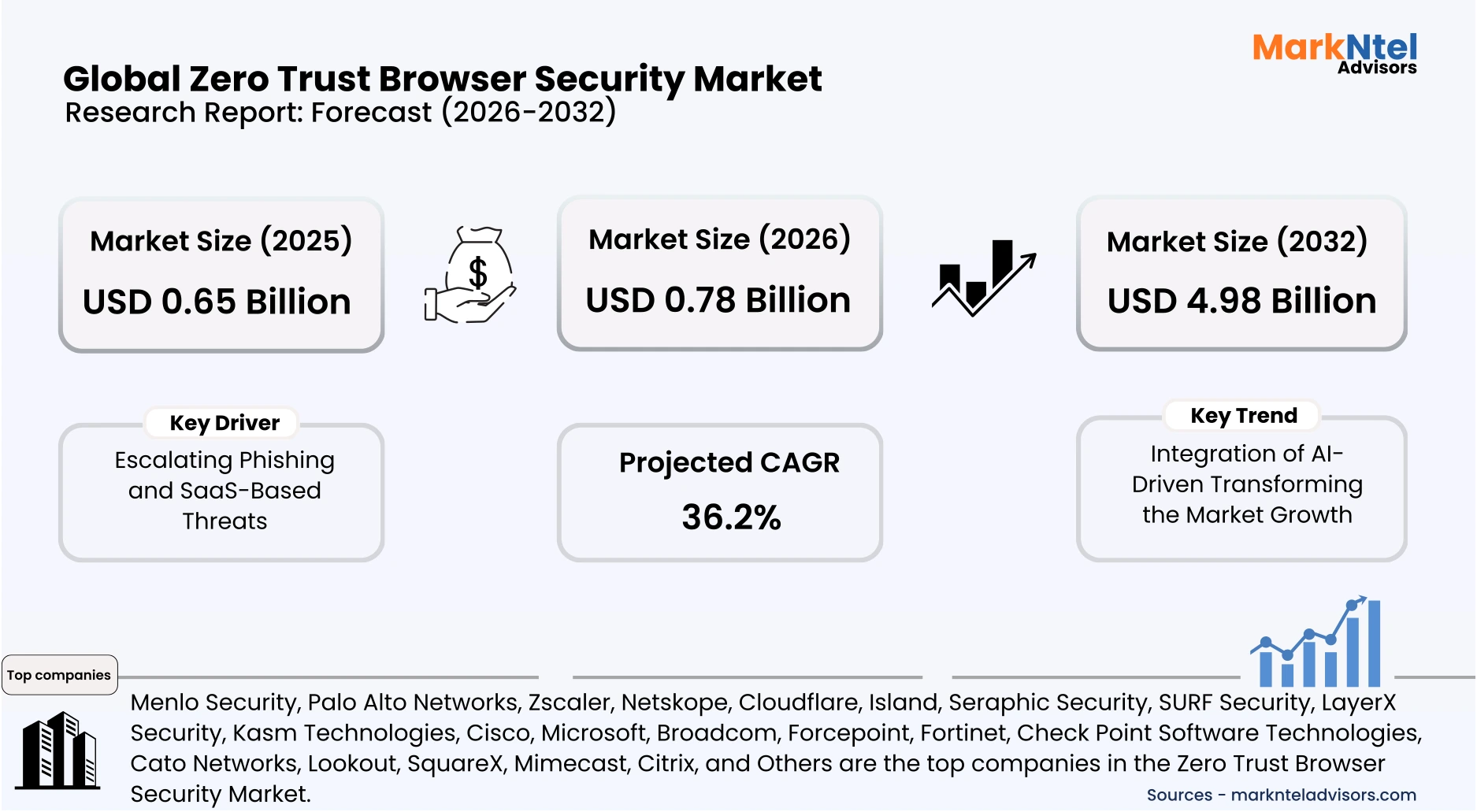
- Market size was valued at around USD 0.65 billion in 2025 and is projected to grow from USD 0.78 billion in 2026 to USD 4.98 billion by 2032. The estimated CAGR from 2026 to 2032 is around 36.2%, indicating strong growth.
- North America holds the largest market share of about 47% in the Global Zero Trust Browser Security Market in 2026.
- By Deployment Architecture, the BFSI segment represented a significant share of about 26% in the Global Zero Trust Browser Security Market in 2026.
- By Component, the Solution segment presented a significant share of about 85% in the Global Zero Trust Browser Security Market in 2026.
- Leading Zero Trust Browser Security Companies in the Global Market are Menlo Security, Palo Alto Networks, Zscaler, Netskope, Cloudflare, Island, Seraphic Security, SURF Security, LayerX Security, Kasm Technologies, Cisco, Microsoft, Broadcom, Forcepoint, Fortinet, Check Point Software Technologies, Cato Networks, Lookout, SquareX, Mimecast, Citrix, and others.
Market Insights & Analysis: Global Zero Trust Browser Security Market (2026-32):
The Global Zero Trust Browser Security Market size was valued at around USD 0.65 billion in 2025 and is projected to grow from USD 0.78 billion in 2026 to USD 4.98 billion by 2032. Along with this, the market is estimated to grow at a CAGR of around 36.2% during the forecast period, i.e., 2026-32.
The market expansion is directly linked to the structural shift from perimeter-based security to identity-driven access models. As enterprises migrate workloads to SaaS platforms, browser sessions increasingly serve as the primary entry point to corporate data. As per IBM (2024), the global average breach cost reached USD 4.45 million , reinforcing investment in browser-layer protection mechanisms.
Consequently, governments are formalizing zero-trust implementation frameworks. For instance, the U.S. Office of Management and Budget’s 2024 Zero Trust Strategy mandates federal agencies to implement identity, device, and network segmentation controls by the end of 2026. Similarly, the European Union’s NIS2 Directive, enforced in 2024, requires enhanced cybersecurity governance across critical sectors. These regulatory mandates are not isolated policies but structured drivers accelerating browser isolation and session monitoring adoption across public and private enterprises.
Parallel to regulatory momentum, cybersecurity spending is rising globally. For example, the global security and risk management spending exceeded USD 215 billion in 2024, demonstrating sustained double-digit growth. As a result, enterprises are integrating browser security within broader SASE and SSE frameworks to consolidate digital access controls.
Simultaneously, vendor innovation is strengthening market maturity. Menlo Security expanded adaptive clientless rendering in 2025 to improve performance across unmanaged devices, while Island scaled enterprise browser deployments with granular last-mile policy enforcement. Cloudflare enhanced browser isolation within its global edge network spanning more than 300 cities worldwide . Collectively, these advancements are reducing web-based attack surfaces while maintaining secure productivity in hybrid work environments.
Global Zero Trust Browser Security Market Recent Developments:
- 2026: Zscaler announced its acquisition of SquareX, to extend Zero Trust browser security by embedding lightweight security extensions into standard browsers on any device.
- 2025: Palo Alto Networks enhanced its Prisma SASE platform with the introduction of Prisma Access Browser 2.0, a SASE-native secure browser designed to extend Zero Trust security directly into browser environments. The solution integrates AI-powered threat detection, real-time data protection, and advanced access controls to secure user activity across devices and locations. By strengthening protection against browser-based threats such as phishing and malware, the platform reinforces the growing importance of browser-centric security in enabling secure access across modern, cloud-first enterprise environments.
Global Zero Trust Browser Security Market Scope:
| Category | Segments |
|---|---|
| By Product Architecture | (Remote Browser Isolation, Secure Enterprise Browsers, Hybrid Risk Adaptive Browser Security), |
| By Component | (Solutions, Services), |
| By Deployment Type | (On-Premises, Cloud-Based, Hybrid), |
| By Organization Size | (Small & Medium Enterprises (SMEs), Large Enterprises), |
| By Deployment Architecture | (Secure Service Edge Integrated, Standalone Browser Security Platforms, Endpoint and Identity Integrated), |
| By Primary Use Case | (Phishing and Credential Theft Prevention, Ransomware and Malware Containment, Secure Third Party and Contractor Access, SaaS Application Protection, Unmanaged and BYOD Device Access, Insider Risk and Session Visibility), |
| By End-User | (BFSI, Healthcare, Government & Defense, IT & Telecom, Retail & E-Commerce, Manufacturing, Education, Energy & Utilities, Others), |
Global Zero Trust Browser Security Market Driver:
Escalating Phishing and SaaS-Based Threats
The rapid expansion of SaaS ecosystems is directly increasing browser-centric attack surfaces, thereby accelerating demand for Zero Trust browser security solutions. For instance, the FBI’s 2024 Internet Crime Report recorded 859,532 cybercrime complaints, with phishing/spoofing accounting for over 193,000 incidents, making it the most reported attack category .
This threat escalation is not confined to one sector. For reference, the U.S. Department of Health and Human Services (HHS) reported 725 large healthcare data breaches in 2023, affecting more than 133 million individuals, with phishing and credential compromise serving as common entry vectors. Similarly, ransomware campaigns targeting educational institutions and government agencies frequently originate from malicious web links or SaaS account takeovers, further reinforcing browser-level vulnerabilities.
Moreover, hybrid and remote work models continue to expand web-based access points. The International Labour Organization (2024) confirms sustained remote work adoption across advanced economies, increasing reliance on browser-based authentication. Consequently, traditional perimeter defenses and VPN-based architectures prove insufficient. In response, enterprises are integrating Zero Trust browser controls, including session isolation, continuous authentication, and script containment, to prevent credential harvesting, SaaS token abuse, and lateral movement before attackers can escalate privileges, thereby structurally driving global market adoption.
Global Zero Trust Browser Security Market Trend:
Integration of AI-Driven Transforming the Market Growth
Vendors are embedding AI to analyze browser activity at scale, spot malicious behavior, and proactively contain risks before they impact users. For example, Menlo Security now offers HEAT Shield AI, which leverages Google’s Gemini models to detect and block highly evasive web threats such as zero-hour phishing, social engineering, and impersonation attacks in real time by analyzing in-browser telemetry .
Similarly, Zscaler recently acquired SquareX to extend AI-augmented Zero Trust controls directly into browser sessions across managed and unmanaged devices , enhancing phishing protection and defense against data loss and AI-driven exploits.
Other companies, such as Cloudbrink, are introducing Safe AI features that recognize traffic from AI agents and browser-based AI services, providing unified policy control and visibility across users, applications, and AI workflows. Emerging vendors like LayerX Security integrate identity and Zero Trust access with advanced analytics to minimize security team workload while closing critical browser-side gaps.
Together, these integrations illustrate how AI-enhanced Zero Trust browser security enables faster threat detection, context-aware session control, and automated response, turning what was once manual monitoring into a proactive, adaptive defense tailored for the increasingly intelligent threat landscape.
Global Zero Trust Browser Security Market Opportunity:
Regulatory Mandates for Zero-Trust Implementation
Regulatory mandates are no longer peripheral guidelines; they are directly reshaping procurement priorities and accelerating the adoption of Zero Trust Browser Security worldwide. For instance, in the United States, OMB Memorandum M-22-09 requires federal agencies to achieve defined Zero Trust architecture outcomes by the end of 2024, embedding identity verification, phishing-resistant multi-factor authentication (MFA), encrypted communications, device validation, and continuous monitoring into federal systems. Additionally, the CISA Zero Trust Maturity Model Version 2.0 (2023) translates this policy into operational benchmarks across five pillars: identity, devices, networks, applications, and data, creating measurable compliance checkpoints that browser isolation, secure web gateways, and session monitoring tools directly support. As agencies modernize access to cloud applications and web platforms, browser-layer controls become essential for enforcing least-privilege access and preventing credential-based attacks.
Similarly, the European Union’s NIS2 Directive (2023) expands cybersecurity obligations to 18 critical sectors and mandates stricter risk management, supply-chain oversight, and rapid incident reporting. These requirements increase reliance on encrypted browsing environments, anomaly detection, and centralized visibility across web traffic. Likewise, Australia’s 2023–2030 Cyber Security Strategy prioritizes identity security, zero-trust architecture, and resilient digital infrastructure, reinforcing browser-level enforcement mechanisms.
Global Zero Trust Browser Security Market Challenge:
Integration Complexity within Legacy Security Architectures
Integration complexity remains a structural challenge for Zero Trust browser security adoption. Large enterprises operate deeply heterogeneous security environments that include Security Information and Event Management (SIEM), Data Loss Prevention (DLP), Identity and Access Management (IAM), and Endpoint Detection and Response (EDR) systems deployed across hybrid cloud and on-premise infrastructures. For instance, the European Union Agency for Cybersecurity (ENISA) in its 2024 Threat Landscape Report highlights that fragmented security architectures and interoperability gaps continue to slow coordinated cyber-defense modernization across critical sectors such as energy, finance, and public administration. Additionally, ENISA emphasizes that legacy systems and siloed tooling create operational friction during Zero Trust transitions.
Similarly, browser isolation technologies must integrate seamlessly with identity providers, policy engines, logging platforms, and threat-intelligence feeds to ensure consistent enforcement of least-privilege access and continuous verification principles. For reference, inconsistent API compatibility, latency sensitivity, and policy synchronization challenges can disrupt unified monitoring and response workflows, particularly in multinational enterprises operating across regulatory jurisdictions. Likewise, misaligned configurations between cloud security layers and browser isolation controls can generate visibility blind spots, undermining threat detection efficiency.
Global Zero Trust Browser Security Market (2026-32) Segmentation Analysis:
The Global Zero Trust Browser Security Market study of MarkNtel Advisors evaluates & highlights the major trends and influencing factors in each segment. It includes predictions for the period 2026–32 at the Global level. Based on the analysis, the market has been further classified as;
Based on Component:
- Solutions
- Services
Solutions dominate the Zero Trust Browser Security Market with a market share of about 85% because enterprises require continuous, automated protection embedded directly into browser sessions rather than periodic advisory or support services. The growing volume of web-based attacks makes technology-led enforcement essential. For instance, the FBI’s 2024 Internet Crime Report recorded total cybercrime losses exceeding USD 16.6 billion , with phishing and credential-based intrusions among the most reported incidents. Because these attacks typically begin within web browsers through malicious links or compromised SaaS logins, organizations prioritize deployable controls such as remote browser isolation, secure web gateways, and Zero Trust Network Access (ZTNA) platforms.
Additionally, the Cybersecurity and Infrastructure Security Agency (CISA) emphasizes continuous diagnostics and mitigation across federal systems, reinforcing the need for real-time monitoring and automated browser-level enforcement rather than one-time consulting engagements.
Moreover, hybrid work expansion and SaaS dependency require persistent session inspection and script containment. Services such as integration and training remain supportive; however, recurring software deployments provide measurable risk reduction. Consequently, technology solutions structurally command the larger share of enterprise spending in Zero Trust browser security compared to professional services.
Based on End-User:
- BFSI
- Healthcare
- Government & Defense
- IT & Telecom
- Retail & E-Commerce
- Manufacturing
- Education
- Energy & Utilities
- Others
The BFSI (Banking, Financial Services, and Insurance) sector leads this market with a market share of about 26% because banking operations are highly digitized, heavily regulated, and continuously targeted through web-based attack vectors. For instance, the European Union Agency for Cybersecurity (ENISA) Threat Landscape for the Finance Sector 2024 identified 488 publicly reported cyber incidents affecting financial entities between January 2023 and June 2024, with credit institutions (banks) accounting for 46% of cases . This concentration of attacks directly increases demand for secure browser sessions, identity validation, and real-time threat isolation.
Moreover, financial regulators such as the U.S. Office of the Comptroller of the Currency (OCC) emphasize continuous monitoring and third-party risk controls in supervisory guidance. Collectively, high attack frequency, regulatory enforcement, financial loss exposure, and systemic risk sensitivity position BFSI as the dominant end-user segment for Zero Trust browser security globally.
Global Zero Trust Browser Security Market (2026-32): Regional Projection
North America dominates the Global Zero Trust Browser Security landscape with a market share of about 47% because federal mandates, rising cyber-risk exposure, and coordinated digital-security investments span the United States, Canada, and Mexico. For instance, in the United States, the White House’s Federal Zero Trust Strategy (OMB M-22-09) mandates agencies to implement Zero Trust architecture, including identity-centric access and continuous verification, by 2024 . Additionally, NIST SP 800-207 provides the technical framework that underpins secure browser access, remote isolation, and least-privilege web usage across federal systems. Similarly, the U.S. federal budget allocated over USD 13 billion for civilian cybersecurity in 2024 , reinforcing the large-scale deployment of secure access technologies.
For reference, in Canada, the government’s National Cyber Security Strategy and subsequent Canadian Centre for Cyber Security guidance promote Zero Trust principles to protect federal digital services and critical infrastructure. Additionally, Canada reported over 70,000 cybercrime incidents in 2023 , increasing demand for secure browsers and identity-based controls.
Likewise, Mexico has strengthened its cybersecurity posture through its National Cybersecurity Strategy, while cybercrime investigations are coordinated by the National Guard’s Scientific Division. For instance, Mexico ranks among the most targeted countries in Latin America for cyberattacks, prompting the modernization of secure access and web-security frameworks.
Gain a Competitive Edge with Our Global Zero Trust Browser Security Market Report:
- Global Zero Trust Browser Security Market Report by MarkNtel Advisors provides a detailed & thorough analysis of market size & share, growth rate, competitive landscape, and key players. This comprehensive analysis helps businesses gain a holistic understanding of the market dynamics & make informed decisions.
- This report also highlights current market trends & future projections, allowing businesses to identify emerging opportunities & potential challenges. By understanding market forecasts, companies can align their strategies & stay ahead of the competition.
- Global Zero Trust Browser Security Market Report aids in assessing & mitigating risks associated with entering or operating in the market. By understanding market dynamics, regulatory frameworks, and potential challenges, businesses can develop strategies to minimize risks & optimize their operations.
*Reports Delivery Format - Market research studies from MarkNtel Advisors are offered in PDF, Excel and PowerPoint formats. Within 24 hours of the payment being successfully received, the report will be sent to your email address.
Frequently Asked Questions
- Market Segmentation
- Introduction
- Product Definition
- Research Process
- Assumptions
- Executive Summary
- Global Zero Trust Browser Security Market Trends & Development
- Threat Landscape & Entry Vectors, 2022-2032F
- Overview of Browser-Based Threats
- Common Threat Entry Vectors
- Phishing & Social Engineering
- Malicious Web Downloads
- Browser Exploits & Zero-Day Attacks
- Man-in-the-Browser Attacks
- SaaS Application Exploitation
- Impact of Remote & Hybrid Work
- Ransomware & Advanced Persistent Threats (APTs)
- Case Examples of Browser-Based Breaches
- Start-up Ecosystem & Innovation Landscape, 2022-2032F
- Overview of Emerging Start-ups
- Funding & Investment Trends
- Venture Capital & Strategic Investments
- Innovation Areas
- Browser Isolation
- Secure Access Service Edge (SASE) Integration
- AI-Based Threat Detection
- Secure Enterprise Browsers
- Mergers, Acquisitions & Strategic Partnerships
- Competitive Positioning of Start-ups Vs Established Players
- Business Case & ROI Analysis, 2022-2032F
- Cost-Benefit Analysis of Zero Trust Browser Security
- Total Cost of Ownership (TCO) Comparison
- ROI Models for Enterprises
- Deployment Scenarios
- Large Enterprise Use Case
- SME Deployment Model
- Government Sector Use Case
- Productivity & Risk Reduction Impact
- Comparative Analysis Vs Traditional Secure Web Gateways
- Global Zero Trust Browser Security Market Dynamics
- Growth Drivers
- Challenges
- Global Zero Trust Browser Security Market Policies & Regulations
- Global Zero Trust Browser Security Market Hotspot & Opportunities
- Global Zero Trust Browser Security Market Outlook, 2022-2032F
- Market Size & Analysis
- By Revenues (USD Million)
- Market Share & Analysis
- By Product Architecture - (USD Million)
- Remote Browser Isolation
- Secure Enterprise Browsers
- Hybrid Risk Adaptive Browser Security
- By Component- (USD Million)
- Solutions
- Browser Isolation Engines
- Enterprise Browser Platforms
- Policy and Enforcement Engines
- Browser-Level Data Loss Prevention
- Session Inspection and Recording
- Services
- Zero Trust Browser Architecture Consulting
- Deployment and Integration
- Managed Browser Security Services
- Incident Investigation and Forensics
- Solutions
- By Deployment Type - (USD Million)
- On-Premises
- Cloud-Based
- Hybrid
- By Organization Size - (USD Million)
- Small & Medium Enterprises (SMEs)
- Large Enterprises
- By Deployment Architecture
- Secure Service Edge Integrated
- Standalone Browser Security Platforms
- Endpoint and Identity Integrated
- By Primary Use Case
- Phishing and Credential Theft Prevention
- Ransomware and Malware Containment
- Secure Third Party and Contractor Access
- SaaS Application Protection
- Unmanaged and BYOD Device Access
- Insider Risk and Session Visibility
- By End-User - (USD Million)
- BFSI
- Healthcare
- Government & Defense
- IT & Telecom
- Retail & E-Commerce
- Manufacturing
- Education
- Energy & Utilities
- Others
- By Region
- North America
- South America
- Europe
- The Middle East & Africa
- Asia-Pacific
- By Company
- Competition Characteristics
- Market Share of Leading Companies
- By Product Architecture - (USD Million)
- Market Size & Analysis
- North America Zero Trust Browser Security Market Outlook, 2022-2032F
- Market Size & Analysis
- By Revenues (USD Million)
- Market Share & Analysis
- By Product Architecture (USD Million)
- By Component (USD Million)
- By Deployment Type (USD Million)
- By Organization Size (USD Million)
- By Deployment Architecture (USD Million)
- By Primary Use Case (USD Million)
- By End-User (USD Million)
- By Country
- The US
- Canada
- Mexico
- The US Zero Trust Browser Security Market Outlook, 2022-2032F
- Market Size & Analysis
- By Revenues (USD Million)
- Market Share & Analysis
- By Product Architecture (USD Million)
- By Component (USD Million)
- By Deployment Type (USD Million)
- By Organization Size (USD Million)
- By Deployment Architecture (USD Million)
- By Primary Use Case (USD Million)
- By End-User (USD Million)
- Market Size & Analysis
- Canada Zero Trust Browser Security Market Outlook, 2022-2032F
- Market Size & Analysis
- By Revenues (USD Million)
- Market Share & Analysis
- By Product Architecture (USD Million)
- By Component (USD Million)
- By Deployment Type (USD Million)
- By Organization Size (USD Million)
- By Deployment Architecture (USD Million)
- By Primary Use Case (USD Million)
- By End-User (USD Million)
- Market Size & Analysis
- Mexico Zero Trust Browser Security Market Outlook, 2022-2032F
- Market Size & Analysis
- By Revenues (USD Million)
- Market Share & Analysis
- By Product Architecture (USD Million)
- By Component (USD Million)
- By Deployment Type (USD Million)
- By Organization Size (USD Million)
- By Deployment Architecture (USD Million)
- By Primary Use Case (USD Million)
- By End-User (USD Million)
- Market Size & Analysis
- Market Size & Analysis
- South America Zero Trust Browser Security Market Outlook, 2022-2032F
- Market Size & Analysis
- By Revenues (USD Million)
- Market Share & Analysis
- By Product Architecture (USD Million)
- By Component (USD Million)
- By Deployment Type (USD Million)
- By Organization Size (USD Million)
- By Deployment Architecture (USD Million)
- By Primary Use Case (USD Million)
- By End-User (USD Million)
- By Country
- Brazil
- Argentina
- Chile
- Rest of South America
- Brazil Zero Trust Browser Security Market Outlook, 2022-2032F
- Market Size & Analysis
- By Revenues (USD Million)
- Market Share & Analysis
- By Product Architecture (USD Million)
- By Component (USD Million)
- By Deployment Type (USD Million)
- By Organization Size (USD Million)
- By Deployment Architecture (USD Million)
- By Primary Use Case (USD Million)
- By End-User (USD Million)
- Market Size & Analysis
- Argentina Zero Trust Browser Security Market Outlook, 2022-2032F
- Market Size & Analysis
- By Revenues (USD Million)
- Market Share & Analysis
- By Product Architecture (USD Million)
- By Component (USD Million)
- By Deployment Type (USD Million)
- By Organization Size (USD Million)
- By Deployment Architecture (USD Million)
- By Primary Use Case (USD Million)
- By End-User (USD Million)
- Market Size & Analysis
- Chile Zero Trust Browser Security Market Outlook, 2022-2032F
- Market Size & Analysis
- By Revenues (USD Million)
- Market Share & Analysis
- By Product Architecture (USD Million)
- By Component (USD Million)
- By Deployment Type (USD Million)
- By Organization Size (USD Million)
- By Deployment Architecture (USD Million)
- By Primary Use Case (USD Million)
- By End-User (USD Million)
- Market Size & Analysis
- Market Size & Analysis
- Europe Zero Trust Browser Security Market Outlook, 2022-2032F
- Market Size & Analysis
- By Revenues (USD Million)
- Market Share & Analysis
- By Product Architecture (USD Million)
- By Component (USD Million)
- By Deployment Type (USD Million)
- By Organization Size (USD Million)
- By Deployment Architecture (USD Million)
- By Primary Use Case (USD Million)
- By End-User (USD Million)
- By Country
- The UK
- Germany
- France
- BENELUX
- Rest of Europe
- The UK Zero Trust Browser Security Market Outlook, 2022-2032F
- Market Size & Analysis
- By Revenues (USD Million)
- Market Share & Analysis
- By Product Architecture (USD Million)
- By Component (USD Million)
- By Deployment Type (USD Million)
- By Organization Size (USD Million)
- By Deployment Architecture (USD Million)
- By Primary Use Case (USD Million)
- By End-User (USD Million)
- Market Size & Analysis
- Germany Zero Trust Browser Security Market Outlook, 2022-2032F
- Market Size & Analysis
- By Revenues (USD Million)
- Market Share & Analysis
- By Product Architecture (USD Million)
- By Component (USD Million)
- By Deployment Type (USD Million)
- By Organization Size (USD Million)
- By Deployment Architecture (USD Million)
- By Primary Use Case (USD Million)
- By End-User (USD Million)
- Market Size & Analysis
- France Zero Trust Browser Security Market Outlook, 2022-2032F
- Market Size & Analysis
- By Revenues (USD Million)
- Market Share & Analysis
- By Product Architecture (USD Million)
- By Component (USD Million)
- By Deployment Type (USD Million)
- By Organization Size (USD Million)
- By Deployment Architecture (USD Million)
- By Primary Use Case (USD Million)
- By End-User (USD Million)
- Market Size & Analysis
- BENELUX Zero Trust Browser Security Market Outlook, 2022-2032F
- Market Size & Analysis
- By Revenues (USD Million)
- Market Share & Analysis
- By Product Architecture (USD Million)
- By Component (USD Million)
- By Deployment Type (USD Million)
- By Organization Size (USD Million)
- By Deployment Architecture (USD Million)
- By Primary Use Case (USD Million)
- By End-User (USD Million)
- Market Size & Analysis
- Market Size & Analysis
- The Middle East & Africa Zero Trust Browser Security Market Outlook, 2022-2032F
- Market Size & Analysis
- By Revenues (USD Million)
- Market Share & Analysis
- By Product Architecture (USD Million)
- By Component (USD Million)
- By Deployment Type (USD Million)
- By Organization Size (USD Million)
- By Deployment Architecture (USD Million)
- By Primary Use Case (USD Million)
- By End-User (USD Million)
- By Country
- Saudi Arabia
- UAE
- Israel
- Turkey
- South Africa
- Kenya
- Nigeria
- Rest of the Middle East & Africa
- Saudi Arabia Zero Trust Browser Security Market Outlook, 2022-2032F
- Market Size & Analysis
- By Revenues (USD Million)
- Market Share & Analysis
- By Product Architecture (USD Million)
- By Component (USD Million)
- By Deployment Type (USD Million)
- By Organization Size (USD Million)
- By Deployment Architecture (USD Million)
- By Primary Use Case (USD Million)
- By End-User (USD Million)
- Market Size & Analysis
- UAE Zero Trust Browser Security Market Outlook, 2022-2032F
- Market Size & Analysis
- By Revenues (USD Million)
- Market Share & Analysis
- By Product Architecture (USD Million)
- By Component (USD Million)
- By Deployment Type (USD Million)
- By Organization Size (USD Million)
- By Deployment Architecture (USD Million)
- By Primary Use Case (USD Million)
- By End-User (USD Million)
- Market Size & Analysis
- Israel Zero Trust Browser Security Market Outlook, 2022-2032F
- Market Size & Analysis
- By Revenues (USD Million)
- Market Share & Analysis
- By Product Architecture (USD Million)
- By Component (USD Million)
- By Deployment Type (USD Million)
- By Organization Size (USD Million)
- By Deployment Architecture (USD Million)
- By Primary Use Case (USD Million)
- By End-User (USD Million)
- Market Size & Analysis
- Turkey Zero Trust Browser Security Market Outlook, 2022-2032F
- Market Size & Analysis
- By Revenues (USD Million)
- Market Share & Analysis
- By Product Architecture (USD Million)
- By Component (USD Million)
- By Deployment Type (USD Million)
- By Organization Size (USD Million)
- By Deployment Architecture (USD Million)
- By Primary Use Case (USD Million)
- By End-User (USD Million)
- Market Size & Analysis
- South Africa Zero Trust Browser Security Market Outlook, 2022-2032F
- Market Size & Analysis
- By Revenues (USD Million)
- Market Share & Analysis
- By Product Architecture (USD Million)
- By Component (USD Million)
- By Deployment Type (USD Million)
- By Organization Size (USD Million)
- By Deployment Architecture (USD Million)
- By Primary Use Case (USD Million)
- By End-User (USD Million)
- Market Size & Analysis
- Nigeria Zero Trust Browser Security Market Outlook, 2022-2032F
- Market Size & Analysis
- By Revenues (USD Million)
- Market Share & Analysis
- By Product Architecture (USD Million)
- By Component (USD Million)
- By Deployment Type (USD Million)
- By Organization Size (USD Million)
- By Deployment Architecture (USD Million)
- By Primary Use Case (USD Million)
- By End-User (USD Million)
- Market Size & Analysis
- Kenya Zero Trust Browser Security Market Outlook, 2022-2032F
- Market Size & Analysis
- By Revenues (USD Million)
- Market Share & Analysis
- By Product Architecture (USD Million)
- By Component (USD Million)
- By Deployment Type (USD Million)
- By Organization Size (USD Million)
- By Deployment Architecture (USD Million)
- By Primary Use Case (USD Million)
- By End-User (USD Million)
- Market Size & Analysis
- Market Size & Analysis
- Asia-Pacific Zero Trust Browser Security Market Outlook, 2022-2032F
- Market Size & Analysis
- By Revenues (USD Million)
- Market Share & Analysis
- By Product Architecture (USD Million)
- By Component (USD Million)
- By Deployment Type (USD Million)
- By Organization Size (USD Million)
- By Deployment Architecture (USD Million)
- By Primary Use Case (USD Million)
- By End-User (USD Million)
- By Country
- China
- Japan
- India
- South Korea
- Indonesia
- Vietnam
- Singapore
- Rest of Asia-Pacific
- China Zero Trust Browser Security Market Outlook, 2022-2032F
- Market Size & Analysis
- By Revenues (USD Million)
- Market Share & Analysis
- By Product Architecture (USD Million)
- By Component (USD Million)
- By Deployment Type (USD Million)
- By Organization Size (USD Million)
- By Deployment Architecture (USD Million)
- By Primary Use Case (USD Million)
- By End-User (USD Million)
- Market Size & Analysis
- Japan Zero Trust Browser Security Market Outlook, 2022-2032F
- Market Size & Analysis
- By Revenues (USD Million)
- Market Share & Analysis
- By Product Architecture (USD Million)
- By Component (USD Million)
- By Deployment Type (USD Million)
- By Organization Size (USD Million)
- By Deployment Architecture (USD Million)
- By Primary Use Case (USD Million)
- By End-User (USD Million)
- Market Size & Analysis
- India Zero Trust Browser Security Market Outlook, 2022-2032F
- Market Size & Analysis
- By Revenues (USD Million)
- Market Share & Analysis
- By Product Architecture (USD Million)
- By Component (USD Million)
- By Deployment Type (USD Million)
- By Organization Size (USD Million)
- By Deployment Architecture (USD Million)
- By Primary Use Case (USD Million)
- By End-User (USD Million)
- Market Size & Analysis
- South Korea Zero Trust Browser Security Market Outlook, 2022-2032F
- Market Size & Analysis
- By Revenues (USD Million)
- Market Share & Analysis
- By Product Architecture (USD Million)
- By Component (USD Million)
- By Deployment Type (USD Million)
- By Organization Size (USD Million)
- By Deployment Architecture (USD Million)
- By Primary Use Case (USD Million)
- By End-User (USD Million)
- Market Size & Analysis
- Indonesia Zero Trust Browser Security Market Outlook, 2022-2032F
- Market Size & Analysis
- By Revenues (USD Million)
- Market Share & Analysis
- By Product Architecture (USD Million)
- By Component (USD Million)
- By Deployment Type (USD Million)
- By Organization Size (USD Million)
- By Deployment Architecture (USD Million)
- By Primary Use Case (USD Million)
- By End-User (USD Million)
- Market Size & Analysis
- Vietnam Zero Trust Browser Security Market Outlook, 2022-2032F
- Market Size & Analysis
- By Revenues (USD Million)
- Market Share & Analysis
- By Product Architecture (USD Million)
- By Component (USD Million)
- By Deployment Type (USD Million)
- By Organization Size (USD Million)
- By Deployment Architecture (USD Million)
- By Primary Use Case (USD Million)
- By End-User (USD Million)
- Market Size & Analysis
- Singapore Zero Trust Browser Security Market Outlook, 2022-2032F
- Market Size & Analysis
- By Revenues (USD Million)
- Market Share & Analysis
- By Product Architecture (USD Million)
- By Component (USD Million)
- By Deployment Type (USD Million)
- By Organization Size (USD Million)
- By Deployment Architecture (USD Million)
- By Primary Use Case (USD Million)
- By End-User (USD Million)
- Market Size & Analysis
- Market Size & Analysis
- Global Zero Trust Browser Security Market Strategic Imperatives for Success & Growth
- Competitive Outlook
- Company Profiles
- Menlo Security
- Business Description
- Product Portfolio
- Strategic Alliances or Partnerships
- Recent Developments
- Financial Details
- Others
- Palo Alto Networks
- Business Description
- Product Portfolio
- Strategic Alliances or Partnerships
- Recent Developments
- Financial Details
- Others
- Zscaler
- Business Description
- Product Portfolio
- Strategic Alliances or Partnerships
- Recent Developments
- Financial Details
- Others
- Netskope
- Business Description
- Product Portfolio
- Strategic Alliances or Partnerships
- Recent Developments
- Financial Details
- Others
- Cloudflare
- Business Description
- Product Portfolio
- Strategic Alliances or Partnerships
- Recent Developments
- Financial Details
- Others
- Island
- Business Description
- Product Portfolio
- Strategic Alliances or Partnerships
- Recent Developments
- Financial Details
- Others
- Seraphic Security
- Business Description
- Product Portfolio
- Strategic Alliances or Partnerships
- Recent Developments
- Financial Details
- Others
- SURF Security
- Business Description
- Product Portfolio
- Strategic Alliances or Partnerships
- Recent Developments
- Financial Details
- Others
- LayerX Security
- Business Description
- Product Portfolio
- Strategic Alliances or Partnerships
- Recent Developments
- Financial Details
- Others
- Kasm Technologies
- Business Description
- Product Portfolio
- Strategic Alliances or Partnerships
- Recent Developments
- Financial Details
- Others
- Cisco
- Business Description
- Product Portfolio
- Strategic Alliances or Partnerships
- Recent Developments
- Financial Details
- Others
- Microsoft
- Business Description
- Product Portfolio
- Strategic Alliances or Partnerships
- Recent Developments
- Financial Details
- Others
- Broadcom
- Business Description
- Product Portfolio
- Strategic Alliances or Partnerships
- Recent Developments
- Financial Details
- Others
- Forcepoint
- Business Description
- Product Portfolio
- Strategic Alliances or Partnerships
- Recent Developments
- Financial Details
- Others
- Fortinet
- Business Description
- Product Portfolio
- Strategic Alliances or Partnerships
- Recent Developments
- Financial Details
- Others
- Check Point Software Technologies
- Business Description
- Product Portfolio
- Strategic Alliances or Partnerships
- Recent Developments
- Financial Details
- Others
- Cato Networks
- Business Description
- Product Portfolio
- Strategic Alliances or Partnerships
- Recent Developments
- Financial Details
- Others
- Lookout
- Business Description
- Product Portfolio
- Strategic Alliances or Partnerships
- Recent Developments
- Financial Details
- SquareX
- Business Description
- Product Portfolio
- Strategic Alliances or Partnerships
- Recent Developments
- Financial Details
- Others
- Mimecast
- Business Description
- Product Portfolio
- Strategic Alliances or Partnerships
- Recent Developments
- Financial Details
- Others
- Citrix
- Business Description
- Product Portfolio
- Strategic Alliances or Partnerships
- Recent Developments
- Financial Details
- Others
- Others
- Menlo Security
- Company Profiles
- Disclaimer
MarkNtel Advisors follows a robust and iterative research methodology designed to ensure maximum accuracy and minimize deviation in market estimates and forecasts. Our approach combines both bottom-up and top-down techniques to effectively segment and quantify various aspects of the market. A consistent feature across all our research reports is data triangulation, which examines the market from three distinct perspectives to validate findings. Key components of our research process include:
1. Scope & Research Design At the outset, MarkNtel Advisors define the research objectives and formulate pertinent questions. This phase involves determining the type of research—qualitative or quantitative—and designing a methodology that outlines data collection methods, target demographics, and analytical tools. They also establish timelines and budgets to ensure the research aligns with client goals.
2. Sample Selection and Data Collection In this stage, the firm identifies the target audience and determines the appropriate sample size to ensure representativeness. They employ various sampling methods, such as random or stratified sampling, based on the research objectives. Data collection is carried out using tools like surveys, interviews, and observations, ensuring the gathered data is reliable and relevant.
3. Data Analysis and Validation Once data is collected, MarkNtel Advisors undertake a rigorous analysis process. This includes cleaning the data to remove inconsistencies, employing statistical software for quantitative analysis, and thematic analysis for qualitative data. Validation steps are taken to ensure the accuracy and reliability of the findings, minimizing biases and errors.

4. Data Forecast and FinalizationThe final phase involves forecasting future market trends based on the analyzed data. MarkNtel Advisors utilize predictive modeling and time series analysis to anticipate market behaviors. The insights are then compiled into comprehensive reports, featuring visual aids like charts and graphs, and include strategic recommendations to inform client decision-making
We offer flexible licensing options to cater to varying organizational needs. Choose the pricing pack that best suits your requirements:
Buy Now Inquire Before Buying
 Request Customization
 Talk to our Consultant







