

UAE Green Building Material Market Research Report: Forecast (2026-2032)
UAE Green Building Material Market - By Product Type (Eco-friendly Structural Materials (Recycled Steel & Metal Products, Sustainable Wood Products & Engineered Timber, Bamboo & Bi ... o-based Composites, Low Carbon Concrete / Green Concrete), Energy Efficiency Materials (Insulation Materials, Low VOC and Non-Toxic Paints & Coatings, High Performance Glazing & Windows, Green Roof & Cool Roof Systems, Solar Panels & Building Integrated Photovoltaics (BIPV))), By Construction Type (Greenfield Construction, Retrofit / Renovation Projects, Modular & Prefabricated Construction, Net Zero / Energy Positive Building Projects), By Price Tier (Budget Range, Mid-Range, Premium Range), By Application (Exterior (Windows, Roofing, Doors, Sidings, Others), Interior (Floorings, Insulation, Building Systems, Others), Structural, Others), By End User (Residential Buildings, Commercial Buildings, Industrial Facilities, Government & Public Sector Projects, Institutional Buildings), and others Read more
- Buildings, Construction, Metals & Mining
- Feb 2026
- Pages 135
- Report Format: PDF, Excel, PPT
UAE Green Building Material Market
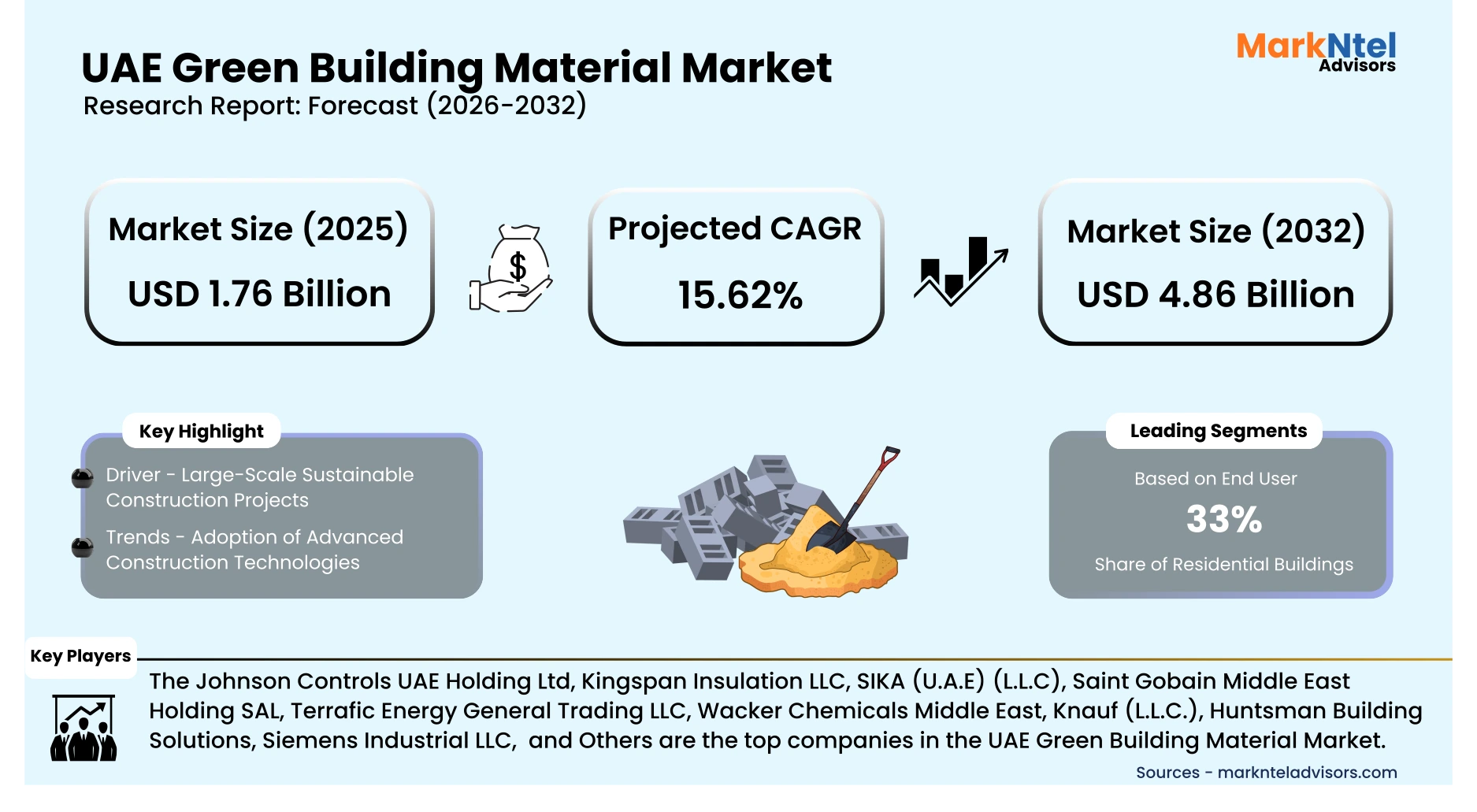
Projected 15.62% CAGR from 2026 to 2032
Study Period
2026-2032
Market Size (2025)
USD 1.76 Billion
Market Size (2032)
USD 4.86 Billion
Base Year
2025
Projected CAGR
15.62%
Leading Segments
By End User: Residential Buildings
UAE Green Building Material Market Report Key Takeaways:
- Market size was valued at around USD 1.76 billion in 2025 and is projected to reach USD 4.86 billion by 2032. The estimated CAGR from 2026 to 2032 is around 15.62%, indicating strong growth.
- Abu Dhabi & Al Ain hold the largest market share of about 42% in the UAE Green Building Material Market in 2025.
- By product type, the insulation materials segment represented a significant share of about 32% in the UAE Green Building Material Market in 2025.
- By end user, the residential buildings segment seized a significant share of about 33% in the UAE Green Building Material Market in 2025.
- Leading green building material companies in the UAE are Kingspan Insulation LLC, SIKA (U.A.E) (L.L.C), Saint Gobain Middle East Holding SAL, Terrafic Energy General Trading LLC, Wacker Chemicals Middle East, Knauf (L.L.C.), Huntsman Building Solutions, Siemens Industrial LLC, Holcim UAE, Styro Insulations Materials Industries LLC, RAK Ceramics P.J.S.C., and Others.
Market Insights & Analysis: UAE Green Building Material Market (2026-32):
The UAE Green Building Material Market size was valued at around USD 1.76 billion in 2025 and is projected to reach USD 4.86 billion by 2032. Along with this, the market is estimated to grow at a CAGR of around 15.62% during the forecast period, i.e., 2026-32.
The UAE Green Building Material Market is projected to expand steadily, driven by large-scale sustainable construction initiatives and the increasing integration of advanced construction technologies across new developments.
The UAE green building materials market is advancing steadily as sustainability principles become embedded within large-scale construction planning across multiple emirates. In Abu Dhabi, the continued expansion of Masdar City represents a cornerstone of sustainable urban development. According to Masdar’s 2024 ESG disclosures, ongoing projects include net-zero energy commercial buildings and public infrastructure that mandate the use of low-carbon concrete, high-efficiency insulation, and solar-integrated façades. These developments are designed to achieve superior performance benchmarks under Estidama Pearl and international green certification systems, thereby reinforcing sustained demand for environmentally responsible building materials across institutional and commercial end-users.
Further reinforcing Abu Dhabi’s leadership, Masdar City’s M-19D office development, currently under construction, targets one of the highest sustainability certification levels globally. The project incorporates advanced envelope materials, recycled steel components, and passive cooling design to significantly reduce embodied and operational carbon.
Additionally, the upcoming Connect Park expansion, scheduled for completion in 2025, integrates agrivoltaic systems and stormwater-responsive materials, broadening applications for innovative green construction inputs within public spaces and mixed-use developments.
Beyond Abu Dhabi, sustainable construction is also shaping residential and community-focused projects in other emirates. The Sustainable City on Yas Island continues to demonstrate large-scale adoption of eco-certified materials, achieving energy demand reductions of up to 50% through optimized building envelopes and renewable integration.
In Sharjah, the Khalid Bin Sultan City development has progressed through initial phases with strong market absorption, prompting preparations for subsequent construction stages that prioritize low-impact materials, water-efficient systems, and climate-responsive architecture, thereby extending material demand into the medium term.
In Dubai, sustainability-oriented construction is gaining renewed momentum through the establishment of Expo City’s Green Innovation District, which is positioned as a national platform for clean-energy infrastructure, circular construction practices, and climate-focused urban design.
Looking beyond 2025, the UAE’s Net-Zero by 2050 Strategy is expected to drive further tightening of building performance standards, including lifecycle carbon assessments and enhanced material efficiency requirements.
Overall, the convergence of region-specific green construction projects and forward-looking regulatory ambitions positions the UAE green building materials market for sustained growth well beyond 2025, underpinned by continuous innovation and expanding application scope.
UAE Green Building Material Market Recent Developments:
- 2025: DesertBoard, a UAE firm, introduced Palm Strand Board (PSB), a sustainable construction material made from regenerated date palm biomass. Launched at the Saudi Wood Expo 2025, PSB transforms abundant agricultural palm waste into a durable, moisture‑resistant, and high‑insulation building board, supporting circular economy goals and regional sustainability needs.
UAE Green Building Material Market Scope:
| Category | Segments |
|---|---|
| By Product Type | Eco-friendly Structural Materials (Recycled Steel & Metal Products, Sustainable Wood Products & Engineered Timber, Bamboo & Bio-based Composites, Low Carbon Concrete / Green Concrete), Energy Efficiency Materials (Insulation Materials, Low VOC and Non-Toxic Paints & Coatings, High Performance Glazing & Windows, Green Roof & Cool Roof Systems, Solar Panels & Building Integrated Photovoltaics (BIPV) |
| By Construction Type | Greenfield Construction, Retrofit / Renovation Projects, Modular & Prefabricated Construction, Net Zero / Energy Positive Building Projects |
| By Price Tier | Budget Range, Mid-Range, Premium Range |
| By Application | Exterior (Windows, Roofing, Doors, Sidings, Others), Interior (Floorings, Insulation, Building Systems, Others), Structural, Others |
| By End User | Residential Buildings, Commercial Buildings, Industrial Facilities, Government & Public Sector Projects, Institutional Buildings |
UAE Green Building Material Market Driver:
Large-Scale Sustainable Construction Projects
A central driver of demand in the UAE green building materials industry is the proliferation of new, high-profile sustainable construction projects that embed stringent environmental performance requirements into material specifications.
In Masdar City, Abu Dhabi, net-zero developments are driving demand for advanced green materials. The completed NZ1 commercial building generates 101% of its energy through on-site solar and diverts nearly 90% of construction waste, demonstrating large-scale integration of sustainable materials and systems.
In addition to NZ1, Masdar City Square comprises seven commercial buildings covering approximately 50,000 square meters and targets LEED Platinum, WELL Gold, and Estidama 4-Pearl certifications, including a net-zero energy headquarters that integrates solar PV façades and high-efficiency structural systems .
Another demand-generating project is the Middle East’s first net-zero energy mosque in Masdar City, scheduled for completion in 2025. The building integrates 1,590 m² of photovoltaic panels, rammed-earth insulation, and passive cooling systems, reinforcing sustainable material adoption in community infrastructure.
Furthermore, 385 new buildings in Abu Dhabi met Estidama sustainability standards by early 2025, spanning residential, commercial, and institutional sectors, indicating widespread uptake of green construction norms that require certified sustainable materials for compliance .
The acceleration of sustainable mega-projects, particularly net-zero energy developments with rigorous certification benchmarks, is a structural demand driver for green building materials in the UAE, shaping procurement practices and scaling the use of advanced sustainable inputs across the built environment.
UAE Green Building Material Market Trend:
Adoption of Advanced Construction Technologies
A key trend in the UAE green building materials market is the adoption of advanced construction technologies and digital tools that enhance sustainability, reduce waste, and optimize material performance.
Building Information Modeling (BIM) has emerged as a pivotal innovation, with Dubai mandating BIM for large-scale projects from January 2024. BIM enables accurate material planning, early conflict detection, and energy performance optimization, while its integration with AI and machine learning enhances decision-making around resource allocation and efficiency.
Another advancing trend is the application of 3D printing technology for construction. The UAE is actively promoting the use of 3D printing, with commitments announced at industry forums for 25% of new buildings to be 3D printed by 2030 . This technology not only allows for highly customizable design solutions but also significantly reduces material waste and construction time, aligning with sustainability priorities.
Meanwhile, IoT-enabled sensors and digital twins allow real-time monitoring of environmental conditions, structural integrity, and energy use on sites in Dubai, improving scheduling and reducing lifecycle costs .
Material innovation continues with eco-friendly concretes and low-emission composites. UAE University research in 2024 demonstrated concrete blocks that absorb CO₂ during production, offering both emission reduction and carbon sequestration potential.
The convergence of BIM, 3D printing, IoT, and advanced eco-materials is establishing a sustained technological trend that enhances construction efficiency and accelerates green material adoption across the UAE.
These technological advancements are not isolated; they are converging within design, construction, and materials supply chains to standardize performance-oriented sustainability, pushing the market toward higher efficiency and lower environmental impact.
UAE Green Building Material Market Opportunity
Expansion of Sustainable Construction Frameworks and Project Pipelines
The UAE presents a substantial opportunity for green building material adoption through expanded sustainable construction mandates and project pipelines across multiple emirates. In Ras Al Khaimah Economic Zone (RAKEZ), the endorsement of the Barjeel green building regulations and the ongoing development of new industrial warehouses and worker accommodations designed to meet these standards signal expanding demand for energy-efficient insulation, eco-certified façade systems, and water-saving fixtures in non-traditional construction segments . This creates a broader structural base for sustainable material uptake beyond conventional urban cores.
Large-scale events and industry platforms such as Big 5 Global 2025 in Dubai showcased a cohort of 19 French companies exhibiting bio-based and low-carbon material solutions, intensifying cross-border collaboration on sustainable products and positioning the UAE as a regional hub for advanced construction inputs . This influx of international suppliers with eco-certified portfolios enhances choice for developers and expands opportunities for localized production and distribution partnerships.
Professional training initiatives also underpin market opportunities. For example, the Emirates Green Building Council (EmiratesGBC) sustainable construction training in mid-2025, developed with Holcim Academy, focuses on low-carbon concrete and concrete lifecycle assessment, signaling investment in skills that facilitate broader adoption of innovative green materials across design and execution phases.
The combination of new regulatory frameworks, strong market uptake of sustainable communities, international supplier engagement, and targeted professional capacity building creates a favorable structural environment for new entrants and established suppliers to scale in the UAE green building material market.
UAE Green Building Material Market Challenge:
Skilled Workforce Shortage Impeding Market Growth
Despite strong policy support, several challenges threaten the growth of green building materials in the UAE. Supply chain constraints are a core issue; essential materials like steel, concrete, and glass face delays and shortages due to global shipping bottlenecks, fluctuating raw material prices, and logistical complexities. These disruptions increase lead times, cause project delays, and raise costs, undermining schedule reliability.
The sector also faces skilled workforce shortages. A 2025 industry survey reported that 46% of UAE construction firms struggle to recruit professionals capable of specifying and installing advanced sustainable materials and systems, directly impacting project implementation .
High material costs further constrain adoption. Rising prices, driven by import dependencies and global market pressures, can erode margins and deter developers from selecting premium eco‑materials, even when long-term savings are available.
Collectively, these structural factors supply chain disruption, workforce shortages, and rising input costs constrain project execution timelines, inflate budgets, and may slow the mainstream adoption of green building materials across large sustainable developments.
Addressing supply chain resilience and skilled labor gaps will be essential to maintain construction momentum and ensure widespread integration of sustainable materials in the UAE.
UAE Green Building Material Market (2026-32) Segmentation Analysis:
The UAE Green Building Material Market study of MarkNtel Advisors evaluates & highlights the major trends and influencing factors in each segment. It includes predictions for the period 2026–32 at the country level. Based on the analysis, the market has been further classified as;
Based on Product Type:
- Eco-friendly Structural Materials
- Recycled Steel & Metal Products
- Sustainable Wood Products & Engineered Timber
- Bamboo & Bio-based Composites
- Low Carbon Concrete / Green Concrete
- Energy Efficiency Materials
- Insulation Materials
- Low VOC and Non-Toxic Paints & Coatings
- High Performance Glazing & Windows
- Green Roof & Cool Roof Systems
- Solar Panels & Building Integrated Photovoltaics (BIPV)
The insulation materials segment dominates the UAE Green Building Material market, accounting for around 32% market share, reflecting due to their central role in meeting energy efficiency and sustainability requirements embedded in local building codes.
Dubai’s Green Building Regulations, overseen by the Dubai Supreme Council of Energy, explicitly promote improved energy performance and near‑zero energy buildings, which significantly depend on advanced insulation products to reduce cooling loads and overall energy use in new constructions. Compliance with these regulations has positioned insulation as a baseline requirement in material specifications.
Government and industry initiatives also underscore insulation’s importance: retrofit programmes, such as Dubai’s plan to enhance efficiency in over 9,000 government buildings through solar integration and smart technology, implicitly reinforce insulation use since effective thermal envelopes are vital for achieving energy targets under the Dubai Demand Side Management Strategy 2050.
Abu Dhabi’s Estidama Pearl Rating System and Ras Al Khaimah’s Barjeel Green Building Regulations similarly mandate minimum energy performance and envelope standards for newly constructed buildings, creating widespread material demand for high‑performance insulation, reflective coatings, and roof systems that improve thermal resistance.
Based on End User:
- Residential Buildings
- Commercial Buildings
- Industrial Facilities
- Government & Public Sector Projects
- Institutional Buildings
The residential buildings dominate the UAE Green Building Material Market, holding around 33% market share, driven by rising demand for sustainable living spaces, rapid urban growth, and strengthened regulatory and consumer focus on eco-efficient homes.
In 2025, residential projects accounted for the largest share of green building applications, reflecting ongoing investments in housing developments designed to integrate energy-efficient systems, low-carbon materials, and smart water management solutions, thereby reducing both operational costs and environmental impact.
High-profile residential projects exemplify this dominance. For instance, DEWA’s LEED Platinum residential complex in Warsan, Dubai, achieved 28% energy savings and 61% water savings while incorporating low-VOC certified interiors and high-performance insulation, highlighting how material selection is directly aligned with sustainability targets in multi-family housing.
Further reinforcing residential dominance, upcoming master-planned developments such as Jubail Island in Abu Dhabi are designed with sustainability at the core, combining natural ecosystem preservation with high-performance green materials, ensuring that residential demand continues to drive innovation and growth in the green building materials market.
The convergence of regulatory incentives, consumer demand for sustainable living, and landmark eco-residential projects positions the residential buildings segment as the largest and most influential driver of green material adoption in the UAE.
UAE Green Building Material Market (2026-32): Regional Projection
Abu Dhabi & Al Ain dominates the UAE Green Building Material Market with an estimated 42% share, driven by comprehensive sustainability mandates and high-volume project implementation.
The Estidama Pearl Rating System, enforced across all new buildings, has resulted in over 380 projects in design or construction meeting Estidama standards by 2025, creating consistent demand for low-carbon concrete, energy-efficient insulation, and certified sustainable finishes.
Abu Dhabi’s initiatives go beyond regulatory compliance, emphasizing energy and water efficiency, indoor environmental quality, and lifecycle sustainability of materials. Notable projects include net-zero energy commercial and residential developments integrating solar PV, recycled water systems, and advanced envelope technologies, setting benchmarks for material adoption and green construction practices.
In contrast, Dubai maintains a strong green construction presence through LEED-certified and Dubai Green Building Regulations-aligned projects, primarily driven by commercial and international certification requirements.
Sharjah and the Northern Emirates are emerging markets; flagship developments like Khalid Bin Sultan City showcase sustainable residential adoption, but at a smaller scale compared to Abu Dhabi.
Overall, regulatory rigor, high project volumes, and strategic sustainability initiatives consolidate Abu Dhabi & Al Ain as the leading region for green building material demand, establishing it as a benchmark for eco-friendly construction in the UAE.
Gain a Competitive Edge with Our UAE Green Building Material Market Report:
- UAE Green Building Material Market Report by MarkNtel Advisors provides a detailed & thorough analysis of market size & share, growth rate, competitive landscape, and key players. This comprehensive analysis helps businesses gain a holistic understanding of the market dynamics & make informed decisions.
- This report also highlights current market trends & future projections, allowing businesses to identify emerging opportunities & potential challenges. By understanding market forecasts, companies can align their strategies & stay ahead of the competition.
- UAE Green Building Material Market Report aids in assessing & mitigating risks associated with entering or operating in the market. By understanding market dynamics, regulatory frameworks, and potential challenges, businesses can develop strategies to minimize risks & optimize their operations.
*Reports Delivery Format - Market research studies from MarkNtel Advisors are offered in PDF, Excel and PowerPoint formats. Within 24 hours of the payment being successfully received, the report will be sent to your email address.
Frequently Asked Questions
- Market Segmentation
- Introduction
- Product Definition
- Research Process
- Assumptions
- Executive Summary
- UAE Green Building Material Market Policies, Regulations, and Product Standards
- UAE Green Building Material Market Trends & Developments
- UAE Green Building Material Market Dynamics
- Growth Factors
- Challenges
- UAE Green Building Material Market Hotspot & Opportunities
- UAE Green Building Material Market Outlook, 2022-2032F
- Market Size & Outlook
- By Revenues (USD Million)
- Market Share & Outlook
- By Product Type- Market Size & Forecast 2022-2032, USD Million
- Eco-friendly Structural Materials
- Recycled Steel & Metal Products
- Sustainable Wood Products & Engineered Timber
- Bamboo & Bio-based Composites
- Low Carbon Concrete / Green Concrete
- Energy Efficiency Materials
- Insulation Materials
- Low VOC and Non-Toxic Paints & Coatings
- High Performance Glazing & Windows
- Green Roof & Cool Roof Systems
- Solar Panels & Building Integrated Photovoltaics (BIPV)
- Eco-friendly Structural Materials
- By Construction Type- Market Size & Forecast 2022-2032, USD Million
- Greenfield Construction
- Retrofit / Renovation Projects
- Modular & Prefabricated Construction
- Net Zero / Energy Positive Building Projects
- By Price Tier - Market Size & Forecast 2022-2032, USD Million
- Budget Range
- Mid-Range
- Premium Range
- By Application - Market Size & Forecast 2022-2032, USD Million
- Exterior
- Windows
- Roofing
- Doors
- Sidings
- Others
- Interior
- Floorings
- Insulation
- Building Systems
- Others
- Structural
- Others
- Exterior
- By End User - Market Size & Forecast 2022-2032, USD Million
- Residential Buildings
- Commercial Buildings
- Industrial Facilities
- Government & Public Sector Projects
- Institutional Buildings
- By Region- Market Size & Forecast 2022-2032, USD Million
- Abu Dhabi & Al Ain
- Dubai
- Sharjah & Northern Emirates
- By Company
- Competition Characteristics
- Market Share & Analysis
- By Product Type- Market Size & Forecast 2022-2032, USD Million
- Market Size & Outlook
- UAE Eco-Friendly Structural Material Market Outlook, 2022-2032
- Market Size & Outlook
- By Revenues (USD Million)
- Market Share & Outlook
- By Construction Type- Market Size & Forecast 2022-2032, USD Million
- By Price Tier - Market Size & Forecast 2022-2032, USD Million
- By Application - Market Size & Forecast 2022-2032, USD Million
- By End User - Market Size & Forecast 2022-2032, USD Million
- By Region- Market Size & Forecast 2022-2032, USD Million
- Market Size & Outlook
- UAE Energy Efficiency Material Market Outlook, 2022-2032
- Market Size & Outlook
- By Revenues (USD Million)
- Market Share & Outlook
- By Construction Type- Market Size & Forecast 2022-2032, USD Million
- By Price Tier - Market Size & Forecast 2022-2032, USD Million
- By Application - Market Size & Forecast 2022-2032, USD Million
- By End User - Market Size & Forecast 2022-2032, USD Million
- By Region- Market Size & Forecast 2022-2032, USD Million
- Market Size & Outlook
- UAE Green Building Material Market Key Strategic Imperatives for Success & Growth
- Competitive Outlook
- Company Profiles
- Kingspan Insulation LLC
- Business Description
- Product Portfolio
- Collaborations & Alliances
- Recent Developments
- Financial Details
- Others
- SIKA (U.A.E) (L.L.C)
- Business Description
- Product Portfolio
- Collaborations & Alliances
- Recent Developments
- Financial Details
- Others
- Saint Gobain Middle East Holding SAL
- Business Description
- Product Portfolio
- Collaborations & Alliances
- Recent Developments
- Financial Details
- Others
- Terrafic Energy General Trading LLC
- Business Description
- Product Portfolio
- Collaborations & Alliances
- Recent Developments
- Financial Details
- Others
- Wacker Chemicals Middle East
- Business Description
- Product Portfolio
- Collaborations & Alliances
- Recent Developments
- Financial Details
- Others
- Knauf (L.L.C.)
- Business Description
- Product Portfolio
- Collaborations & Alliances
- Recent Developments
- Financial Details
- Others
- Huntsman Building Solutions
- Business Description
- Product Portfolio
- Collaborations & Alliances
- Recent Developments
- Financial Details
- Others
- Siemens Industrial LLC
- Business Description
- Product Portfolio
- Collaborations & Alliances
- Recent Developments
- Financial Details
- Others
- Holcim UAE
- Business Description
- Product Portfolio
- Collaborations & Alliances
- Recent Developments
- Financial Details
- Others
- Styro Insulations Materials Industries LLC
- Business Description
- Product Portfolio
- Collaborations & Alliances
- Recent Developments
- Financial Details
- Others
- RAK Ceramics P.J.S.C.
- Business Description
- Product Portfolio
- Collaborations & Alliances
- Recent Developments
- Financial Details
- Others
- Kingspan Insulation LLC
- Company Profiles
- Disclaimer
MarkNtel Advisors follows a robust and iterative research methodology designed to ensure maximum accuracy and minimize deviation in market estimates and forecasts. Our approach combines both bottom-up and top-down techniques to effectively segment and quantify various aspects of the market. A consistent feature across all our research reports is data triangulation, which examines the market from three distinct perspectives to validate findings. Key components of our research process include:
1. Scope & Research Design At the outset, MarkNtel Advisors define the research objectives and formulate pertinent questions. This phase involves determining the type of research—qualitative or quantitative—and designing a methodology that outlines data collection methods, target demographics, and analytical tools. They also establish timelines and budgets to ensure the research aligns with client goals.
2. Sample Selection and Data Collection In this stage, the firm identifies the target audience and determines the appropriate sample size to ensure representativeness. They employ various sampling methods, such as random or stratified sampling, based on the research objectives. Data collection is carried out using tools like surveys, interviews, and observations, ensuring the gathered data is reliable and relevant.
3. Data Analysis and Validation Once data is collected, MarkNtel Advisors undertake a rigorous analysis process. This includes cleaning the data to remove inconsistencies, employing statistical software for quantitative analysis, and thematic analysis for qualitative data. Validation steps are taken to ensure the accuracy and reliability of the findings, minimizing biases and errors.

4. Data Forecast and FinalizationThe final phase involves forecasting future market trends based on the analyzed data. MarkNtel Advisors utilize predictive modeling and time series analysis to anticipate market behaviors. The insights are then compiled into comprehensive reports, featuring visual aids like charts and graphs, and include strategic recommendations to inform client decision-making
We offer flexible licensing options to cater to varying organizational needs. Choose the pricing pack that best suits your requirements:
Buy Now Inquire Before Buying
 Request Customization
 Talk to our Consultant







