

UAE Camel Milk Market Research Report: Trends, Forecast & Opportunities (2026-2032)
By Product Type (Fresh Camel Milk, Processed Camel Milk Products, Others), By Packaging Type (Bottles, Cartons / Tetra Packs, Plastic Containers, Pouches / Sachets, Others), By Dis ... tribution Channel (Supermarkets & Hypermarkets, Convenience Stores, Specialty Stores, Online Retail / E-commerce, Direct Sales), By Application (Food & Beverage Processing, Nutraceuticals / Functional Foods, Cosmetics & Personal Care, Pharmaceuticals, Others), By End User (Households, Foodservice, Institutional Buyers), and others Read more
- Food & Beverages
- Mar 2026
- Pages 120
- Report Format: PDF, Excel, PPT
UAE Camel Milk Market
Projected 7.85% CAGR from 2026 to 2032
Study Period
2026-2032
Market Size (2026)
USD 108 Million
Market Size (2032)
USD 170 Million
Base Year
2025
Projected CAGR
7.85%
Leading Segments
By End User: Households
UAE Camel Milk Market Report Key Takeaways:
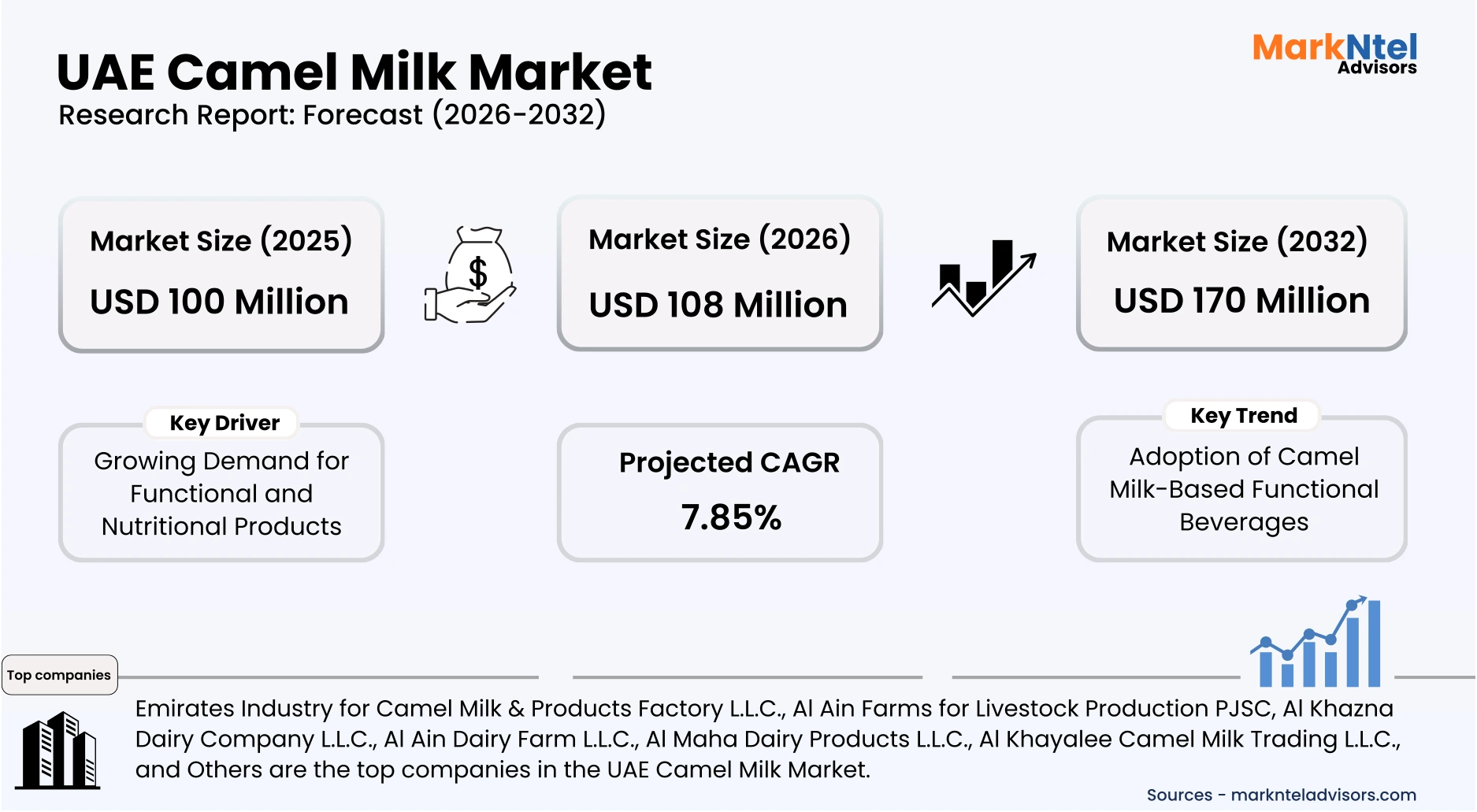
- The UAE Camel Milk Market size was valued at USD 100 million in 2025 and is projected to grow from USD 108 million in 2026 to USD 170 million by 2032, exhibiting a CAGR of 7.85% during the forecast period.
- By product type, the fresh camel milk segment represented a significant share of about 52% in the UAE Camel Milk Market in 2026.
- By end user, the households segment seized a significant share of about 65% in the UAE Camel Milk Market in 2026.
- Leading companies in the UAE market are Emirates Industry for Camel Milk & Products Factory L.L.C., Al Ain Farms for Livestock Production PJSC, Al Khazna Dairy Company L.L.C., Al Ain Dairy Farm L.L.C., Al Maha Dairy Products L.L.C., Al Khayalee Camel Milk Trading L.L.C., and Others.
Market Insights & Analysis: UAE Camel Milk Market (2026-32):
The UAE Camel Milk Market size was valued at USD 100 million in 2025 and is projected to grow from USD 108 million in 2026 to USD 170 million by 2032. Along with this, the market is estimated to grow at a CAGR of around 7.85% during the forecast period, i.e., 2026-32.
The UAE Camel Milk Market is projected to expand steadily, driven by increasing consumer preference for functional and nutrient-rich dairy products, along with the rising adoption of camel milk-based functional beverages among health-conscious consumers.
Camel milk is widely recognized for its distinctive nutritional profile and health benefits, which encourage both domestic consumption and international demand. Its composition includes approximately 3–3.9% protein, primarily derived from casein and whey proteins. Unlike cow’s milk, camel milk does not contain certain allergenic proteins such as β-lactoglobulin, making it easier to digest and less likely to trigger milk allergies.
In addition to its nutritional value, camel milk has gained attention for its potential role in managing metabolic conditions. Scientific studies highlight that camel milk contains insulin-like proteins and bioactive peptides that can support glucose metabolism. Research has shown that camel milk protein hydrolysate administered at 500 mg per kilogram of body weight demonstrated hypoglycemic and hypolipidemic effects, reducing both blood glucose and lipid levels while improving antioxidant enzyme activity. Such findings have strengthened camel milk’s positioning as a functional dairy product in health and wellness segments.
Another advantage of camel milk is its greater heat stability compared with cow’s milk. Experimental studies indicate that at temperatures around 90°C, cow milk experiences greater whey protein denaturation than camel milk. This improved heat tolerance allows camel milk to maintain stability during processing and storage. Furthermore, higher concentrations of antimicrobial components such as lysozyme and lactoferrin help extend shelf life, allowing camel milk to be stored for longer periods without rapid spoilage.
The UAE also benefits from a strong livestock base that supports camel dairy production. According to the Abu Dhabi Agriculture and Food Safety Authority (ADAFSA), Abu Dhabi hosts approximately 476,082 camels, including 254,034 in Al Ain and 99,071 in Abu Dhabi city, providing a substantial foundation for camel milk production and processing . Government-supported livestock programs are focused on improving breeding efficiency and productivity to strengthen food security and expand the supply of nutrient-rich dairy products.
At the same time, innovation in value-added products is shaping the market outlook. The growing popularity of camel milk-based functional beverages is attracting consumers seeking convenient, health-oriented drink options. These products expand consumption occasions and strengthen camel milk’s role in the functional beverage segment.
Future market expansion is also supported by the global ambitions of UAE dairy companies. For example, Camelicious, one of the country’s major camel dairy producers, plans to expand distribution to more than 30 international markets by 2030, particularly in Asia, where demand for functional dairy products is increasing. The company expects annual growth of 15–20%, driven by exports and product diversification.
The growing adoption of camel milk-based functional beverages is increasing consumer interest in nutrient-rich dairy alternatives. These convenient, health-focused drinks expand consumption occasions and attract wellness-oriented consumers, supporting higher demand and accelerating overall camel milk market growth.
UAE Camel Milk Market Recent Developments:
- 2025: Emirates Industry for Camel Milk & Products (Camelicious) outlined plans to expand camel milk consumption in the UAE. Former CEO Mark Wyllie emphasized increasing the consumer base and promoting camel milk as a health-focused dairy product produced at one of the world’s largest camel farms near Dubai.
UAE Camel Milk Market Scope:
| Category | Segments |
|---|---|
| By Product Type | (Fresh Camel Milk, Processed Camel Milk Products, Others), |
| By Packaging Type | (Bottles, Cartons / Tetra Packs, Plastic Containers, Pouches / Sachets, Others), |
| By Distribution Channel | (Supermarkets & Hypermarkets, Convenience Stores, Specialty Stores, Online Retail / E-commerce, Direct Sales), |
| By Application | (Food & Beverage Processing, Nutraceuticals / Functional Foods, Cosmetics & Personal Care, Pharmaceuticals, Others), |
| By End User | (Households, Foodservice, Institutional Buyers), |
UAE Camel Milk Market Driver:
Growing Demand for Functional and Nutritional Products
The strong nutritional composition and digestibility of camel milk are significant factors driving demand in the UAE camel milk market. As consumers increasingly prioritize functional foods and nutrient-dense dairy alternatives, camel milk is gaining recognition for its superior nutritional profile and potential health benefits.
Scientific research indicates that camel milk contains 3–5 times higher vitamin C levels than cow’s milk, with concentrations typically ranging between 35 and 37 mg per liter. This high vitamin C content contributes to improved immune function and antioxidant protection, strengthening camel milk’s positioning as a functional dairy product in health-oriented diets.
Camel milk contains a diverse range of essential minerals that support overall health. Nutritional studies indicate it provides about 114 mg of calcium, 156 mg of potassium, 10.5 mg of magnesium, 59 mg of sodium, and 51.5 mg of phosphorus per 100 g, along with trace elements such as iron, zinc, copper, and manganese, which help maintain bone strength, regulate metabolic functions, balance electrolytes, and support immune health .
Camel milk is suitable for individuals with dairy intolerance due to its protein composition. β-casein accounts for about 65% of total casein in camel milk, compared with around 36% in cow milk. The absence of allergenic proteins such as β-lactoglobulin reduces allergy risks, making it a viable alternative to conventional dairy.
The superior nutrient composition and improved digestibility of camel milk are strengthening its adoption as a functional dairy product. As awareness of these health benefits grows, consumer demand is expected to increase, supporting sustained expansion of the UAE camel milk market.
UAE Camel Milk Market Trend:
Adoption of Camel Milk-Based Functional Beverages
A prominent trend in the UAE camel milk market is the rising popularity of camel milk-based functional beverages, reflecting shifting consumer preferences toward nutrient-dense drinks that support immunity, energy levels, and digestive wellness.
Camel milk is naturally rich in essential nutrients, including vitamin C, iron, bioactive proteins, and immunoglobulins, which support immune function and metabolic health. These nutritional attributes have encouraged beverage manufacturers to utilize camel milk as a key ingredient in health-oriented drink formulations.
To capitalize on this demand, UAE dairy companies are increasingly introducing ready-to-drink camel milk beverages with functional positioning. In 2025, Emirates Industry for Camel Milk & Products (Camelicious) introduced an updated line of flavored camel milk drinks featuring date, chocolate, and strawberry varieties. These beverages are designed to appeal to consumers seeking convenient, nutritious drink options while maintaining the traditional benefits associated with camel milk.
The introduction of flavored and value-added camel milk beverages indicates a shift from conventional dairy consumption toward innovative beverage formats that combine nutrition, convenience, and taste.
As consumer awareness of functional foods continues to increase in the UAE, the development of camel milk-based beverages is becoming an important strategy for dairy companies to expand product portfolios and reach new health-conscious customer segments.
UAE Camel Milk Market Opportunity:
Government Support for Camel Farming and Local Heritage
Government initiatives to preserve camel farming and Emirati heritage are creating growth opportunities for the UAE camel milk market. Support through veterinary services, breeding programs, and livestock development helps maintain healthy camel populations and strengthens the supply chain for camel dairy production.
A key example is the ongoing programs implemented by the Abu Dhabi Agriculture and Food Safety Authority (ADAFSA) to improve herd productivity and animal health across the emirate. In 2023, ADAFSA delivered 185,797 veterinary services to more than 130,700 camels, covering treatments, medical examinations, vaccinations, and reproductive support .
In addition, 237,487 camels received parasite-control spraying treatments, helping prevent diseases and improve livestock productivity . These initiatives ensure healthier camel herds and enable a consistent milk supply for dairy processing and product innovation.
Beyond veterinary care, the UAE government is also investing in research and biosecurity programs to strengthen the camel sector. Abu Dhabi hosts a globally recognized camel disease research centre that conducts advanced diagnostics, laboratory testing, and disease monitoring to safeguard camel health and improve livestock productivity. Such research infrastructure enhances the long-term sustainability of camel farming and supports the development of high-value dairy products derived from camel milk.
Government programs supporting camel health, breeding, and research are strengthening the livestock ecosystem in the UAE. By ensuring sustainable camel farming and improving herd productivity, these initiatives create strong opportunities for expanding camel milk production and accelerating the growth of the UAE camel milk market.
UAE Camel Milk Market Challenge:
High Production Costs and Limited Milk Yield
A significant challenge for the UAE camel milk market is the relatively low milk productivity of camels compared with conventional dairy animals, which restricts large-scale commercial production and limits supply availability.
According to the Food and Agriculture Organization, camels raised in desert environments typically produce around 2–6 liters of milk per day, which reflects the natural conditions under which many camel farms operate across the UAE. Even under improved intensive farming systems with controlled feeding and veterinary management, daily production generally ranges between 12 and 20 liters, still lower than the milk yield achieved by modern dairy cows in specialized dairy farms.
Another structural limitation affecting the UAE camel dairy sector is the long reproductive and lactation cycle of camels, which slows herd expansion and milk supply growth. FAO data indicates that camels produce approximately 800–3,600 liters of milk per lactation cycle, lasting between 9 and 18 months . In addition, camels reach reproductive maturity later than cattle, meaning herd productivity increases at a slower rate.
These biological characteristics make camel dairy farming more resource-intensive and less scalable. As a result, limited milk availability and higher operational costs can increase product prices, creating a barrier to widespread adoption and potentially slowing the overall growth of the UAE camel milk market.
UAE Camel Milk Market (2026-32) Segmentation Analysis:
The UAE Camel Milk Market study of MarkNtel Advisors evaluates & highlights the major trends and influencing factors in each segment. It includes predictions for the period 2026–32 at the country level. Based on the analysis, the market has been further classified as;
Based on Product Type:
- Fresh Camel Milk
- Raw camel milk
- Pasteurized camel milk
- Flavored camel milk
- Processed Camel Milk Products
- Camel milk powder
- Camel milk yogurt
- Camel milk cheese
- Camel milk ice cream
- Fermented camel milk beverages
- Others
The fresh camel milk segment dominates the UAE Camel Milk market, accounting for approximately 52% market share, due to strong consumer preference for minimally processed and nutritionally intact dairy products.
In the UAE, camel milk has traditionally been consumed in its fresh form, and many consumers perceive fresh milk as offering the highest nutritional value compared with processed alternatives. Raw and pasteurized camel milk retain essential nutrients such as vitamins, minerals, and bioactive proteins, which contribute to their popularity among health-conscious consumers seeking natural and functional dairy products.
Pasteurized camel milk is particularly dominant within the fresh milk segment, as it provides a balance between safety and nutritional quality. As a result, supermarkets, specialty health stores, and dairy retailers across the UAE widely distribute pasteurized camel milk, increasing its accessibility to a larger consumer base.
Flavored camel milk is also gaining traction within the fresh milk category. Manufacturers are introducing flavored variants to attract younger consumers and expand usage occasions. These ready-to-drink products combine the nutritional benefits of camel milk with enhanced taste profiles, supporting higher retail demand.
Overall, the dominance of fresh camel milk in the UAE market is supported by traditional consumption patterns, strong nutritional perception, and increasing availability through modern retail channels, making it the most widely consumed camel milk product category in the country.
Based on End User:
- Households
- Foodservice
- Restaurants
- Cafés
- Hotels
- Institutional Buyers
- Hospitals
- Schools
The households segment dominates the UAE Camel Milk Market, accounting for about 65% of the total market size, driven primarily by rising consumer awareness of the nutritional and functional benefits associated with camel milk consumption.
Camel milk is widely regarded as a nutrient-rich dairy product containing essential vitamins, minerals, and bioactive compounds that support immune health, digestion, and metabolic functions. As a result, many consumers in the UAE increasingly incorporate camel milk into their daily diets as a healthier alternative to conventional dairy products.
Cultural and traditional consumption patterns further reinforce the dominance of the household segment. Camel milk has long been an integral part of dietary practices in the region, and it continues to be widely consumed in homes due to its association with heritage, natural nutrition, and wellness.
The growing availability of camel milk through modern retail infrastructure has also strengthened household demand. Supermarkets, hypermarkets, specialty health stores, and online grocery platforms across the UAE have significantly improved product accessibility and distribution.
Overall, the combination of strong health awareness, cultural acceptance, and improved retail availability has positioned households as the dominant end-user segment in the UAE camel milk market.
Gain a Competitive Edge with Our UAE Camel Milk Market Report:
- UAE Camel Milk Market Report by MarkNtel Advisors provides a detailed & thorough analysis of market size & share, growth rate, competitive landscape, and key players. This comprehensive analysis helps businesses gain a holistic understanding of the market dynamics & make informed decisions.
- This report also highlights current market trends & future projections, allowing businesses to identify emerging opportunities & potential challenges. By understanding market forecasts, companies can align their strategies & stay ahead of the competition.
- UAE Camel Milk Market Report aids in assessing & mitigating risks associated with entering or operating in the market. By understanding market dynamics, regulatory frameworks, and potential challenges, businesses can develop strategies to minimize risks & optimize their operations.
*Reports Delivery Format - Market research studies from MarkNtel Advisors are offered in PDF, Excel and PowerPoint formats. Within 24 hours of the payment being successfully received, the report will be sent to your email address.
Frequently Asked Questions
- Market Segmentation
- Introduction
- Product Definition
- Research Process
- Assumptions
- Executive Summary
- UAE Camel Milk Market Policies, Regulations, and Product Standards
- UAE Camel Milk Market Trends & Developments
- UAE Camel Milk Market Dynamics
- Growth Factors
- Challenges
- UAE Camel Milk Market Hotspot & Opportunities
- UAE Camel Milk Market Outlook, 2022-2032F
- Market Size & Outlook
- By Revenues (USD Million)
- Market Share & Outlook
- By Product Type - Market Size & Forecast 2022-2032, USD Million
- Fresh Camel Milk
- Raw camel milk
- Pasteurized camel milk
- Flavored camel milk
- Processed Camel Milk Products
- Camel milk powder
- Camel milk yogurt
- Camel milk cheese
- Camel milk ice cream
- Fermented camel milk beverages
- Others
- Fresh Camel Milk
- By Packaging Type- Market Size & Forecast 2022-2032, USD Million
- Bottles
- Cartons / Tetra Packs
- Plastic Containers
- Pouches / Sachets
- Others
- By Distribution Channel- Market Size & Forecast 2022-2032, USD Million
- Supermarkets & Hypermarkets
- Convenience Stores
- Specialty Stores
- Online Retail / E-commerce
- Direct Sales
- By Application- Market Size & Forecast 2022-2032, USD Million
- Food & Beverage Processing
- Nutraceuticals / Functional Foods
- Cosmetics & Personal Care
- Pharmaceuticals
- Others
- By End User- Market Size & Forecast 2022-2032, USD Million
- Households
- Foodservice
- Restaurants
- Cafés
- Hotels
- Institutional Buyers
- Hospitals
- Schools
- By Region- Market Size & Forecast 2022-2032, USD Million
- Abu Dhabi & Al Ain
- Dubai
- Sharjah & Northern Emirates
- By Company
- Competition Characteristics
- Market Share & Analysis
- By Product Type - Market Size & Forecast 2022-2032, USD Million
- Market Size & Outlook
- UAE Fresh Camel Milk Market Outlook, 2022-2032
- Market Size & Outlook
- By Revenues (USD Million)
- Market Share & Outlook
- By Packaging Type- Market Size & Forecast 2022-2032, USD Million
- By Distribution Channel- Market Size & Forecast 2022-2032, USD Million
- By Application- Market Size & Forecast 2022-2032, USD Million
- By End User- Market Size & Forecast 2022-2032, USD Million
- By Region- Market Size & Forecast 2022-2032, USD Million
- Market Size & Outlook
- UAE Processed Camel Milk Products Market Outlook, 2022-2032
- Market Size & Outlook
- By Revenues (USD Million)
- Market Share & Outlook
- By Packaging Type- Market Size & Forecast 2022-2032, USD Million
- By Distribution Channel- Market Size & Forecast 2022-2032, USD Million
- By Application- Market Size & Forecast 2022-2032, USD Million
- By End User- Market Size & Forecast 2022-2032, USD Million
- By Region- Market Size & Forecast 2022-2032, USD Million
- Market Size & Outlook
- UAE Camel Milk Market Key Strategic Imperatives for Success & Growth
- Competitive Outlook
- Company Profiles
- Emirates Industry for Camel Milk & Products Factory L.L.C.
- Business Description
- Product Portfolio
- Collaborations & Alliances
- Recent Developments
- Financial Details
- Others
- Al Ain Farms for Livestock Production PJSC
- Business Description
- Product Portfolio
- Collaborations & Alliances
- Recent Developments
- Financial Details
- Others
- Al Khazna Dairy Company L.L.C.
- Business Description
- Product Portfolio
- Collaborations & Alliances
- Recent Developments
- Financial Details
- Others
- Al Ain Dairy Farm L.L.C.
- Business Description
- Product Portfolio
- Collaborations & Alliances
- Recent Developments
- Financial Details
- Others
- Al Maha Dairy Products L.L.C.
- Business Description
- Product Portfolio
- Collaborations & Alliances
- Recent Developments
- Financial Details
- Others
- Al Khayalee Camel Milk Trading L.L.C.
- Business Description
- Product Portfolio
- Collaborations & Alliances
- Recent Developments
- Financial Details
- Others
- Others
- Business Description
- Product Portfolio
- Collaborations & Alliances
- Recent Developments
- Financial Details
- Others
- Emirates Industry for Camel Milk & Products Factory L.L.C.
- Company Profiles
- Disclaimer
MarkNtel Advisors follows a robust and iterative research methodology designed to ensure maximum accuracy and minimize deviation in market estimates and forecasts. Our approach combines both bottom-up and top-down techniques to effectively segment and quantify various aspects of the market. A consistent feature across all our research reports is data triangulation, which examines the market from three distinct perspectives to validate findings. Key components of our research process include:
1. Scope & Research Design At the outset, MarkNtel Advisors define the research objectives and formulate pertinent questions. This phase involves determining the type of research—qualitative or quantitative—and designing a methodology that outlines data collection methods, target demographics, and analytical tools. They also establish timelines and budgets to ensure the research aligns with client goals.
2. Sample Selection and Data Collection In this stage, the firm identifies the target audience and determines the appropriate sample size to ensure representativeness. They employ various sampling methods, such as random or stratified sampling, based on the research objectives. Data collection is carried out using tools like surveys, interviews, and observations, ensuring the gathered data is reliable and relevant.
3. Data Analysis and Validation Once data is collected, MarkNtel Advisors undertake a rigorous analysis process. This includes cleaning the data to remove inconsistencies, employing statistical software for quantitative analysis, and thematic analysis for qualitative data. Validation steps are taken to ensure the accuracy and reliability of the findings, minimizing biases and errors.

4. Data Forecast and FinalizationThe final phase involves forecasting future market trends based on the analyzed data. MarkNtel Advisors utilize predictive modeling and time series analysis to anticipate market behaviors. The insights are then compiled into comprehensive reports, featuring visual aids like charts and graphs, and include strategic recommendations to inform client decision-making
We offer flexible licensing options to cater to varying organizational needs. Choose the pricing pack that best suits your requirements:
Buy Now Inquire Before Buying
 Request Customization
 Talk to our Consultant







