Qatar Raw Coffee Beans Market Research Report: Size, Share, Trends & Forecast (2026-2032)
By Beans Type (Arabica, Robusta, Liberica), By Grade (Specialty Grade, Commercial Grade, Commodity Grade), By Processing Method (Wet/Washed process, Dry/Natural process, Honey proc ... ess), By Packaging Type (Bags, Bulk/Unpackaged, Retail Packs), By Price Segment (Premium / Specialty Range, Mid-Range, Value / Commodity Range), By Distribution Channel (Wholesale Distributors & Importers, E-commerce / Online Platforms, Retail Chains (Grocery/Supermarkets), Direct Supply to B2B), By End-User (Household, Commercial), ans others Read more
- Food & Beverages
- Mar 2026
- Pages 140
- Report Format: PDF, Excel, PPT
Qatar Raw Coffee Beans Market
Projected 6.39% CAGR from 2026 to 2032
Study Period
2026-2032
Market Size (2026)
USD 131 Million
Market Size (2032)
USD 190 Million
Base Year
2025
Projected CAGR
6.39%
Leading Segments
By Beans Type: Arabica
Qatar Raw Coffee Beans Market Report Key Takeaways:
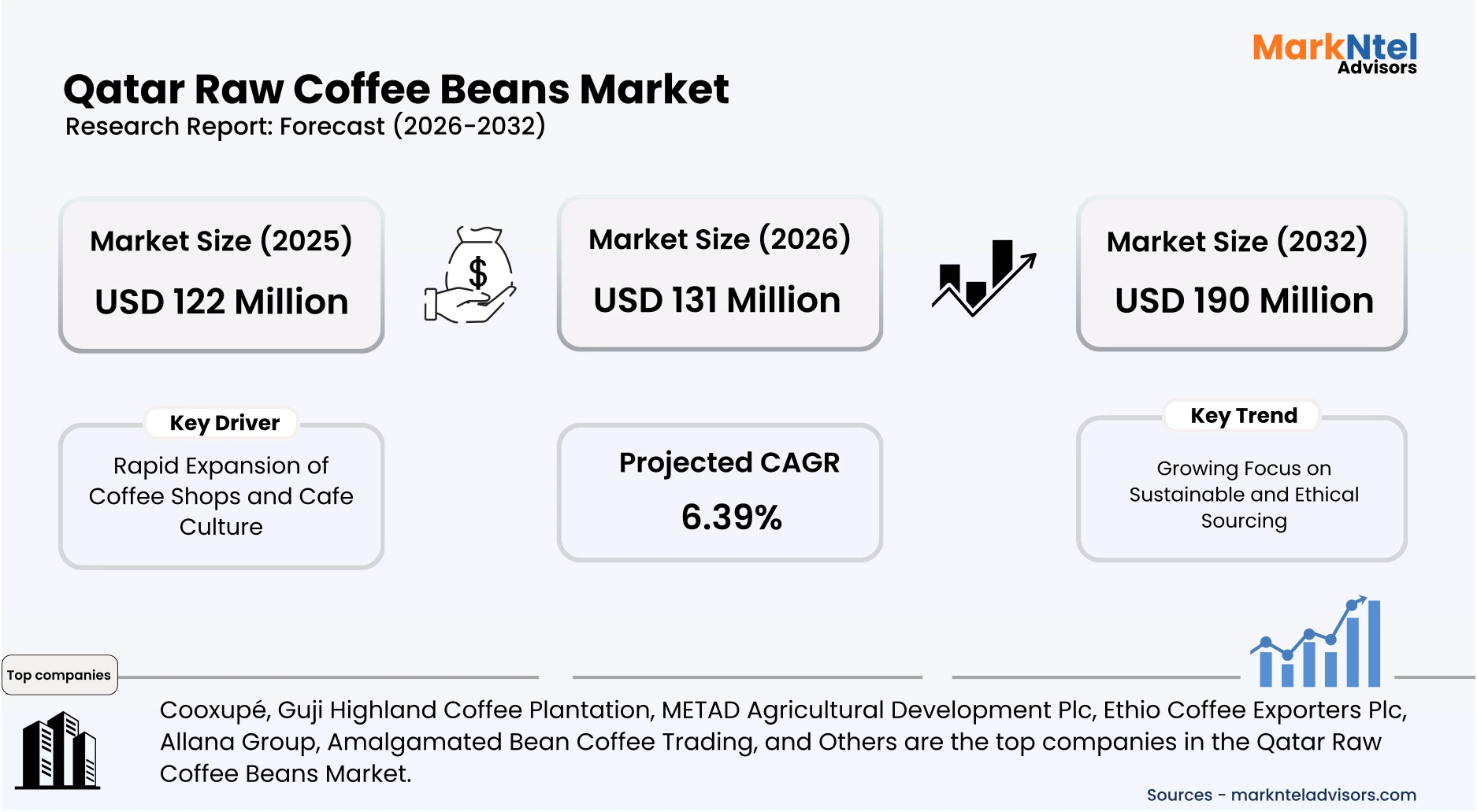
- The Qatar Raw Coffee Beans Market size was valued at USD 122 million in 2025 and is projected to grow from USD 131 million in 2026 to USD 190 million by 2032, exhibiting a CAGR of 6.39% during the forecast period.
- By Beans Type, the arabica segment represented a significant share of about 55% in the Qatar Raw Coffee Beans Market in 2026.
- By end user, the commercial segment presented a significant share of about 50% in the Qatar Raw Coffee Beans Market in 2026.
- Leading companies in Qatar are Cooxupé, Guji Highland Coffee Plantation, METAD Agricultural Development Plc, Ethio Coffee Exporters Plc, Allana Group, Amalgamated Bean Coffee Trading, and Others.
Market Insights & Analysis: Qatar Raw Coffee Beans Market (2026-32):
The Qatar Raw Coffee Beans Market size was valued at USD 122 million in 2025 and is projected to grow from USD 131 million in 2026 to USD 190 million by 2032. Along with this, the market is estimated to grow at a CAGR of around 6.39% during the forecast period, i.e., 2026-32.
The Qatar Raw Coffee Beans Market is projected to expand steadily, driven by the rapid expansion of café culture, tourism development, and increasing emphasis on sustainable sourcing practices. As specialty coffee consumption rises across urban areas, demand for high-quality green coffee beans used by roasters and cafés continues to increase.
The growth of coffee shops across Qatar is a key factor driving the need for raw coffee beans. As of 2025, Qatar had approximately 519 cafés, reflecting the steady expansion of the country’s beverage-focused foodservice sector .
Meanwhile, Doha alone accounts for around 290 cafés, highlighting the capital city as the primary hub for specialty coffee consumption and café activity . The increasing number of cafés, specialty coffee roasters, and independent coffee brands directly supports higher imports of raw coffee beans that are later roasted locally for beverages and retail products.
Tourism and hospitality development also contribute significantly to coffee demand in Qatar. According to tourism sector updates, Qatar currently has around 40,000 hotel rooms, with approximately 7,000 additional rooms under development expected to enter the market in the coming years. Hotels commonly integrate cafés, lounges, and specialty beverage outlets as part of their hospitality offerings, which significantly increases the consumption of roasted coffee and consequently the import demand for raw coffee beans.
In parallel, sustainability initiatives are increasingly influencing sourcing practices in Qatar’s coffee sector. Programs such as Qatar Sustainability Week 2024, supported by the Ministry of Environment and Climate Change, encourage restaurants, cafés, and hospitality operators to adopt responsible sourcing strategies and reduce environmental impact. These initiatives indirectly promote the use of ethically sourced agricultural commodities, including traceable raw coffee beans.
Furthermore, Qatar’s tourism sector continues to expand through international events and exhibitions. The country hosted more than 600 tourism and cultural events in 2025, attracting large numbers of visitors and increasing beverage consumption across cafés, hotels, and dining establishments.
Large-scale urban and retail developments are also strengthening café infrastructure. For example, Baraha Town in Doha, a mixed-use development scheduled to open starting in 2025, will feature over 229 retail outlets along with a 7,764 square meter culinary district dedicated to restaurants, cafés, and food courts with outdoor dining areas . Such integrated dining districts typically attract international coffee chains, specialty cafés, and independent roasters, further expanding the coffee ecosystem and supporting the demand for raw coffee beans.
The expansion of cafés, growth of the tourism and hospitality sector, and the development of large retail dining districts are expected to significantly increase coffee consumption in Qatar. Along with sustainability-driven sourcing practices, these factors will strengthen demand for imported raw coffee beans and support the long-term growth of the Qatar Raw Coffee Beans Market.
Qatar Raw Coffee Beans Market Recent Developments:
- 2025: The Qatar World Coffee Expo 2025 was held at the Qatar National Convention Centre in Doha, bringing together over 340 exhibitors and around 12,000 visitors from the global coffee industry. The event showcased specialty coffee origins, green coffee sourcing, roasting technologies, and brewing innovations, strengthening trade connections between international coffee producers and local roasters. Such platforms support higher imports of raw (green) coffee beans to meet the growing demand from Qatar’s expanding café and specialty coffee sector.
Qatar Raw Coffee Beans Market Scope:
| Category | Segments |
|---|---|
| By Beans Type | (Arabica, Robusta, Liberica), |
| By Grade | (Specialty Grade, Commercial Grade, Commodity Grade), |
| By Processing Method | (Wet/Washed process, Dry/Natural process, Honey process), |
| By Packaging Type | (Bags, Bulk/Unpackaged, Retail Packs), |
| By Price Segment | (Premium / Specialty Range, Mid-Range, Value / Commodity Range), |
| By Distribution Channel | (Wholesale Distributors & Importers, E-commerce / Online Platforms, Retail Chains (Grocery/Supermarkets), Direct Supply to B2B), |
| By End-User | (Household, Commercial), |
Qatar Raw Coffee Beans Market Driver:
Rapid Expansion of Coffee Shops and Cafe Culture
The rapid growth of coffee shops and cafés across Qatar is a major factor driving demand in the raw coffee beans market. Over the past few years, the rising number of specialty cafés, independent outlets, and international chains reflects growing consumer preference for premium coffee beverages and café-centric social experiences.
Much of this growth is concentrated in major urban municipalities. For example, Doha hosts about 307 coffee shops, making it the country’s primary coffee hub, while Al Rayyan Municipality has around 247 outlets. These establishments rely on roasted coffee produced from imported green beans, significantly increasing demand for raw coffee bean imports.
A similar pattern is observed in the café segment. For instance, Doha accounts for about 290 cafés, demonstrating the city’s dominance as the center of specialty coffee consumption and café culture.
Similarly, Al Rayyan Municipality hosts around 168 cafés, reflecting the continued growth of café-based foodservice outlets in suburban and residential districts . The concentration of cafés and coffee shops in these municipalities creates a strong local ecosystem of coffee roasters, beverage retailers, and hospitality businesses that rely on consistent supplies of high-quality raw coffee beans.
The growing number of coffee shops and cafés across Doha and Al Rayyan is strengthening the country’s coffee consumption ecosystem. This expanding café culture is expected to significantly increase the demand for imported raw coffee beans, supporting the sustained growth of the Qatar raw coffee beans market.
Qatar Raw Coffee Beans Market Trend:
Growing Focus on Sustainable and Ethical Sourcing
Sustainability and ethical sourcing are increasingly shaping procurement practices in Qatar’s raw coffee beans market, driven by the rapid expansion of specialty cafés and local roasting businesses.
Coffee importers are required to comply with strict quality and traceability regulations established by the Qatar General Organization for Standards and Metrology, which mandate certification related to product origin, contaminants, and safety standards. These regulatory requirements encourage importers to procure green coffee beans from verified suppliers with transparent supply chains and responsible farming practices.
Industry events are also accelerating the adoption of sustainable sourcing practices. The Doha International Coffee Exhibition 2025 hosted more than 250 exhibitors from over 20 countries, highlighting innovations in specialty coffee production, sustainable cultivation, and responsible sourcing practices . These platforms help Qatari roasters establish relationships with coffee-producing countries, facilitating imports of ethically sourced green coffee beans.
Looking ahead, sustainability goals outlined in Qatar National Vision 2030 emphasize responsible consumption and sustainable supply chains, which are expected to further increase demand for certified organic and fair-trade raw coffee beans.
As sustainability becomes embedded in Qatar’s foodservice and hospitality sectors, coffee buyers are increasingly prioritizing traceable and responsibly sourced green coffee. This shift toward ethical sourcing will expand imports of certified raw coffee beans and strengthen the country’s specialty coffee market in the coming years.
Qatar Raw Coffee Beans Market Opportunity:
Growth in Hospitality and Tourism Coffee Demand
The expansion of tourism and hospitality infrastructure in Qatar is creating significant opportunities for the raw coffee beans market. Hotels, restaurants, cafés, and conference venues increasingly serve specialty coffee beverages, which require a steady supply of high-quality green coffee beans for roasting and brewing.
According to Qatar Tourism, the country welcomed approximately 5.08 million visitors in 2024, representing a 25% increase compared with 2023. During the same year, the hospitality sector recorded around 10 million hotel room nights , reflecting strong hotel occupancy and visitor activity across the country. Growing tourist arrivals naturally increase beverage consumption within hotels, cafés, and restaurants, where coffee is one of the most frequently served drinks for both leisure and business travelers.
The upward trend continued into 2025, when international visitor arrivals reached about 5.1 million, while the hospitality sector recorded over 10.8 million hotel room nights . Hotels and hospitality venues typically integrate cafés, specialty coffee bars, and lounge spaces that serve espresso-based drinks, brewed coffee, and premium beverages.
The continued expansion of Qatar’s tourism and hospitality sector is expected to increase coffee consumption across hotels, restaurants, and event venues. This rising demand will significantly boost the import and utilization of raw coffee beans, creating strong growth opportunities for the Qatar raw coffee beans market.
Qatar Raw Coffee Beans Market Challenge:
Heavy Dependence on Imported Coffee Beans
The Qatar raw coffee beans market faces a structural challenge due to its heavy reliance on imports. The country’s arid climate, limited water resources, and scarce agricultural land make domestic coffee cultivation impractical, forcing roasters, cafés, and foodservice businesses to depend almost entirely on imported green coffee beans.
Trade statistics highlight the scale of this dependence. According to the World Bank’s World Integrated Trade Solution (WITS) database, Qatar imported approximately USD 6.53 million worth of unroasted coffee beans in 2023, equivalent to about 1.36 million kilograms. The majority of these imports were sourced from major coffee-producing nations. Ethiopia accounted for roughly USD 3.76 million, while Brazil supplied about USD 1.35 million worth of raw coffee beans . This reliance on external suppliers exposes the market to fluctuations in global coffee prices, logistics costs, and potential supply disruptions caused by climate conditions in producing countries.
Changes in international trade conditions, shipping expenses, or production shortages in exporting countries can significantly affect procurement costs for Qatari coffee roasters and cafés.
Heavy dependence on imported raw coffee beans increases supply chain vulnerability for Qatar’s coffee industry. Fluctuations in global coffee production and international trade dynamics may raise procurement costs and create supply uncertainty, potentially constraining stable market growth.
Qatar Raw Coffee Beans Market (2026-32) Segmentation Analysis:
The Qatar Raw Coffee Beans Market study of MarkNtel Advisors evaluates & highlights the major trends and influencing factors in each segment. It includes predictions for the period 2026–32 at the country level. Based on the analysis, the market has been further classified as;
Based on Beans Type:
- Arabica
- Robusta
- Liberica
The arabica segment dominates the UAE Raw Coffee Beans market, accounting for approximately 55% of the market size, due to its premium quality, refined flavor characteristics, and strong preference among specialty coffee retailers and hospitality operators.
Compared with other bean varieties, Arabica coffee is recognized for its balanced acidity, smooth body, and complex aromatic notes, making it highly suitable for premium beverages served in specialty cafés and upscale dining establishments.
Qatar’s rapidly developing café culture has significantly strengthened the demand for high-grade coffee beans, particularly Arabica varieties. Many specialty coffee shops and independent roasters emphasize single-origin and specialty-grade Arabica beans sourced from leading coffee-producing countries. These beans allow roasters to create distinctive flavor profiles through customized roasting techniques, which is an important factor in differentiating specialty coffee offerings in a competitive café environment.
The hospitality sector also plays a critical role in sustaining Arabica dominance. Hotels, fine-dining restaurants, and premium cafés increasingly offer espresso-based beverages such as cappuccino, latte, and flat white, which are commonly prepared using Arabica beans due to their consistent flavor and lower bitterness.
Overall, the strong presence of specialty coffee outlets, the premium positioning of café beverages, and growing consumer appreciation for high-quality coffee experiences continue to reinforce the leading position of Arabica beans in Qatar’s raw coffee beans market.
Based on End User:
- Household
- Commercial
- Coffee Shops & Cafés
- Restaurants & Hospitality
The commercial segment dominates the UAE Raw Coffee Beans market, accounting for about 50% of total market value, primarily due to the extensive consumption of coffee across cafés, restaurants, hotels, and other foodservice establishments.
Commercial buyers typically procure raw coffee beans in bulk for roasting and beverage preparation, resulting in significantly higher consumption volumes compared with household users.
Coffee shops and specialty cafés represent a key driver within this segment. Over the past decade, Qatar has experienced substantial growth in independent coffee houses, specialty roasters, and international coffee chains that emphasize high-quality espresso-based beverages. These establishments rely heavily on imported green coffee beans to ensure consistent flavor profiles and to meet consumer expectations for freshly roasted coffee.
The hospitality industry also contributes significantly to commercial demand. Hotels, restaurants, and catering services incorporate coffee as a standard component of their food and beverage offerings, serving it during breakfast, corporate meetings, conferences, and social events.
Furthermore, Qatar’s growing business tourism and event industry has expanded the use of coffee within conference centers, exhibition venues, and corporate offices. Continuous beverage service during meetings and events drives large-scale procurement of coffee supplies.
Overall, the high consumption volumes within cafés, hospitality venues, and foodservice establishments firmly position the commercial sector as the dominant end user in Qatar’s raw coffee beans market.
Gain a Competitive Edge with Our Qatar Raw Coffee Beans Market Report:
- Qatar Raw Coffee Beans Market Report by MarkNtel Advisors provides a detailed & thorough analysis of market size & share, growth rate, competitive landscape, and key players. This comprehensive analysis helps businesses gain a holistic understanding of the market dynamics & make informed decisions.
- This report also highlights current market trends & future projections, allowing businesses to identify emerging opportunities & potential challenges. By understanding market forecasts, companies can align their strategies & stay ahead of the competition.
- Qatar Raw Coffee Beans Market Report aids in assessing & mitigating risks associated with entering or operating in the market. By understanding market dynamics, regulatory frameworks, and potential challenges, businesses can develop strategies to minimize risks & optimize their operations.
*Reports Delivery Format - Market research studies from MarkNtel Advisors are offered in PDF, Excel and PowerPoint formats. Within 24 hours of the payment being successfully received, the report will be sent to your email address.
Frequently Asked Questions
- Market Segmentation
- Introduction
- Product Definition
- Research Process
- Assumptions
- Executive Summary
- Qatar Raw Coffee Beans Market Policies, Regulations, and Product Standards
- Qatar Raw Coffee Beans Market Trends & Developments
- Qatar Raw Coffee Beans Market Dynamics
- Growth Factors
- Challenges
- Qatar Raw Coffee Beans Market Hotspot & Opportunities
- Qatar Raw Coffee Beans Market Outlook, 2022-2032F
- Market Size & Outlook
- By Revenues (USD Million)
- Market Share & Outlook
- By Beans Type- Market Size & Forecast 2022-2032, USD Million
- Arabica
- Robusta
- Liberica
- By Grade- Market Size & Forecast 2022-2032, USD Million
- Specialty Grade
- Commercial Grade
- Commodity Grade
- By Processing Method- Market Size & Forecast 2022-2032, USD Million
- Wet/Washed process
- Dry/Natural process
- Honey process
- By Packaging Type- Market Size & Forecast 2022-2032, USD Million
- Bags
- Bulk/Unpackaged
- Retail Packs
- By Price Segment- Market Size & Forecast 2022-2032, USD Million
- Premium / Specialty Range
- Mid-Range
- Value / Commodity Range
- By Distribution Channel- Market Size & Forecast 2022-2032, USD Million
- Wholesale Distributors & Importers
- E-commerce / Online Platforms
- Retail Chains (Grocery/Supermarkets)
- Direct Supply to B2B
- By End-User- Market Size & Forecast 2022-2032, USD Million
- Household
- Commercial
- Coffee Shops & Cafés
- Restaurants & Hospitality
- By Region - Market Size & Forecast 2022-2032, USD Million
- Doha
- Al Khor
- Al Raiyyan
- Al Dawwah
- Al Wakrah
- Others
- By Company
- Competition Characteristics
- Market Share & Analysis
- By Beans Type- Market Size & Forecast 2022-2032, USD Million
- Market Size & Outlook
- Qatar Arabica Coffee Beans Market Outlook, 2022-2032
- Market Size & Outlook
- By Revenues (USD Million)
- Market Share & Outlook
- By Grade- Market Size & Forecast 2022-2032, USD Million
- By Processing Method- Market Size & Forecast 2022-2032, USD Million
- By Packaging Type- Market Size & Forecast 2022-2032, USD Million
- By Price Segment- Market Size & Forecast 2022-2032, USD Million
- By Distribution Channel- Market Size & Forecast 2022-2032, USD Million
- By End-User- Market Size & Forecast 2022-2032, USD Million
- By Region - Market Size & Forecast 2022-2032, USD Million
- Market Size & Outlook
- Qatar Robusta Coffee Beans Market Outlook, 2022-2032
- Market Size & Outlook
- By Revenues (USD Million)
- Market Share & Outlook
- By Grade- Market Size & Forecast 2022-2032, USD Million
- By Processing Method- Market Size & Forecast 2022-2032, USD Million
- By Packaging Type- Market Size & Forecast 2022-2032, USD Million
- By Price Segment- Market Size & Forecast 2022-2032, USD Million
- By Distribution Channel- Market Size & Forecast 2022-2032, USD Million
- By End-User- Market Size & Forecast 2022-2032, USD Million
- By Region - Market Size & Forecast 2022-2032, USD Million
- Market Size & Outlook
- Qatar Liberica Coffee Beans Market Outlook, 2022-2032
- Market Size & Outlook
- By Revenues (USD Million)
- Market Share & Outlook
- By Grade- Market Size & Forecast 2022-2032, USD Million
- By Processing Method- Market Size & Forecast 2022-2032, USD Million
- By Packaging Type- Market Size & Forecast 2022-2032, USD Million
- By Price Segment- Market Size & Forecast 2022-2032, USD Million
- By Distribution Channel- Market Size & Forecast 2022-2032, USD Million
- By End-User- Market Size & Forecast 2022-2032, USD Million
- By Region - Market Size & Forecast 2022-2032, USD Million
- Market Size & Outlook
- Qatar Raw Coffee Beans Market Key Strategic Imperatives for Success & Growth
- Competitive Outlook
- Company Profiles
- Cooxupé
- Business Description
- Product Portfolio
- Collaborations & Alliances
- Recent Developments
- Financial Details
- Others
- Guji Highland Coffee Plantation
- Business Description
- Product Portfolio
- Collaborations & Alliances
- Recent Developments
- Financial Details
- Others
- METAD Agricultural Development Plc
- Business Description
- Product Portfolio
- Collaborations & Alliances
- Recent Developments
- Financial Details
- Others
- Ethio Coffee Exporters Plc
- Business Description
- Product Portfolio
- Collaborations & Alliances
- Recent Developments
- Financial Details
- Others
- Allana Group
- Business Description
- Product Portfolio
- Collaborations & Alliances
- Recent Developments
- Financial Details
- Others
- Amalgamated Bean Coffee Trading
- Business Description
- Product Portfolio
- Collaborations & Alliances
- Recent Developments
- Financial Details
- Others
- Others
- Business Description
- Product Portfolio
- Collaborations & Alliances
- Recent Developments
- Financial Details
- Others
- Cooxupé
- Company Profiles
- Disclaimer
MarkNtel Advisors follows a robust and iterative research methodology designed to ensure maximum accuracy and minimize deviation in market estimates and forecasts. Our approach combines both bottom-up and top-down techniques to effectively segment and quantify various aspects of the market. A consistent feature across all our research reports is data triangulation, which examines the market from three distinct perspectives to validate findings. Key components of our research process include:
1. Scope & Research Design At the outset, MarkNtel Advisors define the research objectives and formulate pertinent questions. This phase involves determining the type of research—qualitative or quantitative—and designing a methodology that outlines data collection methods, target demographics, and analytical tools. They also establish timelines and budgets to ensure the research aligns with client goals.
2. Sample Selection and Data Collection In this stage, the firm identifies the target audience and determines the appropriate sample size to ensure representativeness. They employ various sampling methods, such as random or stratified sampling, based on the research objectives. Data collection is carried out using tools like surveys, interviews, and observations, ensuring the gathered data is reliable and relevant.
3. Data Analysis and Validation Once data is collected, MarkNtel Advisors undertake a rigorous analysis process. This includes cleaning the data to remove inconsistencies, employing statistical software for quantitative analysis, and thematic analysis for qualitative data. Validation steps are taken to ensure the accuracy and reliability of the findings, minimizing biases and errors.

4. Data Forecast and FinalizationThe final phase involves forecasting future market trends based on the analyzed data. MarkNtel Advisors utilize predictive modeling and time series analysis to anticipate market behaviors. The insights are then compiled into comprehensive reports, featuring visual aids like charts and graphs, and include strategic recommendations to inform client decision-making
We offer flexible licensing options to cater to varying organizational needs. Choose the pricing pack that best suits your requirements:
Buy Now Inquire Before Buying
 Request Customization
 Talk to our Consultant