

Global Propane Market Research Report: Growth Drivers & Forecast (2026-2032)
By Form (Liquid, Gas), By Purity (98%, 99%), By Grade (HD – 5, HD – 10, Commercial), By End Use (Residential, Commercial, Industrial, Others), and others ... Read more
- Energy
- Feb 2026
- Pages 205
- Report Format: PDF, Excel, PPT
Global Propane Market
Projected 13.7% CAGR from 2026 to 2032
Study Period
2026-2032
Market Size (2026)
USD 120 billion
Market Size (2032)
USD 259.4 billion
Largest Region
North America
Projected CAGR
13.7%
Leading Segments
By End Use: Residential
Global Propane Market Report Key Takeaways:
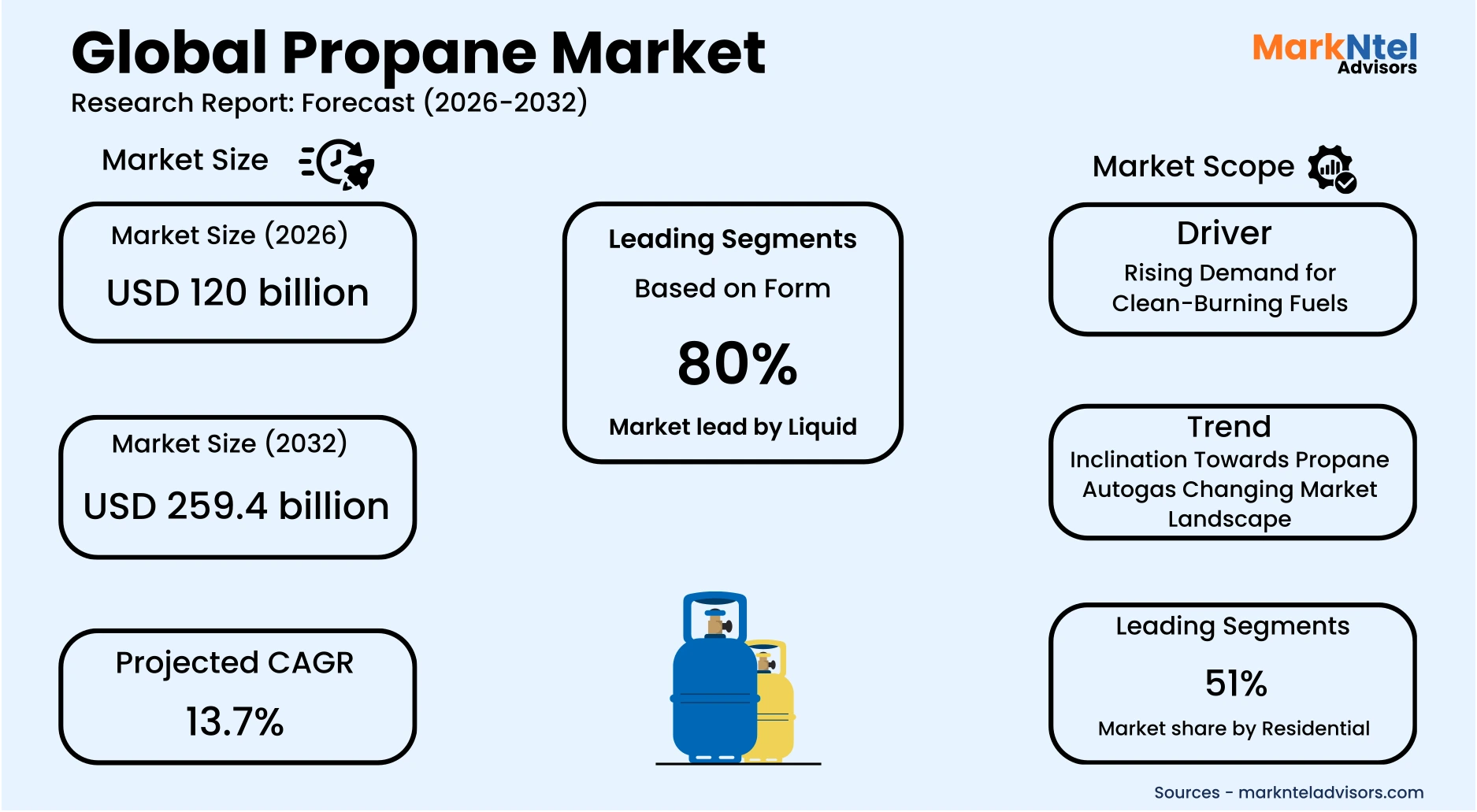
- Market size is estimated at around USD 120 billion in 2026 and is projected to reach USD 259.4 billion by 2032. The estimated CAGR from 2026 to 2032 is around 13.7%, indicating strong growth.
- North America holds the largest market share of about 40% in the Global Propane Market in 2026.
- By form, the liquid segment represented a significant share of about 80% in the Global Propane Market in 2026.
- By end use, the residential sector seized a significant share of about 51% in the Global Propane Market in 2026.
- Leading companies in the market are Saudi Aramco, BP plc, China Petroleum & Chemical Corporation (Sinopec), China National Petroleum Corporation (CNPC), Phillips 66, ConocoPhillips, Eni S.p.A., ExxonMobil, GAIL (India) Limited, Chevron Corporation, Gazprom, Indian Oil Corporation, Shell plc, Reliance Industries Ltd., TotalEnergies, and Others.
Market Insights & Analysis: Global Propane Market (2026-32):
The Global Propane Market size is estimated at around USD 120 billion in 2026 and is projected to reach USD 259.4 billion by 2032. Along with this, the market is estimated to grow at a CAGR of around 13.7% during the forecast period, i.e., 2026-32.
The global propane market is projected to expand steadily, supported by growing demand for clean-burning fuels, policy-driven adoption in developing economies, and investments in supply infrastructure. Propane continues to gain traction as an efficient alternative for residential cooking, heating, and industrial energy use due to its lower emissions compared with conventional solid fuels. The market is primarily driven by rising global demand for low-emission energy solutions, particularly in regions transitioning away from biomass and coal.
Government support remains a major growth catalyst. In 2025, the Government of India approved subsidies of approximately USD 3.4 billion to support subsidized LPG supply for nearly 100 million low-income households, directly increasing propane consumption in the residential segment . Similar policy-driven adoption is emerging elsewhere. For instance, Tanzania aims to increase households using clean cooking fuels from 6.9% to nearly 75–80% by 2030, indicating strong future demand growth across emerging markets .
Global trade dynamics are also shaping the outlook. U.S. propane exports rose nearly 9.6% to about 1.893 million barrels per day in 2025, reflecting strong international demand and tightening supply conditions. Rising freight costs of approximately USD 606 per container further demonstrate logistical pressures and expanding cross-border propane consumption .
The market is also witnessing a structural transformation toward sustainable fuels. In January 2025, the U.S. Department of Energy announced funding of up to USD 23 million under the Sustainable Propane and Renewable Chemicals (SPARC) initiative to support research into producing propane from biomass and waste feedstocks. Such initiatives are expected to strengthen renewable fuel supply chains and create long-term growth opportunities.
Infrastructure investments in emerging economies will further support expansion. In October 2025, Ghana Oil Company (GOIL) announced a USD 50 million investment to expand LPG storage capacity in Ghana by approximately 12,000 metric tons by 2026, aiming to improve supply security and meet rising national consumption . This highlights increasing infrastructure demand across developing propane markets.
Global Propane Market Recent Developments:
- 2025: Trafigura, in partnership with CF Industries, completed the first-ever voyage transporting ammonia and propane together from the U.S. to Europe. The project demonstrated cost-efficient logistics for low-carbon fuels, supporting future demand growth in propane-linked energy transportation markets.
- 2025: BW LPG announced plans to begin construction of India’s largest LPG import terminal near Mumbai in 2025, with storage capacity of about 120,000 m³. The facility will support propane and butane imports, strengthening regional supply chains and long-term energy security.
Global Propane Market Scope:
| Category | Segments |
|---|---|
| By Form | (Liquid, Gas), |
| By Purity | (98%, 99%), |
| By Grade | (HD – 5, HD – 10, Commercial), |
| By End Use | (Residential, Commercial, Industrial, Others), |
Global Propane Market Driver:
Rising Demand for Clean-Burning Fuels
The increasing global emphasis on reducing air pollution and greenhouse gas emissions is significantly driving demand for propane as a cleaner-burning fuel. According to the U.S. Department of Energy, propane is classified as an alternative clean fuel because it produces fewer harmful emissions compared to gasoline, diesel, and coal-based energy sources. Studies show propane-powered vehicles emit about 12% less carbon dioxide (CO₂), 20% less nitrogen oxides (NOx), and up to 60% less carbon monoxide than gasoline vehicles, highlighting their environmental advantages .
Government initiatives promoting clean cooking fuels are further accelerating adoption. For example, India’s Government of India launched large-scale LPG distribution programs that expanded access to millions of households, significantly increasing LPG consumption and reducing dependence on biomass fuels. Household LPG usage in India increased by approximately 56% after policy interventions promoting cleaner cooking energy .
Looking ahead, future investments will continue to stimulate propane demand. Countries across Asia and Africa are expanding LPG infrastructure, storage capacity, and import terminals to support urbanization and clean energy transitions. Energy security strategies, including long-term LPG supply agreements and diversification of imports beyond 2025, are also expected to strengthen propane consumption globally.
Overall, as governments prioritize low-emission fuels and cleaner household energy solutions, propane adoption is expected to accelerate across multiple sectors. These environmental benefits and policy-driven initiatives will play a critical role in sustaining long-term market growth.
Global Propane Market Trend:
Inclination Towards Propane Autogas Changing Market Landscape
The global propane market is witnessing a significant trend toward the growth of propane Autogas as countries seek cost-effective and lower-emission transportation fuels. Propane autogas produces fewer particulate emissions and nitrogen oxides than gasoline or diesel, making it attractive for urban air-quality improvement programs and commercial fleet decarbonization strategies. Governments are supporting adoption through fuel subsidies, tax incentives, and infrastructure investments, particularly in emerging economies where fuel affordability remains critical.
For example, Algeria, where government incentive programs and pricing advantages have rapidly expanded propane vehicle adoption. National energy company Sonatrach reported that the country’s autogas vehicle fleet exceeded 1 million vehicles by 2024, compared with just over 200,000 in 2014, while LPG consumption reached approximately 3.4 million tons, largely driven by transportation demand. The planned policy adjustments are expected to further optimize domestic supply and sustain market growth. Additionally, according to the International Energy Agency, transport fuel diversification toward LPG and propane remains a practical pathway for reducing oil dependency in developing regions, given existing distribution networks and relatively low infrastructure costs compared with those for electric mobility.
Overall, the increasing penetration of propane autogas in public transport, logistics fleets, and passenger vehicles is expected to strengthen long-term propane demand. This trend supports market expansion by creating new consumption channels beyond traditional residential and industrial applications.
Global Propane Market Opportunity:
Expansion of Sustainable Construction Frameworks and Project Pipelines
Emerging economies present a significant growth opportunity for the global propane market due to rising energy demand, limited natural gas pipeline infrastructure, and increasing government efforts to expand clean cooking access. According to the International Energy Agency (IEA), nearly 2.3 billion people worldwide still rely on traditional fuels such as biomass and charcoal for cooking, creating strong potential for liquefied petroleum gas (LPG) and propane adoption in Asia and Africa. Achieving universal clean cooking access by 2030 would require approximately USD 8 billion in annual investment in fuel distribution, storage, and infrastructure, highlighting the scale of future market expansion .
Government-supported programs are already accelerating adoption. India alone has provided more than 80 million LPG connections to households under national clean cooking initiatives, demonstrating how policy intervention can rapidly expand propane consumption in developing markets.
In addition, international financing mechanisms are increasing investments. The World Bank established a USD 500 million Clean Cooking Fund to support infrastructure and fuel access programs in low-income countries, further strengthening future demand potential.
With population growth, urbanization, and policy support continuing beyond 2025, propane suppliers are expected to expand distribution networks and storage capacity across emerging regions.
Overall, expanding clean energy access programs and infrastructure investments in developing economies will significantly increase propane consumption, positioning emerging markets as a major long-term growth engine for the global propane industry.
Global Propane Market Challenge:
Price Volatility Linked to Crude Oil and Natural Gas
One of the major challenges in the global propane market is price volatility caused by fluctuations in crude oil and natural gas markets, since propane is primarily produced as a by-product of natural gas processing and crude oil refining. Any disruption in upstream energy markets directly impacts propane supply costs and pricing stability. According to the U.S. Energy Information Administration (EIA), propane prices historically move in correlation with crude oil benchmarks due to shared production economics and feedstock dependence. The agency reported that U.S. wholesale propane prices rose significantly during periods of crude price spikes and supply tightness, particularly during winter demand peaks and geopolitical disruptions.
A recent 2025 example highlights this volatility. Global oil prices fluctuated around USD 60–75 per barrel amid geopolitical tensions and supply uncertainties, which contributed to instability in propane pricing across international markets. Such volatility increases procurement risks for distributors and raises operating costs for industries dependent on propane as a fuel or feedstock.
Furthermore, seasonal demand swings, especially winter heating demand in North America and Europe, amplify price unpredictability, complicating long-term supply contracts and investment planning.
Overall, price instability linked to crude oil and natural gas markets creates uncertainty for producers and end users, potentially limiting adoption and investment. However, improved storage infrastructure and diversified supply sources could mitigate this challenge over time.
Global Propane Market (2026-32) Segmentation Analysis:
The Global Propane Market study of MarkNtel Advisors evaluates & highlights the major trends and influencing factors in each segment. It includes predictions for the period 2026–32 at the global level. Based on the analysis, the market has been further classified as;
Based on Form:
-
- Liquid
- Gas
The liquid form segment dominates the global propane market with approximately 80% share, as propane is primarily stored, transported, and distributed in liquefied form under moderate pressure. Liquefaction significantly reduces volume, enabling efficient bulk storage, long-distance transportation, and convenient cylinder distribution for residential, commercial, and industrial applications. Liquid propane also provides higher energy density compared to gaseous form, making it more practical for heating, fuel, and petrochemical feedstock uses. The well-established infrastructure of storage tanks, tanker trucks, marine carriers, and refilling stations further supports liquid propane adoption worldwide. Industries prefer liquid propane because it can be easily vaporized at the point of use, ensuring consistent supply and operational flexibility.
Additionally, international trade of propane largely occurs in refrigerated or pressurized liquid form, reinforcing its commercial dominance. Growing LPG trade volumes, expanding distribution networks, and rising off-grid energy demand continue to strengthen the leadership of the liquid segment globally overall today.
Based on End Use:
- Residential
- Commercial
- Industrial
- Others
The residential segment holds the largest share of the global propane industry, accounting for about 51% of total demand, primarily due to its widespread use as a household energy source. Propane is extensively utilized for cooking, space heating, water heating, and backup power generation in regions lacking reliable electricity or natural gas infrastructure. Its portability, lower emissions compared to other fossil fuels, and ease of storage in cylinders make it highly suitable for residential consumers, particularly in developing economies and rural areas. Governments in countries also promote LPG and propane adoption through subsidy programs and clean-energy initiatives, further accelerating household consumption. In colder climates, propane is preferred for residential heating because it delivers consistent performance even at low temperatures.
Moreover, population growth, urbanization, and rising living standards are increasing appliance ownership, which boosts propane consumption. These factors collectively strengthen residential demand, ensuring its dominant position across mature and emerging markets.
Global Propane Market (2026-32): Regional Projection
The global propane market is dominated by North America, holding around 40% share, primarily due to its large natural gas production base, advanced shale extraction technologies, and strong export infrastructure. The United States is the world’s largest producer of natural gas liquids, including propane, supported by extensive shale resources such as the Permian and Marcellus basins. High residential heating demand, widespread LPG usage, and developed storage and transportation networks further strengthen regional consumption. According to the U.S. Energy Information Administration, U.S. propane production has increased significantly over the past decade, with monthly output reaching record levels in 2025, ensuring strong supply availability .
A recent example highlighting regional dominance is the continued expansion of North American export capacity, particularly along the U.S. Gulf Coast, where infrastructure investments are aimed at meeting rising international demand for LPG and propane shipments. These developments reinforce North America’s leadership in global supply and trade. The combination of abundant feedstock, export-oriented logistics, and mature end-use markets continues to position the region as the primary contributor to global propane market growth.
Gain a Competitive Edge with Our Global Propane Market Report:
- Global Propane Market Report by MarkNtel Advisors provides a detailed & thorough analysis of market size & share, growth rate, competitive landscape, and key players. This comprehensive analysis helps businesses gain a holistic understanding of the market dynamics & make informed decisions.
- This report also highlights current market trends & future projections, allowing businesses to identify emerging opportunities & potential challenges. By understanding market forecasts, companies can align their strategies & stay ahead of the competition.
- Global Propane Market Report aids in assessing & mitigating risks associated with entering or operating in the market. By understanding market dynamics, regulatory frameworks, and potential challenges, businesses can develop strategies to minimize risks & optimize their operations.
*Reports Delivery Format - Market research studies from MarkNtel Advisors are offered in PDF, Excel and PowerPoint formats. Within 24 hours of the payment being successfully received, the report will be sent to your email address.
Frequently Asked Questions
- Market Segmentation
- Introduction
- Product Definition
- Research Process
- Assumptions
- Executive Summary
- Global Propane Market Policies, Regulations, Product Standards
- Global Propane Market Trends & Development
- Global Propane Market Dynamics
- Growth Drivers
- Challenges
- Global Propane Market Hotspot & Opportunities
- Global Propane Market Outlook, 2022-2032F
- Market Size & Analysis
- By Revenue (USD Million)
- By Volume (Thousand Tons)
- Market Share & Analysis
- By Form- (USD Million & Thousand Tons)
- Liquid
- Gas
- By Purity- (USD Million & Thousand Tons)
- 98%
- 99%
- 99.5%
- By Grade- (USD Million & Thousand Tons)
- HD – 5
- HD – 10
- Commercial
- By End Use- (USD Million & Thousand Tons)
- Residential
- Commercial
- Industrial
- Others
- By Region
- North America
- South America
- Europe
- Middle East & Africa
- Asia-Pacific
- By Company
- Competition Characteristics
- Market Share & Analysis
- By Form- (USD Million & Thousand Tons)
- Market Size & Analysis
- North America Propane Market Outlook, 2022-2032F
- Market Size & Analysis
- By Revenue (USD Million)
- By Volume (Thousand Tons)
- Market Share & Analysis
- By Form- (USD Million & Thousand Tons)
- By Purity- (USD Million & Thousand Tons)
- By Grade- (USD Million & Thousand Tons)
- By End Use- (USD Million & Thousand Tons)
- By Country
- The US
- Canada
- Mexico
- The US Propane Market Outlook, 2022-2032F
- Market Size & Analysis
- By Revenue (USD Million)
- By Volume (Thousand Tons)
- Market Share & Analysis
- By Form- (USD Million & Thousand Tons)
- By Purity- (USD Million & Thousand Tons)
- By Grade- (USD Million & Thousand Tons)
- By End Use- (USD Million & Thousand Tons)
- Market Size & Analysis
- Canada Propane Market Outlook, 2022-2032F
- Market Size & Analysis
- By Revenue (USD Million)
- By Volume (Thousand Tons)
- Market Share & Analysis
- By Form- (USD Million & Thousand Tons)
- By Purity- (USD Million & Thousand Tons)
- By Grade- (USD Million & Thousand Tons)
- By End Use- (USD Million & Thousand Tons)
- Market Size & Analysis
- Mexico Propane Market Outlook, 2022-2032F
- Market Size & Analysis
- By Revenue (USD Million)
- By Volume (Thousand Tons)
- Market Share & Analysis
- By Form- (USD Million & Thousand Tons)
- By Purity- (USD Million & Thousand Tons)
- By Grade- (USD Million & Thousand Tons)
- By End Use- (USD Million & Thousand Tons)
- Market Size & Analysis
- Market Size & Analysis
- South America Propane Market Outlook, 2022-2032F
- Market Size & Analysis
- By Revenue (USD Million)
- By Volume (Thousand Tons)
- Market Share & Analysis
- By Form- (USD Million & Thousand Tons)
- By Purity- (USD Million & Thousand Tons)
- By Grade- (USD Million & Thousand Tons)
- By End Use- (USD Million & Thousand Tons)
- By Country
- Brazil
- Argentina
- Rest of South America
- Brazil Propane Market Outlook, 2022-2032F
- Market Size & Analysis
- By Revenue (USD Million)
- By Volume (Thousand Tons)
- Market Share & Analysis
- By Form- (USD Million & Thousand Tons)
- By Purity- (USD Million & Thousand Tons)
- By Grade- (USD Million & Thousand Tons)
- By End Use- (USD Million & Thousand Tons)
- Market Size & Analysis
- Argentina Propane Market Outlook, 2022-2032F
- Market Size & Analysis
- By Revenue (USD Million)
- By Volume (Thousand Tons)
- Market Share & Analysis
- By Form- (USD Million & Thousand Tons)
- By Purity- (USD Million & Thousand Tons)
- By Grade- (USD Million & Thousand Tons)
- By End Use- (USD Million & Thousand Tons)
- Market Size & Analysis
- Market Size & Analysis
- Europe Propane Market Outlook, 2022-2032F
- Market Size & Analysis
- By Revenue (USD Million)
- By Volume (Thousand Tons)
- Market Share & Analysis
- By Form- (USD Million & Thousand Tons)
- By Purity- (USD Million & Thousand Tons)
- By Grade- (USD Million & Thousand Tons)
- By End Use- (USD Million & Thousand Tons)
- By Country
- The UK
- Italy
- Germany
- France
- Spain
- BENELUX
- Rest of Europe
- The UK Propane Market Outlook, 2022-2032F
- Market Size & Analysis
- By Revenue (USD Million)
- By Volume (Thousand Tons)
- Market Share & Analysis
- By Connectivity- (USD Million & Thousand Tons)
- By Offering- (USD Million & Thousand Tons)
- By End User- (USD Million & Thousand Tons)
- Market Size & Analysis
- Italy Propane Market Outlook, 2022-2032F
- Market Size & Analysis
- By Revenue (USD Million)
- By Volume (Thousand Tons)
- Market Share & Analysis
- By Form- (USD Million & Thousand Tons)
- By Purity- (USD Million & Thousand Tons)
- By Grade- (USD Million & Thousand Tons)
- By End Use- (USD Million & Thousand Tons)
- Market Size & Analysis
- Germany Propane Market Outlook, 2022-2032F
- Market Size & Analysis
- By Revenue (USD Million)
- By Volume (Thousand Tons)
- Market Share & Analysis
- By Form- (USD Million & Thousand Tons)
- By Purity- (USD Million & Thousand Tons)
- By Grade- (USD Million & Thousand Tons)
- By End Use- (USD Million & Thousand Tons)
- Market Size & Analysis
- France Propane Market Outlook, 2022-2032F
- Market Size & Analysis
- By Revenue (USD Million)
- By Volume (Thousand Tons)
- Market Share & Analysis
- By Form- (USD Million & Thousand Tons)
- By Purity- (USD Million & Thousand Tons)
- By Grade- (USD Million & Thousand Tons)
- By End Use- (USD Million & Thousand Tons)
- Market Size & Analysis
- Spain Propane Market Outlook, 2022-2032F
- Market Size & Analysis
- By Revenue (USD Million)
- By Volume (Thousand Tons)
- Market Share & Analysis
- By Form- (USD Million & Thousand Tons)
- By Purity- (USD Million & Thousand Tons)
- By Grade- (USD Million & Thousand Tons)
- By End Use- (USD Million & Thousand Tons)
- Market Size & Analysis
- BENELUX Propane Market Outlook, 2022-2032F
- Market Size & Analysis
- By Revenue (USD Million)
- By Volume (Thousand Tons)
- Market Share & Analysis
- By Form- (USD Million & Thousand Tons)
- By Purity- (USD Million & Thousand Tons)
- By Grade- (USD Million & Thousand Tons)
- By End Use- (USD Million & Thousand Tons)
- Market Size & Analysis
- Market Size & Analysis
- Middle East & Africa Propane Market Outlook, 2022-2032F
- Market Size & Analysis
- By Revenue (USD Million)
- By Volume (Thousand Tons)
- Market Share & Analysis
- By Form- (USD Million & Thousand Tons)
- By Purity- (USD Million & Thousand Tons)
- By Grade- (USD Million & Thousand Tons)
- By End Use- (USD Million & Thousand Tons)
- By Country
- Saudi Arabia
- UAE
- South Africa
- Rest of Middle East & Africa
- Saudi Arabia Propane Market Outlook, 2022-2032F
- Market Size & Analysis
- By Revenue (USD Million)
- By Volume (Thousand Tons)
- Market Share & Analysis
- By Form- (USD Million & Thousand Tons)
- By Purity- (USD Million & Thousand Tons)
- By Grade- (USD Million & Thousand Tons)
- By End Use- (USD Million & Thousand Tons)
- Market Size & Analysis
- UAE Propane Market Outlook, 2022-2032F
- Market Size & Analysis
- By Revenue (USD Million)
- By Volume (Thousand Tons)
- Market Share & Analysis
- By Form- (USD Million & Thousand Tons)
- By Purity- (USD Million & Thousand Tons)
- By Grade- (USD Million & Thousand Tons)
- By End Use- (USD Million & Thousand Tons)
- Market Size & Analysis
- South Africa Propane Market Outlook, 2022-2032F
- Market Size & Analysis
- By Revenue (USD Million)
- By Volume (Thousand Tons)
- Market Share & Analysis
- By Form- (USD Million & Thousand Tons)
- By Purity- (USD Million & Thousand Tons)
- By Grade- (USD Million & Thousand Tons)
- By End Use- (USD Million & Thousand Tons)
- Market Size & Analysis
- Market Size & Analysis
- Asia-Pacific Propane Market Outlook, 2022-2032F
- Market Size & Analysis
- By Revenue (USD Million)
- By Volume (Thousand Tons)
- Market Share & Analysis
- By Form- (USD Million & Thousand Tons)
- By Purity- (USD Million & Thousand Tons)
- By Grade- (USD Million & Thousand Tons)
- By End Use- (USD Million & Thousand Tons)
- By Country
- China
- Japan
- India
- South Korea
- Australia
- Rest of APAC
- China Propane Market Outlook, 2022-2032F
- Market Size & Analysis
- By Revenue (USD Million)
- By Volume (Thousand Tons)
- Market Share & Analysis
- By Form- (USD Million & Thousand Tons)
- By Purity- (USD Million & Thousand Tons)
- By Grade- (USD Million & Thousand Tons)
- By End Use- (USD Million & Thousand Tons)
- Market Size & Analysis
- Japan Propane Market Outlook, 2022-2032F
- Market Size & Analysis
- By Revenue (USD Million)
- By Volume (Thousand Tons)
- Market Share & Analysis
- By Form- (USD Million & Thousand Tons)
- By Purity- (USD Million & Thousand Tons)
- By Grade- (USD Million & Thousand Tons)
- By End Use- (USD Million & Thousand Tons)
- Market Size & Analysis
- India Propane Market Outlook, 2022-2032F
- Market Size & Analysis
- By Revenue (USD Million)
- By Volume (Thousand Tons)
- Market Share & Analysis
- By Form- (USD Million & Thousand Tons)
- By Purity- (USD Million & Thousand Tons)
- By Grade- (USD Million & Thousand Tons)
- By End Use- (USD Million & Thousand Tons)
- Market Size & Analysis
- South Korea Propane Market Outlook, 2022-2032F
- Market Size & Analysis
- By Revenue (USD Million)
- By Volume (Thousand Tons)
- Market Share & Analysis
- By Form- (USD Million & Thousand Tons)
- By Purity- (USD Million & Thousand Tons)
- By Grade- (USD Million & Thousand Tons)
- By End Use- (USD Million & Thousand Tons)
- Market Size & Analysis
- Australia Propane Market Outlook, 2022-2032F
- Market Size & Analysis
- By Revenue (USD Million)
- By Volume (Thousand Tons)
- Market Share & Analysis
- By Form- (USD Million & Thousand Tons)
- By Purity- (USD Million & Thousand Tons)
- By Grade- (USD Million & Thousand Tons)
- By End Use- (USD Million & Thousand Tons)
- Market Size & Analysis
- Market Size & Analysis
- Global Propane Market Key Strategic Imperatives for Success & Growth
- Competition Outlook
- Company Profiles
- Saudi Aramco
- Business Description
- Product Portfolio
- Strategic Alliances or Partnerships
- Recent Developments
- Financial Details
- Others
- BP plc
- Business Description
- Product Portfolio
- Strategic Alliances or Partnerships
- Recent Developments
- Financial Details
- Others
- China Petroleum & Chemical Corporation
- Business Description
- Product Portfolio
- Strategic Alliances or Partnerships
- Recent Developments
- Financial Details
- Others
- China National Petroleum Corporation
- Business Description
- Product Portfolio
- Strategic Alliances or Partnerships
- Recent Developments
- Financial Details
- Others
- Phillips 66
- Business Description
- Product Portfolio
- Strategic Alliances or Partnerships
- Recent Developments
- Financial Details
- Others
- ConocoPhillips
- Business Description
- Product Portfolio
- Strategic Alliances or Partnerships
- Recent Developments
- Financial Details
- Others
- Eni S.p.A.
- Business Description
- Product Portfolio
- Strategic Alliances or Partnerships
- Recent Developments
- Financial Details
- Others
- ExxonMobil
- Business Description
- Product Portfolio
- Strategic Alliances or Partnerships
- Recent Developments
- Financial Details
- Others
- GAIL (India) Limited
- Business Description
- Product Portfolio
- Strategic Alliances or Partnerships
- Recent Developments
- Financial Details
- Others
- Chevron Corporation
- Business Description
- Product Portfolio
- Strategic Alliances or Partnerships
- Recent Developments
- Financial Details
- Others
- Gazprom
- Business Description
- Product Portfolio
- Strategic Alliances or Partnerships
- Recent Developments
- Financial Details
- Others
- Indian Oil Corporation
- Business Description
- Product Portfolio
- Strategic Alliances or Partnerships
- Recent Developments
- Financial Details
- Others
- Shell plc
- Business Description
- Product Portfolio
- Strategic Alliances or Partnerships
- Recent Developments
- Financial Details
- Others
- Reliance Industries Ltd.
- Business Description
- Product Portfolio
- Strategic Alliances or Partnerships
- Recent Developments
- Financial Details
- Others
- TotalEnergies
- Business Description
- Product Portfolio
- Strategic Alliances or Partnerships
- Recent Developments
- Financial Details
- Others
- Others
- Saudi Aramco
- Company Profiles
- Disclaimer
MarkNtel Advisors follows a robust and iterative research methodology designed to ensure maximum accuracy and minimize deviation in market estimates and forecasts. Our approach combines both bottom-up and top-down techniques to effectively segment and quantify various aspects of the market. A consistent feature across all our research reports is data triangulation, which examines the market from three distinct perspectives to validate findings. Key components of our research process include:
1. Scope & Research Design At the outset, MarkNtel Advisors define the research objectives and formulate pertinent questions. This phase involves determining the type of research—qualitative or quantitative—and designing a methodology that outlines data collection methods, target demographics, and analytical tools. They also establish timelines and budgets to ensure the research aligns with client goals.
2. Sample Selection and Data Collection In this stage, the firm identifies the target audience and determines the appropriate sample size to ensure representativeness. They employ various sampling methods, such as random or stratified sampling, based on the research objectives. Data collection is carried out using tools like surveys, interviews, and observations, ensuring the gathered data is reliable and relevant.
3. Data Analysis and Validation Once data is collected, MarkNtel Advisors undertake a rigorous analysis process. This includes cleaning the data to remove inconsistencies, employing statistical software for quantitative analysis, and thematic analysis for qualitative data. Validation steps are taken to ensure the accuracy and reliability of the findings, minimizing biases and errors.

4. Data Forecast and FinalizationThe final phase involves forecasting future market trends based on the analyzed data. MarkNtel Advisors utilize predictive modeling and time series analysis to anticipate market behaviors. The insights are then compiled into comprehensive reports, featuring visual aids like charts and graphs, and include strategic recommendations to inform client decision-making
We offer flexible licensing options to cater to varying organizational needs. Choose the pricing pack that best suits your requirements:
Buy Now Inquire Before Buying
 Request Customization
 Talk to our Consultant







