

North America Plant-Based Dairy Products Market Research Report: Forecast (2026-2032)
North America Plant-Based Dairy Products Market - By Product Type Plant-Based Milk (Almond Milk, Oat Milk, Soy Milk, Rice Milk, Other plant-based Milks, Cheese, Yogurt, Butter, Ice ... -Cream, Creamer, Other Dairy Alternatives), By Source (Nuts, Grains, Legumes, Coconut, Others), By End Users B2B (HoReCa, Snacks & Savoury, Bakery & Confectionary), Food Service (HoReCa, Retail Users, By Sales Channel (Supermarkets, Hypermarkets, Local Grocery Stores, Online, Others), ansd others Read more
- Food & Beverages
- Jan 2026
- Pages 165
- Report Format: PDF, Excel, PPT
North America Plant-Based Dairy Products Market
Projected 5.86% CAGR from 2026 to 2032
Study Period
2026-2032
Market Size (2025)
USD 4.78 Billion
Market Size (2032)
USD 7.12 Billion
Base Year
2025
Projected CAGR
5.86%
Leading Segments
By Product Type: Plant-based Milk
North America Plant-Based Dairy Products Market Report Key Takeaways:
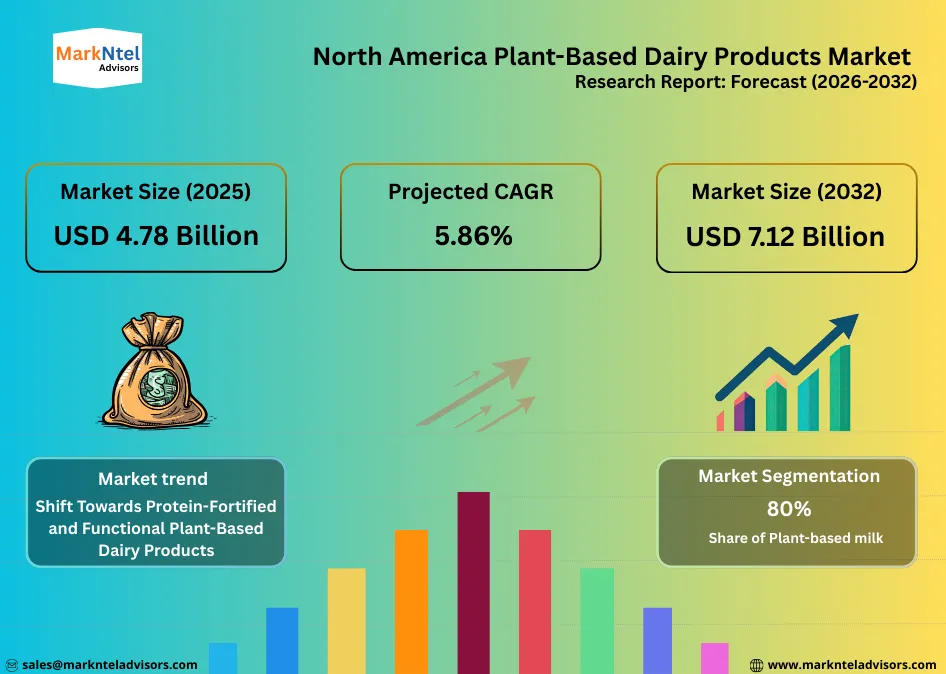
- The North America Plant-Based Dairy Products Market size was valued at around USD 4.78 billion in 2025 and is projected to reach USD 7.12 billion by 2032. The estimated CAGR from 2026 to 2032 is around 5.86%, indicating strong growth.
- By product type, the plant-based milk represented 80% of the North America Plant-Based Dairy Products Market size in 2025, while plant-based cheese is expected to grow at a CAGR of around 8% during 2026-32.
- By Country, the United States leads the North America Plant-Based Dairy Products Market with a dominant 79% share in 2025.
- The leading Plant-Based Dairy Products companies are Oatly Group AB, Danone North America, Blue Diamond Growers, Califia Farms LLC, Violife LLC, SunOpta Inc., Chobani LLC, Elmhurst 1925 LLC, Nestlé, Planet Oat, Daiya Foods Inc., and others.
Market Insights & Analysis: North America Plant-Based Dairy Products Market (2026-2032):
The North America Plant-Based Dairy Products Market size was valued at around USD 4.78 billion in 2025 and is projected to reach USD 7.12 billion by 2032. Along with this, the market is estimated to grow at a CAGR of around 5.86% during the forecast period, i.e., 2026-32. The North America Plant-Based Dairy Products Market is primarily driven by a growing health- and wellness-focused dietary shift that is reshaping consumer food choices across retail and foodservice channels. Increasing awareness of nutrition, sugar intake, and digestive health is encouraging consumers to opt for dairy alternatives that offer improved nutrient profiles, lower sugar content, and added functional benefits without sacrificing taste, texture, or everyday usability. As a result, manufacturers are prioritizing formulations that address these expectations, reinforcing sustained demand across multiple Plant-Based Dairy Products categories.
Product innovation beyond traditional soy and almond bases is shaping the market’s forward momentum. In early 2025, Maïzly introduced a corn-based plant milk in the U.S., enriched with vitamins D₂, A, E, and calcium, and formulated with roughly one-fourth the sugar of conventional dairy milk, reflecting growing interest in allergen-friendly and low-sugar alternatives that align with preventive health goals. Such diversification is expected to widen consumer adoption across age groups and dietary preferences over the forecast period.
Beyond product development, policy alignment and public sentiment are reinforcing market momentum. A 2025 national poll of 2,203 U.S. adults found that 67% support the inclusion of plant-based meals and non-dairy milk options in school lunch programs, signaling potential demand growth from public education systems and government-supported nutrition initiatives. This institutional alignment may help normalize Plant-Based Dairy Products consumption from an early age.
Overall, continued investment in fortified formulations, foodservice-ready products, and flavor innovation is likely to accelerate mainstream adoption. As health-focused consumption and supportive regulatory clarity expand beyond retail into schools and commercial dining, the North America Plant-Based Dairy Products Market is positioned for sustained growth.
North America Plant-Based Dairy Products Market Recent Developments:
- November 2025: Danone launched Silk Protein in North America, a Plant-Based Dairy Products range with enhanced protein content. The launch targets health-conscious and flexitarian consumers seeking nutritious alternatives, aiming to address protein-related concerns and strengthen everyday adoption of Plant-Based Dairy Products.
- May 2025: German plant-based food company Veganz Group AG teamed up with Jindilli Beverages (US) to introduce products using the Mililk® technology across North America (USA & Canada). This collaboration brings printed plant-based Mililk® oat and almond milk to retail and foodservice, expanding consumer choice with innovative Plant-Based Dairy Products alternatives.
North America Plant-Based Dairy Products Market Scope:
| Category | Segments |
|---|---|
| By Product Type | Plant-Based Milk, (Almond Milk, Oat Milk, Soy Milk, Rice Milk, Other plant-based Milks, Cheese, Yogurt, Butter, Ice-Cream, Creamer, Other Dairy Alternatives |
| By Source | Nuts, Grains, Legumes, Coconut, Others |
| By End Users | B2B (HoReCa, Snacks & Savoury, Bakery & Confectionary), Food Service (HoReCa, Retail Users, |
| By Sales Channel | Supermarkets, Hypermarkets, Local Grocery Stores, Online, Others), and others |
North America Plant-Based Dairy Products Market Drivers:
Health & Wellness-Driven Dietary Shift
A key driver of the Plant-Based Dairy Products market in North America is the increasing focus on health and wellness, reflected in both consumer behavior and government nutrition policy. Federal dietary guidance, such as the U.S. Dietary Guidelines for Americans, underscores the importance of nutrient-dense foods and balanced diets, encouraging consumption patterns that prioritize overall health while recognizing fortified plant-based options, particularly fortified soy beverages, as acceptable dairy alternatives due to similar nutrient profiles (calcium, vitamin D) when appropriately fortified. Soy beverages fortified with calcium, vitamin A, and vitamin D are included in the dairy group under these Guidelines because of their nutritional equivalency to cow’s milk in key nutrients that are public health priorities.
Government policy is also evolving to support access to healthier diet options. In 2025, Congress amended the Whole Milk for Healthy Kids Act to allow nutritionally equivalent plant-based milks in the National School Lunch Program alongside traditional milk, expanding child access to non-dairy nutritious choices in schools serving 30 million students annually.
Furthermore, national opinion reflects this health focus. For instance, in October 2025 found that 67 % of U.S. adults support offering plant-based and nondairy milk alternatives in school meals to help students maintain healthier diets.
Overall, growing health awareness, reinforced by federal nutrition guidance and expanding policy support for Plant-Based Dairy Products alternatives, is accelerating adoption. As education and accessibility increase beyond 2025, this health-oriented shift will continue to drive market expansion across consumer segments and institutional settings.
North America Plant-Based Dairy Products Market Trends:
Shift Towards Protein-Fortified and Functional Plant-Based Dairy Products
The North America Plant-Based Dairy Products Market is increasingly shaped by a shift toward protein-fortified and functionally enhanced formulations, as consumers compare plant-based options more directly with traditional dairy on nutritional value. Many shoppers now expect nondairy alternatives to deliver comparable protein, calcium, and vitamin content, rather than serving solely as lactose-free substitutes.
This trend is evident in recent product innovations targeting protein adequacy and everyday usability. In 2025, Danone expanded its Silk® portfolio with the launch of Silk Protein products, formulated to deliver higher protein levels than conventional plant-based alternatives and aimed at health-focused consumers and flexitarians who perceive protein as a key dietary requirement. This reflects broader industry efforts to close the nutritional gap between dairy and plant-based beverages.
Regulatory developments are reinforcing this functional focus. The U.S. Food and Drug Administration has been advancing voluntary guidance on clearer labeling for plant-based milk alternatives, encouraging transparent disclosure of nutrients such as calcium and vitamin D relative to dairy milk. Improved labeling is pushing manufacturers to strengthen formulations to meet consumer expectations.
Overall, protein fortification, functional nutrition claims, and regulatory-driven transparency are redefining Plant-Based Dairy Products from a choice into a nutritionally competitive category in North America.
North America Plant-Based Dairy Products Market Challenges:
Higher Production Costs Limiting Wider Adoption
A major challenge for the North America Plant-Based Dairy Products Market is higher production costs compared with conventional dairy, which can limit adoption among price-sensitive consumers. Retail prices for plant-based milk alternatives in the U.S. tend to be significantly higher than cow’s milk at the grocery level. For example, plant-based milks often average around USD 7.27 per gallon, whereas cow’s milk typically retails closer to USD 4.21 per gallon, creating a noticeable price differential at the consumer point of purchase. This premium reflects the younger industry’s higher processing, blending, and packaging costs as well as smaller production scales compared with the mature dairy sector, which benefits from long-established supply chains and economies of scale.
The pricing gap also affects everyday consumption decisions. Even though major U.S. coffee chains such as Dunkin, Starbucks, and others have moved to eliminate extra charges for plant-based milk in beverages, the underlying production cost structure still translates into higher retail prices for Plant-Based Dairy product beverages relative to conventional dairy.
Additionally, historical data show that unit prices for plant-based milk products are on average higher than dairy about 20% more per unit when broader cost comparisons are made across categories.
Because Plant-Based Dairy Products have yet to achieve the same scale or benefit from similar subsidy frameworks as conventional dairy, which has had government support for decades, this persistent price premium remains a barrier to wider adoption among cost-conscious households. Overcoming this challenge will require continued innovation in production efficiency, ingredient sourcing, and scale expansion to reduce costs and close the price gap with traditional dairy.
North America Plant-Based Dairy Products Market (2026-32) Segmentation Analysis:
The North America Plant-Based Dairy Products Market Report and Forecast 2026-2032 offers a detailed analysis of the market based on the following segments:
Based on Product Type:
- Plant-Based Milk
- Almond Milk
- Oat Milk
- Soy Milk
- Rice Milk
- Other plant-based Milks
- Cheese
- Yogurt
- Butter
- Ice-Cream
- Creamer
- Other Dairy Alternatives
Plant-based milk represents the most dominant segment in the North America Plant-Based Dairy Products Market, accounting for nearly 80% of total consumption. Its leadership is primarily driven by its role as a direct and convenient replacement for conventional milk in daily diets. Consumers widely use plant-based milk for coffee, cereals, smoothies, and cooking, making it a high-frequency purchase compared to other dairy alternatives such as cheese or yoghurt. The segment benefits from strong penetration across both retail and foodservice channels, supported by extensive availability in supermarkets, cafés, and quick-service restaurants.
Additionally, the variety within this segment, including almond, oat, soy, and rice milk, allows manufacturers to cater to diverse dietary needs such as lactose intolerance, vegan preferences, and calorie-controlled diets. Continuous product innovation, including fortification with calcium, vitamin D, and protein, has further strengthened consumer acceptance. As a result, plant-based milk has become the entry point for many consumers transitioning away from traditional dairy, reinforcing its market leadership.
Based on Source:
- Nuts
- Grains
- Legumes
- Coconut
- Others
Among source categories, nut-based products, particularly almond-derived offerings, hold a leading position in the North America Plant-Based Dairy Products Market. This dominance is closely linked to early consumer exposure and long-standing familiarity with nut-based milk alternatives. Almond milk was one of the first plant-based Dairy product substitutes to achieve mainstream acceptance, establishing strong brand recognition and trust. Nuts offer a neutral taste profile, smooth texture, and adaptability across beverages, creamers, and culinary applications, making them commercially versatile.
From a production standpoint, nut-based formulations are easier to standardize and scale compared to some grain or legume sources, supporting consistent quality and shelf stability. Consumer perception also plays a role, as nut-based products are often associated with natural ingredients and clean-label positioning. These factors have enabled nuts to remain the preferred source for manufacturers and consumers alike, sustaining their leadership across multiple Plant-Based Dairy Products product categories.
North America Plant-Based Dairy Products Market (2026-32): Regional Projection
The Plant-Based Dairy Products industry in North America is dominated by the United States, accounting for nearly 79% of total regional demand. The U.S. leads due to high consumer awareness of health, wellness, and dietary alternatives, supported by a large flexitarian and lactose-intolerant population. Strong retail penetration through supermarkets, specialty health stores, and e-commerce platforms has improved product accessibility nationwide.
Major metropolitan areas such as New York, Los Angeles, Chicago, and San Francisco drive volume consumption, supported by higher disposable incomes and lifestyle-driven food choices. The presence of leading manufacturers, including Danone, Califia Farms, and Oatly, has accelerated innovation in plant-based milk, creamers, and yogurt alternatives.
Additionally, widespread adoption in cafés, quick-service restaurants, and institutional settings such as schools and corporate cafeterias strengthens demand. Favorable regulatory clarity, active product launches, and strong foodservice partnerships further reinforce U.S. market leadership, positioning the country as the leader.
Gain a Competitive Edge with Our North America Plant-Based Dairy Products Market Report:
- North America Plant-Based Dairy Products Market Report by MarkNtel Advisors provides a detailed & thorough analysis of market size & share, growth rate, competitive landscape, and key players. This comprehensive analysis helps businesses gain a holistic understanding of the market dynamics & make informed decisions.
- This report also highlights current market trends & future projections, allowing businesses to identify emerging opportunities & potential challenges. By understanding market forecasts, companies can align their strategies & stay ahead of the competition.
- North America Plant-Based Dairy Products Market Report aids in assessing & mitigating risks associated with entering or operating in the market. By understanding market dynamics, regulatory frameworks, and potential challenges, businesses can develop strategies to minimize risks & optimize their operations.
*Reports Delivery Format - Market research studies from MarkNtel Advisors are offered in PDF, Excel and PowerPoint formats. Within 24 hours of the payment being successfully received, the report will be sent to your email address.
Frequently Asked Questions
- Market Segmentation
- Introduction
- Product Definition
- Research Process
- Assumptions
- Executive Summary
- North America Plant-Based Dairy Products Market Policies, Regulations, and Product Standards
- North America Plant-Based Dairy Products Market Supply Chain Analysis
- North America Plant-Based Dairy Products Market Trends & Developments
- North America Plant-Based Dairy Products Market Dynamics
- Growth Drivers
- Challenges
- North America Plant-Based Dairy Products Market Hotspot & Opportunities
- North America Plant-Based Dairy Products Market Outlook, 2022-2032
- Market Size & Outlook
- By Revenues (USD Million)
- By Quantity Sold
- Market Share & Outlook
- By Product Type- Market Size & Forecast 2022-2032F, USD Million
- Plant-Based Milk
- Almond Milk
- Oat Milk
- Soy Milk
- Rice Milk
- Other plant-based Milks
- Cheese
- Yogurt
- Butter
- Ice-Cream
- Creamer
- Other Dairy Alternatives
- Plant-Based Milk
- By Source- Market Size & Forecast 2022-2032F, USD Million
- Nuts
- Grains
- Legumes
- Coconut
- Others
- By End Users- Market Size & Forecast 2022-2032F, USD Million
- B2B
- HoReCa
- Snacks & Savoury
- Bakery & Confectionary
- Food Service
- HoReCa
- Retail Users
- B2B
- By Sales Channel- Market Size & Forecast 2022-2032F, USD Million
- Supermarkets
- Hypermarkets
- Local Grocery Stores
- Online
- Others
- By Country
- United States
- Canada
- Mexico
- By Leading Companies
- Company Revenue Shares
- Competitor Characteristics
- By Product Type- Market Size & Forecast 2022-2032F, USD Million
- Market Size & Outlook
- United States Plant-Based Dairy Market Outlook, 2022-2032
- Market Size & Analysis
- Market Revenues (USD Million)
- Quantity Sold
- Market Share & Analysis
- By Product Type- Market Size & Forecast 2022-2032, USD Million
- By Source- Market Size & Forecast 2022-2032, USD Million
- By End Users- Market Size & Forecast 2022-2032, USD Million
- By Sales Channel- Market Size & Forecast 2022-2032, USD Million
- Market Size & Analysis
- Canada Plant-Based Dairy Market Outlook, 2022-2032
- Market Size & Analysis
- Market Revenues (USD Million)
- Quantity Sold
- Market Share & Analysis
- By Product Type- Market Size & Forecast 2022-2032, USD Million
- By Source- Market Size & Forecast 2022-2032, USD Million
- By End Users- Market Size & Forecast 2022-2032, USD Million
- By Sales Channel- Market Size & Forecast 2022-2032, USD Million
- Market Size & Analysis
- Mexico Plant-Based Dairy Market Outlook, 2022-2032
- Market Size & Analysis
- Market Revenues (USD Million)
- Quantity Sold
- Market Share & Analysis
- By Product Type- Market Size & Forecast 2022-2032, USD Million
- By Source- Market Size & Forecast 2022-2032, USD Million
- By End Users- Market Size & Forecast 2022-2032, USD Million
- By Sales Channel- Market Size & Forecast 2022-2032, USD Million
- Market Size & Analysis
- North America Plant-Based Dairy Products Market Key Strategic Imperatives for Success & Growth
- Competition Outlook
- Company Profiles
- Oatly Group AB
- Business Description
- Product Portfolio
- Strategic Alliances or Partnerships
- Recent Developments
- Financial Details
- Others
- Danone North America
- Business Description
- Product Portfolio
- Strategic Alliances or Partnerships
- Recent Developments
- Financial Details
- Others
- Blue Diamond Growers
- Business Description
- Product Portfolio
- Strategic Alliances or Partnerships
- Recent Developments
- Financial Details
- Others
- Califia Farms LLC
- Business Description
- Product Portfolio
- Strategic Alliances or Partnerships
- Recent Developments
- Financial Details
- Others
- Violife LLC
- Business Description
- Product Portfolio
- Strategic Alliances or Partnerships
- Recent Developments
- Financial Details
- Others
- SunOpta Inc.
- Business Description
- Product Portfolio
- Strategic Alliances or Partnerships
- Recent Developments
- Financial Details
- Others
- Chobani LLC
- Business Description
- Product Portfolio
- Strategic Alliances or Partnerships
- Recent Developments
- Financial Details
- Others
- Elmhurst 1925 LLC
- Business Description
- Product Portfolio
- Strategic Alliances or Partnerships
- Recent Developments
- Financial Details
- Others
- Nestlé
- Business Description
- Product Portfolio
- Strategic Alliances or Partnerships
- Recent Developments
- Financial Details
- Others
- Planet Oat
- Business Description
- Product Portfolio
- Strategic Alliances or Partnerships
- Recent Developments
- Financial Details
- Others
- Daiya Foods Inc.
- Business Description
- Product Portfolio
- Strategic Alliances or Partnerships
- Recent Developments
- Financial Details
- Others
- Others
- Oatly Group AB
- Company Profiles
- Disclaimer
MarkNtel Advisors follows a robust and iterative research methodology designed to ensure maximum accuracy and minimize deviation in market estimates and forecasts. Our approach combines both bottom-up and top-down techniques to effectively segment and quantify various aspects of the market. A consistent feature across all our research reports is data triangulation, which examines the market from three distinct perspectives to validate findings. Key components of our research process include:
1. Scope & Research Design At the outset, MarkNtel Advisors define the research objectives and formulate pertinent questions. This phase involves determining the type of research—qualitative or quantitative—and designing a methodology that outlines data collection methods, target demographics, and analytical tools. They also establish timelines and budgets to ensure the research aligns with client goals.
2. Sample Selection and Data Collection In this stage, the firm identifies the target audience and determines the appropriate sample size to ensure representativeness. They employ various sampling methods, such as random or stratified sampling, based on the research objectives. Data collection is carried out using tools like surveys, interviews, and observations, ensuring the gathered data is reliable and relevant.
3. Data Analysis and Validation Once data is collected, MarkNtel Advisors undertake a rigorous analysis process. This includes cleaning the data to remove inconsistencies, employing statistical software for quantitative analysis, and thematic analysis for qualitative data. Validation steps are taken to ensure the accuracy and reliability of the findings, minimizing biases and errors.

4. Data Forecast and FinalizationThe final phase involves forecasting future market trends based on the analyzed data. MarkNtel Advisors utilize predictive modeling and time series analysis to anticipate market behaviors. The insights are then compiled into comprehensive reports, featuring visual aids like charts and graphs, and include strategic recommendations to inform client decision-making
We offer flexible licensing options to cater to varying organizational needs. Choose the pricing pack that best suits your requirements:
Buy Now Inquire Before Buying
 Request Customization
 Talk to our Consultant







