

Mozambique Compressor Market Research Report: Size, Share, Trends & Forecast (2026-2032)
By Compressor Type (Air Compressors, Gas Compressors), By Technology (Reciprocating Compressors, Rotary (screw) Compressors, Centrifugal Compressors), By Portability (Thousand Unit ... s) (Stationary, Portable), By End User (Oil & Gas, Construction, Manufacturing, Power & Utilities, Mining, Others), By Pressure Rating (Low (Upto 20 bar), Medium (21 to 100 bar), High (101 to 300 bar), Ultra-High (Above 300 bar)) Read more
- Buildings, Construction, Metals & Mining
- Mar 2026
- Pages 180
- Report Format: PDF, Excel, PPT
Mozambique Compressor Market
Projected 7.21% CAGR from 2026 to 2032
Study Period
2026-2032
Market Size (2026)
USD 27 Million
Market Size (2032)
USD 41 Million
Base Year
2025
Projected CAGR
7.21%
Leading Segments
By End User: Mining
Mozambique Compressor Market Report Key Takeaways:
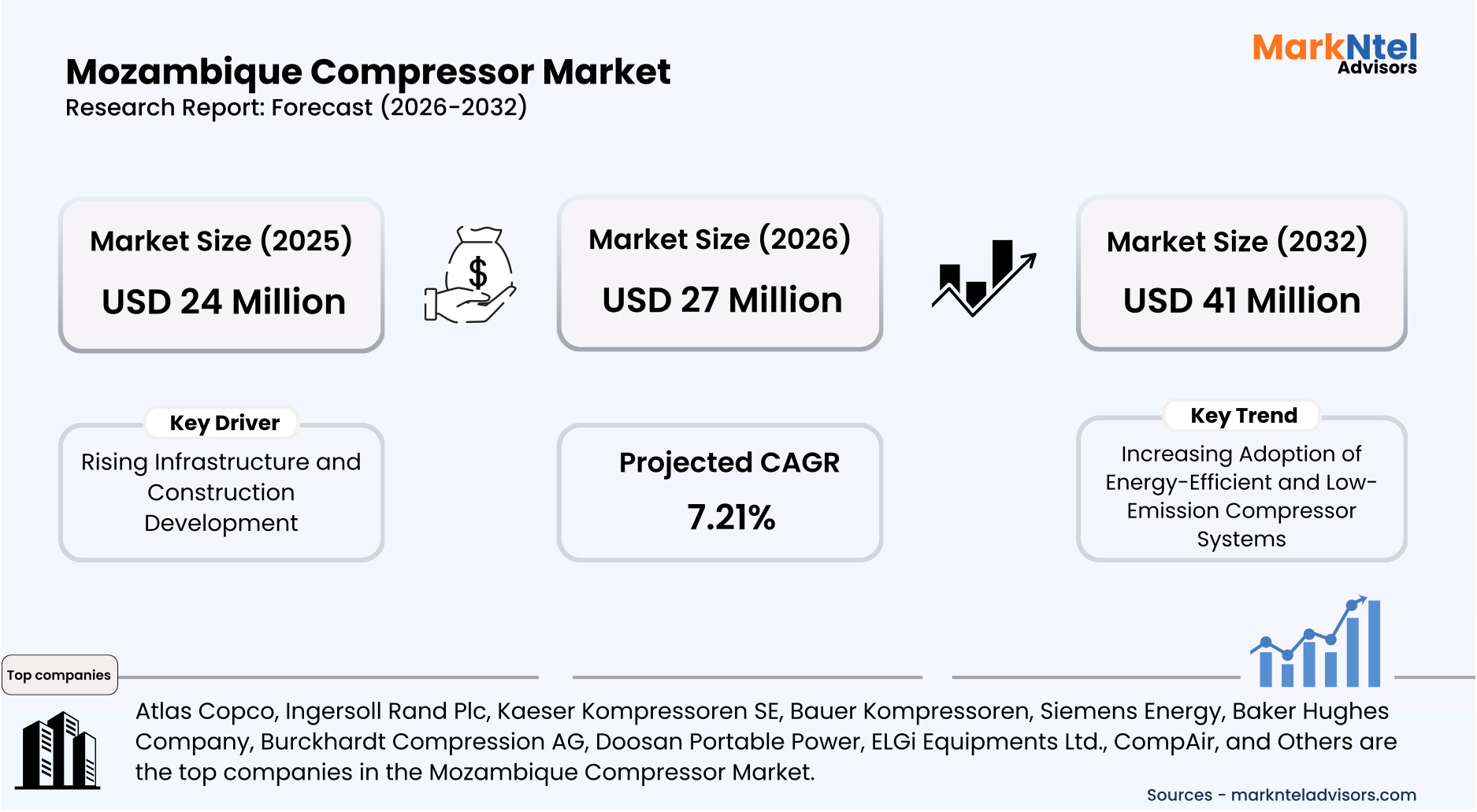
- The Mozambique Compressor Market size was valued at around USD 24 million in 2025 and is projected grow from USD 27 million in 2026 to USD 41 million by 2032, exhibiting a CAGR of 7.21% during the forecast period.
- By Compressor Type, the Air Compressor segment represented a significant share of about 62% in the Mozambique Compressor Market in 2026.
- By end-user, the mining segment presented a significant share of about 29% in the Mozambique Compressor Market in 2026.
- Leading Compressor companies in the Mozambique are Atlas Copco, Ingersoll Rand Plc, Kaeser Kompressoren SE, Bauer Kompressoren, Siemens Energy, Baker Hughes Company, Burckhardt Compression AG, Doosan Portable Power, ELGi Equipments Ltd., CompAir, and Others.
Market Insights & Analysis: Mozambique Compressor Market (2026-32):
The Mozambique Compressor Market size was valued at around USD 24 million in 2025 and is projected grow from USD 27 million in 2026 to USD 41 million by 2032, exhibiting a CAGR of 7.21% during the forecast period, i.e., 2026-32.
Mozambique’s Compressor market has strengthened in line with macroeconomic expansion supported by energy sector investments. According to the World Bank’s Mozambique Economic Update (2024), GDP growth could reach approximately 8% in the medium term under favorable conditions as LNG production expands and exports scale up . The report underscores that liquefied natural gas development remains central to Mozambique’s structural growth strategy. Industrial Compressor are essential for gas extraction, liquefaction, processing, and pressure management across upstream and midstream energy operations.
Current market conditions reflect rising capital expenditure under Mozambique’s National Development Strategy 2015–2035 and infrastructure prioritization in the 2025 state budget. LNG megaproject construction and operational phases require high-capacity centrifugal and reciprocating Compressor for refrigeration cycles and pressure control systems. In parallel, according to the World Bank’s World Development Indicators, Mozambique’s urban population exceeded 13.6 million in 2024, supporting expanding residential and commercial demand for HVAC and refrigeration systems incorporating small Compressor. Growing retail, healthcare, and office infrastructure further reinforces commercial end-user demand.
Regulatory reforms in the electricity and hydrocarbons sectors continue to reinforce private participation and industrial expansion. Implementation of the Integrated Master Plan 2018–2043 supports expanded generation capacity, strengthening procurement of auxiliary Compressor in thermal and hydroelectric plants. Mozambique’s updated climate commitments encourage improved industrial energy efficiency, indirectly promoting adoption of variable-speed and oil-free compressor technologies. In 2026, Mozambique, in partnership with the African Development Bank, advanced financing discussions for the USD 4.5 billion, 1,500 MW Mphanda Nkuwa Hydropower Project, supported by a Partial Risk Guarantee facility to strengthen energy infrastructure and regional power exports. Public investment in hospitals, universities, and municipal water utilities also sustains institutional demand for compressed air and cooling equipment.
Looking ahead, compressor demand is expected to remain anchored by LNG production scaling and downstream industrial diversification. Industrial users will continue to account for the majority of market revenue, while commercial and institutional segments expand alongside electrification and urbanization improvements. International equipment suppliers are strengthening regional distribution partnerships and after-sales service capabilities to support operational reliability. Supported by sustained LNG investment, infrastructure modernization, and demographic expansion, Mozambique’s Compressor market presents a stable medium-term growth trajectory.
Mozambique Compressor Market Recent Developments:
- 2024 : Atlas Copco announced the launch of its X-Air⁺ 1200-25 portable compressor, designed for demanding applications in construction, mining, and energy sectors with improved efficiency and up to ~11% better fuel usage than predecessors. This new machine targets portable compressor demand segments relevant to emerging markets like Mozambique where mobile compressor usage is growing.
- 2025 : Atlas Copco’s Class Zero oil-free air compressor range was spotlighted as a world standard for critical industrial applications requiring ultra-clean compressed air. These oil-free Compressor are increasingly relevant in sectors such as LNG, pharmaceutical, and food processing segments where contamination-free operation is crucial and market demand is rising.
Mozambique Compressor Market Scope:
| Category | Segments |
|---|---|
| By Compressor Type | (Air Compressors, Gas Compressors), |
| By Technology | (Reciprocating Compressors, Rotary (screw) Compressors, Centrifugal Compressors), |
| By Portability | (Thousand Units) (Stationary, Portable), |
| By End User | (Oil & Gas, Construction, Manufacturing, Power & Utilities, Mining, Others), |
| By Pressure Rating | (Low (Upto 20 bar), Medium (21 to 100 bar), High (101 to 300 bar), Ultra-High (Above 300 bar)) |
Mozambique Compressor Market Driver:
Rising Infrastructure and Construction Development
Mozambique’s infrastructure expansion has intensified following confirmed multilateral financing and public capital commitments during 2025–2026. In 2026, the World Bank has outlined plans to mobilize USD 6 billion over five years to support Mozambique’s development priorities, including transport and utilities infrastructure. Concurrently, national policy frameworks emphasize rehabilitation of roads, ports, and urban services to support economic recovery. The African Development Bank projects real GDP growth of 2.7% in 2025 and 3.5% in 2026, supported by extractive and construction activity, reinforcing the structural role of capital formation.
These funding commitments are measurably translating into corridor upgrades, logistics modernization, and public works execution across central and southern Mozambique. The government is prioritizing the modernization of the Maputo, Beira, and Nacala corridors, including port capacity expansion, railway upgrades, and road network improvements to strengthen trade connectivity with landlocked regional economies such as Malawi, Zambia, Zimbabwe, and the Democratic Republic of the Congo. Government statements indicate significant budget allocations for road and bridge rehabilitation under the 2025–2029 development plan, strengthening nationwide project pipelines. Infrastructure execution requires extensive deployment of compressed air systems for drilling, excavation, material handling, and plant operations at construction and energy sites. As projects span multiple provinces, compressor demand expands geographically rather than remaining concentrated in a single industrial cluster.
This driver expands market volume because infrastructure projects require physical installation of new compressor units rather than marginal upgrades or price adjustments. Each financed transport corridor, port upgrade, or utility project increases the installed base of portable and stationary Compressor, generating both primary equipment sales and subsequent maintenance demand. Unlike cyclical commodity pricing effects, public infrastructure commitments are multi-year capital programs backed by institutional financing. Consequently, sustained infrastructure investment constitutes a systemic demand engine that directly enlarges Mozambique’s compressor market size and unit consumption.
Mozambique Compressor Market Trend:
Increasing Adoption of Energy-Efficient and Low-Emission Compressor Systems
The shift toward energy-efficient and low-emission compressor systems has intensified as Mozambique advances large-scale gas and transport projects under internationally financed frameworks. The International Energy Agency’s 2024 Mozambique Energy Policy Review identifies efficiency improvements in industrial electricity use as essential to managing rising demand and limiting system strain. At the same time, multilateral development financing increasingly integrates climate performance conditions into project execution. These structural factors have elevated efficiency compliance from a cost consideration to a project requirement, a shift further reinforced by the 2025 restart of the nearly USD 20 billion Mozambique LNG project, where high-efficiency and low-emission centrifugal Compressor are deployed for boil-off gas systems in line with international environmental and operational standards.
This transition is reshaping supplier strategies and operational models within industrial segments. Contractors involved in corridor, port, and gas infrastructure development are embedding energy performance benchmarks into technical specifications and tender criteria. Low-emission diesel Compressor and high-efficiency electric systems are preferred to reduce fuel intensity and operational downtime in remote project locations. Equipment providers are expanding digital performance monitoring and predictive maintenance offerings, shifting competition toward lifecycle optimization rather than standalone equipment pricing.
The trend is expected to persist because Mozambique’s infrastructure expansion remains tied to external financing and global trade integration. Development partners prioritize carbon intensity reduction and energy productivity across funded assets, reinforcing durable compliance expectations. As industrial facilities are designed for multi-decade service life, efficiency standards become embedded at commissioning. This sustained alignment between financing conditions, regulatory oversight, and operational economics ensures long-term influence on compressor technology selection.
Mozambique Compressor Market Opportunity:
Expansion of Mining Activities and Mineral Processing Capacity
Mozambique’s mining sector is strengthening, supported by coal production in Tete Province and renewed extractive activity. According to the African Development Bank’s 2025 outlook, extractive industries remain a key contributor to medium-term growth. As production levels recover and stabilize, mining operators are expanding drilling operations and upgrading processing infrastructure. This structural expansion directly increases demand for heavy-duty industrial equipment.
Mining operations are highly compression-intensive, requiring compressed air systems for drilling, blasting, crushing, material handling, and plant utilities. Each new shaft, beneficiation plant, or processing line requires stationary and portable Compressor operating under continuous load. Increased production intensity also accelerates equipment wear, leading to higher replacement and servicing demand. This establishes a direct cause-and-effect link between mining output and compressor deployment.
The opportunity is particularly favorable for emerging players because mining sites are geographically concentrated and often remote. Smaller suppliers can compete by offering localized equipment rental, technical servicing, and customized compressor configurations. Unlike large OEMs focused on large contracts, agile entrants can penetrate through operational support and rapid-response solutions. As extractive capacity expands, scalable equipment supply and service participation becomes commercially viable.
Mozambique Compressor Market Challenge:
Limited Technical Skills and Trained Service Engineers in Local Markets
Mozambique faces a structural shortage of technically trained industrial personnel, constraining equipment servicing capacity. The World Bank’s Human Capital Index indicates persistent gaps in education outcomes and workforce readiness, while national statistics highlight limited availability of advanced technical training programs in engineering fields . Rapid expansion in mining and gas operations has increased demand for specialized mechanical and electrical skills faster than domestic supply can respond. This imbalance creates a systemic constraint on the maintenance and optimization of complex industrial systems such as Compressor.
The skills gap measurably impacts market participants by increasing reliance on expatriate technicians and cross-border service teams. International energy operators in northern Mozambique have previously mobilized foreign technical staff to support project execution, reflecting limited local availability of specialized engineers. Longer mobilization times raise operational costs and delay preventive maintenance cycles, particularly in remote provinces. Such constraints reduce operational efficiency and increase downtime risks for compression-intensive mining and LNG activities.
This structural limitation materially restricts market expansion by discouraging rapid scaling of installed equipment fleets. Investors factor technical support availability into capital deployment decisions, particularly for high-pressure and precision compressor systems. Limited local servicing capacity can elevate lifecycle costs and reduce equipment reliability, affecting adoption rates. Without sustained investment in vocational and engineering training programs, the skills deficit remains a binding constraint on market scalability.
Mozambique Compressor Market (2026-32) Segmentation Analysis:
The Mozambique Compressor market study of MarkNtel Advisors evaluates & highlights the major trends and influencing factors in each segment. It includes predictions for the period 2026–32 at the country level. Based on the analysis, the market has been further classified as;
Based on Compressor Type:
- Air Compressors
- Gas Compressors
Air Compressors dominate the Mozambique Compressor Market by type, accounting for approximately 62% of total demand, primarily because the country’s industrial and extractive activities rely extensively on compressed air for mechanical operations. Mining operations in provinces such as Tete and Niassa require portable and stationary air Compressor for drilling, blasting, pneumatic tools, ventilation support, and material handling. According to publicly available data from the U.S. Geological Survey, Mozambique remains an active producer of coal and graphite, both of which involve compression-intensive extraction and processing stages. These applications require continuous air supply systems rather than gas compression units, structurally elevating air compressor demand.
Industrial usage patterns further reinforce this dominance. Construction projects, road rehabilitation programs, and small-scale manufacturing facilities utilize air Compressor for on-site power tools, concrete spraying, equipment cleaning, and assembly processes. Unlike gas Compressor, which are typically confined to LNG processing and specialized hydrocarbon applications, air Compressor serve a broader cross-section of end users, including workshops, industrial plants, and decentralized project sites. This wider applicability translates into higher installation volumes and replacement cycles across multiple provinces.
Cost structure and operational flexibility also support air compressor leadership. Air Compressor generally involve lower capital investment and simpler installation requirements compared to high-specification gas compression systems. In a market characterized by dispersed industrial activity and moderate project scale, equipment versatility and ease of maintenance are critical. The combination of cross-industry applicability, mining intensity, and cost efficiency structurally positions air Compressor as the leading compressor type in Mozambique.
Based on End User:
- Oil & Gas
- Construction
- Manufacturing
- Power & Utilities
- Mining
- Others
Mining dominates the Mozambique Compressor Market by end-user, accounting for approximately 29% of total demand, primarily due to the country’s reliance on coal and mineral extraction activities that are highly compression-intensive. Coal production in Tete Province remains a central pillar of the extractive economy, with Mozambique projecting output to exceed 22 million tonnes in 2026, signaling renewed expansion momentum in the sector. Mining operations require continuous use of compressed air for drilling, blasting, pneumatic conveying, ventilation, and on-site processing functions, creating sustained equipment deployment across active extraction zones.
Production intensity further reinforces this dominance. Public disclosures from mining operators indicate that coal extraction and associated beneficiation processes operate under high-duty cycles, requiring reliable portable and stationary compressor systems to maintain throughput. Unlike sectors such as construction, where compressor usage fluctuates with project timelines, mining operations function year-round, generating consistent demand for both new equipment and replacement units. The operational scale and mechanical dependency of extractive sites therefore translate directly into higher compressor consumption relative to other industrial segments.
Geographic concentration also strengthens mining’s leading position. Major coal reserves and processing facilities are clustered in industrial provinces, creating localized equipment ecosystems with continuous operational requirements. While LNG and infrastructure projects contribute significantly to capital expenditure, mining’s sustained production cycles, equipment wear intensity, and mechanical dependency collectively position it as the dominant end-user industry within Mozambique’s compressor market.
Gain a Competitive Edge with Our Mozambique Compressor Market Report:
- Mozambique Compressor Market Report by MarkNtel Advisors provides a detailed & thorough analysis of market size & share, growth rate, competitive landscape, and key players. This comprehensive analysis helps businesses gain a holistic understanding of the market dynamics & make informed decisions.
- This report also highlights current market trends & future projections, allowing businesses to identify emerging opportunities & potential challenges. By understanding market forecasts, companies can align their strategies & stay ahead of the competition.
- Mozambique Compressor Market Report aids in assessing & mitigating risks associated with entering or operating in the market. By understanding market dynamics, regulatory frameworks, and potential challenges, businesses can develop strategies to minimize risks & optimize their operations.
*Reports Delivery Format - Market research studies from MarkNtel Advisors are offered in PDF, Excel and PowerPoint formats. Within 24 hours of the payment being successfully received, the report will be sent to your email address.
Frequently Asked Questions
- Market Segmentation
- Introduction
- Product Definition
- Research Process
- Assumptions
- Executive Summary
- Mozambique Compressor Supply Chain Analysis
- Mozambique Compressor Import-Export Analysis
- Mozambique Compressor Market Trends & Developments
- Mozambique Compressor Market Dynamics
- Growth Drivers
- Challenges
- Mozambique Compressor Market Hotspot & Opportunities
- Mozambique Compressor Market Policies & Regulations
- Mozambique Compressor Market Outlook, 2022-32F
- Market Size & Analysis
- By Revenues (USD Million)
- By Unit Sold (Thousand)
- Market Segmentation & Analysis
- By Compressor Type- (Thousand Units)
- Air Compressors
- Gas Compressors
- By Technology- (Thousand Units)
- Reciprocating Compressors
- Rotary (screw) Compressors
- Centrifugal Compressors
- By Portability (Thousand Units)
- Stationary
- Portable
- By End User- (Thousand Units)
- Oil & Gas
- Construction
- Manufacturing
- Power & Utilities
- Mining
- Others
- By Pressure Rating- (Thousand Units)
- Low (Upto 20 bar)
- Medium (21 to 100 bar)
- High (101 to 300 bar)
- Ultra-High (Above 300 bar)
- By Competition
- Competition Characteristics
- Market Share of Top Companies
- By Compressor Type- (Thousand Units)
- Market Size & Analysis
- Mozambique Air Compressor Market Outlook, 2022-32F
- Market Size & Analysis
- By Revenues (USD Million)
- By Unit Sold (Thousand)
- Market Segmentation & Analysis
- By Technology- (Thousand Units)
- By Portability- (Thousand Units)
- By End User- (Thousand Units)
- By Pressure Rating- (Thousand Units)
- Market Size & Analysis
- Mozambique Gas Compressor Market Outlook, 2022-32F
- Market Size & Analysis
- By Revenues (USD Million)
- By Unit Sold (Thousand)
- Market Segmentation & Analysis
- By Technology- (Thousand Units)
- By Portability- (Thousand Units)
- By End User- (Thousand Units)
- By Pressure Rating- (Thousand Units)
- Market Size & Analysis
- Competitive Outlook
- Company Profiles
- Atlas Copco
- Business Description
- Product Portfolio
- Strategic Alliances or Partnerships
- Recent Developments
- Financial Details
- Others
- Ingersoll Rand Plc
- Business Description
- Product Portfolio
- Strategic Alliances or Partnerships
- Recent Developments
- Financial Details
- Others
- Kaeser Kompressoren SE
- Business Description
- Product Portfolio
- Strategic Alliances or Partnerships
- Recent Developments
- Financial Details
- Others
- Bauer Kompressoren
- Business Description
- Product Portfolio
- Strategic Alliances or Partnerships
- Recent Developments
- Financial Details
- Others
- Siemens Energy
- Business Description
- Product Portfolio
- Strategic Alliances or Partnerships
- Recent Developments
- Financial Details
- Others
- Baker Hughes Company
- Business Description
- Product Portfolio
- Strategic Alliances or Partnerships
- Recent Developments
- Financial Details
- Others
- Burckhardt Compression AG
- Business Description
- Product Portfolio
- Strategic Alliances or Partnerships
- Recent Developments
- Financial Details
- Others
- Doosan Portable Power
- Business Description
- Product Portfolio
- Strategic Alliances or Partnerships
- Recent Developments
- Financial Details
- Others
- ELGi Equipments Ltd.
- Business Description
- Product Portfolio
- Strategic Alliances or Partnerships
- Recent Developments
- Financial Details
- Others
- CompAir
- Business Description
- Product Portfolio
- Strategic Alliances or Partnerships
- Recent Developments
- Financial Details
- Others
- Others
- Atlas Copco
- Company Profiles
- Disclaimer
MarkNtel Advisors follows a robust and iterative research methodology designed to ensure maximum accuracy and minimize deviation in market estimates and forecasts. Our approach combines both bottom-up and top-down techniques to effectively segment and quantify various aspects of the market. A consistent feature across all our research reports is data triangulation, which examines the market from three distinct perspectives to validate findings. Key components of our research process include:
1. Scope & Research Design At the outset, MarkNtel Advisors define the research objectives and formulate pertinent questions. This phase involves determining the type of research—qualitative or quantitative—and designing a methodology that outlines data collection methods, target demographics, and analytical tools. They also establish timelines and budgets to ensure the research aligns with client goals.
2. Sample Selection and Data Collection In this stage, the firm identifies the target audience and determines the appropriate sample size to ensure representativeness. They employ various sampling methods, such as random or stratified sampling, based on the research objectives. Data collection is carried out using tools like surveys, interviews, and observations, ensuring the gathered data is reliable and relevant.
3. Data Analysis and Validation Once data is collected, MarkNtel Advisors undertake a rigorous analysis process. This includes cleaning the data to remove inconsistencies, employing statistical software for quantitative analysis, and thematic analysis for qualitative data. Validation steps are taken to ensure the accuracy and reliability of the findings, minimizing biases and errors.

4. Data Forecast and FinalizationThe final phase involves forecasting future market trends based on the analyzed data. MarkNtel Advisors utilize predictive modeling and time series analysis to anticipate market behaviors. The insights are then compiled into comprehensive reports, featuring visual aids like charts and graphs, and include strategic recommendations to inform client decision-making
We offer flexible licensing options to cater to varying organizational needs. Choose the pricing pack that best suits your requirements:
Buy Now Inquire Before Buying
 Request Customization
 Talk to our Consultant







