

Middle East & Africa Water Desalination Equipment Market Research Report: Forecast (2026-2032)
Middle East & Africa Water Desalination Equipment Market - By Technology (Reverse Osmosis (RO), Multi-Stage Flash (MSF) Distillation, Multi-Effect Distillation (MED), Electrodialys ... is (ED), Others), By Product (Membranes, Pumps & Motors, Evaporators, Energy Recovery Devices, Others), By Application (Municipal, Industrial, Agricultural), By Source of Water (Seawater Desalination, Brackish Water Desalination, River & Wastewater Desalination), and others Read more
- Environment
- Feb 2026
- Pages 165
- Report Format: PDF, Excel, PPT
Middle East & Africa Water Desalination Equipment Market
Projected 8.7% CAGR from 2026 to 2032
Study Period
2026-2032
Market Size (2025)
USD 4.8 Billion
Market Size (2032)
USD 8.6 Billion
Base Year
2025
Projected CAGR
8.7%
Leading Segments
By Source of Water: Seawater Desalination
Middle East & Africa Water Desalination Equipment Market Report Key Takeaways:
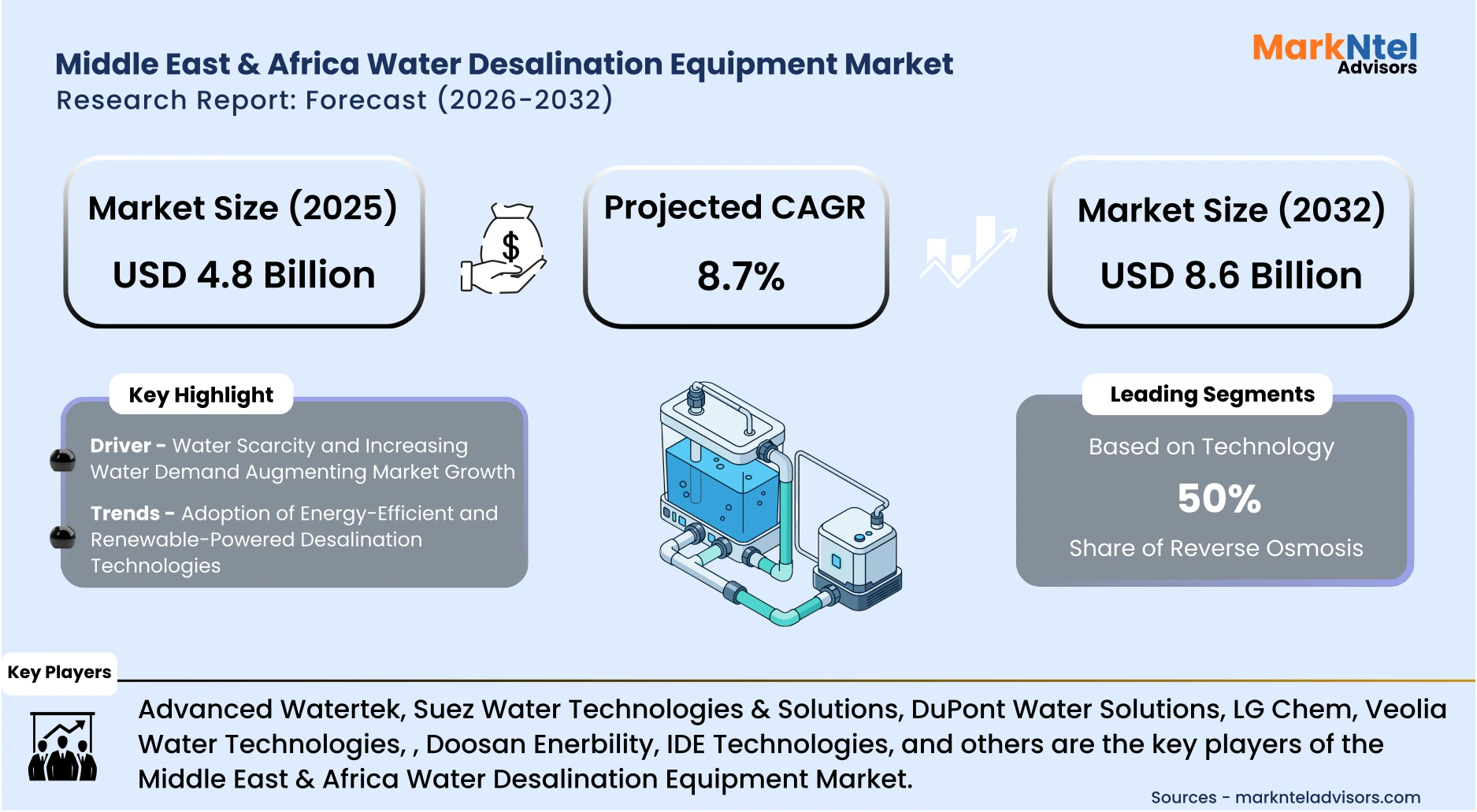
- The Middle East & Africa Water Desalination Equipment Market size was valued at around USD 4.8 billion in 2025 and is projected to reach USD 8.6 billion by 2032. The estimated CAGR from 2026 to 2032 is around 8.7%, indicating strong growth.
- By technology, the reverse osmosis (RO) represented 50% of the Middle East & Africa Water Desalination Equipment Market size in 2025.
- By Source of Water, the Seawater Desalination represented 40% of the Middle East & Africa Water Desalination Equipment Market size in 2025.
- UAE leads the Middle East & Africa Water Desalination Equipment Market with a dominant 36% share in 2025.
- The leading water desalination equipment companies are Advanced Watertek, Suez Water Technologies & Solutions, DuPont Water Solutions, LG Chem, Veolia Water Technologies, Toyobo Co. Ltd, Sulzer, Torishima Pump Mfg. Co., Doosan Enerbility, IDE Technologies, and others.
Market Insights & Analysis: Middle East & Africa Water Desalination Equipment Market (2026- 2032):
The Middle East & Africa Water Desalination Equipment Market size was valued at around USD 4.8 billion in 2025 and is projected to reach USD 8.6 billion by 2032. Along with this, the market is estimated to grow at a CAGR of around 8.7% during the forecast period, i.e., 2026-32. The Middle East & Africa Water Desalination Equipment Market is expected to witness sustained expansion from 2025 to 2032 as worsening water scarcity, prolonged drought cycles, and rising freshwater demand continue to strain conventional water resources.
Governments across the region are increasingly prioritizing desalination as a strategic solution to ensure long-term water security. In North Africa, Morocco has announced plans to raise the share of desalinated water in its drinking supply from 25 % to 60 % by 2030, with projected annual output reaching 1.7 billion m³, driving large-scale deployment of desalination equipment and infrastructure .
Egypt is also accelerating desalination development, aiming to increase national capacity to 9 million m³/day by 2050, supported by an initial USD 3 billion investment phase to add over 3 million m³/day, as pressure on Nile water availability intensifies .
Alongside capacity expansion, the region is transitioning toward energy-efficient and renewable-powered desalination systems. In August 2025, AMEA Power joined the USD 273 million Agadir desalination expansion in Morocco, integrating wind energy to support production of up to 400,000 m³/day, strengthening cross-regional desalination infrastructure . The same Agadir expansion is supported by a 150 MW wind farm, underscoring the growing role of clean energy in desalination operations.
Smaller-scale renewable projects are also emerging, such as Djibouti’s solar-powered desalination plant, launched in 2025 to supply clean water to about 5,000 residents .
Together, these developments indicate that rising water stress combined with sustainability-driven infrastructure planning will continue to accelerate demand for advanced desalination equipment across the Middle East & Africa through 2032.
Middle East & Africa Water Desalination Equipment Market Recent Developments:
- July 2025: Lantania and partners won a USD 544 million project to build a 600,000 m³/day reverse osmosis seawater desalination plant in Jubail, Saudi Arabia, boosting regional capacity and infrastructure development .
- July 2025: VA Tech Wabag secured a USD 272 million contract from the Saudi Water Authority to deliver a 300 MLD seawater reverse osmosis plant in Yanbu, marking a significant investment in advanced desalination equipment and engineering.
Middle East & Africa Water Desalination Equipment Market Scope:
| Category | Segments |
|---|---|
| By Technology | Reverse Osmosis (RO), Multi-Stage Flash (MSF) Distillation, Multi-Effect Distillation (MED), Electrodialysis (ED), Others |
| By Product | Membranes, Pumps & Motors, Evaporators, Energy Recovery Devices, Others |
| By Application | Municipal, Industrial, Agricultural |
| By Source of Water | Seawater Desalination, Brackish Water Desalination, River & Wastewater Desalination |
Middle East & Africa Water Desalination Equipment Market Driver:
Water Scarcity and Increasing Water Demand Augmenting Market Growth
Rising water scarcity and demand are primary drivers of the Middle East & Africa water desalination equipment market. The region has less than 1% of the world’s freshwater resources but serves over 6% of the global population, creating intense pressure on available water supplies. Already, countries such as Kuwait rely on desalination for nearly 90% of drinking water, Saudi Arabia about 70%, and the UAE around 42%, underscoring widespread scarcity across Gulf Cooperation Council (GCC) states.
Official data shows that by 2050, freshwater demand in the region is projected to increase sharply due to population growth (expected to rise by 30 % between 2020 and 2050) and urbanization, further straining limited natural water sources, while demand could surge by up to 25% globally .
Major national initiatives also reflect this trend. Saudi Arabia plans to more than double its desalination capacity to about 20 million m³/day by 2030 to address future water demand. Jordan’s Aqaba–Amman Water Desalination and Conveyance Project, backed by USD 295 million in financing from the Green Climate Fund and aiming to deliver 300 million m³/year to nearly half the population, highlights urgent investment in water security .
Furthermore, countries are planning further capacity expansions and renewable-powered desalination to counter growing scarcity, including nearly doubling regional capacity by 2030 with potential USD 100 billion in investments.
Overall, as natural freshwater resources dwindle and demand soars due to population and economic growth, water scarcity will continue to accelerate investment in desalination equipment, driving substantial market growth.
Middle East & Africa Water Desalination Equipment Market Trend:
Adoption of Energy-Efficient and Renewable-Powered Desalination Technologies
A major trend shaping the Middle East & Africa water desalination equipment market is the increased adoption of energy-efficient systems and integration of renewable energy to power desalination facilities. Governments across the region are pursuing this trend to reduce energy costs, lower carbon emissions, and align with national sustainability goals, such as the UAE’s Net Zero by 2050 strategy and Saudi Arabia’s renewable targets under Vision 2030. In Dubai, the Hassyan seawater reverse osmosis (RO) project, investing USD 920 million, uses clean energy and waste heat with the lowest water tariff bid at USD 0.36536 per cubic meter, reflecting a shift toward energy-efficient operations and cleaner sources .
In Oman, the Sharqiyah Desalination Plant now runs on a 17 MWp solar PV farm, generating over 32,000 MWh yearly and covering its daytime energy needs, cutting roughly 27,200 t of CO₂ emissions annually .
Jordan’s Aqaba–Amman project plans to deploy a solar power component of 724 GWh yearly to offset energy requirements for its 851,000 m³/day RO plant, enhancing sustainability .
Overall, this trend not only reduces operational costs and environmental impact but also supports long-term energy security, making desalination more sustainable and affordable, a key factor boosting future equipment demand.
Middle East & Africa Water Desalination Equipment Market Challenges:
High Capital & Operational Costs
One of the most significant challenges facing the Middle East & Africa water desalination equipment market is the high capital expenditure (CAPEX) and ongoing operational costs associated with desalination infrastructure. Large‑scale desalination plants require substantial upfront investment. For example, major facilities such as the Fujairah F1 Independent Water and Power Plant in the UAE cost approximately USD 1.2 billion to build. Beyond construction, new projects like the Aqaba–Amman Water Desalination and Conveyance Project are estimated at USD 6 billion, reflecting the enormous funding required for pipelines, energy systems, and distribution networks .
Operational costs also pose a financial burden. Desalination is energy‑intensive, with electricity often accounting for 40% or more of total plant operating expenses due to high energy demand for pumping and filtration . Even with efficiency gains, average water production costs via reverse osmosis and similar technologies can range from USD 0.31 to USD 0.85 per cubic meter, depending on plant size, energy sources, and local conditions. These costs can strain government budgets, especially where tariffs are regulated and cannot fully cover true expenses, limiting the pace at which new facilities can be financed and built.
Overall, High capital and operational costs not only deter private investment but also require sustained public funding and innovative financing solutions, making cost management a central barrier to accelerating desalination capacity and equipment deployment in the region.
Middle East & Africa Water Desalination Equipment Market (2026-32) Segmentation Analysis:
The Middle East & Africa Water Desalination Equipment Market Report and Forecast 2026-2032 offers a detailed analysis of the market based on the following segments:
Based on Technology:
- Reverse Osmosis (RO)
- Multi-Stage Flash (MSF) Distillation
- Multi-Effect Distillation (MED)
- Electrodialysis (ED)
- Others
Reverse Osmosis (RO) is the leading technology in the global market, holding around 50% market share. Its popularity is driven by high energy efficiency, lower operating costs, and scalability compared with thermal methods like Multi-Stage Flash (MSF) or Multi-Effect Distillation (MED). Modern RO systems utilize advanced membranes and energy recovery devices that significantly reduce energy consumption, making them ideal for both large-scale industrial and municipal applications. For instance, the Taweelah RO Desalination Plant in the UAE, operational in 2024, produces approximately 909,200 m³/day of freshwater while maintaining low energy consumption .
In India, the BMC Manori RO Plant in Mumbai, planned in 2025, aims to supply sustainable freshwater to urban populations using RO technology. These examples highlight RO’s efficiency, reliability, and growing adoption, confirming its leadership in desalination technology .
Based on the Source of Water:
- Seawater Desalination
- Brackish Water Desalination
- River & Wastewater Desalination
Seawater desalination is the dominant source segment, accounting for around 40 % of market demand, driven by water scarcity in coastal regions, urbanization, and industrial requirements. RO is the preferred technology for seawater desalination because it effectively treats high-salinity water at lower energy costs and is highly scalable. For example, the Aqaba–Amman Water Desalination Project in Jordan is planned to produce around 851,000 m³/day of potable water using RO, making it one of the largest seawater desalination initiatives globally . The Taweelah RO Plant in the UAE, operational in 2024, also demonstrates large-scale seawater conversion with energy-efficient RO technology.
Additionally, India’s BMC Manori Plant in Mumbai, planned in 2025, aims to meet municipal water demand via seawater RO. These examples confirm seawater desalination’s critical role in addressing freshwater scarcity globally.
Middle East & Africa Water Desalination Equipment Market (2026-32): Regional Projection
The water desalination equipment market in the Middle East & Africa is dominated by the United Arab Emirates (UAE), accounting for approximately 36% of the regional market size. The UAE’s dominance is primarily driven by its extremely arid climate and limited natural freshwater resources, which create a strong dependence on desalination to meet municipal, industrial, and agricultural water demands.
The country has invested heavily in large-scale, technologically advanced desalination plants, emphasizing efficiency and sustainability. Government initiatives to ensure water security, along with the adoption of modern technologies such as reverse osmosis and energy-efficient desalination systems, further reinforce its market leadership. Urban population growth, rapid industrialization, and high per capita water consumption in the UAE continue to drive demand for advanced desalination equipment. As a result, the UAE remains the key hub for desalination infrastructure and equipment deployment in the Middle East & Africa region.
Gain a Competitive Edge with Our Middle East & Africa Water Desalination Equipment Market Report:
- Middle East & Africa Water Desalination Equipment Market Report by MarkNtel Advisors provides a detailed & thorough analysis of market size & share, growth rate, competitive landscape, and key players. This comprehensive analysis helps businesses gain a holistic understanding of the market dynamics & make informed decisions.
- This report also highlights current market trends & future projections, allowing businesses to identify emerging opportunities & potential challenges. By understanding market forecasts, companies can align their strategies & stay ahead of the competition.
- Middle East & Africa Water Desalination Equipment Market Report aids in assessing & mitigating risks associated with entering or operating in the market. By understanding market dynamics, regulatory frameworks, and potential challenges, businesses can develop strategies to minimize risks & optimize their operations.
*Reports Delivery Format - Market research studies from MarkNtel Advisors are offered in PDF, Excel and PowerPoint formats. Within 24 hours of the payment being successfully received, the report will be sent to your email address.
Frequently Asked Questions
- Market Segmentation
- Introduction
- Product Definition
- Research Process
- Assumptions
- Executive Summary
- Middle East & Africa Water Desalination Equipment Market Policies, Regulations, and Product Standards
- Middle East & Africa Water Desalination Equipment Market Trends & Developments
- Middle East & Africa Water Desalination Equipment Market Dynamics
- Growth Factors
- Challenges
- Middle East & Africa Water Desalination Equipment Market Hotspot & Opportunities
- Middle East & Africa Water Desalination Equipment Market Outlook, 2022-2032F
- Market Size & Outlook
- By Revenues (USD Million)
- Market Share & Analysis
- By Technology- Market Size & Forecast 2022-2032, USD Million
- Reverse Osmosis (RO)
- Multi-Stage Flash (MSF) Distillation
- Multi-Effect Distillation (MED)
- Electrodialysis (ED)
- Others
- By Product- Market Size & Forecast 2022-2032, USD Million
- Membranes
- Pumps & Motors
- Evaporators
- Energy Recovery Devices
- Others
- By Application- Market Size & Forecast 2022-2032, USD Million
- Municipal
- Industrial
- Agricultural
- By Source of Water- Market Size & Forecast 2022-2032, USD Million
- Seawater Desalination
- Brackish Water Desalination
- River & Wastewater Desalination
- By Country
- Saudi Arabia
- United Arab Emirates
- Israel
- Qatar
- Kuwait
- Morocco
- Egypt
- South Africa
- Rest of Middle East & Africa
- By Company
- Competition Characteristics
- Market Share & Analysis
- By Technology- Market Size & Forecast 2022-2032, USD Million
- Market Size & Outlook
- Saudi Arabia Water Desalination Equipment Market Outlook, 2022-2032F
- Market Size & Outlook
- By Revenues (USD Million)
- Market Share & Analysis
- By Technology- Market Size & Forecast 2022-2032, USD Million
- By Product- Market Size & Forecast 2022-2032, USD Million
- By Application- Market Size & Forecast 2022-2032, USD Million
- By Source of Water- Market Size & Forecast 2022-2032, USD Million
- Market Size & Outlook
- United Arab Emirates Water Desalination Equipment Market Outlook, 2022-2032F
- Market Size & Outlook
- By Revenues (USD Million)
- Market Share & Analysis
- By Technology- Market Size & Forecast 2022-2032, USD Million
- By Product- Market Size & Forecast 2022-2032, USD Million
- By Application- Market Size & Forecast 2022-2032, USD Million
- By Source of Water- Market Size & Forecast 2022-2032, USD Million
- Market Size & Outlook
- Israel Water Desalination Equipment Market Outlook, 2022-2032F
- Market Size & Outlook
- By Revenues (USD Million)
- Market Share & Analysis
- By Technology- Market Size & Forecast 2022-2032, USD Million
- By Product- Market Size & Forecast 2022-2032, USD Million
- By Application- Market Size & Forecast 2022-2032, USD Million
- By Source of Water- Market Size & Forecast 2022-2032, USD Million
- Market Size & Outlook
- Qatar Water Desalination Equipment Market Outlook, 2022-2032F
- Market Size & Outlook
- By Revenues (USD Million)
- Market Share & Analysis
- By Technology- Market Size & Forecast 2022-2032, USD Million
- By Product- Market Size & Forecast 2022-2032, USD Million
- By Application- Market Size & Forecast 2022-2032, USD Million
- By Source of Water- Market Size & Forecast 2022-2032, USD Million
- Market Size & Outlook
- Kuwait Water Desalination Equipment Market Outlook, 2022-2032F
- Market Size & Outlook
- By Revenues (USD Million)
- Market Share & Analysis
- By Technology- Market Size & Forecast 2022-2032, USD Million
- By Product- Market Size & Forecast 2022-2032, USD Million
- By Application- Market Size & Forecast 2022-2032, USD Million
- By Source of Water- Market Size & Forecast 2022-2032, USD Million
- Market Size & Outlook
- Morocco Water Desalination Equipment Market Outlook, 2022-2032F
- Market Size & Outlook
- By Revenues (USD Million)
- Market Share & Analysis
- By Technology- Market Size & Forecast 2022-2032, USD Million
- By Product- Market Size & Forecast 2022-2032, USD Million
- By Application- Market Size & Forecast 2022-2032, USD Million
- By Source of Water- Market Size & Forecast 2022-2032, USD Million
- Market Size & Outlook
- Egypt Water Desalination Equipment Market Outlook, 2022-2032F
- Market Size & Outlook
- By Revenues (USD Million)
- Market Share & Analysis
- By Technology- Market Size & Forecast 2022-2032, USD Million
- By Product- Market Size & Forecast 2022-2032, USD Million
- By Application- Market Size & Forecast 2022-2032, USD Million
- By Source of Water- Market Size & Forecast 2022-2032, USD Million
- Market Size & Outlook
- South Africa Water Desalination Equipment Market Outlook, 2022-2032F
- Market Size & Outlook
- By Revenues (USD Million)
- Market Share & Analysis
- By Technology- Market Size & Forecast 2022-2032, USD Million
- By Product- Market Size & Forecast 2022-2032, USD Million
- By Application- Market Size & Forecast 2022-2032, USD Million
- By Source of Water- Market Size & Forecast 2022-2032, USD Million
- Market Size & Outlook
- Middle East & Africa Water Desalination Equipment Market Key Strategic Imperatives for Success & Growth
- Competitive Outlook
- Company Profiles
- Advanced Watertek
- Business Description
- Product Portfolio
- Collaborations & Alliances
- Recent Developments
- Financial Details
- Others
- Suez Water Technologies & Solutions
- Business Description
- Product Portfolio
- Collaborations & Alliances
- Recent Developments
- Financial Details
- Others
- DuPont Water Solutions
- Business Description
- Product Portfolio
- Collaborations & Alliances
- Recent Developments
- Financial Details
- Others
- LG Chem
- Business Description
- Product Portfolio
- Collaborations & Alliances
- Recent Developments
- Financial Details
- Others
- Veolia Water Technologies
- Business Description
- Product Portfolio
- Collaborations & Alliances
- Recent Developments
- Financial Details
- Others
- Toyobo Co. Ltd
- Business Description
- Product Portfolio
- Collaborations & Alliances
- Recent Developments
- Financial Details
- Others
- Sulzer
- Business Description
- Product Portfolio
- Collaborations & Alliances
- Recent Developments
- Financial Details
- Others
- Torishima Pump Mfg. Co.
- Business Description
- Product Portfolio
- Collaborations & Alliances
- Recent Developments
- Financial Details
- Others
- Doosan Enerbility
- Business Description
- Product Portfolio
- Collaborations & Alliances
- Recent Developments
- Financial Details
- Others
- IDE Technologies
- Business Description
- Product Portfolio
- Collaborations & Alliances
- Recent Developments
- Financial Details
- Others
- Others
- Business Description
- Product Portfolio
- Collaborations & Alliances
- Recent Developments
- Financial Details
- Others
- Advanced Watertek
- Company Profiles
- Disclaimer
MarkNtel Advisors follows a robust and iterative research methodology designed to ensure maximum accuracy and minimize deviation in market estimates and forecasts. Our approach combines both bottom-up and top-down techniques to effectively segment and quantify various aspects of the market. A consistent feature across all our research reports is data triangulation, which examines the market from three distinct perspectives to validate findings. Key components of our research process include:
1. Scope & Research Design At the outset, MarkNtel Advisors define the research objectives and formulate pertinent questions. This phase involves determining the type of research—qualitative or quantitative—and designing a methodology that outlines data collection methods, target demographics, and analytical tools. They also establish timelines and budgets to ensure the research aligns with client goals.
2. Sample Selection and Data Collection In this stage, the firm identifies the target audience and determines the appropriate sample size to ensure representativeness. They employ various sampling methods, such as random or stratified sampling, based on the research objectives. Data collection is carried out using tools like surveys, interviews, and observations, ensuring the gathered data is reliable and relevant.
3. Data Analysis and Validation Once data is collected, MarkNtel Advisors undertake a rigorous analysis process. This includes cleaning the data to remove inconsistencies, employing statistical software for quantitative analysis, and thematic analysis for qualitative data. Validation steps are taken to ensure the accuracy and reliability of the findings, minimizing biases and errors.

4. Data Forecast and FinalizationThe final phase involves forecasting future market trends based on the analyzed data. MarkNtel Advisors utilize predictive modeling and time series analysis to anticipate market behaviors. The insights are then compiled into comprehensive reports, featuring visual aids like charts and graphs, and include strategic recommendations to inform client decision-making
We offer flexible licensing options to cater to varying organizational needs. Choose the pricing pack that best suits your requirements:
Buy Now Inquire Before Buying
 Request Customization
 Talk to our Consultant







