

Malaysia Air Conditioners Market Research Report: Forecast (2026-2032)
Malaysia Air Conditioners Market - By Product Type Room Air Conditioners (Window AC, Split AC), VRF Systems, Chillers, Packaged Air Conditioners, Cassette Air Conditioners, ... Ducted Split Systems, Others (Air Handling Units (AHU) / Fan Coil Units (FCU), etc.), By Refrigerant Type (R32, R410A, R134a, R1234ze / R1234yf, R744, Others), By Distribution Channel (Direct Sales, Authorized Dealers & Distributors, Multi-Brand Stores, Online), By End-User (Residential, Offices, Retail & Malls, Hotels & Hospitality, Hospitals & Healthcare, Educational Institutions, Manufacturing, Pharmaceuticals, Food & Beverage, Data Centers, Others), and others Read more
- Environment
- Feb 2026
- Pages 135
- Report Format: PDF, Excel, PPT
Malaysia Air Conditioners Market
Projected 6.9% CAGR from 2026 to 2032
Study Period
2026-2032
Market Size (2025)
USD 862.9 Million
Market Size (2032)
USD 1376.9 Million
Base Year
2025
Projected CAGR
6.9%
Leading Segments
By End User: Residential
Malaysia Air Conditioners Market Report Key Takeaways:
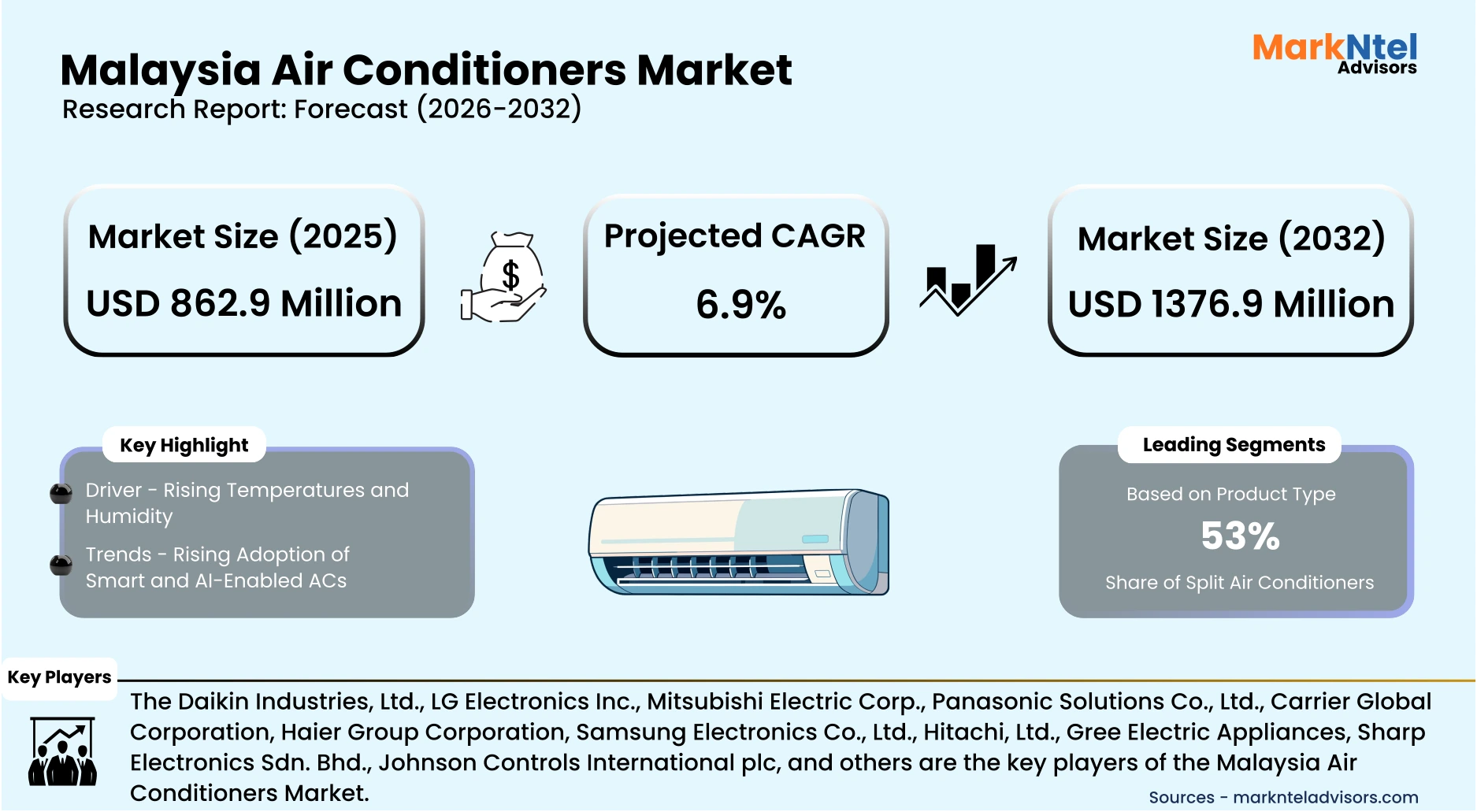
- The Malaysia Air Conditioners Market size was valued at around USD 862.9 million in 2025 and is projected to reach USD 1,376.9 million by 2032. The estimated CAGR from 2026 to 2032 is around 6.9%, indicating strong growth.
- By product type, the split air conditioners represented 53% of the total number of units sold in 2025. Room air conditioner volume sales are expected to grow at a CAGR of approximately 7.19% during 2026-32.
- By product type, VRF system sales are projected to grow at a CAGR of around 6.89% during 2026-32.
- By end user, the residential sector represented 34% of the Malaysia Air Conditioners Market size in 2025.
- The leading air conditioner companies are Daikin Industries, Ltd., LG Electronics Inc., Mitsubishi Electric Corp., Panasonic Solutions Co., Ltd., Carrier Global Corporation, Haier Group Corporation, Samsung Electronics Co., Ltd., Hitachi, Ltd., Gree Electric Appliances, Sharp Electronics Sdn. Bhd., Johnson Controls International plc, and others.
Market Insights & Analysis: Malaysia Air Conditioners Market (2026-2032):
The Malaysia Air Conditioners Market size was valued at around USD 862.9 million in 2025 and is projected to reach USD 1,376.9 million by 2032. Along with this, the market is estimated to grow at a CAGR of around 6.9% during the forecast period, i.e., 2026-32. The Malaysia Air Conditioners Market is positioned for steady growth supported by climatic realities, changing consumer behavior, and rapid technological upgrades. Malaysia’s equatorial climate creates year-round cooling demand, with government data confirming persistently high temperatures and humidity. In 2024, the Chuping meteorological station recorded a maximum mean temperature of 32.0°C, while relative humidity frequently exceeded 80%, reinforcing air conditioning as a necessity rather than a discretionary appliance for indoor comfort and productivity.
Alongside climate pressure, the market is evolving technologically. Consumers increasingly prefer intelligent, connected cooling solutions that offer energy savings and ease of control. This shift is evident in recent product launches such as Comfee’s Gusto smart air conditioner, introduced in Malaysia in July 2025. The product offers app-based control from up to 15 km and integrates AI algorithms that deliver more than 30% energy savings compared with conventional operation, reflecting growing demand for smart, efficiency-oriented appliances.
Rising electricity awareness, government emphasis on energy efficiency standards, and expanding urban housing and commercial infrastructure further support long-term demand. From residential apartments to offices, healthcare facilities, and data-intensive buildings, cooling systems remain critical infrastructure. Looking ahead, continued urban development, smart-home adoption, and climate resilience planning are expected to accelerate replacement cycles and new installations.
Overall, Malaysia’s air conditioners market is set to expand steadily through 2032, driven by unavoidable climatic conditions and a clear transition toward smarter, energy-efficient cooling solutions that align comfort with sustainability.
Malaysia Air Conditioners Market Recent Developments:
- March 2025: Midea Malaysia aims to achieve USD 214 M in 2025 sales by capitalizing on strong demand for energy-efficient inverter air conditioners. Demand for such high-efficiency ACs grew from 10% to over 50% of the market, driven by rising energy costs and consumer preference for sustainable cooling.
- November 2025: AUX showcased its expanding range of residential and commercial AC units in Malaysia and previewed a voice command air conditioner set for early 2026 release. The focus on smart, user-centric cooling solutions reflects growing market trends toward tech-enabled, energy-efficient appliances.
Malaysia Air Conditioners Market Scope:
| Category | Segments |
|---|---|
| By Product Type | Room Air Conditioners (Window AC, Split AC), VRF Systems, Chillers, Packaged Air Conditioners, Cassette Air Conditioners, Ducted Split Systems, Others (Air Handling Units (AHU) / Fan Coil Units (FCU), etc. |
| By Refrigerant Type | R32, R410A, R134a, R1234ze / R1234yf, R744, Others |
| By Distribution Channel | Direct Sales, Authorized Dealers & Distributors, Multi-Brand Stores, Online |
| By End-User | Residential, Offices, Retail & Malls, Hotels & Hospitality, Hospitals & Healthcare, Educational Institutions, Manufacturing, Pharmaceuticals, Food & Beverage, Data Centers, Others), and others |
Malaysia Air Conditioners Market Driver:
Rising Temperatures and Humidity
Malaysia’s tropical equatorial climate is characterized by persistently high temperatures and humidity, which directly drive demand for air conditioning systems. According to the Malaysian Meteorological Department (MetMalaysia), average daily temperatures typically range between 31°C and 33°C, with relative humidity around 80% across most regions due to abundant moisture in the air. High humidity reduces thermal comfort, increasing reliance on air conditioning to maintain indoor livability and productivity.
Government climate projections further indicate that average annual temperatures could rise by approximately 1.0–1.5°C by 2050 and up to 1.7–2.1°C by 2100 due to global warming, intensifying heat stress and cooling needs over the long term. Malaysia’s Department of Statistics reported ambient temperatures reaching as high as 32.0°C in 2024, reflecting persistent heat conditions that augment cooling demand.
This combination of sustained heat and humidity means indoor spaces without efficient cooling become uncomfortable and unproductive, particularly during prolonged heat waves, which have become more frequent in recent years. Building energy use studies show that air conditioning systems can account for up to 50% of a building’s total electrical consumption in Malaysia, underscoring how climate directly shapes energy demand patterns.
Moreover, planned investments in data centers and large commercial facilities (expected to expand significantly by 2035 with multi-gigawatt power loads) will further escalate cooling requirements. Enhanced grid upgrades and energy-efficient infrastructure projects will expand AC deployment in residential and commercial properties alike.
Overall, consistently high temperatures and humidity, compounded by long-term warming trends, are foundational drivers propelling growth in Malaysia’s air conditioner market, underpinning both present demand and future expansion.
Malaysia Air Conditioners Market Trend:
Rising Adoption of Smart and AI-Enabled ACs
In 2025, Malaysia’s air conditioner market is witnessing accelerated adoption of smart and AI-enabled cooling systems, reflecting a broader shift toward energy-efficient, climate-responsive technologies. For example, LG Malaysia has introduced advanced AI-driven models like the DUALCOOL™ AI air conditioner, which incorporates features such as adaptive energy management, window-open detection, and connectivity through the ThinQ app to monitor and control energy use in real time. These functions allow users to customize electricity consumption and improve efficiency, directly addressing rising utility costs.
Similarly, Midea Malaysia’s 2025 smart inverter AC series utilizes AI power optimization algorithms (e.g., ECOMASTER AI) that enable up to 49% enhanced energy savings compared with regular modes, certified by SIRIM Malaysia, the national standards body, underscoring how artificial intelligence enhances operational efficiency.
These innovations are driven by growing consumer expectations for intuitive control, remote connectivity, and energy conservation, supported by government energy-efficiency benchmarks like ASEAN Cool Initiative targets for stricter Minimum Energy Performance Standards (MEPS). Malaysia’s policy emphasis on efficient appliances encourages brands to integrate intelligent features that reduce overall power demand.
With rising electricity costs and increased regulatory focus on sustainability, AI-enabled ACs are set to become mainstream beyond 2025, boosting demand for predictive maintenance, automated energy optimization, and smart-home integration across residential and commercial sectors.
Malaysia Air Conditioners Market Challenge:
High Initial Cost of Advanced Systems
One significant challenge in the Malaysia air conditioners market is the high upfront cost of advanced, energy-efficient cooling systems compared with basic models. While government tariff policies aim to keep electricity rates fair, the initial purchase expenditure for higher-end systems remains a barrier for many consumers. Under Malaysia’s updated electricity tariff regime (effective from July, 2025), domestic users continue to pay itemised energy, capacity, and network charges with lower and higher usage tiers defined reflecting real supply costs, even as incentives encourage efficiency.
Advanced systems, such as inverters and smart ACs, which offer adaptive performance and lower lifetime energy bills, often come with higher price tags than standard units. Retail pricing data shows that inverter units with superior efficiency (e.g., 1.5 HP models) can range up to 3,297 RM (USD 692) compared with fixed-speed models of similar capacity, indicating a premium cost for advanced technology. Even with government rebate programmes, for example, the SAVE 4.0 initiative offering up to RM 400 (USD 84) e-rebate on energy-efficient AC purchases, the reduction only partially offsets the initial expenditure for higher-end systems.
These higher upfront requirements can deter price-sensitive households and small businesses from adopting advanced AC technologies, slowing market penetration of efficiency-focused solutions despite long-term cost savings. Consequently, the market must balance initial affordability with energy performance to sustain broader adoption throughout the forecast period.
Malaysia Air Conditioners Market (2026-32) Segmentation Analysis:
The Malaysia Air Conditioners Market Report and Forecast 2026-2032 offers a detailed analysis of the market based on the following segments:
Based on Product Type:
- Room Air Conditioners
- Window AC
- By Tonnage Capacity
- Upto 1 Ton
- 1 Ton to 2 Ton
- Above 2 Ton
- By Tonnage Capacity
- Split AC - USD Million & Thousand Units
- By Tonnage Capacity
- Upto 1 Ton
- 1 Ton to 1.5 Ton
- Above 1.6 to 2 tons
- Above 2 Ton
- By Tonnage Capacity
- Window AC
- VRF Systems
- Chillers
- Air-cooled chillers
- Water-cooled chillers
- Others
- Packaged Air Conditioners
- Upto 5 Tons
- 6 to 10 Tons
- 11 to 20 Tons
- Above 20 Tons
- Cassette Air Conditioners
- Upto 2 Tons
- 2.1 to 4 Tons
- 4.1 to 5 Tons
- Above 5 Tons
- Ducted Split Systems
- Upto 5 Tons
- 6 to 10 Tons
- 11 to 20 Tons
- Above 20 Tons
- Others
Split air conditioners dominate the market with a 53% share in unit sales due to their superior balance of performance, efficiency, and consumer convenience. These systems offer quieter operation, better cooling distribution, and improved aesthetics compared to window units. The wide availability of inverter-based models helps reduce electricity consumption, making split ACs attractive in price-sensitive and energy-conscious markets. Flexible installation options allow usage across apartments, independent houses, and small commercial spaces.
In addition, manufacturers offer split ACs in multiple tonnage capacities, catering to diverse room sizes and climate conditions. Strong brand competition, frequent product upgrades, and aggressive promotional strategies through offline and online channels have further accelerated adoption. Rising urban housing development and replacement of older cooling systems continue to reinforce the leadership of split air conditioners in overall unit sales.
Based on End User:
- Residential
- Offices
- Retail & Malls
- Hotels & Hospitality
- Hospitals & Healthcare
- Educational Institutions
- Manufacturing
- Pharmaceuticals
- Food & Beverage
- Data Centers
- Others
The residential segment leads the market with a 34% share, supported by steady growth in urbanization and household income levels. Increasing exposure to extreme temperatures has made air conditioning a basic household necessity rather than a luxury. Expansion of apartment projects, especially in mid-income and affordable housing categories, has significantly increased residential AC installations. Government-led energy efficiency awareness programs and star-rating systems have encouraged households to invest in efficient cooling solutions. Easy availability of consumer financing, seasonal discounts, and online purchasing options have also improved affordability. Moreover, work-from-home trends and longer indoor occupancy have increased cooling demand in homes, positioning the residential segment as the most consistent and volume-driven end-user category in the market.
Malaysia Air Conditioners Market (2026-32): Regional Projection
The Malaysia Air Conditioners Market is dominated by Eastern China, including provinces such as Jiangsu, Zhejiang, Guangdong, and Shandong. These regions lead due to high urbanization rates, dense populations, and extensive industrial and municipal infrastructure requiring advanced wastewater treatment solutions. The presence of large urban centers and industrial hubs drives demand for centralized and technologically advanced treatment plants.
Additionally, stringent local government regulations on water pollution control and water reuse incentivize the adoption of modern physical, chemical, biological, and digital treatment technologies. Eastern China also attracts substantial public and private investments in wastewater infrastructure, enabling the deployment of smart monitoring systems and energy-efficient solutions. The combination of high wastewater volumes, regulatory enforcement, and financial capacity makes Eastern China the most significant regional market, accounting for a major share of national water and wastewater treatment technology adoption, and positioning it as a key driver for market growth over the coming decade.
Gain a Competitive Edge with Our Malaysia Air Conditioners Market Report:
- Malaysia Air Conditioners Market Report by MarkNtel Advisors provides a detailed & thorough analysis of market size & share, growth rate, competitive landscape, and key players. This comprehensive analysis helps businesses gain a holistic understanding of the market dynamics & make informed decisions.
- This report also highlights current market trends & future projections, allowing businesses to identify emerging opportunities & potential challenges. By understanding market forecasts, companies can align their strategies & stay ahead of the competition.
- Malaysia Air Conditioners Market Report aids in assessing & mitigating risks associated with entering or operating in the market. By understanding market dynamics, regulatory frameworks, and potential challenges, businesses can develop strategies to minimize risks & optimize their operations.
*Reports Delivery Format - Market research studies from MarkNtel Advisors are offered in PDF, Excel and PowerPoint formats. Within 24 hours of the payment being successfully received, the report will be sent to your email address.
Frequently Asked Questions
- Market Segmentation
- Introduction
- Product Definition
- Research Process
- Assumptions
- Executive Summary
- Malaysia Air Conditioners Market Policies, Regulations, and Product Standards
- Malaysia Air Conditioners Market Supply Chain Analysis
- Malaysia Air Conditioners Market Import/ Export
- Malaysia Air Conditioners Market Trends & Developments
- Malaysia Air Conditioners Market Dynamics
- Growth Drivers
- Challenges
- Malaysia Air Conditioners Market Hotspot & Opportunities
- Malaysia Air Conditioners Market Outlook, 2022-2032
- Market Size & Outlook
- By Revenues (USD Million)
- By Units Sold (Thousand Units)
- Market Share & Outlook
- By Product Type - Market Size & Forecast 2022-2032F, USD Million & Thousand Units
- Room Air Conditioners- USD Million & Thousand Units
- Window AC- USD Million & Thousand Units
- By Tonnage Capacity
- Upto 1 Ton
- 1 Ton to 2 Ton
- Above 2 Ton
- By Tonnage Capacity
- Split AC - USD Million & Thousand Units
- By Tonnage Capacity
- Upto 1 Ton
- 1 Ton to 1.5 Ton
- Above 1.6 to 2 Ton
- Above 2 Ton
- By Tonnage Capacity
- Window AC- USD Million & Thousand Units
- VRF Systems
- Chillers
- Air-cooled chillers
- Water-cooled chillers
- Others
- Packaged Air Conditioners
- Upto 5 Tons
- 6 to 10 Tons
- 11 to 20 Tons
- Above 20 Tons
- Cassette Air Conditioners
- Upto 2 Tons
- 2.1 to 4 Tons
- 4.1 to 5 Tons
- Above 5 Tons
- Ducted Split Systems
- Upto 5 Tons
- 6 to 10 Tons
- 11 to 20 Tons
- Above 20 Tons
- Others (Air Handling Units (AHU) / Fan Coil Units (FCU), etc.)
- Room Air Conditioners- USD Million & Thousand Units
- By Refrigerant Type – Market Size & Forecast 2022-2032, USD Million
- R32
- R410A
- R134a
- R290
- R1234ze / R1234yf
- Others
- By Distribution Channel – Market Size & Forecast 2022-2032, USD Million
- Direct Sales
- Authorized Dealers & Distributors
- Multi-Brand Stores
- Online
- By End User – Market Size & Forecast 2022-2032, USD Million
- Residential
- Offices
- Retail & Malls
- Hotels & Hospitality
- Hospitals & Healthcare
- Educational Institutions
- Manufacturing
- Pharmaceuticals
- Food & Beverage
- Data Centers
- Others
- By Region
- Midwest
- Northeast
- South
- Central-West
- By Company
- Company Revenue Shares
- Competitor Characteristics
- By Product Type - Market Size & Forecast 2022-2032F, USD Million & Thousand Units
- Market Size & Outlook
- Malaysia Window Air Conditioners Market Outlook, 2022-2032
- Market Size & Analysis
- Market Revenues (USD Million)
- By Units Sold (Thousand Units)
- Market Share & Analysis
- By Refrigerant Type - Market Size & Forecast 2022-2032, USD Million
- By Distribution Channel- Market Size & Forecast 2022-2032, USD Million
- By End-User- Market Size & Forecast 2022-2032, USD Million
- By Region
- By Technology
- Inverter
- Non Inverter
- By Price Range
- By Automation
- Smart
- Non Smart
- By Star Rating
- Market Size & Analysis
- Malaysia Split Air Conditioners Market Outlook, 2022-2032
- Market Size & Analysis
- Market Revenues (USD Million)
- By Units Sold (Thousand Units)
- Market Share & Analysis
- By Refrigerant Type - Market Size & Forecast 2022-2032, USD Million
- By Distribution Channel- Market Size & Forecast 2022-2032, USD Million
- By End-User- Market Size & Forecast 2022-2032, USD Million
- By Region
- By Technology
- By Price Range
- By Automation
- By Star Rating
- Market Size & Analysis
- Malaysia VRF Systems Air Conditioners Market Outlook, 2022-2032
- Market Size & Analysis
- Market Revenues (USD Million)
- By Units Sold (Thousand Units)
- Market Share & Analysis
- By Refrigerant Type - Market Size & Forecast 2022-2032, USD Million
- By Distribution Channel- Market Size & Forecast 2022-2032, USD Million
- By End-User- Market Size & Forecast 2022-2032, USD Million
- By Region
- Market Size & Analysis
- Malaysia Chiller Air Conditioners Market Outlook, 2022-2032
- Market Size & Analysis
- By Revenue (USD Million)
- Market Share & Analysis
- By Cooling Type
- Air Cooled Chillers
- Water Cooled Chillers
- By Compressor Technology
- Reciprocating
- Scroll
- Screw
- Centrifugal
- By Refrigerant Type – Market Size & Forecast 2022-2032, USD Million
- By End User – Market Size & Forecast 2022-2032, USD Million
- By Installation
- New Installation
- Retrofit or Modernization
- By Region
- By Cooling Type
- Market Size & Analysis
- Malaysia Packaged Air Conditioners Market Outlook, 2022-2032
- Market Size & Analysis
- Market Revenues (USD Million)
- By Units Sold (Thousand Units)
- Market Share & Analysis
- By Refrigerant Type - Market Size & Forecast 2022-2032, USD Million
- By Distribution Channel- Market Size & Forecast 2022-2032, USD Million
- By End-User- Market Size & Forecast 2022-2032, USD Million
- By Region
- Market Size & Analysis
- Malaysia Cassette Air Conditioners Market Outlook, 2022-2032
- Market Size & Analysis
- Market Revenues (USD Million)
- By Units Sold (Thousand Units)
- Market Share & Analysis
- By Refrigerant Type - Market Size & Forecast 2022-2032, USD Million
- By Distribution Channel- Market Size & Forecast 2022-2032, USD Million
- By End-User- Market Size & Forecast 2022-2032, USD Million
- By Region
- Market Size & Analysis
- Malaysia Ducted Split Systems Air Conditioners Market Outlook, 2022-2032
- Market Size & Analysis
- Market Revenues (USD Million)
- By Units Sold (Thousand Units)
- Market Share & Analysis
- By Refrigerant Type - Market Size & Forecast 2022-2032, USD Million
- By Distribution Channel- Market Size & Forecast 2022-2032, USD Million
- By End-User- Market Size & Forecast 2022-2032, USD Million
- By Region
- Market Size & Analysis
- Malaysia Air Conditioners Market Key Strategic Imperatives for Success & Growth
- Competition Outlook
- Company Profiles
- Daikin Industries, Ltd.
- Business Description
- Product Portfolio
- Strategic Alliances or Partnerships
- Recent Developments
- Financial Details
- Others
- LG Electronics Inc.
- Business Description
- Product Portfolio
- Strategic Alliances or Partnerships
- Recent Developments
- Financial Details
- Others
- Mitsubishi Electric Corp.
- Business Description
- Product Portfolio
- Strategic Alliances or Partnerships
- Recent Developments
- Financial Details
- Others
- Panasonic Solutions Co., Ltd.
- Business Description
- Product Portfolio
- Strategic Alliances or Partnerships
- Recent Developments
- Financial Details
- Others
- Carrier Global Corporation
- Business Description
- Product Portfolio
- Strategic Alliances or Partnerships
- Recent Developments
- Financial Details
- Others
- Haier Group Corporation
- Business Description
- Product Portfolio
- Strategic Alliances or Partnerships
- Recent Developments
- Financial Details
- Others
- Samsung Electronics Co., Ltd
- Business Description
- Product Portfolio
- Strategic Alliances or Partnerships
- Recent Developments
- Financial Details
- Others
- Hitachi, Ltd.
- Business Description
- Product Portfolio
- Strategic Alliances or Partnerships
- Recent Developments
- Financial Details
- Others
- Gree Electric Appliances
- Business Description
- Product Portfolio
- Strategic Alliances or Partnerships
- Recent Developments
- Financial Details
- Others
- Sharp Electronics Sdn. Bhd.
- Business Description
- Product Portfolio
- Strategic Alliances or Partnerships
- Recent Developments
- Financial Details
- Others
- Johnson Controls International plc
- Business Description
- Product Portfolio
- Strategic Alliances or Partnerships
- Recent Developments
- Financial Details
- Others
- Others
- Daikin Industries, Ltd.
- Company Profiles
Disclaimer
MarkNtel Advisors follows a robust and iterative research methodology designed to ensure maximum accuracy and minimize deviation in market estimates and forecasts. Our approach combines both bottom-up and top-down techniques to effectively segment and quantify various aspects of the market. A consistent feature across all our research reports is data triangulation, which examines the market from three distinct perspectives to validate findings. Key components of our research process include:
1. Scope & Research Design At the outset, MarkNtel Advisors define the research objectives and formulate pertinent questions. This phase involves determining the type of research—qualitative or quantitative—and designing a methodology that outlines data collection methods, target demographics, and analytical tools. They also establish timelines and budgets to ensure the research aligns with client goals.
2. Sample Selection and Data Collection In this stage, the firm identifies the target audience and determines the appropriate sample size to ensure representativeness. They employ various sampling methods, such as random or stratified sampling, based on the research objectives. Data collection is carried out using tools like surveys, interviews, and observations, ensuring the gathered data is reliable and relevant.
3. Data Analysis and Validation Once data is collected, MarkNtel Advisors undertake a rigorous analysis process. This includes cleaning the data to remove inconsistencies, employing statistical software for quantitative analysis, and thematic analysis for qualitative data. Validation steps are taken to ensure the accuracy and reliability of the findings, minimizing biases and errors.

4. Data Forecast and FinalizationThe final phase involves forecasting future market trends based on the analyzed data. MarkNtel Advisors utilize predictive modeling and time series analysis to anticipate market behaviors. The insights are then compiled into comprehensive reports, featuring visual aids like charts and graphs, and include strategic recommendations to inform client decision-making
We offer flexible licensing options to cater to varying organizational needs. Choose the pricing pack that best suits your requirements:
Buy Now Inquire Before Buying
 Request Customization
 Talk to our Consultant







