

Latin America Plant-Based Dairy Products Market Research Report: Forecast (2025-2030)
Latin America Plant-Based Dairy Products Market - By Product (Plant-based Milk [Almond milk, Oat Milk, Soy Milk, Coconut Milk], Plant-based Cheese [Nut-based Cheese, Soy-based Chee ... se], Plant-based Yogurt [Almond Yogurt, Coconut Yogurt, Soy Yogurt], Plant-based Butter, Others), By Source (Fruits, Vegetables, Seeds & Nuts, Others), By Sales Channel (Supermarket/Hypermarket, Convenience Stores, Specialty Stores, Online Stores, Others), By Nature (Organic, Conventional), By End Use (Bakery & Confectionery, Snacks & Savories, Ready to Eat Meals, HoReCa, Dietary Supplements) and Others Read more
- Food & Beverages
- May 2025
- Pages 153
- Report Format: PDF, Excel, PPT
Market Insights & Analysis: Latin America Plant-Based Dairy Products Market (2025-2030):
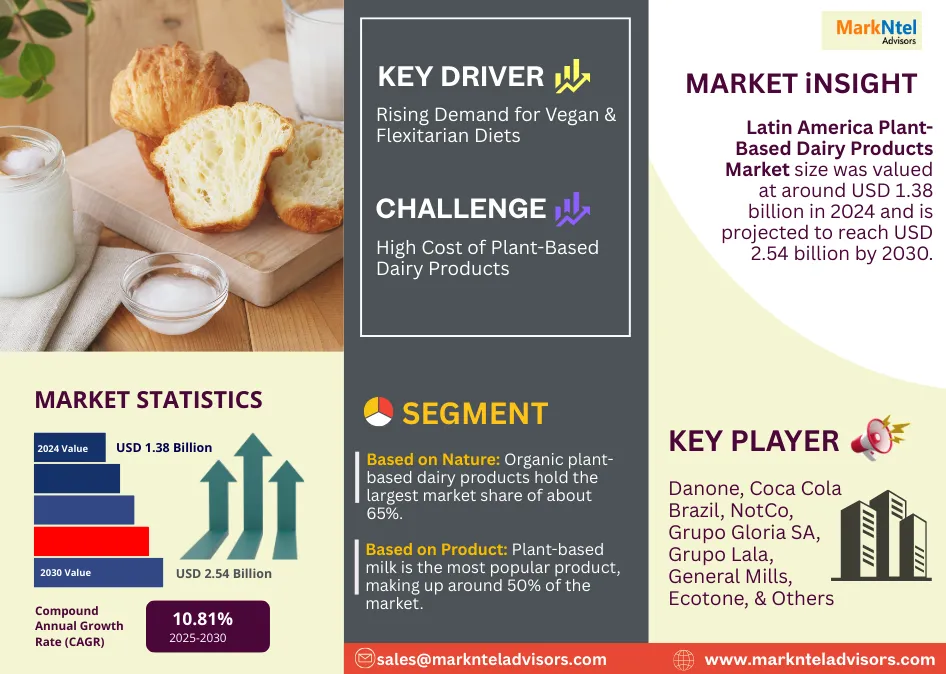
The Latin America Plant-Based Dairy Products Market size was valued at around USD 1.38 billion in 2024 and is projected to reach USD 2.54 billion by 2030. Along with this, the market is estimated to grow at a CAGR of around 10.81% during the forecast period (2025-30). The Latin American region has witnessed a boom in the plant-based dairy product market due to a shift in consumers' lifestyle, fitness trends, and developing environmental consciousness. Brazil, Mexico, and Argentina are the top countries in this region currently embracing plant-based products, which include some dairy alternatives like almonds, soy, and oat milk. People in Brazil are increasingly turning to a vegetarian diet, with above 14% of the population adopting diets that comprise less meat intake. Similarly, the high demand for plant-based dairy products like almonds and soya milk is attributed to the tendency of human beings to keep away from dairy intake based on lactose intolerance.
According to the National Institute of Statistics and Geography (INEGI), plant-based products are being taken more since the increase in the standard of living of individuals. More Mexicans are turning to healthful meals, and consumption of plant-based milk is rapidly increasing across the most important cities. Further, as in line with an FAO (Food and Agriculture Organization) survey, around 70% of Latin Americans are lactose intolerant. This section of the populace is about to be the most important consumer base for companies in the forthcoming years.
| Report Coverage | Details |
|---|---|
| Historical Years | 2020–23 |
| Forecast Years | 2025–30 |
| Market Value in 2024 | USD 1.38 Billion |
| Market Value by 2030 | USD 2.54 Billion |
| CAGR (2025–30) | 10.81% |
| Leading Country | Mexico |
| Top Key Players | Danone, Coca Cola Brazil, NotCo, Grupo Gloria SA, Grupo Industrial Cuadritos Biotek, Mastellone Hermanos S.A., Grupo Lala, General Mills, Flora Food Group, Ecotone, and Others |
| Key Report Highlights |
|
*Boost strategic growth with in-depth market analysis - Get a free sample preview today!
Consumer worries about environmental degradation are also driving the market demand in Latin America. Most plant-based products are environmentally friendly compared to dairy farming, in which water and land are used significantly. This is specifically relevant in Latin America, where water is swiftly turning into a scarce resource, and consequently, the environmental advantages of soy-based products are especially appealing. For example, it takes approximately 1,000 liters of water to supply a liter of cow’s milk, and 48 liters of water to produce an oat milk plant-primarily based product. Therefore, there is a higher demand for plant-based dairy products in the region, which is augmenting the size & volume of the regional market.
In addition, one of the causes of land loss and forest destruction in countries such as Brazil is dairy product cultivation in Latin America. Most of the deforestation in the Amazon, especially in Brazil, was due to cattle production for their leather and meat, based on information from the Brazilian Agricultural Research Corporation (EMBRAPA). In comparison, plant-based milk alternatives use much less land and have fewer negative impacts on the environment. Plant-based items are gaining ground in the market due to increased consumer interest in sustainability. This is evidenced by the increasing popularity of plant-based milk products such as soy cheese in countries like Brazil and Mexico, among others.
Latin America Plant-Based Dairy Products Market Driver:
Rising Demand for Vegan & Flexitarian Diets – The recognition of some vegan and flexitarian diets has a vital role in the growth of the plant-based dairy industry throughout Latin America. Consumers are increasingly moving towards plant-based diets in Brazil, Mexico, and Argentina due to health and environmental reasons. Veganism is a food plan that excludes all animal products, along with dairy products. This trend is being headed with the aid of increasing attention of fitness benefits from diets which might be rich in flora, and counter the problems related to ethics and animal agriculture.
A survey carried out by the Brazilian IBOPE Institute revealed that about 10% of the Brazilian population has followed a vegan or natural vegetarian weight-reduction plan, and this percentage is on the rise, mainly in young people. A report published by the National Institute of Health in Mexico indicates that more than 20% of Mexico’s population is reliant on a plant-based diet or has reduced their meat diet, with maximum of them preferring the use of plant-based milk instead of cow milk.
However, more people in the region are turning to a flexitarian diet, where most of the foods consumed are plant-based, but additionally, even though rare, some animal products. Latin Americans are willingly lowering their meat and dairy intake, which is also a new trend that responds to health-aware problems such as weight problems, cardiovascular disease, and various troubles currently going on in Brazil and Mexico. This is why milk consumption from plants, that is, almond milk, oat milk, and soy milk, is on the upward trend, as consumers are increasingly attracted to it.
Latin America Plant-Based Dairy Products Market Challenge:
High Cost of Plant-Based Dairy Products – Plant-based dairy products are relatively expensive compared to dairy products, especially for people in Latin America. The high production costs, restricted local raw materials, and the fact that a lot of the material needs to be imported. For instance, consumers in Brazil or Argentina pay USD3.50 – USD4.50 for a liter of oat milk, although the same amount of regular milk costs USD1.50 – USD2.00. There are no factories in most regions to produce plant-derived products, which makes the products expensive to acquire since many items are imported. This can be resolved through local purchasing of ingredients, improved techniques of production, and support from the government. It would increase plant-based dairy accessibility and its consumption in different regions, given that the expenses would be reduced.
Latin America Plant-Based Dairy Products Market Trend:
Oat Milk Gaining Traction – Oat milk is also coming up as one of the quickest-growing trends in the Latin America Plant-Based Dairy Product Market, winning over lactose-intolerant, health-aware, and eco-conscious consumers. Its demand has grown in nations such as Mexico and Colombia since 2020, with urban communities seeking dairy-free substitutes actively, with Brazil leading the pace and Argentina emerging as the fastest-growing in Latin America's Oat Milk Market.
To cater to the growing trend, cafés and supermarkets are increasingly stocking oat milk alternatives, with barista versions becoming a mainstay in coffee culture. Unlike other plant-based milks, oat milk is hailed for its velvety texture, nutritional value, and smaller environmental footprint, making it the go-to choice over almond and soy milk. These include brands such as NotCo, Oatly, and Silk (Danone), which are all adding oat milk varieties to their offerings, driving its commonality and positioning it firmly at the center of the plant-based trend.
Latin America Plant-Based Dairy Products Market (2025-2030): Segmentation Analysis
The Latin America Plant-Based Dairy Product Market study of MarkNtel Advisors evaluates & highlights the major trends and influencing factors in each segment. It includes predictions for the period 2025–2030 at the regional levels. Based on the analysis, the market has been further classified as:
By Nature:
- Organic
- Conventional
In the Latin American region, organic plant-based dairy products hold the largest market share of about 65%. This dominance is mainly attributed to the need to have healthier and environmentally friendly products. For instance, the sales of organic food in Brazil increased by 8% in 2023, and the total value was USD 3.1 billion based on the information from the Brazilian Institute of Geography and Statistics (IBGE). Consumers perceive organic plant-based dairy as natural and chemical-free, and the trend is for cleaner and greener food products. Many people in Latin America are willing to spend even more on organic products. Latin America is continuing to support sustainability, thus the organic plant-based dairy products are dominating the market.
By Product:
- Plant-based Milk
- Plant-based Cheese
- Plant-based Yogurt
- Plant-based Butter
- Others (Creamers, ice creams, etc.)
In Latin America, plant-based milk is the most popular product, making up around 50% of the market. As more people become aware of health and environmental issues, they are turning to dairy milk alternatives. Further ongoing product innovation has created a variety of plant-based milks in the market, like almond milk, soy milk, oat milk, and coconut milk, to cater to consumers’ needs. Plant-based milk has a taste and texture close to cow’s milk and thus, can be used equally well in hot beverages, breakfast bowls, baked products, as well as in cooking. For this reason, due to the similarity in nutritive value and flexibility, many people prefer it over animal milk, and thus it has been established in the Latin American region longer than other categories of plant-based dairy products.
Latin America Plant-Based Dairy Products Market (2025-30): Regional Projections
Geographically, the Global Plant-Based Dairy Products Market expands across:
- Brazil
- Mexico
- Argentina
- Peru
- Chile
- Ecuador
- Colombia
- Rest of Latin America
Out of them, Mexico dominates the Latin America plant-based Dairy Products Market. It holds about 32% of the total regional market value. Mexico is one of the largest producers of plant-based dairy products in Latin America. The production is growing rapidly as consumers become more health and sustainability-conscious and there is increased demand from Mexico’s emerging middle class for Plant-based alternatives oat, soy, or almond milk, on account of rising disposable income, fueling enthusiasm for dietary changes and supporting the growth of the market. With rising government support to promote sustainable agriculture and plant-based industries, there is ongoing product innovation happening in Mexico’s Plant-Based Dairy Products Market.
Latin America Plant-Based Dairy Products Industry Recent Development:
- January 2024: NotCo has recently made significant strides in the plant-based dairy segment in Brazil. The company launched NotCreme, a chickpea-based milk cream, during an episode of MasterChef Brazil, where it also serves as an official sponsor. This innovative product stands out because it can be used in both sweet and savory dishes, and it resists acidity, making it suitable for recipes like lemon-based desserts and creamy sauces.
Gain a Competitive Edge with Our Latin America Plant-Based Dairy Products Market Report
- Latin America Plant-Based Dairy Products Market Report by MarkNtel Advisors provides a detailed & thorough analysis of market size, growth rate, competitive landscape, and key players. This comprehensive analysis helps business organizations to gain a holistic understanding of market dynamics & make informed decisions.
- This report also highlights current market trends & future projections, allowing business organizations to identify emerging opportunities & potential challenges. By understanding market forecasts, companies can align their strategies & stay ahead of the competition.
- Latin America Plant-Based Dairy Products Market Report aids in assessing & mitigating risks associated with entering or operating in the market. By understanding market dynamics, regulatory frameworks, and potential challenges, business organizations can develop strategies to minimize risks & optimize their operations.
*Reports Delivery Format - Market research studies from MarkNtel Advisors are offered in PDF, Excel and PowerPoint formats. Within 24 hours of the payment being successfully received, the report will be sent to your email address.
Frequently Asked Questions
- Market Segmentation
- Introduction
- Market Definition
- Research Process
- Assumptions
- Executive Summary
- Latin America Plant-Based Dairy Products Market Trends & Insights
- Latin America Plant-Based Dairy Products Market Dynamics
- Growth Drivers
- Challenges
- Latin America Plant-Based Dairy Products Market Hotspot & Opportunities
- Latin America Plant-Based Dairy Products Market Supply Chain Analysis
- Latin America Plant-Based Dairy Products Market Regulation & Policy
- Latin America Plant-Based Dairy Products Market Outlook, 2020-2030F
- Market Size & Analysis
- By Revenues (USD Million)
- Market Share & Analysis
- By Product
- Plant-based Milk
- Almond milk- Market Size & Forecast 2020-2030, USD Million
- Oat Milk-Market Size & Forecast 2020-2030, USD Million
- Soy Milk-Market Size & Forecast 2020-2030, USD Million
- Coconut Milk- Market Size & Forecast 2020-2030, USD Million
- Rice Milk-Market Size & Forecast 2020-2030, USD Million
- Pea Milk-Market Size & Forecast 2020-2030, USD Million
- Others (Cashew, Hazelnut, etc.)
- Plant-based Cheese
- Nut-based Cheese-Market Size & Forecast 2020-2030, USD Million
- Soy-based Cheese- Market Size & Forecast 2020-2030, USD Million
- Plant-based Yogurt
- Almond Yogurt-Market Size & Forecast 2020-2030, USD Million
- Coconut Yogurt-Market Size & Forecast 2020-2030, USD Million
- Soy Yogurt-Market Size & Forecast 2020-2030, USD Million
- Plant-based Butter- Size & Forecast 2020-2030, USD Million
- Others (Creamers, ice creams, etc.)
- Plant-based Milk
- By Source
- Fruits- Market Size & Forecast 2020-2030, USD Million
- Vegetables- Market Size & Forecast 2020-2030, USD Million
- Seeds & Nuts- Market Size & Forecast 2020-2030, USD Million
- Others
- By Sales Channel
- Supermarket/Hypermarket- Market Size & Forecast 2020-2030, USD Million
- Convenience Stores- Market Size & Forecast 2020-2030, USD Million
- Specialty Stores- Market Size & Forecast 2020-2030, USD Million
- Online Stores -Market Size & Forecast 2020-2030, USD Million
- Others
- By Nature
- Organic- Market Size & Forecast 2020-2030, USD Million
- Conventional- Market Size & Forecast 2020-2030, USD Million
- By End Use
- Bakery & Confectionery- Market Size & Forecast 2020-2030, USD Million
- Snacks & Savories- Market Size & Forecast 2020-2030, USD Million
- Ready to Eat Meals- Market Size & Forecast 2020-2030, USD Million
- HoReCa- Market Size & Forecast 2020-2030, USD Million
- Dietary Supplements- Market Size & Forecast 2020-2030, USD Million
- Others
- By Country
- Brazil
- Mexico
- Argentina
- Peru
- Chile
- Ecuador
- Colombia
- Rest of Latin America
- By Competitors
- Competition Characteristics
- Market Share & Analysis
- By Product
- Market Size & Analysis
- Brazil Plant-Based Dairy Products Market Outlook, 2020-2030
- Market Size & Analysis
- By Revenues (USD Million)
- Market Share & Analysis
- By Product - Market Size & Forecast 2020-2030, USD Million
- By Source - Market Size & Forecast 2020-2030, USD Million
- By Sales Channel- Market Size & Forecast 2020-2030, USD Million
- By Nature-Market Size & Forecast 2020-2030, USD Million
- By End Use- Market Size & Forecast 2020-2030, USD Million
- Market Size & Analysis
- Argentina Plant-Based Dairy Products Market Outlook, 2020-2030
- Market Size & Analysis
- By Revenues (USD Million)
- Market Share & Analysis
- By Product - Market Size & Forecast 2020-2030, USD Million
- By Source - Market Size & Forecast 2020-2030, USD Million
- By Sales Channel- Market Size & Forecast 2020-2030, USD Million
- By Nature - Market Size & Forecast 2020-2030, USD Million
- By End-Use-Market Size & Forecast 2020-2030, USD Million
- Market Size & Analysis
- Peru Plant-Based Dairy Products Market Outlook, 2020-2030
- Market Size & Analysis
- By Revenues (USD Million)
- Market Share & Analysis
- By Product- Market Size & Forecast 2020-2030, USD Million
- By Source - Market Size & Forecast 2020-2030, USD Million
- By Sales Channel- Market Size & Forecast 2020-2030, USD Million
- By Nature - Market Size & Forecast 2020-2030, USD Million
- By End-Use-Market Size & Forecast 2020-2030, USD Million
- Market Size & Analysis
- Chile Plant-Based Dairy Products Market Outlook, 2020-2030
- Market Size & Analysis
- By Revenues (USD Million)
- Market Share & Analysis
- By Product- Market Size & Forecast 2020-2030, USD Million
- By Source - Market Size & Forecast 2020-2030, USD Million
- By Sales Channel- Market Size & Forecast 2020-2030, USD Million
- By Nature - Market Size & Forecast 2020-2030, USD Million
- By End-Use-Market Size & Forecast 2020-2030, USD Million
- Market Size & Analysis
- Ecuador Plant-Based Dairy Products Market Outlook, 2020-2030
- Market Size & Analysis
- By Revenues (USD Million)
- Market Share & Analysis
- By Product - Market Size & Forecast 2020-2030, USD Million
- By Source- Market Size & Forecast 2020-2030, USD Million
- By Sales Channel- Market Size & Forecast 2020-2030, USD Million
- By Nature - Market Size & Forecast 2020-2030, USD Million
- By End-Use-Market Size & Forecast 2020-2030, USD Million
- Market Size & Analysis
- Colombia Plant-Based Dairy Products Market Outlook, 2020-2030
- Market Size & Analysis
- By Revenues (USD Million)
- Market Share & Analysis
- By Product - Market Size & Forecast 2020-2030, USD Million
- By Source - Market Size & Forecast 2020-2030, USD Million
- By Sales Channel- Market Size & Forecast 2020-2030, USD Million
- By Nature - Market Size & Forecast 2020-2030, USD Million
- By End-Use-Market Size & Forecast 2020-2030, USD Million
- Market Size & Analysis
- Latin America Plant-Based Dairy Products Market Key Strategic Imperatives for Success & Growth
- Competition Outlook
- Company Profile
- Danone
- Business Description
- Product Portfolio
- Strategic Alliances or Partnerships
- Recent Developments
- Financial Details
- Others
- Coca Cola Brazil
- Business Description
- Product Portfolio
- Strategic Alliances or Partnerships
- Recent Developments
- Financial Details
- Others
- NotCo
- Business Description
- Product Portfolio
- Strategic Alliances or Partnerships
- Recent Developments
- Financial Details
- Others
- Grupo Gloria SA
- Business Description
- Product Portfolio
- Strategic Alliances or Partnerships
- Recent Developments
- Financial Details
- Others
- Grupo Industrial Cuadritos Biotek
- Business Description
- Product Portfolio
- Strategic Alliances or Partnerships
- Recent Developments
- Financial Details
- Others
- Mastellone Hermanos S.A.
- Business Description
- Product Portfolio
- Strategic Alliances or Partnerships
- Recent Developments
- Financial Details
- Others
- Grupo Lala
- Business Description
- Product Portfolio
- Strategic Alliances or Partnerships
- Recent Developments
- Financial Details
- Others
- General Mills
- Business Description
- Product Portfolio
- Strategic Alliances or Partnerships
- Recent Developments
- Financial Details
- Others
- Flora Food Group
- Business Description
- Product Portfolio
- Strategic Alliances or Partnerships
- Recent Developments
- Financial Details
- Others
- Ecotone
- Business Description
- Product Portfolio
- Strategic Alliances or Partnerships
- Recent Developments
- Financial Details
- Others
- Others
- Danone
- Company Profile
- Disclaimer
MarkNtel Advisors follows a robust and iterative research methodology designed to ensure maximum accuracy and minimize deviation in market estimates and forecasts. Our approach combines both bottom-up and top-down techniques to effectively segment and quantify various aspects of the market. A consistent feature across all our research reports is data triangulation, which examines the market from three distinct perspectives to validate findings. Key components of our research process include:
1. Scope & Research Design At the outset, MarkNtel Advisors define the research objectives and formulate pertinent questions. This phase involves determining the type of research—qualitative or quantitative—and designing a methodology that outlines data collection methods, target demographics, and analytical tools. They also establish timelines and budgets to ensure the research aligns with client goals.
2. Sample Selection and Data Collection In this stage, the firm identifies the target audience and determines the appropriate sample size to ensure representativeness. They employ various sampling methods, such as random or stratified sampling, based on the research objectives. Data collection is carried out using tools like surveys, interviews, and observations, ensuring the gathered data is reliable and relevant.
3. Data Analysis and Validation Once data is collected, MarkNtel Advisors undertake a rigorous analysis process. This includes cleaning the data to remove inconsistencies, employing statistical software for quantitative analysis, and thematic analysis for qualitative data. Validation steps are taken to ensure the accuracy and reliability of the findings, minimizing biases and errors.

4. Data Forecast and FinalizationThe final phase involves forecasting future market trends based on the analyzed data. MarkNtel Advisors utilize predictive modeling and time series analysis to anticipate market behaviors. The insights are then compiled into comprehensive reports, featuring visual aids like charts and graphs, and include strategic recommendations to inform client decision-making
We offer flexible licensing options to cater to varying organizational needs. Choose the pricing pack that best suits your requirements:
Buy Now Inquire Before Buying
 Request Customization
 Talk to our Consultant







