

Kuwait Courier Market Research Report: Trends & Forecast (2026-2032)
By Destination (Domestic Courier, International / Cross-Border Courier), By Business Model (Business-to-Business (B2B), Business-to-Consumer (B2C), Consumer-to-Consumer (C2C)), By ... Delivery Speed (Economy (2–5 days) Delivery, Express (Next-Day) Delivery), By Mode of Transport (Roadways, Airways, Railways, Maritime (Bulk / cross-border logistics)), By Shipment Type (Lightweight Shipments (Up to 2 kg), Medium Weight Shipments (2–10 kg), Heavy Weight Shipments (Above 10 kg)), By End User (E-commerce & Retail, Healthcare & Pharmaceuticals, BFSI, Manufacturing & Industrial, Government & Legal, Others), and others Read more
- FMCG
- Apr 2026
- Pages 140
- Report Format: PDF, Excel, PPT
Kuwait Courier Market
Projected 6.97% CAGR from 2026 to 2032
Study Period
2026-2032
Market Size (2026)
USD 225.28 Million
Market Size (2032)
USD 337.56 Million
Base Year
2025
Projected CAGR
6.97%
Leading Segments
By Destination: Domestic Courier
Kuwait Courier Market Report Key Takeaways:
- The Kuwait Courier market size was valued at USD 210.63 million in 2025 and is projected to grow from USD 225.28 million in 2026 to USD 337.56 million by 2032, exhibiting a CAGR of 6.97% during the forecast period.
- By destination, the domestic courier segment represented a significant share of about 62% in the Kuwait Courier Market in 2026.
- By business model, the business-to-business (B2B) segment seized a significant share of about 55% in the Kuwait Courier Market in 2026.
- Leading courier companies in the Kuwait Market are Aramex PJSC, DHL Group, FedEx Corporation, Posta Plus Company K.S.C.C., United Parcel Service, Inc., Shipa Delivery, SMSA Express, OCS Worldwide, and Others.
Market Insights & Analysis: Kuwait Courier Market (2026-32):
The Kuwait Courier Market size was valued at approximately USD 210.63 million in 2025 and is projected to grow from USD 225.28 million in 2026 to USD 337.56 million by 2032. Along with this, the market is estimated to grow at a CAGR of around 6.97% during the forecast period, i.e., 2026-32.
The Kuwait Courier Market is projected to expand steadily, driven by the rapid expansion of the e-commerce sector and increasing adoption of real-time tracking and digital platforms, enhancing delivery efficiency, transparency, and overall customer experience across logistics operations.
The country’s e-commerce sector reached approximately USD 1.61 billion in 2024, according to statements from Kuwait’s Central Agency for Information Technology (CAIT), reflecting a strong consumer shift toward online retail and positioning Kuwait among the fastest-growing digital commerce markets in the region. This surge is directly translating into higher parcel volumes, particularly across urban centers where online retail activity is heavily concentrated.
E-commerce growth is predominantly driven by key governorates such as Al Asimah, Hawalli, and Al Farwaniya. By 2025–2026, Al Asimah alone hosts over 1,500+ online stores, followed by Hawalli with around 846 stores and Al Farwaniya with approximately 260 stores, collectively accounting for a substantial share of national online transactions. This geographic concentration is intensifying last-mile delivery demand, requiring dense courier networks and faster fulfillment capabilities.
The diversification of product categories is further accelerating courier demand. For example, platforms such as Goxip, connecting users to over 36,000 brands and 5 million products, are driving both domestic and cross-border shipments.
Similarly, Xcite by Alghanim Electronics exemplifies the scale of logistics required in the electronics segment. With 300+ global brands and services such as 1-hour delivery, scheduled drop-offs, and installation, each transaction, ranging from smartphones to large appliances, generates complex logistics needs, including specialized handling and reverse logistics .
Alongside volume growth, the market is undergoing digital transformation. The adoption of real-time tracking systems and integrated mobile applications is enhancing shipment visibility, operational efficiency, and customer experience. These capabilities are becoming essential as consumers increasingly demand transparency, speed, and reliability in delivery services.
Government initiatives are further strengthening market fundamentals. For instance, Kuwait Vision 2035 aims to position the country as a regional logistics hub through investments in infrastructure, free trade zones such as Shuwaikh and Al-Nuwaiseeb, and enhanced private sector participation.
Concurrently, the rollout of advanced connectivity technologies, including 5.5G networks (2024–2025), is enabling faster digital transactions and scalable e-commerce ecosystems. Regulatory reforms under the 2025 economic strategy are also improving the business environment, facilitating expansion for logistics and courier providers. Looking ahead, increased investment in transport infrastructure, ports, and supply chain systems through 2026 is expected to significantly improve delivery efficiency and parcel throughput.
The convergence of e-commerce expansion, digital logistics adoption, and government-led infrastructure development will continue to drive courier demand in Kuwait. These factors collectively position the market for sustained and scalable long-term growth.
Kuwait Courier Market Recent Developments:
- 2025: Meituan expanded its international delivery platform Keeta into Kuwait, partnering with major brands such as McDonald’s and Starbucks. The launch introduces app-based ordering with real-time tracking, strengthening digital logistics infrastructure, and increasing demand for efficient courier and last-mile delivery services.
Kuwait Courier Market Scope:
| Category | Segments |
|---|---|
| By Destination | (Domestic Courier, International / Cross-Border Courier), |
| By Business Model | (Business-to-Business (B2B), Business-to-Consumer (B2C), Consumer-to-Consumer (C2C)), |
| By Delivery Speed | (Economy (2–5 days) Delivery, Express (Next-Day) Delivery), |
| By Mode of Transport | (Roadways, Airways, Railways, Maritime (Bulk / cross-border logistics)), |
| By Shipment Type | (Lightweight Shipments (Up to 2 kg), Medium Weight Shipments (2–10 kg), Heavy Weight Shipments (Above 10 kg)), |
| By End User | (E-commerce & Retail, Healthcare & Pharmaceuticals, BFSI, Manufacturing & Industrial, Government & Legal, Others), |
Kuwait Courier Market Driver:
Expanding E-Commerce Sector Driving Market Growth
The rapid growth of e-commerce is significantly driving demand for courier services in Kuwait. According to the Central Bank of Kuwait, online spending reached approximately USD 61.3 billion in 2024, accounting for nearly 40% of total card transactions, reflecting the increasing reliance on digital commerce channels. This surge in online transactions is directly translating into higher parcel volumes, particularly in high-frequency categories such as fashion and lifestyle products.
Fashion-focused e-commerce platforms are playing a crucial role in this expansion. For instance, Namshi offers access to over 1,800 global fashion brands, including major labels such as Nike, Adidas, and Calvin Klein, catering to a broad consumer base in Kuwait . The platform’s operational model emphasizes fast delivery and seamless exchange services, ensuring that each transaction, ranging from apparel and footwear to accessories, requires efficient courier handling.
Additionally, the fashion segment generates substantial reverse logistics demand due to frequent returns and exchanges, further increasing shipment volumes and operational complexity for courier providers. The combination of high purchase frequency, smaller parcel sizes, and return cycles makes fashion e-commerce one of the most logistics-intensive segments.
The expansion of digital payments and fashion e-commerce is accelerating parcel volumes and delivery frequency. This trend will continue to strengthen courier demand, driving sustained growth and operational scaling in Kuwait’s logistics market.
Kuwait Courier Market Trend:
Adoption of Real-Time Tracking and Digital Platforms
The Kuwait courier market is witnessing a strong shift toward real-time tracking and fully digital delivery platforms, driven by increasing customer demand for transparency, speed, and convenience. A key example is the digital ecosystem offered by Aramex, which reflects how courier services are evolving into technology-enabled platforms rather than traditional delivery models.
The Aramex app operates as a fully integrated courier platform, allowing users to track shipments in real time, schedule pickups and deliveries, make online payments, and manage returns digitally. This end-to-end digital integration ensures that every shipment is visible throughout its journey, enabling customers to monitor parcel location, delivery status, and estimated arrival times live. Such capabilities significantly enhance customer experience while improving operational efficiency for logistics providers.
This trend is further supported by Kuwait’s high smartphone penetration and advanced digital infrastructure, which enable seamless adoption of app-based courier services. Businesses are increasingly integrating these platforms into their operations to streamline order fulfillment, reduce delivery errors, and enhance last-mile coordination.
Looking ahead, continued investments in AI-driven logistics, smart routing, and automated delivery systems are expected to further strengthen digital courier ecosystems beyond 2025 in Kuwait.
The adoption of real-time tracking and digital platforms is transforming courier operations in Kuwait. As visibility and convenience become essential, these technologies will drive higher customer engagement and sustained growth in the courier market.
Kuwait Courier Market Opportunity:
Development of Regional Logistics Hubs Offering Lucrative Growth Opportunities
The expansion of large-scale logistics infrastructure in Kuwait is creating a strong growth avenue for the courier market, supported by government-led investment and economic diversification efforts.
A prominent example is the Mubarak Al-Kabeer Port project on Bubiyan Island, which is being developed as a strategic gateway to enhance Kuwait’s role in regional and global trade networks. In 2025–2026, Kuwait signed an engineering, procurement, and construction (EPC) contract valued at approximately USD 4.1 billion, accelerating the project’s execution and signaling long-term commitment to logistics sector expansion.
Once operational, the port is expected to handle over 8 million TEUs annually by 2026, significantly increasing cargo throughput capacity . This scale of expansion will directly support higher parcel volumes, facilitating faster movement of goods across borders and strengthening last-mile delivery demand.
The project aligns with Kuwait’s broader Vision 2035 strategy, which focuses on transforming the country into a regional logistics and trade hub through improved port infrastructure and connectivity.
Beyond 2025, additional development phases, including logistics zones, warehousing clusters, and multimodal transport integration, are expected to further enhance supply chain efficiency. These advancements will attract international trade flows and increase reliance on courier networks for timely distribution.
The rise of integrated logistics hubs will substantially boost shipment volumes and connectivity in Kuwait. This will drive sustained demand for courier services, enabling market expansion and long-term growth opportunities.
Kuwait Courier Market Challenge:
Last-Mile Delivery Complexities Impeding Market Smooth Progression
Last-mile delivery remains a critical challenge in Kuwait’s courier market due to urban congestion, infrastructure limitations, and operational inefficiencies. In densely populated regions such as Al Asimah and Hawalli, traffic congestion significantly delays parcel movement, increasing delivery turnaround time and fuel costs for courier operators.
Studies on Kuwait’s logistics sector highlight that urban traffic remains one of the most persistent barriers to efficient last-mile distribution, forcing companies to explore alternatives such as drones and autonomous vehicles to bypass road bottlenecks.
Additionally, physical access constraints in certain residential and remote areas further complicate deliveries. Inefficient route planning and difficulty in locating exact delivery points lead to repeated delivery attempts, increasing operational expenses.
Logistics assessments in 2024 also indicate that last-mile delivery in congested urban centers and hard-to-reach areas faces accessibility and coordination challenges, affecting overall service reliability.
The rapid rise in e-commerce order volumes is intensifying this issue, placing additional pressure on existing delivery networks. Courier firms must manage higher parcel loads without proportionate infrastructure upgrades, leading to delays and reduced efficiency in peak periods.
Persistent last-mile complexities increase delivery costs and reduce operational efficiency. If not addressed through infrastructure and technology upgrades, these challenges will constrain service quality and hinder the overall growth potential of Kuwait’s courier market.
Kuwait Courier Market (2026-32) Segmentation Analysis:
The Kuwait Courier Market study of MarkNtel Advisors evaluates & highlights the major trends and influencing factors in each segment. It includes predictions for the period 2026–32 at the country level. Based on the analysis, the market has been further classified as;
Based on Destination:
- Domestic Courier
- International / Cross-Border Courier
The domestic courier segment dominates the Kuwait Courier market, accounting for approximately 62% of market size, primarily supported by the strong growth of local e-commerce and the country’s highly urbanized population structure.
A substantial proportion of online transactions is fulfilled within national boundaries, particularly across key economic hubs such as Al Asimah, Hawalli, and Al Farwaniya, resulting in consistent demand for intra-city and inter-city parcel distribution.
The increasing consumer preference for expedited delivery services, including same-day and next-day fulfillment, further strengthens the reliance on domestic courier networks, which are better positioned to ensure speed, cost efficiency, and service reliability. In comparison to international shipments, domestic deliveries involve fewer regulatory procedures, enabling quicker processing and reduced operational complexities.
Moreover, the expansion of local retailers, food delivery platforms, and omnichannel businesses has led to a surge in high-frequency, small-sized shipments, reinforcing domestic logistics activity. Reverse logistics, particularly in segments such as fashion and consumer electronics, also contributes significantly to domestic courier volumes due to frequent returns and exchanges.
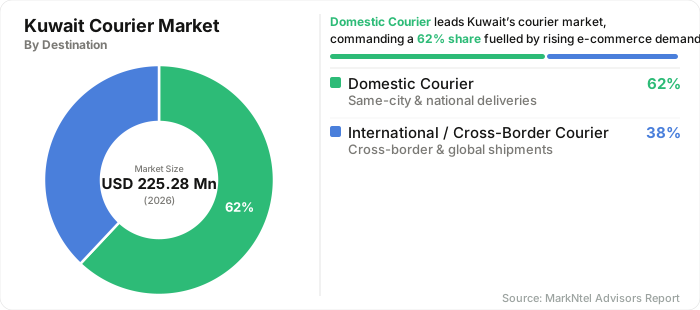
Collectively, the combination of dense urban demand, faster delivery expectations, and operational advantages continues to reinforce the leadership of the domestic courier segment within Kuwait’s overall courier market.
Based on Business Model:
- Business-to-Business (B2B)
- Business-to-Consumer (B2C)
- Consumer-to-Consumer (C2C)
The business-to-business (B2B) segment dominates the Kuwait Courier market, accounting for about 55% of the total market value, driven by the country’s strong reliance on structured supply chains and inter-business trade activities.
A significant portion of courier demand originates from transactions between wholesalers, distributors, retailers, and corporate entities that require consistent, bulk, and time-sensitive deliveries. Industries such as retail distribution, healthcare, manufacturing, and electronics depend heavily on reliable B2B logistics to maintain inventory flow and operational continuity.
Unlike B2C shipments, B2B deliveries typically involve larger volumes, scheduled dispatches, and recurring contracts, ensuring stable and predictable revenue streams for courier service providers.
Additionally, the growing presence of organized retail and the expansion of warehousing and distribution networks across Kuwait are further strengthening demand for efficient business logistics solutions.
The segment also benefits from higher-value shipments and specialized handling requirements, including temperature-controlled logistics for pharmaceuticals and secure transportation for high-value goods.
Furthermore, ongoing investments in logistics infrastructure and trade facilitation are supporting the smoother movement of goods between businesses, reinforcing the importance of B2B courier networks. Overall, the consistency, scale, and operational importance of inter-business shipments continue to position the B2B segment as the leading contributor to Kuwait’s courier market.
Kuwait Courier Market Competitive Landscape
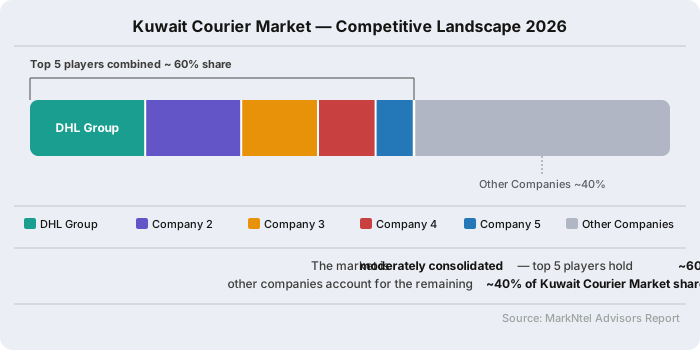
The market is moderately consolidated, with the top five players accounting for approximately 60% of the total market share. Leading companies include Aramex PJSC, DHL Group, FedEx Corporation, United Parcel Service, Inc., and Posta Plus Company K.S.C.C.
- Major Courier Companies in Kuwait
- Aramex PJSC
- DHL Group
- FedEx Corporation
- Posta Plus Company K.S.C.C.
- United Parcel Service, Inc
- Shipa Delivery
- SMSA Express
- OCS Worldwide
- Others
Gain a Competitive Edge with Our Kuwait Courier Market Report:
- Kuwait Courier Market Report by MarkNtel Advisors provides a detailed & thorough analysis of market size & share, growth rate, competitive landscape, and key players. This comprehensive analysis helps businesses gain a holistic understanding of the market dynamics & make informed decisions.
- This report also highlights current market trends & future projections, allowing businesses to identify emerging opportunities & potential challenges. By understanding market forecasts, companies can align their strategies & stay ahead of the competition.
- Kuwait Courier Market Report aids in assessing & mitigating risks associated with entering or operating in the market. By understanding market dynamics, regulatory frameworks, and potential challenges, businesses can develop strategies to minimize risks & optimize their operations.
*Reports Delivery Format - Market research studies from MarkNtel Advisors are offered in PDF, Excel and PowerPoint formats. Within 24 hours of the payment being successfully received, the report will be sent to your email address.
Frequently Asked Questions
- Market Segmentation
- Introduction
- Product Definition
- Research Process
- Assumptions
- Executive Summary
- Kuwait Courier Market Policies, Regulations, and Product Standards
- Kuwait Courier Market Trends & Developments
- Kuwait Courier Market Dynamics
- Growth Factors
- Challenges
- Kuwait Courier Market Hotspot & Opportunities
- Kuwait Courier Market Outlook, 2022-2032F
- Market Size & Outlook
- By Revenues (USD Million)
- Market Share & Outlook
- By Destination- Market Size & Forecast 2022-2032, USD Million
- Domestic Courier
- International / Cross-Border Courier
- By Business Model - Market Size & Forecast 2022-2032, USD Million
- Business-to-Business (B2B)
- Business-to-Consumer (B2C)
- Consumer-to-Consumer (C2C)
- By Delivery Speed- Market Size & Forecast 2022-2032, USD Million
- Economy (2–5 days) Delivery
- Express (Next-Day) Delivery
- By Mode of Transport- Market Size & Forecast 2022-2032, USD Million
- Roadways
- Airways
- Railways
- Maritime (Bulk / cross-border logistics)
- By Shipment Type- Market Size & Forecast 2022-2032, USD Million
- Lightweight Shipments (Up to 2 kg)
- Medium Weight Shipments (2–10 kg)
- Heavy Weight Shipments (Above 10 kg)
- By End User- Market Size & Forecast 2022-2032, USD Million
- E-commerce & Retail
- Healthcare & Pharmaceuticals
- BFSI
- Manufacturing & Industrial
- Government & Legal
- Others
- By Region- Market Size & Forecast 2022-2032, USD Million
- Al Asimah
- Al Farwaniya
- Hawalli
- Al Ahmadi
- Al Jahra
- By Company
- Competition Characteristics
- Market Share & Analysis
- By Destination- Market Size & Forecast 2022-2032, USD Million
- Market Size & Outlook
- Kuwait Domestic Courier Market Outlook, 2022-2032
- Market Size & Outlook
- By Revenues (USD Million)
- Market Share & Outlook
- By Business Model - Market Size & Forecast 2022-2032, USD Million
- By Delivery Speed- Market Size & Forecast 2022-2032, USD Million
- By Mode of Transport- Market Size & Forecast 2022-2032, USD Million
- By Shipment Type- Market Size & Forecast 2022-2032, USD Million
- By End User- Market Size & Forecast 2022-2032, USD Million
- By Region- Market Size & Forecast 2022-2032, USD Million
- Market Size & Outlook
- Kuwait International / Cross-Border Courier Market Outlook, 2022-2032
- Market Size & Outlook
- By Revenues (USD Million)
- Market Share & Outlook
- By Business Model - Market Size & Forecast 2022-2032, USD Million
- By Delivery Speed- Market Size & Forecast 2022-2032, USD Million
- By Mode of Transport- Market Size & Forecast 2022-2032, USD Million
- By Shipment Type- Market Size & Forecast 2022-2032, USD Million
- By End User- Market Size & Forecast 2022-2032, USD Million
- By Region- Market Size & Forecast 2022-2032, USD Million
- Market Size & Outlook
- Kuwait Courier Market Key Strategic Imperatives for Success & Growth
- Competitive Outlook
- Company Profiles
- Aramex PJSC
- Business Description
- Product Portfolio
- Collaborations & Alliances
- Recent Developments
- Financial Details
- Others
- DHL Group
- Business Description
- Product Portfolio
- Collaborations & Alliances
- Recent Developments
- Financial Details
- Others
- FedEx Corporation
- Business Description
- Product Portfolio
- Collaborations & Alliances
- Recent Developments
- Financial Details
- Others
- Posta Plus Company K.S.C.C.
- Business Description
- Product Portfolio
- Collaborations & Alliances
- Recent Developments
- Financial Details
- Others
- United Parcel Service, Inc.
- Business Description
- Product Portfolio
- Collaborations & Alliances
- Recent Developments
- Financial Details
- Others
- Shipa Delivery
- Business Description
- Product Portfolio
- Collaborations & Alliances
- Recent Developments
- Financial Details
- Others
- SMSA Express
- Business Description
- Product Portfolio
- Collaborations & Alliances
- Recent Developments
- Financial Details
- Others
- OCS Worldwide
- Business Description
- Product Portfolio
- Collaborations & Alliances
- Recent Developments
- Financial Details
- Others
- Others
- Business Description
- Product Portfolio
- Collaborations & Alliances
- Recent Developments
- Financial Details
- Others
- Aramex PJSC
- Company Profiles
- Disclaimer
MarkNtel Advisors follows a robust and iterative research methodology designed to ensure maximum accuracy and minimize deviation in market estimates and forecasts. Our approach combines both bottom-up and top-down techniques to effectively segment and quantify various aspects of the market. A consistent feature across all our research reports is data triangulation, which examines the market from three distinct perspectives to validate findings. Key components of our research process include:
1. Scope & Research Design At the outset, MarkNtel Advisors define the research objectives and formulate pertinent questions. This phase involves determining the type of research—qualitative or quantitative—and designing a methodology that outlines data collection methods, target demographics, and analytical tools. They also establish timelines and budgets to ensure the research aligns with client goals.
2. Sample Selection and Data Collection In this stage, the firm identifies the target audience and determines the appropriate sample size to ensure representativeness. They employ various sampling methods, such as random or stratified sampling, based on the research objectives. Data collection is carried out using tools like surveys, interviews, and observations, ensuring the gathered data is reliable and relevant.
3. Data Analysis and Validation Once data is collected, MarkNtel Advisors undertake a rigorous analysis process. This includes cleaning the data to remove inconsistencies, employing statistical software for quantitative analysis, and thematic analysis for qualitative data. Validation steps are taken to ensure the accuracy and reliability of the findings, minimizing biases and errors.

4. Data Forecast and FinalizationThe final phase involves forecasting future market trends based on the analyzed data. MarkNtel Advisors utilize predictive modeling and time series analysis to anticipate market behaviors. The insights are then compiled into comprehensive reports, featuring visual aids like charts and graphs, and include strategic recommendations to inform client decision-making
We offer flexible licensing options to cater to varying organizational needs. Choose the pricing pack that best suits your requirements:
Buy Now Inquire Before Buying
 Request Customization
 Talk to our Consultant







