

Indonesia Textile Dyes Market Research Report: Trends & Forecast (2026-2032)
By Dye Type (Reactive Dyes, Direct Dyes, Disperse Dyes, Vat Dyes, Acid Dyes, Sulfur Dyes, Others), By Fiber Type (Cellulose, Polyester, Wool, Polyamide (Nylon), Acrylic, Acetate), ... By Form (Powder, Liquid, Paste / Granules), By Application (Clothing & Apparel, Home Textiles, Industrial Textiles), and others Read more
- Chemicals
- Mar 2026
- Pages 125
- Report Format: PDF, Excel, PPT
Indonesia Textile Dyes Market
Projected 5.60% CAGR from 2026 to 2032
Study Period
2026-2032
Market Size (2026)
USD 155 Million
Market Size (2032)
USD 215 Million
Base Year
2025
Projected CAGR
5.60%
Leading Segments
By Application: Clothing & Apparel
Indonesia Textile Dyes Market Report Key Takeaways:
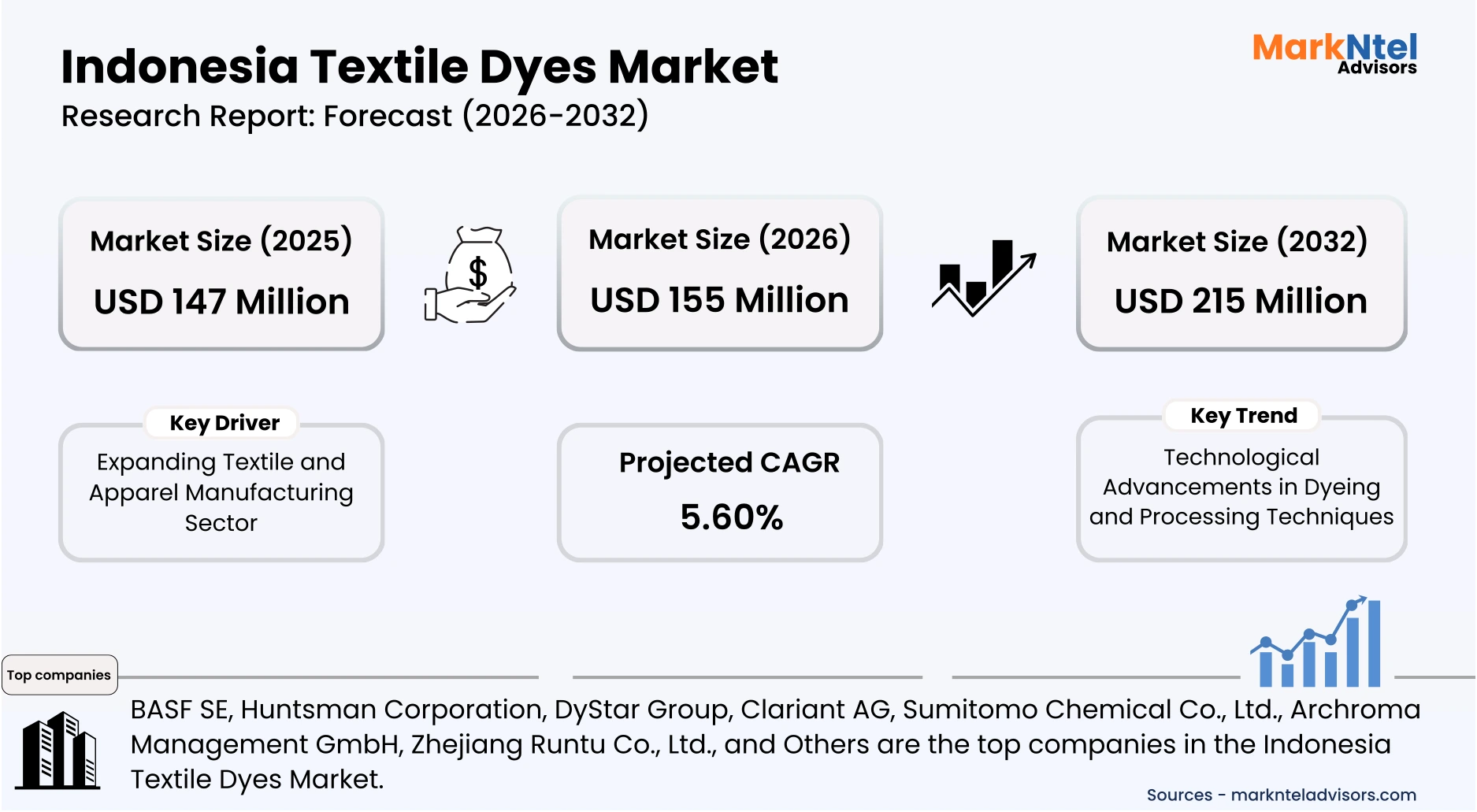
- The Indonesia Textile Dyes Market size was valued at USD 147 million in 2025 and is projected to grow from USD 155 million in 2026 to USD 215 million by 2032, exhibiting a CAGR of 5.60% during the forecast period.
- By dye type, the reactive dyes segment captured a significant share of about 34% in the Indonesia Textile Dyes Market in 2026.
- By application, the clothing & apparel segment seized a significant share of about 68% in the Indonesia Textile Dyes Market in 2026.
- Leading textile dyes companies in Indonesia are BASF SE, Huntsman Corporation, DyStar Group, Clariant AG, Sumitomo Chemical Co., Ltd., Archroma Management GmbH, Zhejiang Runtu Co., Ltd., and Others.
Market Insights & Analysis: Indonesia Textile Dyes Market (2026-32):
The Indonesia Textile Dyes Market size was valued at USD 147 million in 2025 and is projected to grow from USD 155 million in 2026 to USD 215 million by 2032. Along with this, the market is estimated to grow at a CAGR of around 5.60% during the forecast period, i.e., 2026-32.
The Indonesia Textile Dyes Market is projected to expand steadily, driven by the expansion of the country’s textile and apparel manufacturing industry and increasing adoption of advanced dyeing and processing technologies that improve production efficiency, sustainability, and fabric quality.
According to Indonesia’s Ministry of Industry, the textile manufacturing sector grew 5.90% year-on-year in 2024, while the apparel segment expanded by 2.64%. Additionally, textile exports increased by 7.34%, reflecting strong global demand for Indonesian garments and fabrics . Rising production in domestic textile mills is consequently increasing the demand for dyeing chemicals used in fabric coloration and finishing processes.
International trade trends also reinforce this outlook. In 2024, Indonesia exported approximately USD 7.11 billion worth of apparel and footwear to the United States, representing a 7.5% increase from USD 6.61 billion in 2023. The United States remains one of Indonesia’s largest export markets for textile products, and rising export volumes require higher production of dyed fabrics and garments, thereby increasing the demand for textile dyes and processing chemicals.
Indonesia’s textile raw-material supply chain supports dye demand. According to the Indonesian Synthetic Fiber Producers Association (APSyFI), polyester fiber and filament yarn consumption reaches about 1.4 million tons annually, and polyester textiles require specialized dyes and processing chemicals, driving steady demand.
Industry expansion plans are expected to strengthen this demand in the coming years. APSyFI reports that several manufacturers are planning capacity expansions that will add 190,000 tons of polyester fiber, 250,000 tons of Partially Oriented Yarn (POY), and 50,000 tons of Draw Twisted Yarn (DTY) production capacity in Indonesia. These projects are supported by investments of approximately USD 250 million, which will expand domestic textile production and increase dye consumption in fiber and fabric processing.
Technological advancements in dyeing and processing techniques are also improving industry efficiency. Modern dyeing systems enable textile manufacturers to reduce water and energy consumption, improve color consistency, and adopt more sustainable production processes. These technologies allow Indonesian textile producers to remain competitive in export markets while increasing operational scale.
Government support is expected to further accelerate the industry’s growth beyond 2025. For example, in December 2025, Indonesia’s Ministry of Finance announced a financing allocation of approximately USD 119 million to support textile and furniture exporters through the Indonesia Eximbank (LPEI). The financing program offers export-oriented companies loans with interest rates of around 6%, enabling manufacturers to expand production capacity and strengthen global competitiveness .
The continued expansion of Indonesia’s textile and apparel industry, combined with rising export demand and large-scale investments in synthetic fiber production, will significantly increase the need for textile dyes. Government financing programs and technological improvements in dyeing processes are expected to further accelerate market growth in the coming years.
Indonesia Textile Dyes Market Recent Developments:
- 2025: Archroma launched AVITERA® RASPBERRY SE, a new trichromatic red reactive dye designed for cellulosic fibers. The innovation enables textile mills to produce deep and extra-dark shades with strong color fastness while reducing water, energy use, and emissions by up to 50% compared with conventional dyeing technologies.
Indonesia Textile Dyes Market Scope:
| Category | Segments |
|---|---|
| By Dye Type | (Reactive Dyes, Direct Dyes, Disperse Dyes, Vat Dyes, Acid Dyes, Sulfur Dyes, Others), |
| By Fiber Type | (Cellulose, Polyester, Wool, Polyamide (Nylon), Acrylic, Acetate), |
| By Form | (Powder, Liquid, Paste / Granules), |
| By Application | (Clothing & Apparel, Home Textiles, Industrial Textiles), |
Indonesia Textile Dyes Market Driver:
Expanding Textile and Apparel Manufacturing Sector
Increasing investment in Indonesia’s textile and apparel sector is driving demand for textile dyes, as dyeing and finishing are essential in fabric production. Expanding investments in mills and garment facilities are boosting production capacity, thereby increasing the consumption of dyes and processing chemicals.
Official data indicates rising investor confidence in Indonesia’s textile sector. Total investment in the textile, apparel, and footwear industries increased from about USD 1.9 billion in 2023 to USD 2.5 billion in 2024 , supporting manufacturing expansion, new facility development, and modernization of production lines across key textile regions.
Investment growth has been particularly significant in the apparel segment. For example, in 2024, apparel-sector investment rose by 124.9%, increasing from approximately USD 290 million in 2023 to approximately USD 650 million. This sharp rise reflects the expansion of garment manufacturing capacity and increasing demand for dyed fabrics used in export-oriented apparel production.
Industry expansion is continuing into 2025. For instance, new textile and apparel projects approved during the first quarter of 2025 attracted approximately USD 19 million in investments, particularly within established textile clusters in West Java and Central Java. These projects are strengthening Indonesia’s textile production ecosystem and increasing downstream demand for textile dyes used in fabric coloration and finishing processes.
Rising capital investment and new manufacturing projects are expanding Indonesia’s textile production capacity and reinforcing industrial growth. As fabric and garment output increases, the requirement for textile dyes and processing chemicals will continue to grow, supporting the long-term expansion of the textile dyes market.
Indonesia Textile Dyes Market Trend:
Technological Advancements in Dyeing and Processing Techniques
Technological innovation in dyeing and textile processing is emerging as a significant trend in Indonesia’s textile dyes market, as manufacturers increasingly adopt advanced technologies to improve efficiency and environmental sustainability.
The adoption of advanced dyeing technologies, including digital textile printing, automated dyeing systems, and water-efficient processes, is increasing in Indonesia. These innovations help manufacturers reduce chemical use and wastewater while improving color accuracy, enabling textile producers to meet global sustainability standards and remain competitive in export markets.
Waterless dyeing technology is gaining attention as it significantly reduces or eliminates water use in textile processing. Techniques such as supercritical CO₂ dyeing and plasma-based treatment apply color without conventional wet processes, helping manufacturers reduce wastewater discharge and energy consumption.
The modernization of Indonesia’s textile industry is accelerating technology adoption, with companies upgrading factories through advanced machinery and automated systems under restructuring initiatives valued at about USD 6 billion .
In addition, the EnaTex research project, conducted in collaboration with Indonesian universities and international partners, has developed innovative approaches to improve textile pre-treatment, dyeing, and finishing processes, with the potential to reduce energy consumption by up to 40%.
The growing integration of advanced dyeing technologies and factory modernization initiatives is transforming Indonesia’s textile processing landscape. These innovations improve efficiency, reduce environmental impact, and increase dye utilization, thereby supporting sustained growth in the country’s textile dyes market.
Indonesia Textile Dyes Market Opportunity:
Shift Towards Sustainable Solutions Creating Growth Opportunities
The growing shift toward sustainable textile production is creating significant opportunities for eco-friendly dyes in Indonesia’s textile dyes market. Environmental concerns related to chemical discharge and wastewater from conventional dyeing processes have encouraged the government and industry stakeholders to promote greener alternatives.
Indonesia’s Green Industry Standard (GIS) encourages textile manufacturers to adopt environmentally responsible production methods, including reduced chemical usage, energy efficiency, and improved wastewater management during dyeing and finishing operations .
Sustainability initiatives are also being integrated into broader circular-economy programs. Indonesia’s Circular Economy Roadmap (2025–2045) identifies the textile sector as a priority industry for sustainable transformation, encouraging innovations such as natural dyes derived from agricultural materials and improved recycling practices .
Industry adoption is already emerging. Large Indonesian textile producers are increasingly shifting toward eco-friendly chemicals and dyes to reduce environmental impacts and comply with international sustainability standards in export markets.
As sustainability regulations tighten and export markets demand environmentally responsible textile production, the adoption of eco-friendly dyes is expected to accelerate. This transition will create significant growth opportunities for suppliers of sustainable dye formulations in Indonesia’s textile industry.
Indonesia Textile Dyes Market Challenge:
Volatile Raw Material Prices
Volatility in raw material availability and pricing presents a significant challenge for Indonesia’s textile dyes market because dye manufacturing and textile processing rely heavily on petrochemical intermediates and synthetic fiber inputs.
One of the most critical raw materials is Mono Ethylene Glycol (MEG), which is widely used in the production of polyester fibers that dominate modern textile manufacturing. According to the Indonesian Fiber and Filament Yarn Producers Association (APSyFI), Indonesia requires around 600,000 tons of MEG annually to support polyester production. However, domestic production capacity is limited to approximately 200,000 tons per year, and actual output has reportedly declined to around 50,000 tons in recent years , forcing manufacturers to depend heavily on imported supplies.
Supply stability has become even more uncertain due to regulatory changes affecting raw-material imports. Indonesia’s Trade Regulation No. 36 of 2023 introduced stricter import rules that restrict entry ports for several raw materials, including MEG. These regulatory adjustments have created logistical bottlenecks and longer lead times for polyester producers and downstream textile manufacturers that rely on a consistent raw-material supply.
Fluctuations in raw-material availability and import restrictions increase production costs and supply risks for textile manufacturers and dye producers. As a result, such volatility can slow industrial expansion and limit growth in Indonesia’s textile dyes market.
Indonesia Textile Dyes Market (2026-32) Segmentation Analysis:
The Indonesia Textile Dyes Market study of MarkNtel Advisors evaluates & highlights the major trends and influencing factors in each segment. It includes predictions for the period 2026–32 at the country level. Based on the analysis, the market has been further classified as;
Based on Dye Type:
- Reactive Dyes
- Direct Dyes
- Disperse Dyes
- Vat Dyes
- Acid Dyes
- Sulfur Dyes
- Others
The reactive dyes segment dominates the Indonesia Textile Dyes Market, accounting for around 34% market share, due to their superior compatibility with cellulosic fibers and their ability to produce vibrant, durable colors.
These dyes chemically react with fibers such as cotton, viscose, rayon, and linen, forming strong covalent bonds that ensure excellent wash fastness and long-lasting color retention. This strong fiber–dye interaction makes reactive dyes particularly suitable for high-quality textile applications where durability and color stability are essential.
The dominance of reactive dyes is closely associated with the widespread use of cotton-based textiles in the apparel and home furnishing industries. Cotton remains one of the most widely utilized natural fibers in global textile manufacturing, and reactive dyes are specifically designed to achieve efficient dye uptake and uniform coloration in cellulose-based materials. As a result, textile manufacturers frequently rely on reactive dyes to meet the growing demand for cotton garments, bed linens, towels, and other household textiles.
Furthermore, continuous improvements in reactive dye formulations and dyeing technologies are enhancing fixation efficiency and reducing water and chemical consumption during the dyeing process. These advancements support more sustainable textile manufacturing practices while maintaining high-quality output. Consequently, the strong performance characteristics and broad application range of reactive dyes continue to reinforce their leading position within the textile dyes market.
Based on Application:
- Clothing & Apparel
- Home Textiles
- Industrial Textiles
The clothing & apparel segment dominates the Indonesia Textile Dyes Market with 68% market share, due to the high volume of fabric used in garment manufacturing and the essential role of dyeing in apparel production.
Dyeing and finishing processes are critical stages in the textile value chain, as they provide fabrics with the desired color, appearance, and durability required for commercial garment production. Consequently, large-scale apparel manufacturing drives substantial demand for textile dyes across various fiber types.
The dominance of this segment is largely supported by the continuous expansion of the global apparel industry, driven by population growth, rising disposable incomes, and evolving fashion trends. Consumers increasingly demand a wide range of garments, including casual wear, sportswear, formal clothing, and seasonal fashion collections. This diversity in apparel products requires extensive use of dyed fabrics, thereby increasing the consumption of textile dyes.
Additionally, the expansion of global fashion supply chains and the rapid growth of online fashion retail have increased garment production volumes. As a result, the clothing and apparel sector remains the primary end-use segment for textile dyes and is expected to maintain its dominant position in the market.
Gain a Competitive Edge with Our Indonesia Textile Dyes Market Report:
- Indonesia Textile Dyes Market Report by MarkNtel Advisors provides a detailed & thorough analysis of market size & share, growth rate, competitive landscape, and key players. This comprehensive analysis helps businesses gain a holistic understanding of the market dynamics & make informed decisions.
- This report also highlights current market trends & future projections, allowing businesses to identify emerging opportunities & potential challenges. By understanding market forecasts, companies can align their strategies & stay ahead of the competition.
- Indonesia Textile Dyes Market Report aids in assessing & mitigating risks associated with entering or operating in the market. By understanding market dynamics, regulatory frameworks, and potential challenges, businesses can develop strategies to minimize risks & optimize their operations.
*Reports Delivery Format - Market research studies from MarkNtel Advisors are offered in PDF, Excel and PowerPoint formats. Within 24 hours of the payment being successfully received, the report will be sent to your email address.
Frequently Asked Questions
- Market Segmentation
- Introduction
- Product Definition
- Research Process
- Assumptions
- Executive Summary
- Indonesia Textile Dyes Market Policies, Regulations, and Product Standards
- Indonesia Textile Dyes Market Trends & Developments
- Indonesia Textile Dyes Market Dynamics
- Growth Factors
- Challenges
- Indonesia Textile Dyes Market Hotspot & Opportunities
- Indonesia Textile Dyes Market Outlook, 2022-2032F
- Market Size & Outlook
- By Revenues (USD Million)
- Market Share & Outlook
- By Dye Type- Market Size & Forecast 2022-2032, USD Million
- Reactive Dyes
- Direct Dyes
- Disperse Dyes
- Vat Dyes
- Acid Dyes
- Sulfur Dyes
- Others
- By Fiber Type- Market Size & Forecast 2022-2032, USD Million
- Cellulose
- Polyester
- Wool
- Polyamide (Nylon)
- Acrylic
- Acetate
- By Form - Market Size & Forecast 2022-2032, USD Million
- Powder
- Liquid
- Paste / Granules
- By Application- Market Size & Forecast 2022-2032, USD Million
- Clothing & Apparel
- Home Textiles
- Industrial Textiles
- By Region- Market Size & Forecast 2022-2032, USD Million
- Java
- Sumatra
- Kalimantan
- Sulawesi
- Others
- By Company
- Competition Characteristics
- Market Share & Analysis
- By Dye Type- Market Size & Forecast 2022-2032, USD Million
- Market Size & Outlook
- Indonesia Reactive Dyes Market Outlook, 2022-2032
- Market Size & Outlook
- By Revenues (USD Million)
- Market Share & Outlook
- By Fiber Type- Market Size & Forecast 2022-2032, USD Million
- By Form - Market Size & Forecast 2022-2032, USD Million
- By Application- Market Size & Forecast 2022-2032, USD Million
- By Region- Market Size & Forecast 2022-2032, USD Million
- Market Size & Outlook
- Indonesia Direct Dyes Market Outlook, 2022-2032
- Market Size & Outlook
- By Revenues (USD Million)
- Market Share & Outlook
- By Fiber Type- Market Size & Forecast 2022-2032, USD Million
- By Form - Market Size & Forecast 2022-2032, USD Million
- By Application- Market Size & Forecast 2022-2032, USD Million
- By Region- Market Size & Forecast 2022-2032, USD Million
- Market Size & Outlook
- Indonesia Disperse Dyes Market Outlook, 2022-2032
- Market Size & Outlook
- By Revenues (USD Million)
- Market Share & Outlook
- By Fiber Type- Market Size & Forecast 2022-2032, USD Million
- By Form - Market Size & Forecast 2022-2032, USD Million
- By Application- Market Size & Forecast 2022-2032, USD Million
- By Region- Market Size & Forecast 2022-2032, USD Million
- Market Size & Outlook
- Indonesia Vat Dyes Market Outlook, 2022-2032
- Market Size & Outlook
- By Revenues (USD Million)
- Market Share & Outlook
- By Fiber Type- Market Size & Forecast 2022-2032, USD Million
- By Form - Market Size & Forecast 2022-2032, USD Million
- By Application- Market Size & Forecast 2022-2032, USD Million
- By Region- Market Size & Forecast 2022-2032, USD Million
- Market Size & Outlook
- Indonesia Acid Dyes Market Outlook, 2022-2032
- Market Size & Outlook
- By Revenues (USD Million)
- Market Share & Outlook
- By Fiber Type- Market Size & Forecast 2022-2032, USD Million
- By Form - Market Size & Forecast 2022-2032, USD Million
- By Application- Market Size & Forecast 2022-2032, USD Million
- By Region- Market Size & Forecast 2022-2032, USD Million
- Market Size & Outlook
- Indonesia Sulfur Dyes Market Outlook, 2022-2032
- Market Size & Outlook
- By Revenues (USD Million)
- Market Share & Outlook
- By Fiber Type- Market Size & Forecast 2022-2032, USD Million
- By Form - Market Size & Forecast 2022-2032, USD Million
- By Application- Market Size & Forecast 2022-2032, USD Million
- By Region- Market Size & Forecast 2022-2032, USD Million
- Market Size & Outlook
- Indonesia Textile Dyes Market Key Strategic Imperatives for Success & Growth
- Competitive Outlook
- Company Profiles
- BASF SE
- Business Description
- Product Portfolio
- Collaborations & Alliances
- Recent Developments
- Financial Details
- Others
- Huntsman Corporation
- Business Description
- Product Portfolio
- Collaborations & Alliances
- Recent Developments
- Financial Details
- Others
- DyStar Group
- Business Description
- Product Portfolio
- Collaborations & Alliances
- Recent Developments
- Financial Details
- Others
- Clariant AG
- Business Description
- Product Portfolio
- Collaborations & Alliances
- Recent Developments
- Financial Details
- Others
- Sumitomo Chemical Co., Ltd.
- Business Description
- Product Portfolio
- Collaborations & Alliances
- Recent Developments
- Financial Details
- Others
- Archroma Management GmbH
- Business Description
- Product Portfolio
- Collaborations & Alliances
- Recent Developments
- Financial Details
- Others
- Zhejiang Runtu Co., Ltd.
- Business Description
- Product Portfolio
- Collaborations & Alliances
- Recent Developments
- Financial Details
- Others
- Others
- Business Description
- Product Portfolio
- Collaborations & Alliances
- Recent Developments
- Financial Details
- Others
- BASF SE
- Company Profiles
- Disclaimer
MarkNtel Advisors follows a robust and iterative research methodology designed to ensure maximum accuracy and minimize deviation in market estimates and forecasts. Our approach combines both bottom-up and top-down techniques to effectively segment and quantify various aspects of the market. A consistent feature across all our research reports is data triangulation, which examines the market from three distinct perspectives to validate findings. Key components of our research process include:
1. Scope & Research Design At the outset, MarkNtel Advisors define the research objectives and formulate pertinent questions. This phase involves determining the type of research—qualitative or quantitative—and designing a methodology that outlines data collection methods, target demographics, and analytical tools. They also establish timelines and budgets to ensure the research aligns with client goals.
2. Sample Selection and Data Collection In this stage, the firm identifies the target audience and determines the appropriate sample size to ensure representativeness. They employ various sampling methods, such as random or stratified sampling, based on the research objectives. Data collection is carried out using tools like surveys, interviews, and observations, ensuring the gathered data is reliable and relevant.
3. Data Analysis and Validation Once data is collected, MarkNtel Advisors undertake a rigorous analysis process. This includes cleaning the data to remove inconsistencies, employing statistical software for quantitative analysis, and thematic analysis for qualitative data. Validation steps are taken to ensure the accuracy and reliability of the findings, minimizing biases and errors.

4. Data Forecast and FinalizationThe final phase involves forecasting future market trends based on the analyzed data. MarkNtel Advisors utilize predictive modeling and time series analysis to anticipate market behaviors. The insights are then compiled into comprehensive reports, featuring visual aids like charts and graphs, and include strategic recommendations to inform client decision-making
We offer flexible licensing options to cater to varying organizational needs. Choose the pricing pack that best suits your requirements:
Buy Now Inquire Before Buying
 Request Customization
 Talk to our Consultant







