India Polypropylene Random Copolymer (PPR) Pipes Market Research Report: Growth Drivers & Forecast (2026-2032)
By Type (Standard PPR Pipes, Composite / Reinforced PPR Pipes, Hot & Cold Water PPR Pipes, High-Pressure PPR Pipes, Low-Pressure PPR Pipes), By Grade (Single-layer PPR Pipes, Multi ... -layer PPR Pipes), By Pipe Diameter (Small Diameter Pipes (< 50 mm), Medium Diameter Pipes (50–200 mm), Large Diameter Pipes (> 200 mm)), By Pressure Rating (PN10, PN16, PN20, PN25), By Distribution Channel (Direct Sales, Distributors & Wholesalers, Retail Stores / Hardware Suppliers, Online Channels), By Application (Plumbing Systems, Water Supply Systems, HVAC & District Cooling Systems, Irrigation Systems, Chemical & Industrial Fluid Transport, Others), By End User (Residential Buildings, Commercial Buildings, Industrial Facilities, Municipal & Infrastructure Projects, Agriculture), and others Read more
- Buildings, Construction, Metals & Mining
- Mar 2026
- Pages 125
- Report Format: PDF, Excel, PPT
India Polypropylene Random Copolymer (PPR) Pipes Market
Projected 7.84% CAGR from 2026 to 2032
Study Period
2026-2032
Market Size (2026)
USD 145 Million
Market Size (2032)
USD 228 Million
Base Year
2025
Projected CAGR
7.84%
Leading Segments
By End User: Residential Buildings
India Polypropylene Random Copolymer (PPR) Pipes Market Report Key Takeaways:
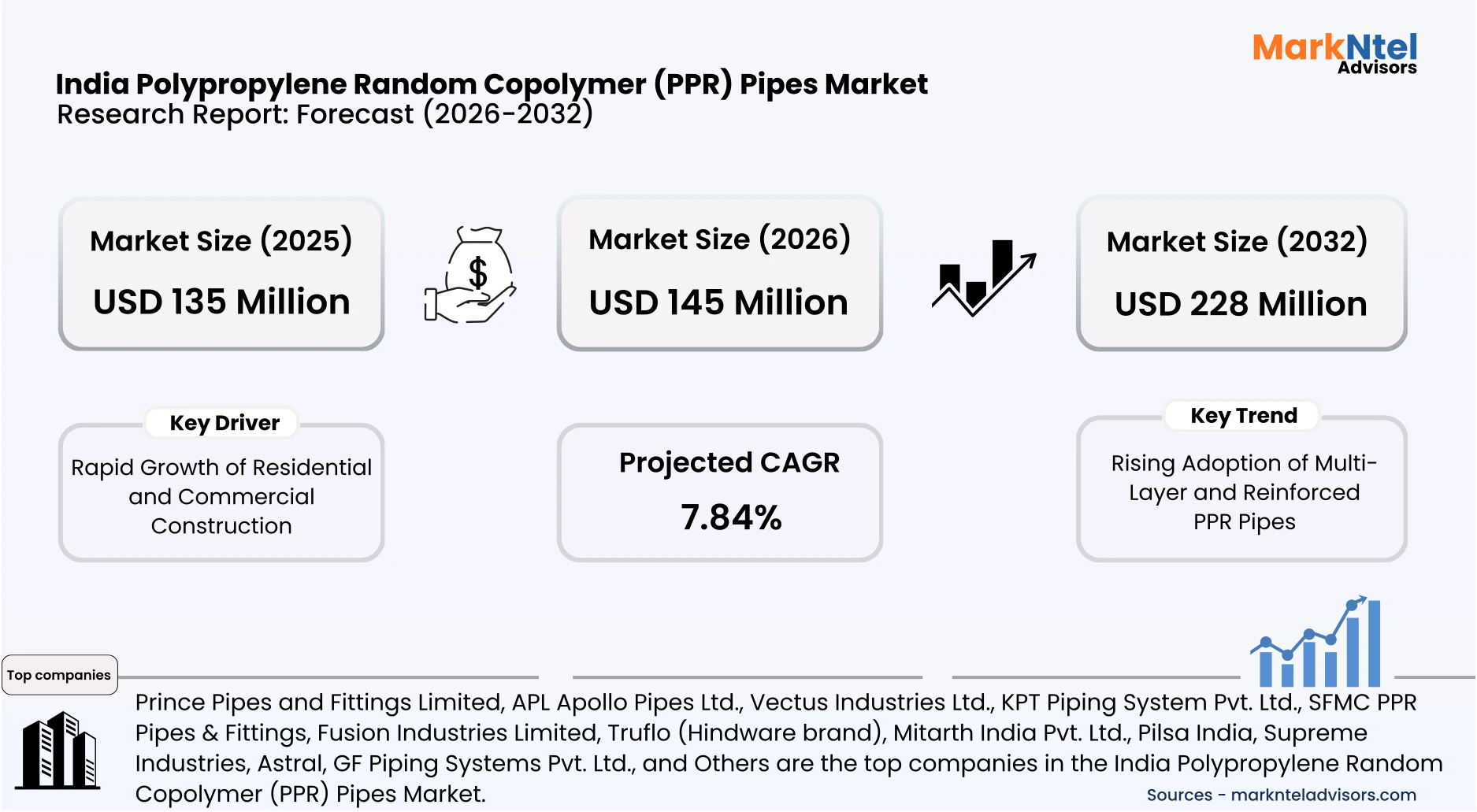
- The India Polypropylene Random Copolymer (PPR) Pipes Market size was valued at around USD 135 million in 2025 and is projected to grow from USD 145 million in 2026 to USD 228 million by 2032, exhibiting a CAGR of 7.84% during the forecast period.
- By type, the hot & cold water PPR pipes segment represented a significant share of about 45% in the India Polypropylene Random Copolymer (PPR) Pipes Market in 2026.
- By end user, the residential buildings segment presented a significant share of about 42% in the India Polypropylene Random Copolymer (PPR) Pipes Market in 2026.
- Leading polypropylene random copolymer (PPR) pipes companies in India are Prince Pipes and Fittings Limited, APL Apollo Pipes Ltd., Vectus Industries Ltd., KPT Piping System Pvt. Ltd., SFMC PPR Pipes & Fittings, Fusion Industries Limited, Truflo (Hindware brand), Mitarth India Pvt. Ltd., Pilsa India, Supreme Industries, Astral, GF Piping Systems Pvt. Ltd., and Others.
Market Insights & Analysis: India Polypropylene Random Copolymer (PPR) Pipes Market (2026-32):
The India Polypropylene Random Copolymer (PPR) Pipes Market size was valued at around USD 135 million in 2025 and is projected to grow from USD 145 million in 2026 to USD 228 million by 2032. Along with this, the market is estimated to grow at a CAGR of around 7.84% during the forecast period, i.e., 2026-32.
The India Polypropylene Random Copolymer (PPR) Pipes Market is projected to expand steadily, driven by the rapid expansion of residential and commercial construction activities and the increasing adoption of advanced multi-layer and reinforced PPR piping systems across modern infrastructure projects.
One of the key growth catalysts is India’s continued infrastructure investment. In the Union Budget 2025–26, the Government of India increased capital expenditure on infrastructure to approximately USD 133 billion, aiming to accelerate urban infrastructure, housing, and construction development nationwide . Such investments directly stimulate demand for plumbing networks, water supply systems, and heating pipelines, all of which require high-performance piping materials.
Construction activity across India further highlights the strong demand outlook. According to construction project tracking data, 2,331 building construction projects were recorded across India in Q1 2024–25, covering nearly 734 million sq. ft. of construction area with a total project value of around USD 32 billion. This large pipeline of projects reflects rapid urbanization and the expansion of residential and commercial infrastructure.
Regionally, Western India leads construction activity with around 947 projects, covering 288.6 million sq. ft. and valued at approximately USD 12.7 billion. Maharashtra dominates this region with 637 projects. Meanwhile, Southern India recorded about 563 projects, covering 244.4 million sq. ft. and valued at around USD 11.1 billion .
North India accounted for about 340 projects, covering 133.8 million sq. ft. with a value of roughly USD 6 billion, supported by urban expansion in Uttar Pradesh, Haryana, and the Delhi NCR region. Similarly, in Eastern India, around 306 construction projects were recorded, covering 40.3 million sq. ft. and valued at approximately USD 1.4 billion, with Odisha and West Bengal contributing a significant share of development activity.
In addition to construction growth, technological improvements in piping systems are shaping the market. The rising adoption of multi-layer and reinforced PPR pipes is becoming a key industry trend, particularly in high-rise buildings and large infrastructure projects. For instance, aluminium-reinforced PPR pipes can reduce thermal expansion by up to 80 % compared with conventional PPR pipes, improving stability and reliability in complex plumbing systems.
Future infrastructure development is also expected to support sustained market growth. The Government of India continues to expand the National Infrastructure Pipeline, which includes over 13,000 projects with planned investments of about USD 2.2 trillion across sectors such as housing, urban infrastructure, and transportation.
Additionally, the government has planned a PPP infrastructure pipeline worth approximately USD 204 billion across 852 projects over the next three years, which will further stimulate construction activity and infrastructure expansion .
Overall, strong infrastructure investment, expanding residential and commercial construction, and the adoption of advanced piping technologies are expected to drive steady growth in the India PPR pipes market. As urban development and infrastructure projects continue to expand across regions, demand for durable and efficient piping systems will increase, supporting long-term market expansion.
India Polypropylene Random Copolymer (PPR) Pipes Market Recent Developments:
- 2026: KPT Piping System Pvt. Ltd. introduced “AL-Therm” PPR-AL-PPR composite pipes, featuring a five-layer structure with an aluminum core between PPR layers. Designed for high-pressure plumbing systems up to PN-25, the product improves dimensional stability and reduces thermal expansion compared with conventional PPR pipes, making it suitable for high-rise residential and commercial buildings.
India Polypropylene Random Copolymer (PPR) Pipes Market Scope:
| Category | Segments |
|---|---|
| By Type | (Standard PPR Pipes, Composite / Reinforced PPR Pipes, Hot & Cold Water PPR Pipes, High-Pressure PPR Pipes, Low-Pressure PPR Pipes), |
| By Grade | (Single-layer PPR Pipes, Multi-layer PPR Pipes), |
| By Pipe Diameter | (Small Diameter Pipes (< 50 mm), Medium Diameter Pipes (50–200 mm), Large Diameter Pipes (> 200 mm)), |
| By Pressure Rating | (PN10, PN16, PN20, PN25), |
| By Distribution Channel | (Direct Sales, Distributors & Wholesalers, Retail Stores / Hardware Suppliers, Online Channels), |
| By Application | (Plumbing Systems, Water Supply Systems, HVAC & District Cooling Systems, Irrigation Systems, Chemical & Industrial Fluid Transport, Others), |
| By End User | (Residential Buildings, Commercial Buildings, Industrial Facilities, Municipal & Infrastructure Projects, Agriculture), |
India Polypropylene Random Copolymer (PPR) Pipes Market Driver:
Rapid Growth of Residential and Commercial Construction
Large-scale infrastructure development and housing expansion across India are significantly driving the demand for advanced plumbing and water distribution systems, supporting the growth of the India Polypropylene Random Copolymer (PPR) Pipes Market.
Under the National Infrastructure Pipeline (NIP), India planned about USD 1.4 trillion in investments between 2020 and 2025 across urban development, transport, and energy sectors, supporting large-scale construction projects that increase demand for modern plumbing and polymer-based piping solutions such as PPR pipes.
Housing development programs are also expanding significantly at the state level. In 2025, the Government of Uttar Pradesh announced plans to build more than 6 million houses under the Pradhan Mantri Awas Yojana–Rural (PMAY-R). Large-scale housing construction of this magnitude requires extensive plumbing installations for potable water supply, drainage, and sanitation networks, thereby increasing demand for reliable piping materials with long service life and corrosion resistance.
Regional construction activity further demonstrates the scale of building expansion across northern India. For example, Uttar Pradesh alone recorded over 127 major building projects covering about 41.9 million sq. ft., while Haryana registered around 60 projects valued at approximately USD 2.4 billion. The continued growth of residential townships, commercial complexes, and mixed-use developments in these states is accelerating the installation of modern piping infrastructure.
As India continues to expand housing and infrastructure projects through national investment programs and state-level initiatives, demand for reliable plumbing systems will rise significantly. This sustained construction momentum is expected to drive long-term adoption of PPR pipes across residential and infrastructure applications.
India Polypropylene Random Copolymer (PPR) Pipes Market Trend:
Rising Adoption of Multi-Layer and Reinforced PPR Pipes
A key trend shaping the India Polypropylene Random Copolymer (PPR) pipes market is the growing adoption of multi-layer and reinforced PPR pipe technologies, particularly in high-rise residential buildings, commercial complexes, and industrial infrastructure projects.
Traditional single-layer PPR pipes are increasingly being replaced by multi-layer composite systems such as PPR-AL-PPR and glass-fiber reinforced PPR pipes, which offer superior strength, dimensional stability, and improved resistance to temperature and pressure variations.
For instance, PPR-AL-PPR pipes use a five-layer structure with PPR layers, adhesive bonds, and an aluminum core. This reinforcement improves rigidity, pressure resistance, and corrosion protection while reducing thermal expansion, making them suitable for high-rise plumbing and centralized water systems.
In addition, reinforced PPR pipes offer strong thermal performance and longevity. Multi-layer PPR piping systems can operate at temperatures of up to approximately 95°C and provide an expected service life of more than 50 years, which makes them ideal for hot-water circulation systems, district plumbing networks, and large commercial facilities. As India continues to develop taller residential buildings and complex infrastructure projects, these advanced pipe systems are becoming increasingly preferred by engineers and plumbing contractors.
The increasing shift toward reinforced and multi-layer PPR technologies reflects the construction sector’s demand for durable and high-performance plumbing materials. As infrastructure complexity and building heights continue to rise, the adoption of advanced PPR piping systems is expected to significantly support the long-term growth of the India PPR pipes market.
India Polypropylene Random Copolymer (PPR) Pipes Market Opportunity:
Expansion of Smart Plumbing and Modular Construction
The expansion of smart plumbing technologies and modular construction methods is creating significant opportunities for the India Polypropylene Random Copolymer (PPR) pipes market. In India, these systems are increasingly adopted in large urban infrastructure and smart building projects.
For instance, under India’s Smart Cities Mission, the government allocated about USD 5.8 billion to develop 100 smart cities, with USD 5.6 billion released by 2024 for urban infrastructure, water supply, and sanitation projects, increasing demand for durable polymer pipes such as PPR .
At the same time, modular and prefabricated construction is gaining traction in India as developers focus on reducing construction timelines and labor dependency. Prefabrication allows building components, including plumbing pipelines, to be assembled off-site and installed quickly during on-site construction. This approach requires lightweight, easy-to-install, and durable piping materials, making PPR pipes suitable for modular infrastructure projects. For example, the Technopark IT campus in Kerala began constructing a 50,000 sq. ft. prefabricated office building in 2025, highlighting the growing adoption of modular construction in commercial developments.
The combined expansion of smart city infrastructure and modular construction projects is expected to accelerate the demand for efficient plumbing solutions. As these technologies scale across urban developments, they will create strong long-term growth opportunities for PPR pipes in India.
India Polypropylene Random Copolymer (PPR) Pipes Market Challenge:
Volatility in Polypropylene Raw Material Prices
Volatility in polypropylene (PP) resin prices presents a significant challenge for the India Polypropylene Random Copolymer (PPR) pipes market, as PP is the primary raw material used in manufacturing these pipes.
The price of polypropylene is closely linked to global crude oil and propylene feedstock markets, making it highly sensitive to fluctuations in energy prices, supply disruptions, and changes in petrochemical production levels. As a result, any instability in the global oil and petrochemical supply chain directly affects the cost structure of PPR pipe manufacturing in India.
Recent market data highlights the extent of these fluctuations. In 2025, certain grades of polypropylene in the Indian market reached approximately USD 1,250 per metric ton, reflecting supply constraints and variations in feedstock costs. Such price volatility creates uncertainty for pipe manufacturers, particularly because raw materials represent a substantial portion of total production costs. When PP resin prices increase sharply, manufacturers face rising production expenses and shrinking profit margins. Conversely, sudden price declines can disrupt procurement planning and lead to inventory valuation losses.
Frequent fluctuations in polypropylene prices create cost instability for PPR pipe manufacturers. This volatility can affect pricing strategies, reduce profitability, and slow investment decisions, ultimately hindering the steady growth of the India PPR pipes market.
India Polypropylene Random Copolymer (PPR) Pipes Market (2026-32) Segmentation Analysis:
The India Polypropylene Random Copolymer (PPR) Pipes Market study of MarkNtel Advisors evaluates and highlights the major trends and influencing factors in each segment. It includes predictions for the period 2026–32 at the country level. Based on the analysis, the market has been further classified as;
Based on Type:
- Standard PPR Pipes
- Composite / Reinforced PPR Pipes
- Hot & Cold Water PPR Pipes
- High-Pressure PPR Pipes
- Low-Pressure PPR Pipes
The hot & cold water PPR pipes segment dominates the India Polypropylene Random Copolymer (PPR) Pipes market, holding around 45% market share, due to their broad applicability in modern plumbing and water distribution systems.
These pipes are engineered to efficiently handle both heated and ambient water flows, making them suitable for a wide range of domestic and commercial applications. Their material composition provides high resistance to temperature variations and internal pressure, allowing them to perform reliably in systems that require consistent water delivery under varying thermal conditions.
One of the key factors supporting the dominance of this segment is the functional versatility of hot and cold water PPR pipes. They are designed to maintain structural stability while transporting water at elevated temperatures, while also ensuring smooth flow for standard cold-water supply networks.
Additionally, these pipes are compatible with advanced fusion welding installation techniques that create homogeneous joints, resulting in highly secure and leak-resistant piping networks. Their smooth internal surface further supports efficient water flow by minimizing scaling and friction losses within pipelines.
Overall, due to their adaptability, durability, and efficient performance in temperature-sensitive plumbing systems, hot & cold water PPR pipes continue to dominate the market and remain a preferred solution for modern water distribution infrastructure.
Based on End User:
- Residential Buildings
- Commercial Buildings
- Industrial Facilities
- Municipal & Infrastructure Projects
- Agriculture
The residential buildings segment dominates the India Polypropylene Random Copolymer (PPR) Pipes Market, with 42% market share, due to the essential role of plumbing and water distribution systems in housing infrastructure.
Every residential structure requires an extensive network of pipelines for potable water supply, hot water circulation, and internal plumbing, making durable piping materials a fundamental component of building design.
The dominance of this segment is largely attributed to the functional characteristics of PPR materials, which are suitable for long-term residential plumbing networks. These pipes offer strong resistance to corrosion, scaling, and chemical reactions that may occur within domestic water supply systems. Their smooth internal surface supports efficient water flow while reducing the accumulation of sediments and minimizing pressure loss within pipelines.
Another important factor supporting their widespread use in residential buildings is the compatibility of PPR pipes with heat-fusion jointing technology. This installation method creates homogeneous and leak-resistant joints, ensuring a secure and durable piping network within household infrastructure.
Furthermore, PPR pipes are valued for their durability, lightweight structure, and low maintenance requirements, which make them suitable for large-scale housing developments. These performance advantages continue to reinforce the prominence of residential buildings as the primary end-user segment in the India PPR pipes market.
Gain a Competitive Edge with Our India Polypropylene Random Copolymer (PPR) Pipes Market Report:
- India Polypropylene Random Copolymer (PPR) Pipes Market Report by MarkNtel Advisors provides a detailed and thorough analysis of market size, share, growth rate, competitive landscape, and key players. This comprehensive analysis helps businesses gain a holistic understanding of the market dynamics and make informed decisions.
- This report also highlights current market trends and future projections, allowing businesses to identify emerging opportunities and potential challenges. By understanding market forecasts, companies can align their strategies and stay ahead of the competition.
- India Polypropylene Random Copolymer (PPR) Pipes Market Report aids in assessing and mitigating risks associated with entering or operating in the market. By understanding market dynamics, regulatory frameworks, and potential challenges, businesses can develop strategies to minimize risks and optimize their operations.
*Reports Delivery Format - Market research studies from MarkNtel Advisors are offered in PDF, Excel and PowerPoint formats. Within 24 hours of the payment being successfully received, the report will be sent to your email address.
Frequently Asked Questions
- Market Segmentation
- Introduction
- Product Definition
- Research Process
- Assumptions
- Executive Summary
- India Polypropylene Random Copolymer (PPR) Pipes Market Policies, Regulations, and Product Standards
- India Polypropylene Random Copolymer (PPR) Pipes Market Trends & Developments
- India Polypropylene Random Copolymer (PPR) Pipes Market Dynamics
- Growth Factors
- Challenges
- India Polypropylene Random Copolymer (PPR) Pipes Market Hotspot & Opportunities
- India Polypropylene Random Copolymer (PPR) Pipes Market Outlook, 2022-2032F
- Market Size & Outlook
- By Revenues (USD Million)
- Market Share & Outlook
- By Type- Market Size & Forecast 2022-2032, USD Million
- Standard PPR Pipes
- Composite / Reinforced PPR Pipes
- Hot & Cold Water PPR Pipes
- High-Pressure PPR Pipes
- Low-Pressure PPR Pipes
- By Grade- Market Size & Forecast 2022-2032, USD Million
- Single-layer PPR Pipes
- Multi-layer PPR Pipes
- PPR-AL-PPR Pipes
- PPR-GF-PPR Pipes
- PPR-PE-AL-PPR Pipes
- PPR-PA-AL-PPR Pipes
- By Pipe Diameter- Market Size & Forecast 2022-2032, USD Million
- Small Diameter Pipes (< 50 mm)
- Medium Diameter Pipes (50–200 mm)
- Large Diameter Pipes (> 200 mm)
- By Pressure Rating- Market Size & Forecast 2022-2032, USD Million
- PN10
- PN16
- PN20
- PN25
- By Distribution Channel- Market Size & Forecast 2022-2032, USD Million
- Direct Sales
- Distributors & Wholesalers
- Retail Stores / Hardware Suppliers
- Online Channels
- By Application- Market Size & Forecast 2022-2032, USD Million
- Plumbing Systems
- Water Supply Systems
- HVAC & District Cooling Systems
- Irrigation Systems
- Chemical & Industrial Fluid Transport
- Others
- By End User- Market Size & Forecast 2022-2032, USD Million
- Residential Buildings
- Commercial Buildings
- Industrial Facilities
- Municipal & Infrastructure Projects
- Agriculture
- By Region- Market Size & Forecast 2022-2032, USD Million
- North
- South
- East
- West
- By Company
- Competition Characteristics
- Market Share & Analysis
- By Type- Market Size & Forecast 2022-2032, USD Million
- Market Size & Outlook
- India Standard PPR Pipes Market Outlook, 2022-2032
- Market Size & Outlook
- By Revenues (USD Million)
- Market Share & Outlook
- By Grade- Market Size & Forecast 2022-2032, USD Million
- By Pipe Diameter- Market Size & Forecast 2022-2032, USD Million
- By Pressure Rating- Market Size & Forecast 2022-2032, USD Million
- By Distribution Channel- Market Size & Forecast 2022-2032, USD Million
- By Application- Market Size & Forecast 2022-2032, USD Million
- By End User- Market Size & Forecast 2022-2032, USD Million
- By Region- Market Size & Forecast 2022-2032, USD Million
- Market Size & Outlook
- India Composite / Reinforced PPR Pipes Market Outlook, 2022-2032
- Market Size & Outlook
- By Revenues (USD Million)
- Market Share & Outlook
- By Grade- Market Size & Forecast 2022-2032, USD Million
- By Pipe Diameter- Market Size & Forecast 2022-2032, USD Million
- By Pressure Rating- Market Size & Forecast 2022-2032, USD Million
- By Distribution Channel- Market Size & Forecast 2022-2032, USD Million
- By Application- Market Size & Forecast 2022-2032, USD Million
- By End User- Market Size & Forecast 2022-2032, USD Million
- By Region- Market Size & Forecast 2022-2032, USD Million
- Market Size & Outlook
- India Hot & Cold Water PPR Pipes Market Outlook, 2022-2032
- Market Size & Outlook
- By Revenues (USD Million)
- Market Share & Outlook
- By Grade- Market Size & Forecast 2022-2032, USD Million
- By Pipe Diameter- Market Size & Forecast 2022-2032, USD Million
- By Pressure Rating- Market Size & Forecast 2022-2032, USD Million
- By Distribution Channel- Market Size & Forecast 2022-2032, USD Million
- By Application- Market Size & Forecast 2022-2032, USD Million
- By End User- Market Size & Forecast 2022-2032, USD Million
- By Region- Market Size & Forecast 2022-2032, USD Million
- Market Size & Outlook
- India High-Pressure PPR Pipes Market Outlook, 2022-2032
- Market Size & Outlook
- By Revenues (USD Million)
- Market Share & Outlook
- By Grade- Market Size & Forecast 2022-2032, USD Million
- By Pipe Diameter- Market Size & Forecast 2022-2032, USD Million
- By Pressure Rating- Market Size & Forecast 2022-2032, USD Million
- By Distribution Channel- Market Size & Forecast 2022-2032, USD Million
- By Application- Market Size & Forecast 2022-2032, USD Million
- By End User- Market Size & Forecast 2022-2032, USD Million
- By Region- Market Size & Forecast 2022-2032, USD Million
- Market Size & Outlook
- India Low-Pressure PPR Pipes Market Outlook, 2022-2032
- Market Size & Outlook
- By Revenues (USD Million)
- Market Share & Outlook
- By Grade- Market Size & Forecast 2022-2032, USD Million
- By Pipe Diameter- Market Size & Forecast 2022-2032, USD Million
- By Pressure Rating- Market Size & Forecast 2022-2032, USD Million
- By Distribution Channel- Market Size & Forecast 2022-2032, USD Million
- By Application- Market Size & Forecast 2022-2032, USD Million
- By End User- Market Size & Forecast 2022-2032, USD Million
- By Region- Market Size & Forecast 2022-2032, USD Million
- Market Size & Outlook
- India Polypropylene Random Copolymer (PPR) Pipes Market Key Strategic Imperatives for Success & Growth
- Competitive Outlook
- Company Profiles
- Prince Pipes and Fittings Limited
- Business Description
- Product Portfolio
- Collaborations & Alliances
- Recent Developments
- Financial Details
- Others
- APL Apollo Pipes Ltd.
- Business Description
- Product Portfolio
- Collaborations & Alliances
- Recent Developments
- Financial Details
- Others
- Vectus Industries Ltd.
- Business Description
- Product Portfolio
- Collaborations & Alliances
- Recent Developments
- Financial Details
- Others
- KPT Piping System Pvt. Ltd.
- Business Description
- Product Portfolio
- Collaborations & Alliances
- Recent Developments
- Financial Details
- Others
- SFMC PPR Pipes & Fittings
- Business Description
- Product Portfolio
- Collaborations & Alliances
- Recent Developments
- Financial Details
- Others
- Fusion Industries Limited
- Business Description
- Product Portfolio
- Collaborations & Alliances
- Recent Developments
- Financial Details
- Others
- Truflo (Hindware brand)
- Business Description
- Product Portfolio
- Collaborations & Alliances
- Recent Developments
- Financial Details
- Others
- Mitarth India Pvt. Ltd.
- Business Description
- Product Portfolio
- Collaborations & Alliances
- Recent Developments
- Financial Details
- Others
- Pilsa India
- Business Description
- Product Portfolio
- Collaborations & Alliances
- Recent Developments
- Financial Details
- Others
- Supreme Industries
- Business Description
- Product Portfolio
- Collaborations & Alliances
- Recent Developments
- Financial Details
- Others
- Astral
- Business Description
- Product Portfolio
- Collaborations & Alliances
- Recent Developments
- Financial Details
- Others
- GF Piping Systems Pvt. Ltd.
- Business Description
- Product Portfolio
- Collaborations & Alliances
- Recent Developments
- Financial Details
- Others
- Prince Pipes and Fittings Limited
- Company Profiles
- Disclaimer
MarkNtel Advisors follows a robust and iterative research methodology designed to ensure maximum accuracy and minimize deviation in market estimates and forecasts. Our approach combines both bottom-up and top-down techniques to effectively segment and quantify various aspects of the market. A consistent feature across all our research reports is data triangulation, which examines the market from three distinct perspectives to validate findings. Key components of our research process include:
1. Scope & Research Design At the outset, MarkNtel Advisors define the research objectives and formulate pertinent questions. This phase involves determining the type of research—qualitative or quantitative—and designing a methodology that outlines data collection methods, target demographics, and analytical tools. They also establish timelines and budgets to ensure the research aligns with client goals.
2. Sample Selection and Data Collection In this stage, the firm identifies the target audience and determines the appropriate sample size to ensure representativeness. They employ various sampling methods, such as random or stratified sampling, based on the research objectives. Data collection is carried out using tools like surveys, interviews, and observations, ensuring the gathered data is reliable and relevant.
3. Data Analysis and Validation Once data is collected, MarkNtel Advisors undertake a rigorous analysis process. This includes cleaning the data to remove inconsistencies, employing statistical software for quantitative analysis, and thematic analysis for qualitative data. Validation steps are taken to ensure the accuracy and reliability of the findings, minimizing biases and errors.

4. Data Forecast and FinalizationThe final phase involves forecasting future market trends based on the analyzed data. MarkNtel Advisors utilize predictive modeling and time series analysis to anticipate market behaviors. The insights are then compiled into comprehensive reports, featuring visual aids like charts and graphs, and include strategic recommendations to inform client decision-making
We offer flexible licensing options to cater to varying organizational needs. Choose the pricing pack that best suits your requirements:
Buy Now Inquire Before Buying
 Request Customization
 Talk to our Consultant