India Induction Cooktops Market Research Report: Growth Drivers & Forecast (2026-2032)
By Product Type (Free-Standing Induction Cooktops, Built-in / Integrated Induction Cooktops, Portable / Countertop Induction Cooktops), By Number of Cooking Zones (Single Burner, T ... wo Burner, Three Burner, Four Burner & Above), By Application (Residential, Commercial), By Surface Type (Flat Surface Induction Cooktops, Concave Surface Induction Cooktops), By Distribution Channel (Hypermarkets / Supermarkets, Specialty Appliance Stores, Online, Others), and others Read more
- FMCG
- Mar 2026
- Pages 130
- Report Format: PDF, Excel, PPT
India Induction Cooktops Market
Projected 8.46% CAGR from 2026 to 2032
Study Period
2026-2032
Market Size (2026)
USD 0.86 Billion
Market Size (2032)
USD 1.40 Billion
Base Year
2025
Projected CAGR
8.46%
Leading Segments
By Product Type: Free-Standing Induction Cooktops
India Induction Cooktops Market Report Key Takeaways:
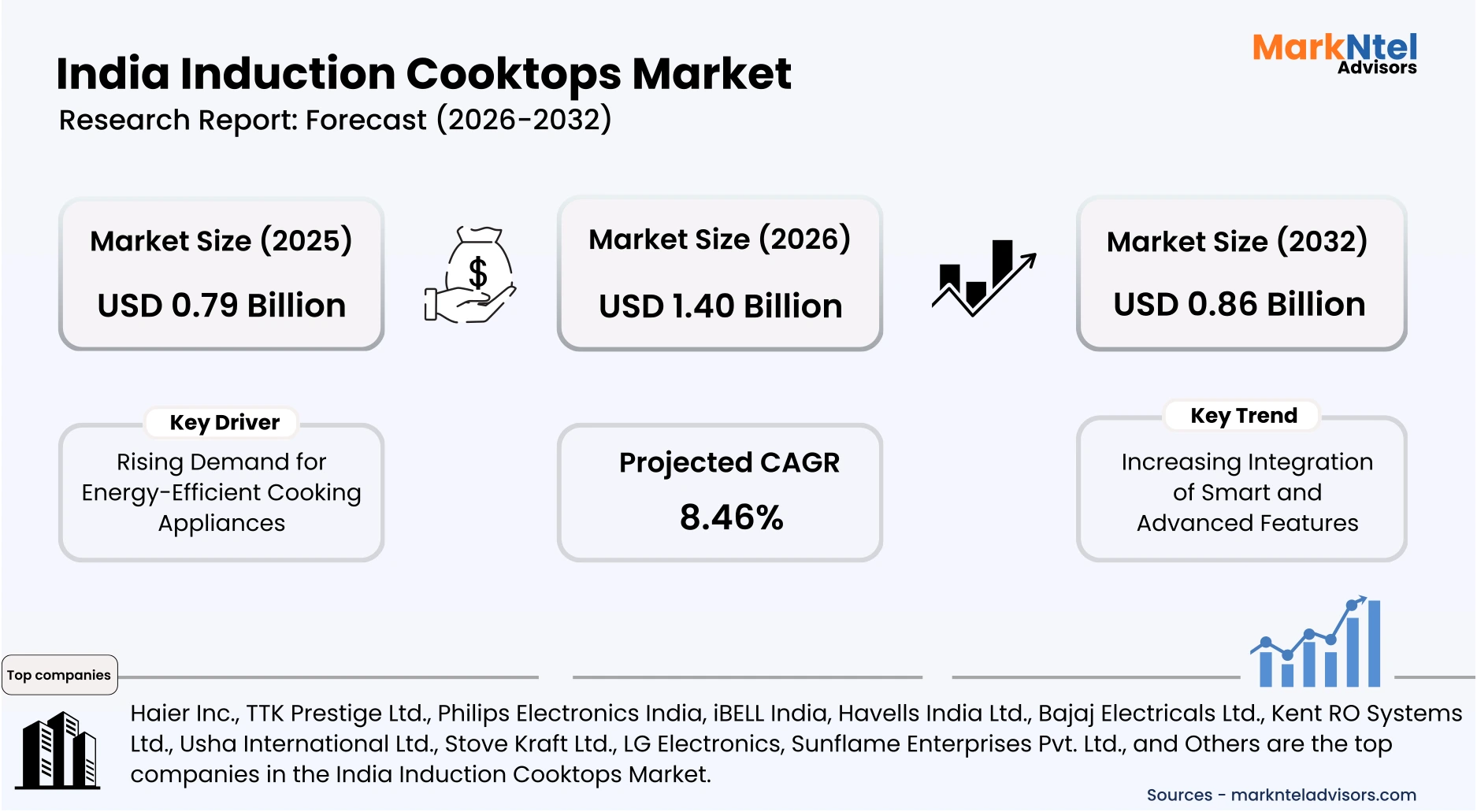
- The India Induction Cooktops market size was valued at USD 0.79 billion in 2025 and is projected to grow from USD 0.86 billion in 2026 to USD 1.40 billion by 2032, exhibiting a CAGR of 8.46% during 2026-32.
- By product type, the free-standing induction cooktops segment represented a significant share of about 59% in the India Induction Cooktops Market in 2026.
- By surface type, the flat surface induction cooktops segment seized a significant share of about 78% in the India Induction Cooktops Market in 2026.
- Leading induction cooktop companies in India are Haier Inc., TTK Prestige Ltd., Philips Electronics India, iBELL India, Havells India Ltd., Bajaj Electricals Ltd., Kent RO Systems Ltd., Usha International Ltd., Stove Kraft Ltd., LG Electronics, Sunflame Enterprises Pvt. Ltd., and Others.
Market Insights & Analysis: India Induction Cooktops Market (2026-32):
The India Induction Cooktops Market size was valued at around USD 0.79 billion in 2025 and is projected to grow from USD 0.86 billion in 2026 to USD 1.40 billion by 2032. Along with this, the market is estimated to grow at a CAGR of around 8.46% during the forecast period, i.e., 2026-32.
The India induction cooktops market is witnessing strong growth, primarily driven by the rising demand for energy-efficient and electricity-based cooking appliances among households. Increasing concerns over LPG supply disruptions have accelerated the shift toward electric cooking solutions, particularly in urban and semi-urban areas. In 2025, companies such as TTK Prestige Ltd. and Stove Kraft Ltd. increased production of induction cooktops to meet the surge in consumer demand. Manufacturers also optimized logistics and pricing strategies to handle the rising orders and supply chain constraints within the kitchen appliance sector .
The market experienced another significant spike in March 2026, when fears of a potential LPG shortage linked to geopolitical disruptions in the Middle East led to rapid consumer adoption of induction cooktops. Online retailers reported stock shortages, while Amazon India recorded over a 30-fold increase in induction stove sales, reflecting a substantial shift toward electricity-based cooking . This surge indicates growing consumer preference for convenient, safe, and energy-efficient cooking solutions as households aim to reduce dependence on fossil fuel-based cooking fuels.
The market is also increasingly characterized by the integration of smart features in induction cooktops. Modern appliances now come with digital touch controls, preset cooking menus, sensor-based temperature regulation, and safety mechanisms that simplify cooking and enhance convenience. For instance, the Prestige PIC 16.0 Plus Induction Cooktop launched by TTK Prestige Ltd. operates at 2000 W and includes eight preset cooking modes, automatic power and temperature adjustments, auto shut-off, and cooling systems for safety .
Similarly, the Bajaj Majesty Slim Induction Cooktop from Bajaj Electricals Ltd. features 2100 W heating capacity, multiple Indian preset cooking programs, pan-sensor technology, auto shut-off, and digital control settings that regulate temperature and power during cooking. These features reflect a broader trend of technological innovation and product differentiation, enhancing the appeal of induction cooktops among tech-savvy consumers.
Overall, the India induction cooktops market is poised for sustained growth, fueled by energy efficiency concerns, smart appliance adoption, and LPG supply uncertainties. Rising consumer awareness, government programs promoting electric cooking, and manufacturers’ focus on innovative product offerings are expected to expand market penetration across urban, semi-urban, and institutional segments. The trend toward smart, safe, and energy-efficient cooking solutions will continue to drive adoption in the coming years, positioning induction cooktops as a key appliance in India’s modern kitchens.
India Induction Cooktops Market Recent Developments:
- 2025: Government of Andhra Pradesh initiated a program to distribute over 55,000 induction cooktops to Anganwadi centers under the national clean cooking initiative. The project, implemented with energy agencies, promotes electric cooking technologies to improve energy efficiency and reduce reliance on LPG-based cooking systems.
- 2026: Induction cooktops were reported as “sold out” on platforms like Amazon and several quick-commerce apps due to a sudden surge in demand across India. The spike followed concerns over LPG cylinder shortages, prompting households to adopt electric cooking appliances as an alternative solution.
India Induction Cooktops Market Scope:
| Category | Segments |
|---|---|
| By Product Type | (Free-Standing Induction Cooktops, Built-in / Integrated Induction Cooktops, Portable / Countertop Induction Cooktops), |
| By Number of Cooking Zones | (Single Burner, Two Burner, Three Burner, Four Burner & Above), |
| By Application | (Residential, Commercial), |
| By Surface Type | (Flat Surface Induction Cooktops, Concave Surface Induction Cooktops), |
| By Distribution Channel | (Hypermarkets / Supermarkets, Specialty Appliance Stores, Online, Others), |
India Induction Cooktops Market Driver:
Rising Demand for Energy-Efficient Cooking Appliances
The growing focus on energy efficiency in household appliances is a major driver supporting the expansion of the India induction cooktops market. Induction technology is considered one of the most efficient cooking methods because it transfers heat directly to the cookware using electromagnetic energy. According to the U.S. Department of Energy, induction cooktops are up to three times more energy-efficient than traditional gas stoves, significantly reducing energy loss during cooking .
Energy efficiency comparisons further highlight the advantage of induction technology. Data from ENERGY STAR shows that around 85% of heating energy in induction cooking is transferred directly to the cookware, whereas gas stoves deliver only about one-third of their energy to the cooking vessel, with the rest lost as heat to the surrounding air . Additionally, laboratory studies show induction cooking systems achieve around 84–90% energy-transfer efficiency, compared with 30–40% efficiency for gas cookin g.
Looking ahead, increasing investments in electrification and energy-efficient household technologies will further strengthen this transition. Global energy policies encouraging electrified cooking and the expansion of renewable electricity grids are expected to make electric cooking appliances more sustainable and cost-effective over the next decade. These developments will encourage consumers to shift away from traditional gas-based cooking solutions.
The superior energy efficiency of induction technology is making it an attractive alternative to traditional cooking methods. As energy conservation and electrification initiatives expand, demand for induction cooktops is expected to grow steadily, supporting long-term market expansion.
India Induction Cooktops Market Trend:
Increasing Integration of Smart and Advanced Features
A major trend driving the India induction cooktops market is the growing integration of smart and advanced technologies in kitchen appliances. Modern induction cooktops increasingly feature touch-control panels, digital displays, sensor-based temperature regulation, and preset cooking programs, which simplify cooking, improve safety, and enhance overall user convenience. These intelligent features allow precise control over cooking temperature and time, reducing energy consumption and minimizing the risk of accidents.
Government initiatives are supporting this trend. For instance, Energy Efficiency Services Limited (EESL) under India’s National Efficient Cooking Programme distributes induction cooktops with digital displays, temperature control, child-lock safety, and auto shut-off functions, enabling households to adopt energy-efficient and safer electric cooking solutions.
Technological innovation is further accelerating adoption. In 2026, manufacturers introduced AI-enabled induction cooktops with built-in assistants that automatically adjust temperature and cooking time, demonstrating how smart technology is transforming household appliances .
Leading brands are also launching feature-rich products for urban consumers. For example, Philips Electronics India launched the Philips HD4995/00 2100W Induction Cooktop, equipped with multiple preset cooking menus, sensor-touch controls, and energy-efficient heating technology, priced at around USD 44–50 .
As Indian households increasingly embrace smart home technologies and automated appliances, the demand for intelligent, energy-efficient, and user-friendly induction cooktops is expected to rise steadily.
Overall, the integration of smart controls, AI-enabled features, and safety systems is transforming induction cooktops into advanced kitchen devices. This trend is likely to accelerate adoption across urban and semi-urban households, driving significant market growth in the coming years.
India Induction Cooktops Market Opportunity:
Growth in Commercial and Institutional Kitchens
A significant opportunity in the India induction cooktops market lies in the growing adoption of electric cooking technologies by commercial and institutional kitchens. In 2026, restaurants and hotels in cities such as Bhopal began shifting to induction-based cooking in response to shortages of commercial LPG cylinders. Many establishments converted 60–80% of their cooking stations to induction hobs, highlighting how commercial kitchens are increasingly relying on energy-efficient and electricity-based cooking solutions.
The adoption of induction cooktops in commercial kitchens is driven by multiple factors. Energy efficiency and faster cooking times reduce operational costs and improve workflow in high-volume food service environments. Safety features such as automatic shut-off, sensor-based temperature control, and child-lock functions also make induction cooktops a preferred alternative to traditional gas stoves, minimizing fire hazards and workplace accidents.
Government initiatives promoting clean energy and electrification in institutional kitchens further support this opportunity. As urbanization continues and the restaurant and hotel sectors expand in tier-2 and tier-3 cities, the demand for high-capacity, durable, and feature-rich induction cooktops is expected to rise.
Overall, the shift of commercial kitchens toward induction-based cooking presents a significant growth avenue for manufacturers. By targeting hotels, restaurants, and institutional kitchens with energy-efficient, safe, and high-performance cooktops, companies can capitalize on increasing electricity adoption and evolving cooking preferences in India.
India Induction Cooktops Market Challenge:
Dependence on Stable Electricity Supply
A major challenge for the India induction cooktops market is the dependence on a consistent and reliable electricity supply. While electrification has improved nationwide, many households, particularly in rural areas, still experience frequent power outages that can affect the performance of electric cooking appliances. On average, an Indian household receives 20.6 hours of power supply per day, with urban areas receiving around 22 hours and rural areas slightly lower at 20 hours daily.
Certain states demonstrate better reliability, such as Delhi, Kerala, and Gujarat, where households in both urban and rural regions enjoy slightly over 23 hours of daily electricity. In contrast, states like Uttar Pradesh, Jharkhand, Haryana, Assam, and Bihar face significant challenges, with rural households experiencing six or more hours of daily outages. Such inconsistent power availability hampers the effective use of induction cooktops, which require continuous electricity to operate efficiently and safely.
The dependence of induction cooktops on uninterrupted electricity makes power reliability a critical barrier to adoption, particularly in rural and semi-urban areas. Strengthening grid infrastructure and reducing outages will be essential to unlock the market’s full potential.
India Induction Cooktops Market (2026-32) Segmentation Analysis:
The India Induction Cooktops Market study of MarkNtel Advisors evaluates & highlights the major trends and influencing factors in each segment. It includes predictions for the period 2026–32 at the country level. Based on the analysis, the market has been further classified as;
Based on Product Type:
-
- Free-Standing Induction Cooktops
- Built-in / Integrated Induction Cooktops
- Portable / Countertop Induction Cooktops
Free-standing induction cooktops account for nearly 59% of the India Induction Cooktops Market due to their convenience, affordability, and ease of installation. Unlike built-in models, these cooktops do not require permanent kitchen modification, making them suitable for a wide range of households, including rented apartments and small urban kitchens. Consumers can simply place the unit on a countertop and connect it to a standard power outlet, which increases adoption among first-time users of electric cooking appliances.
Another factor supporting the dominance of this segment is its lower price range, which typically falls between USD 25 and USD 80, making it accessible to middle-income households. Many brands, such as TTK Prestige Ltd., Havells India Ltd., and Bajaj Electricals Ltd., widely offer portable or free-standing models through retail and online channels. Additionally, the growing demand for flexible cooking solutions in hostels, small homes, and temporary living spaces has further strengthened the segment’s market share.
Based on Surface Type:
-
- Flat Surface Induction Cooktops
- Concave Surface Induction Cooktops
The flat surface induction cooktops segment dominates the Indian market, accounting for 78% of total sales. These cooktops are preferred because they are easy to clean, maintain, and install, making them highly suitable for modern kitchens in urban households. Unlike concave surface models, flat cooktops offer uniform heating and compatibility with a wide range of cookware, including stainless steel, aluminum, and non-stick pans, which enhances their usability.
Flat surface induction cooktops are also favored for their sleek and contemporary design, which fits well with modular kitchen setups, a growing trend in Tier-1 and Tier-2 cities. Additionally, these cooktops often include advanced features such as touch controls, preset cooking modes, and safety sensors, which appeal to tech-savvy consumers seeking convenience and efficiency.
Overall, the combination of ease of use, versatility, aesthetic appeal, and feature integration makes flat surface induction cooktops the most popular choice, driving their dominant market share in India.
India Induction Cooktops Market (2026-32): Regional Projection
The India induction cooktops market is dominated by Tier-1 urban areas, including Delhi-NCR, Mumbai, Bengaluru, Chennai, and Hyderabad. These cities lead the market due to higher disposable incomes, greater awareness of energy-efficient appliances, and widespread electrification, which enable households to adopt modern cooking technologies. Urban consumers are also more inclined toward smart and feature-rich induction cooktops with digital controls, preset cooking modes, and sensor-based safety features.
The presence of large retail chains, e-commerce platforms, and branded appliance stores in these regions further facilitates easy access to a variety of induction cooktop models. Additionally, government initiatives promoting clean and electric cooking in urban centers, along with frequent electricity supply and grid reliability, encourage adoption. Cities like Delhi and Bengaluru, for instance, report over 22 hours of daily electricity availability, supporting continuous use of induction appliances.
Overall, the combination of financial capacity, awareness, infrastructure, and stable power supply makes Tier-1 urban regions the primary drivers of the Indian induction cooktops industry.
Gain a Competitive Edge with Our India Induction Cooktops Market Report:
- India Induction Cooktops Market Report by MarkNtel Advisors provides a detailed & thorough analysis of market size & share, growth rate, competitive landscape, and key players. This comprehensive analysis helps businesses gain a holistic understanding of the market dynamics & make informed decisions.
- This report also highlights current market trends & future projections, allowing businesses to identify emerging opportunities & potential challenges. By understanding market forecasts, companies can align their strategies & stay ahead of the competition.
- India Induction Cooktops Market Report aids in assessing & mitigating risks associated with entering or operating in the market. By understanding market dynamics, regulatory frameworks, and potential challenges, businesses can develop strategies to minimize risks & optimize their operations.
*Reports Delivery Format - Market research studies from MarkNtel Advisors are offered in PDF, Excel and PowerPoint formats. Within 24 hours of the payment being successfully received, the report will be sent to your email address.
Frequently Asked Questions
- Market Segmentation
- Introduction
- Product Definition
- Research Process
- Assumptions
- Executive Summary
- India Induction Cooktops Market Policies, Regulations, and Product Standards
- India Induction Cooktops Market Trends & Developments
- India Induction Cooktops Market Dynamics
- Growth Factors
- Challenges
- India Induction Cooktops Market Hotspot & Opportunities
- India Induction Cooktops Market Outlook, 2022-2032F
- Market Size & Outlook
- By Revenues (USD Million)
- Market Share & Outlook
- By Product Type- Market Size & Forecast 2022-2032, USD Million
- Free-Standing Induction Cooktops
- Built-in / Integrated Induction Cooktops
- Portable / Countertop Induction Cooktops
- By Number of Cooking Zones- Market Size & Forecast 2022-2032, USD Million
- Single Burner
- Two Burner
- Three Burner
- Four Burner & Above
- By Application- Market Size & Forecast 2022-2032, USD Million
- Residential
- Commercial
- By Surface Type- Market Size & Forecast 2022-2032, USD Million
- Flat Surface Induction Cooktops
- Concave Surface Induction Cooktops
- By Distribution Channel- Market Size & Forecast 2022-2032, USD Million
- Hypermarkets / Supermarkets
- Specialty Appliance Stores
- Online
- Others
- By Region- Market Size & Forecast 2022-2032, USD Million
- North
- East
- West
- South
- By Company
- Competition Characteristics
- Market Share & Analysis
- By Product Type- Market Size & Forecast 2022-2032, USD Million
- Market Size & Outlook
- India Free-Standing Induction Cooktops Market Outlook, 2022-2032
- Market Size & Outlook
- By Revenues (USD Million)
- Market Share & Outlook
- By Number of Cooking Zones- Market Size & Forecast 2022-2032, USD Million
- By Application- Market Size & Forecast 2022-2032, USD Million
- By Surface Type- Market Size & Forecast 2022-2032, USD Million
- By Distribution Channel- Market Size & Forecast 2022-2032, USD Million
- By Region- Market Size & Forecast 2022-2032, USD Million
- Market Size & Outlook
- India Built-in / Integrated Induction Cooktops Market Outlook, 2022-2032
- Market Size & Outlook
- By Revenues (USD Million)
- Market Share & Outlook
- By Number of Cooking Zones- Market Size & Forecast 2022-2032, USD Million
- By Application- Market Size & Forecast 2022-2032, USD Million
- By Surface Type- Market Size & Forecast 2022-2032, USD Million
- By Distribution Channel- Market Size & Forecast 2022-2032, USD Million
- By Region- Market Size & Forecast 2022-2032, USD Million
- Market Size & Outlook
- India Portable / Countertop Induction Cooktops Market Outlook, 2022-2032
- Market Size & Outlook
- By Revenues (USD Million)
- Market Share & Outlook
- By Number of Cooking Zones- Market Size & Forecast 2022-2032, USD Million
- By Application- Market Size & Forecast 2022-2032, USD Million
- By Surface Type- Market Size & Forecast 2022-2032, USD Million
- By Distribution Channel- Market Size & Forecast 2022-2032, USD Million
- By Region- Market Size & Forecast 2022-2032, USD Million
- Market Size & Outlook
- India Induction Cooktops Market Key Strategic Imperatives for Success & Growth
- Competitive Outlook
- Company Profiles
- Haier Inc.
- Business Description
- Product Portfolio
- Collaborations & Alliances
- Recent Developments
- Financial Details
- Others
- TTK Prestige Ltd.
- Business Description
- Product Portfolio
- Collaborations & Alliances
- Recent Developments
- Financial Details
- Others
- Philips Electronics India
- Business Description
- Product Portfolio
- Collaborations & Alliances
- Recent Developments
- Financial Details
- Others
- iBELL India
- Business Description
- Product Portfolio
- Collaborations & Alliances
- Recent Developments
- Financial Details
- Others
- Havells India Ltd.
- Business Description
- Product Portfolio
- Collaborations & Alliances
- Recent Developments
- Financial Details
- Others
- Bajaj Electricals Ltd.
- Business Description
- Product Portfolio
- Collaborations & Alliances
- Recent Developments
- Financial Details
- Others
- Kent RO Systems Ltd.
- Business Description
- Product Portfolio
- Collaborations & Alliances
- Recent Developments
- Financial Details
- Others
- Usha International Ltd.
- Business Description
- Product Portfolio
- Collaborations & Alliances
- Recent Developments
- Financial Details
- Others
- Stove Kraft Ltd.
- Business Description
- Product Portfolio
- Collaborations & Alliances
- Recent Developments
- Financial Details
- Others
- LG Electronics
- Business Description
- Product Portfolio
- Collaborations & Alliances
- Recent Developments
- Financial Details
- Others
- Sunflame Enterprises Pvt. Ltd.
- Business Description
- Product Portfolio
- Collaborations & Alliances
- Recent Developments
- Financial Details
- Others
- Others
- Business Description
- Product Portfolio
- Collaborations & Alliances
- Recent Developments
- Financial Details
- Others
- Haier Inc.
- Company Profiles
- Disclaimer
MarkNtel Advisors follows a robust and iterative research methodology designed to ensure maximum accuracy and minimize deviation in market estimates and forecasts. Our approach combines both bottom-up and top-down techniques to effectively segment and quantify various aspects of the market. A consistent feature across all our research reports is data triangulation, which examines the market from three distinct perspectives to validate findings. Key components of our research process include:
1. Scope & Research Design At the outset, MarkNtel Advisors define the research objectives and formulate pertinent questions. This phase involves determining the type of research—qualitative or quantitative—and designing a methodology that outlines data collection methods, target demographics, and analytical tools. They also establish timelines and budgets to ensure the research aligns with client goals.
2. Sample Selection and Data Collection In this stage, the firm identifies the target audience and determines the appropriate sample size to ensure representativeness. They employ various sampling methods, such as random or stratified sampling, based on the research objectives. Data collection is carried out using tools like surveys, interviews, and observations, ensuring the gathered data is reliable and relevant.
3. Data Analysis and Validation Once data is collected, MarkNtel Advisors undertake a rigorous analysis process. This includes cleaning the data to remove inconsistencies, employing statistical software for quantitative analysis, and thematic analysis for qualitative data. Validation steps are taken to ensure the accuracy and reliability of the findings, minimizing biases and errors.

4. Data Forecast and FinalizationThe final phase involves forecasting future market trends based on the analyzed data. MarkNtel Advisors utilize predictive modeling and time series analysis to anticipate market behaviors. The insights are then compiled into comprehensive reports, featuring visual aids like charts and graphs, and include strategic recommendations to inform client decision-making
We offer flexible licensing options to cater to varying organizational needs. Choose the pricing pack that best suits your requirements:
Buy Now Inquire Before Buying
 Request Customization
 Talk to our Consultant